—66— The family Acanthuridae, comprising six genera and about 80 species, is widely distributed in all tropical and subtropical seas except the Mediterranean Sea, and cha- racterized by having one or more distinctive spines on both sides of caudal peduncle (Nelson, 2006; Kim et al., 2007). Among them, five species belonging to three genera (Acanthurus Forsskål, 1775; Naso Lacepède, 1801; Prionurus Lacepède, 1804) have been reported from coastal waters of Korea.
The genus Naso, comprising 17 species, can be dis- tinguished from other two genera by having two anal fin spines (vs. three in Acanthurus and three or four in Prionurus), three pelvic fin rays (vs. five in Acanthurus and Prionurus) and one or two bony plates on the caudal peduncle (vs. four or five in Prionurus and one lancet-like spine in Acanthurus). In Korea, three species have been reported from the South Sea so far: N. unico- rnis (Forsskål, 1775) was collected from Tongyoung (Mori, 1952); N. brevirostris (Cuvier, 1829) from Jeju Island (Kim and Lee, 1994); and N. lituratus (Forster, 1801) from the adjacent waters of Jeju Island, Korea (Lee et al., 2000).
Recently, we collected a single specimen of N. hexa- canthus (Bleeker, 1855) by a set net in the northern coastal waters of Jeju Island, Korea. The morphological characters of N. hexacanthus is described firstly in Ko- rea, and adding to the Korean fish fauna.
Counts and measurements of this specimen follow the methods of Hubbs and Lagler (1964) and Nakabo (2002).
The examined specimen is deposited at the Fish Gene- tics and Breeding Laboratory, Cheju National Univer- sity (CNU), Korea.
Naso hexacanthus (Bleeker, 1855) (New Korean name: Nam-bang-pyo-mun-jwi-chi)
(Fig. 1; Table 1)
Priodon hexacanthus Bleeker, 1855: 421 (type locality:
Ambon Island, Moluccas Islands, Indonesia).
Callicanthus hexacanthus: Chen et al., 1997: 155 (Nan- sha Island, China).
Naso hexacanthus: Schultz and Woods in Schultz et al., 1953: 643 (Bikini, Marshall); Kishimoto in Masuda et al., 1984: 225 (Japan); Yamakawa in Okamura et al., 1985: 531, 699 (Okinawa and adjacent waters, Japan);
Randall in Smith and Heemstra, 1986: 821 (Indo- Pacific; south to Bazaruto, Mozambique); Myers, 1991: 250 (Micronesia); Randall in Randall and Lim, 2000: 642 (listed, South China Sea); Shimada in Na- kabo, 2002: 1322 (Ryukyu Islands, Japan).
Material examined. CNU 20070727, one specimen, 351.1 mm in standard length (SL), Gwideok-ri, Jeju-si, Jeju-do, Korea, about 15 m depth, with set net, 27 July 2007.
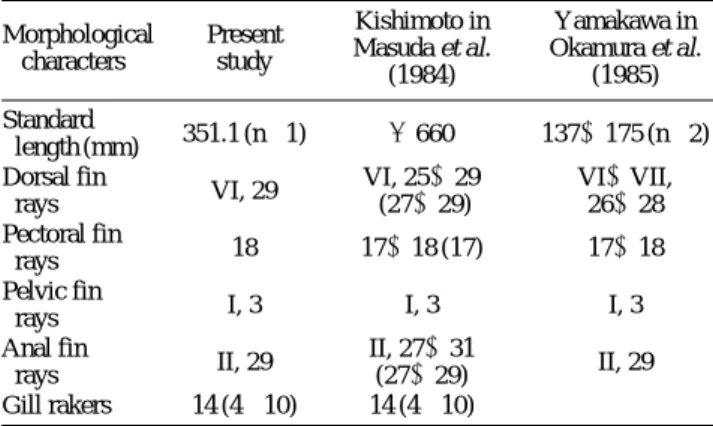
Description. Dorsal fin rays VI, 29; pectoral fin rays 18; pelvic fin rays I, 3; anal fin rays II, 29; gill rakers 4++10.
Proportion of measurements as a percentage of SL:
Body depth 32.3; body width 14.4; head length 22.7;
snout length 12.9; orbit diameter 5.1; interorbital width 9.3; upper jaw length 4.0; predorsal length 21.3; preanal
First Record of the Sleek Unicornfish, Naso hexacanthus (Acanthuridae, Perciformes) from Korea
By Maeng Jin Kim, Byung-Yob Kim, Song-Hun Han, Du-Ok Seo and Choon Bok Song*
College of Ocean Sciences, Cheju National University, Jeju City 690-756, Korea
ABSTRACT A single specimen (351.1 mm SL) of the sleek unicornfish, Naso hexacanthus, belonging to Acanthuridae was firstly collected from the coastal waters of Jeju Island, Korea. The species is characterized by having brownish vertical bands on the dorsal fin and two pale purple bony plates on caudal peduncle. We add this species to the Korean fish fauna and propose its new Korean name,
“Nam-bang-pyo-mun-jwi-chi.”
Key words : Acanthuridae, Naso hexacanthus, first record, Jeju Island, Korea
*Corresponding author: Choon Bok Song Tel: 82-64-754-3471, Fax: 82-64-756-3493, E-mail:[email protected]
KOREAN JOURNAL OF ICHTHYOLOGY, Vol. 20, No. 1, 66-69, March 2008 ISSN: 1225-8598
Received : October 10, 2007 Accepted : February 11, 2008
http://www.fishkorea.or.kr
length 28.7; prepectoral length 19.9; pectoral fin length 14.8; preanus length 26.3; length of longest dorsal spine 11.0; length of pelvic spine 10.5; length of longest anal spine 6.4; caudal peduncle depth 4.0; caudal peduncle length 12.0.
Body elongated and compressed; dorsal profile of head sloping and smoothly convex; head small; eye small; mouth small and terminal; teeth pointed, strong and finely serrate, in a single series on each jaw; short groove in front of eye; caudal peduncle slender, sub- cylindrical, with sharply keeled two bony plates on mid -side; caudal fin slightly emarginated; skin rough and leathery; dorsal and anal fins continuous and unnotch- ed; origin of dorsal fin on vertical from posterior edge of gill opening; first dorsal fin spine strong, roughened laterally; pectoral fin located anterior to pelvic fin;
pelvic fin spine long, reaching origin of anal fin, the length near equaling that of longest first dorsal spine;
first bony plate on caudal peduncle larger than the second one.
Color in life. Dark brown to pale bluish gray dorsally and yellowish ventrally; edges of opercle and pre- opercle with dark brown band; brown band on opercle;
bony plates of caudal peduncle pale purple; dark brown stripe on dorsal fin; anal fin yellow; caudal fin pale pur- ple with brownish yellow posterior margin.
Color after preservation. Head dark dusky; blackish
brown dorsally and dark gray ventrally on body; bony plates of caudal peduncle dark dusky; dark brown stripe on dorsal fin; anal fin yellowish with a distinct black in posterior margin; caudal fin dark purple with a grayish yellow posteriorly.
Distribution. Red Sea; East Africa to the Hawaiian, Marquesan, and Ducie Islands; south to Lord Howe Island, Micronesia; north to Korea (Jeju Island, present study) including southern Japan (Myers, 1991; Shima- da, 2002; Allen et al., 2003).
Remarks. The present specimen, collected from the coastal waters of Jeju Island, Korea, was characterized by having brownish vertical bands on the dorsal fin and two bony plates on caudal peduncle tinted with pale purple. The morphological characters of the specimen matched with the species description given by the pre- vious studies (see Table 1). Naso hexacanthus is similar to N. maculatus (Randall and Struhsaker, 1981) in mor- phological characters such as body form and meristic characters. However, the former can be distinguished by having brownish vertical bands on the dorsal fins and no spots on the upper body (vs. many dark spots on the dorsal half of the body and no vertical bands on the dor- sal fins for the latter) (Shimada, 2002). The geographi- cal distribution of marine fishes is affected by water temperature (Hannesson, 2007). It has been described that N. hexacanthus was originally distributed in Pacific coast of southern Japan and Indo-Pacific (Shimada, 2002). However, the recent occurrence of N. hexacan- thus from the coastal water areas of Jeju Island in Korea seems to be due to rising seawater temperature near the Korean peninsula (Jeong et al., 2003). We suggest a new Korean fish name, “Nam-bang-pyo-mun-jwi-chi” for N.
hexacanthus.
ACKNOWLEDGMENTS
This work was supported by the New Frontier Educa- tion Center for ECO-Friendly Marine Industry in 2007.
We thank Dr. Jonathan Armbruster (Department of Bio- logical Sciences, Auburn University) for his critical read- ing and comments on this manuscript. And we also thank Jeong Ho Park (National Fisheries Research and Development Institute) for providing useful references.
REFERENCES
Allen, G., R. Steene, P. Humann and N. Deloach. 2003.
Reef fish identification-Tropical Pacific. New World Publications, Florida, pp. 1-457.
Bleeker, P. 1855. Zesde bijdrage tot de kennis der ichthyo- logische fauna van Amboina. Natuurkd. Tijdschr.
Neder. Indië, 8: 391-434.
First Record of Naso hexacanthus 67
Fig. 1. Naso hexacanthus (Bleeker), CNU 20070727, 351.1 mm SL, Gwideok-ri, Jeju-si, Jeju-do, Korea.
Table 1. Comparison of the observed and previously reported mor- phological characters of Naso hexacanthus
Morphological Present Kishimoto in Yamakawa in characters study Masuda et al. Okamura et al.
(1984) (1985)
Standard
351.1 (n==1) ≤660 137~175 (n==2) length (mm)
Dorsal fin VI, 29 VI, 25~29 VI~VII,
rays (27~29) 26~28
Pectoral fin
18 17~18 (17) 17~18
rays
Pelvic fin I, 3 I, 3 I, 3
rays Anal fin
II, 29 II, 27~31 II, 29
rays (27~29)
Gill rakers 14 (4++10) 14 (4++10) -
68 Maeng Jin Kim, Byung-Yob Kim, Song-Hun Han, Du-Ok Seo and Choon Bok Song
Bloch, M.E. and J.G. Schneider. 1801. Systema Ichthyolo- giae iconibus cx illustratum. Post obitum auctoris opus inchoatum absolvit, correxit, interpolavit Jo.
Gottlob Schneider, Saxo. Berolini. Sumtibus Aucto- ris Impressum et Bibliopolio Sanderiano Commis- sum, pp. 1-584, pls. 1-110.
Chen, Q.C., Y.Z. Cai and X.M. Ma. 1997. Fishes from Nansha Islands to South China coastal waters 1. Sci- ence Press, Beijing, pp. 1-202.
Cuvier, G. 1829. Le Règne Animal, distribué d’après son organization, pour servir de base à l’histoire naturel- le des animaux et d’introduction à l’anatomie com- paràe. Ed. 2, pp. 1-406.
Forsskål, P. 1775. Descriptiones animalium avium, amp- hibiorum, piscium, insectorum, vermium; quae in iti- nere orientali observavit. Post mortem auctoris edidit Carsten Niebuhr, Hauniae, pp. 1-164.
Hannesson, R. 2007. Geographical distribution of fish cat- ches and temperature variations in the northeast At- lantic since 1945. Mar. Pol., 31: 32-39.
Hubbs, C.L. and K.F. Lagler. 1964. Fishes of the Great Lake Region. Bull. Granbrook Inst. Sci., 26: 19-27.
Jeong, H.D., J.D. Hwang, K.K. Jung, S. Heo, K.T. Sung, W.J. Go, J.Y. Yang and S.W. Kim. 2003. Long term trend of change in water temperature and salinity in coastal waters around Korean peninsula. J. Korean Soc. Mar. Environ. Saf., 9: 59-64.
Kim, I.S. and W.O. Lee. 1994. Fish fauna from Cheju Is- land, Korea. Records of Korean fish fauna 1, Chon- buk Natl. Univ., Chonju, pp. 1-52.
Kim, J.K., J.H. Park and K.S. Hwang. 2007. One unrecord- ed species of Acanthurus nigricauda (Acanthuridae, Perciformes) from Korea. Korean J. Ichthyol., 19:
164-167.
Kishimoto, H. 1984. Family Acanthuridae. In: Masuda, H., K. Amaoka, C. Araga, T. Uyeno and T. Yoshino (ed.), The fishes of the Japanese archipelago. Tokai Univ. Press., Tokyo, pp. 228-232.
Lacepède, B.G.E. 1801. Histoire naturelle des poissons. pp.
1-558.
Lacepède, B.G.E. 1804. Mémoire sur plusieure animaux de la Nouvelle Hollande dont la description n’a pas en- core été publiée. Ann. Mus. Hist. Nat. Paris, pp. 184.
1-211.
Lee, W.O., I.S. Kim and B.J. Kim. 2000. First record of the unicornfishes, Naso lituratus (Pisces: Acanthuridae) from Korea. Korean J. Ichthyol., 12: 96-100.
Mori, T. 1952. Check list of the fishes of Korea. Mem.
Hyogo Univ. Agr., 1: 92-94.
Myers, R.F. 1991. Micronesian reef fishes, 2nd ed. Coral Graphics, Guam, pp. 1-298.
Nakabo, T. 2002. Introduction of Ichthyology. In: Nakabo, T. (ed.), Fishes of Japan with pictorial keys to the species, English ed. Tokai Univ. Press, Tokyo, xxi- xlii.
Nelson, J.S. 2006. Fishes of the world. 4th ed, John Wiley
& Sons, New York, pp. 1-601.
Okamura, O., Y. Machida, T. Yamakawa, K. Matsuura and T. Yatou. 1985. Fishes of the Okinawa trough and the adjacent waters II. Japan Fisheries Resource Con- servation Association, Tokyo, 530pp.
Randall, J.E. 1986. Family Acanthuridae. In: Smith, M.M.
and P.C. Heemstra (ed.), Smith’s sea fishes. Sprin- ger-Verlag, Grahamstown, pp. 811-823.
Randall, J.E. and K.K.P. Lim. 2000. A checklist of the fishes of the South China Sea. Raffles Bull. Zool., Suppl., 8: 569-667.
Randall, J.E. and P. Struhsaker. 1981. Naso maculatus, a new species of acanthurid fish from the Hawaiian Is- lands and Japan. Copeia, 1981: 553-558.
Schultz, L.P. and L.P. Woods. 1953. Family Acanthuridae:
Surgeonfishes. In: Schultz, L.P., E.S. Herald, E.A.
Lachner, A.D. Welander and L.P. Woods (ed.), Fi- shes of the Marshall and Marianas Islands. United States Government Printing Office, Washington, pp.
614-648.
Shimada, K. 2002. Family Acanthuridae. In: Nakabo, T.
(ed.), Fishes of Japan with pictorial keys to the spe- cies, English ed. Tokai Univ. Press, Tokyo, pp. 1319 -1330.
First Record of Naso hexacanthus 69
한국산 양쥐돔과(농어목) 어류 1미기록종, Naso hexacanthus
김맹진∙김병엽∙한송헌∙서두옥∙송춘복
제주대학교 해양과학대학 해양과학부
요 약 : 농어목 양쥐돔과(Acanthuridae)에 속하는 Naso hexacanthus 1개체(표준체장 351.1 mm)가 제주 북부 연안에서 정치망으로 처음 채집되었다. 이 종은 등지느러미에 갈색 수직 무늬가 있고 미병부에 있는 두 개의 골 질판은 연한 보라색을 띠는 것이 특징이며, 이 종의 한국명을 “남방표문쥐치”라고 하였다.
찾아보기 낱말 :양쥐돔과, 남방표문쥐치, 제주도