INTRODUCTION
The family Carangidae comprises 30 genera with about 146 species worldwide(Nelson et al., 2016). It is char- acterized by having two dorsal fins, anal fin with two anterior spines, scutes present and prominent, or reduced in some species and absent in some genera(Smith-Vaniz, 1999; Nelson et al., 2016). Fifty-nine species in 24 gen- era have been reported from Japan(Senou, 2013) and 34 species in 18 genera from Korea(MABIK, 2017).
The genus Caranx Lacepède, 1801 is characterized by body generally deep, dorsal profile more convex than ventral one, gill rakers 20~31, dorsal and anal rays never produced as filaments and two to four canines anteriorly in each jaw(Gunñ, 1990; Smith-Vaniz, 1999). Six species from Japan(Senou, 2013) and two species(C. sexfascia- tus Quoy and Gaimard, 1825, and C. bucculentus Alley- en and Macleay, 1877) from Korea have been reported so far(Kim et al., 2005), but Mori(1952) firstly reported and add C. bucculentus to Korean fish fauna with the specimen collected at the coastal waters of Tongyeong,
southern Sea of Korea. However, as C. bucculentus is known to be distributed in Australia and New Guinea, the correctness of species identification needs to be reviewed in the future. The genus Canrax is very similar to Caran- goides Bleeker, 1851, but is easily distinguished from the latter by having upper jaw with an outer series of moder- ate to strong canines and an inner band of fine teen and lower jaw with a single row of teeth(vs. both with a band of teeth for latter)(Smith-Vaniz, 1986).
During the survey of fisheries resources conducted in the southern coastal waters of Jejudo Island, Korea, we collected a single specimen that was morphologically similar to C. sexfasciatus by a set net. The specimen was identified as C. melampygus, based on its mouth size, the number of rays and shape on fins, etc(Senou, 2013). We here report the morphological characters of C. melampy- gus in order to be added to the list of Korean fish fauna.
Counts and measurements are followed by the methods of Hubbs and Lagler(1964) and Gushiken(1983). The examined specimen is deposited at the Fish Genetics and Breeding Laboratory, Jeju National University(JNU), Korea.
—170 — http://www.fishkorea.or.kr
* Corresponding author: Choon Bok Song Tel: 82-64-754-3471, Fax: 82-64-756-3493, E-mail: [email protected]
First Record of the Bluefin Travelly, Caranx melampygus (Perciformes:
Carangidae) from Korea
By Joon Sang Kim, Maeng Jin Kim
1and Choon Bok Song
2,*Korea Fisheries Resources Agency, Jeju Branch, Jeju 63012, Republic of Korea
1West Fisheries Research Institute, National Institute of Fisheries Sciences, Incheon 22383, Republic of Korea
2College of Ocean Sciences, Jeju National University, Jeju 63243, Republic of Korea
ABSTRACT A single specimen of Caranx melampygus(113mm standard length), belonging to the family Carangidae, was firstly collected by a set net from the coastal waters of Jejudo Island, Korea.
This species is morphologically similar to C. sexfasciatus except for the posterior end of maxilla not reaching the posterior margin of eye (vs. reaching in C. sexfasciatus) and no black blotch on the upper part of opercle (vs. black blotch). We newly add this species to the Korean fish fauna and propose its new Korean name “Jag-eun-ip-jul-jeon-gaeng-i” for the species because it has relatively smaller upper jaw when compared with C. sexfasciatus.
Key words: Carangidae, Caranx melampygus, first record, Jejudo Island, Korea
Caranx melampygus Cuvier, 1833 (New Korean name: Jag-eun-ip-jul-jeon-gaeng-i)
(Fig. 1; Table 1)
Caranx melampygus Cuvier in Cuvier and Valenciennes, 1883: 116(type locality: New Guinea); Kyushin et al., 1977: 256(Indian Ocean); Dor, 1984: 127(Red Sea);
Gushiken, 1984: 155(Japan); Smith-Vaniz, 1986:
647(South Africa); Allen and Swainston, 1988: 72 (north-western Australia); Francis, 1993: 161(south- west Pacific Ocean); Allen and Robertson, 1994: 126 (eastern Pacific); Randall, 1995: 181(Oman); Lin and Shao, 1999: 55(Taiwan); Myers, 1999: 139(Microne- sia); Randall, 2007: 230(Hawaii); Kottelat, 2013: 333 (southeast Asia).
Material examined. JNU-0004, one specimen, 113 mm standard length(SL), Daepo, Jejudo Island, Korea, set net, 18 October, 2010.
Description. Counts and measures for the present spec- imen are shown in Table 1. Measurements are revealed as a percentage against SL: Body depth, 42.4; body width,
13.7; head length, 28.5; upper jaw length, 11.2; snout length, 8.4; eye diameter, 7.6; interorbital width, 8.9; pre- dorsal fin, 38.1; prepectoral fin length, 30.0; preanal fin length, 60.6; length of longest dorsal fin ray, 16.4; pec- toral fin length, 29.2; length of longest anal fin ray, 14.3;
caudal peduncle length, 7.3; caudal peduncle depth, 4.2.
Body oblong, compressed and covered with ctenoid scales; dorsal profile more convex than ventral one, con- vex to second dorsal fin; snout slightly pointed, posterior marin of upper jaw not reaching posterior margin of eye;
lower jaw slightly prominent; orbit diameter smaller than snout length, adipose eyelid weakly developed; upper jaw with outer row of strong canines, and an inner band of small villiform teeth; curved lateral line short than straight part, reached to below fifth ray of second dorsal fin; straight lateral line with three anterior scales fol- lowed by 37 strong scutes; breast completely scaly; two separate dorsal fins characterizing with the height of sec- ond dorsal fin slightly longer than that of first dorsal fin;
anterior of soft dorsal and soft anal fins slightly falcate about equal in length and last one elongated; pectoral fin
Fig. 1. Caranx melampygus, JNU-0004, 113.0 mm, Jejudo Island, Korea. A: when fresh, B: after preservation.
A
B
positioned in front of the pelvic fin and falcated, its end reached at second scutes on straight line; anal fin with two detached spines followed by a single spine with 19 soft rays; and deeply fork caudal fin.
Coloration. When the fresh, Head and body grey-blue above and silver white below; dorsal spine and soft fin dark black; anal soft fin yellowish with dusky black; pec- toral fin yellow; ventral fin white; upper and lower lobe of caudal fin dark black, but light pink on both sides of caudal fin; no horizontal stripe on body; no distinct black blotch on upper part of opercle. After fixation in forma- lin, dark brown above and pale brown below; faint half- bands above the lateral line of young fish; all fins brown;
lower part of the preopercle and opercle white.
Distribution. Known from tropical and subtropical waters of Indo-Pacific Ocean: South Africa Sea, Red Sea to Australia, India, Malaysia, Taiwan, China, Japan to Hawaiian Islands(Smith-Vaniz, 1999) and it occurs in Je- judo Island(present study). Also it distributes in eastern central Pacific Ocean: Mexico to Panama(Smith-Vaniz, 1995).
Remarks. The present specimen, belonging to the fam- ily Carangidae, is characterized by having body oblong, dorsal profile more convex than ventral one, dorsal and anal soft ray not produced as filament, posterior end of maxilla not reaching posterior margin of eye and upper part of opercle with no distinct black blotch and gill rak- ers 20~31. The morphological characters of the pres- ent specimen were compared with those in the previous reports on C. melampygus(Cuvier, 1833; Smith-Vaniz, 1999; Senou, 2013), which revealed that all morpholog- ical traits examined were well matched with each oth- er(Table 1). Thus, we identified our specimen to be C.
melampygus based on morphological characters.
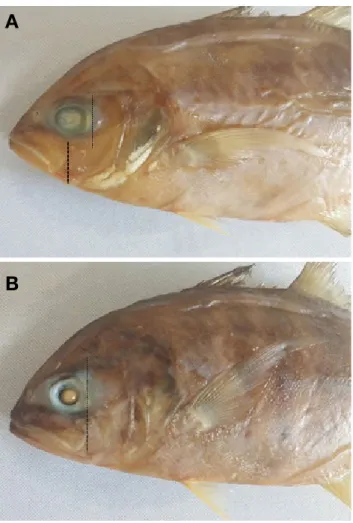
Our specimen morphologically resembles C. sexfascia- tus Quoy and Gaimard, 1825, inhabiting the Korean wa- ter, but it is distinguishable from the latter by having the
posterior end of maxilla not reaching posterior margin of eye(reaching in C. sexfasciatus)(Fig. 2), upper part of opercle with no distinct black blotch(vs. black blotch), soft dorsal fin rays 21~24(vs. 19~22), soft anal fin rays 17~20(vs. 14~17) and lower gill racker 17~21(vs.
Table 1. Morphological traits compared between present and previous studies on C. melampygus and C. sexfasciatus
Meristic characters C. melampygus C. sexfasciatus
Present study Cuvier (1833) Gushiken (1983) Lin and Shao (1999) Present study
No. of specimens 1 1 6 2 1
Fork length (mm) - - - 327~355 128
Standard length (mm) 113 - 125~207 - 123
Counts
Dorsal fin rays VIII+I,23 VIII+I,23~24 VIII+I,22~23 VIII+I,22~24 VIII+I,20
Pectoral fin rays i, 21 - i, 19~20 i, 20 23
Pelvic fin rays I, 5 - - - I, 5
Anal fin rays II+I,19 II+I,19 II+I,18~20 II+I,19~20 II+I,16
Gill rakers 7+18 - 7~8+18~19 7~8+18~20 7+15
Scutes 37 - 36~42 36~42 32
A
B
Fig. 2. Comparison of the distance between the posterior end of maxilla and the posterior margin of eye. A: Caranx melampygus, B: C.
sexfasciatus.
15~19)(Senou, 2013)(Table 1). We suggest its new Ko- rean name “Jag-eun-ip-jul-jeon-gaeng-i” for C. melampy- gus because it has relatively smaller upper jaw when compared with C. sexfasciatus which is named “Jul-jeon- gaeng-i.”
Comparative material. JNU-0003, one specimen, 123 mm standard length(SL), Daepo, Jejudo Island, Korea, set net, 18 October, 2010.
ACKNOWLEDGEMENTS
This research was supported by the 2018 scientific pro- motion program by Jeju National University, Korea.
REFERENCES
Allen, G.R. and R. Swainston. 1988. The marine fishes of north-west- ern Australia. A field guide for anglers and divers. Western Australian Museum, Perth, 201pp.
Allen, G.R. and D.R. Robertson. 1994. Fishes of the tropical eastern Pacific. Crawford House Press, Bathurst, 332pp.
Alleyne, H.G. and W. Macleay. 1877. The ichthyology of the Ch- evert expedition. Proc. Linn. Soc. N.S.W., 1: 261-281, 321- 359.
Bleeker, P. 1851. Over eenige nieuwe geslachten en soorten van Makreelachtige visschen van den Indischen Archipel. Natu- urkundig Tijdschrift voor Nederlandsch Indië, 1: 341-372.
Cuvier, G. 1833. In: Cuvier, G. and A. Valenciennes. Histoire na- turelle des poissons. Tome neuvième. Suite du livre neu- vième. Des Scombéroïdes, 9: 1-512.
Dor, M. 1984. Checklist of the fishes of the Red Sea. CLOFRES.
Israel Academy of Sciences and Humanities, Jerusalem.
Checklist of the fishes of the Red Sea. CLOFRES, 437pp.
Francis, M.P. 1993. Checklist of the coastal fishes of Lord Howe, Norfolk, and Kermadec Island, southwest Pacific Ocean.
Pac. Sci., 47: 136-170.
Froese, R. and D. Pauly(Editors). 2018. FishBase. World Wide Web electronic publication. www.fishbase.org, version(6/2018).
Gunñ, J.S. 1990. A revision of selected genera of the family Caran- gidae(Pisces) from Australian waters. Records of the Aus- tralian Museum, Suppl., 12: 1-77.
Gushiken, S. 1983. Revision of the carangid fishes of Japan. Galax- ea, Publ. Sesoko Mar. Sci. Cent. Univ. Ryukyus, 2: 135- 264.
Gushiken, S. 1984. Family Carangidae. In: Masuda, H., K. Amaoka, C. Araga, T. Uyeno and T. Yoshino(eds.), The fishes of the Japanese Archipelago. Tokai Univ. Press, Tokyo, pp. 153- 158.
Hubbs, C.L. and K.F. Lagler. 1964. Fishes of the Great Laker Re- gion. Bull. Granbrook Inst. Sci., 26: 19-27.
Kim, I.S., Y. Choi, C.L. Lee, Y.J. Lee, B.J. Kim and J.H. Kim. 2005.
Illustrated book of Korean fishes. KyoHak Publishing Co
Ltd, Seoul, 615pp.(in Korean)
Kottelat, M. 2013. The fishes of the inland waters of southeast Asia:
a catalogue and core bibliography of the fishes known to occur in freshwaters, mangroves and estuaries. Raffles Bul- letin of Zoology, Suppl., 27: 1-663.
Kyushin, K., K. Amaoka, K. Nakaya and H. Ida. 1977. Fishes of Indian Ocean. Japan Marine Fishery Resource Research Center, 392pp.
Lacepède, B.G.E. 1801. Histoire naturelle des poissons. Plassan, Paris, 3: 1-558.
Lin, P.L. and K.T. Shao. 1999. A review of the carangid fishes (Family Carangidae) from Taiwan with descriptions of four new records. Zool. Stud., 38: 33-68.
MABIK(National Marine Biodiversity Institute of Korea). 2017.
National list of marine species. National Marine Biodiversi- ty Institute of Korea, Seocheon, 1071pp.(in Korean) Mori, T. 1952. Check list of the fishes of Korea. Mem. Hyogo
Univ. Agric., Biol. Ser., 1: 1-228.
Myers, R.F. 1999. Micronesian reef fishes. A comprehensive guide to the coral reef fishes of Micronesia. 3rd ed. Coral Graph- ics, Guam, 330pp.
Nelson, J.S., T.C. Grande and M.V.H. Wilson. 2016. Fishes of the world. 5th ed. John Wiley & Sons, Hoboken, 705pp.
Quoy, J.R.C. and J.P. Gaimard. 1825. Description des Pois- sons. Chapter IX. In: Freycinet, L. de, Voyage autour du Monde...exécuté sur les corvettes de L. M. “L’Uranie” et “La Physicienne,” pendant les années 1817, 1818, 1819 et 1820.
Paris, 192-401.
Randall, J.E. 1995. Coastal fishes of Oman. Crawford House Pub- lishing Pty Ltd, Bathurst, 439pp.
Randall, J.E. 2007. Reef and shore fishes of the Hawaiian Islands.
University of Hawaii Sea Grant College Program, Honolu- lu, 546pp.
Senou, H. 2013. Carangidae. In: Nakabo, T.(ed.), Fishes of Japan with pictorial keys to the species, 3rd edition. Tokai Univ.
Press, Kanazawa, pp. 878-892.(in Japanese)
Smith-Vaniz, W.F. 1986. Family No. 210: Carangidae. In: Smith, M.M. and P.C. Heemstra(eds.), Smith’s sea fishes. Spring- er-Verlag, Grahamstown, pp. 209-661.
Smith-Vaniz, W.F. 1995. Carangidae. Jureles, pámpanos, cojinúas, zapateros, cocineros, casabes, macarelas, chicharros, jo- robados, medregales, pez pilota. In: Fischer, W., F. Krupp, W. Schneider, C. Sommer, K.E. Carpenter and V. Niem (eds.), Guia FAO para Identification de Especies para lo Fines de la Pesca. Pacifico Centro-Oriental. Vol. 2. FAO, Rome, pp. 940-986.
Smith-Vaniz, W.F. 1999. Carangidae. Jacks and scads(also trev- allies, queenfishes, runners, amberjacks, pilotfishes, pam- panos, etc.). pp. 2659-2756. In: Carpenter, K.E. and V.H.
Niem(eds.), FAO species identification guide for fishery purposes. The living marine resources of the Western Cen- tral Pacific. Vol. 4. Bony fishes part 2(Mugilidae to Caran- gidae). Rome, FAO, pp. 2069-2790.
한국산 전갱이과 어류 1 미기록종, Caranx melampygus
김준상
·
김맹진1·
송춘복2한국수산자원관리공단 제주지소, 1국립수산과학원 서해수산연구소, 2제주대학교 해양과학대학
요 약 : 농어목 전갱이과에 속하는 Caranx melampygus 1개체(표준체장 113mm)가 2010년 8월 13일 제주도 서
귀포시 대포동의 정치망에서 처음으로 채집되었다. 이 종은 형태적으로 우리나라에 서식하고 있는 줄전갱이(C.
sexfasiatus)와 유사하지만 주둥이 끝이 눈의 말단을 이르지 않는 점과 주새개골의 상단에 검은 반점이 없는 것이
특징이다. 이 미기록종의 종명은 줄전갱이와 비교할 때 상대적으로 작은 입을 가지고 있어서 “작은입줄전갱이”로
제안한다.
찾아보기 낱말 : 전갱이과, Caranx melampygus, 미기록종, 작은입줄전갱이, 제주도