The ghost pipefishes inhabit sandy bottoms near rocky, coral reef, and seaweed beds of shal- low tropical waters in the Indo-West Pacific.
They are characterized by having a body covered with bony plates, pelvic fin present, dorsal fin spines present, and brood pouch formed by pelvic fins in female (Orr and Fritzsche, 1993; Senou, 2002). The family revised by Orr and Fritzsche (1993) and Senou (1994) in the Indo-Pacific and Japan, respectively. Thereafter, Orr et al. (2002) described one additional new species and provided a revised key of ghost pipefishes.
The family Solenostomidae comprises a single genus and five species worldwide: Solenostomus cyanopterus Bleeker, 1854, S. leptosoma Tanaka, 1908, S. paradoxus (Pallas, 1770), S. armatus Weber, 1913, and S. halimeda Orr, Fritzsche and Ranall, 2002 (Orr and Fritzsche, 1993; Orr et al., 2002). Of these, the first three species have been recognized in Japan (Senou, 2002).
This species described briefly from the Haw- soon port of southern Jeju Island based on under- water photograph (Park and Choi, 2001), it has not been recorded on the basis of the specimen in Korea until now.
In October 2002, we observed a pair of ghost pipefish identified as Solenostomus cyanopterus in the water, subsequently, collected a single female specimen at 23 m depth on sandy bottom off coastal waters of Yeongdeck, East Sea of Kor- ea. Accordingly, it is herein described as new to the Korean fish fauna. Brief descriptions and comparisons are provided.
Materials and Methods
Measurement methods and terminology of body plates followed Orr and Fritzsche (1993) and Na- kabo (2002). Vertebrae were counted from radio- graphs prepared by soft X-ray (Hitex Co., Japan), and second dorsal, pectoral, and anal fin rays were counted by stereomicroscope after partial
First Record of Ghost Pipefish, Solenostomus cyanopterus (Solenostomidae: Gasterosteiformes) from Korea
Hu-Soon Yim, Jeong-Ho Park1and Kyeong-Ho Han2,* Pohang Regional Maritime Affairs and Fisheries Office, 58-7 Hanggu-dong,
Buk-gu, Pohang-si, Gyeongsangbuk-do 791-120, Korea
1Fisheries Resources Research Team, National Fisheries Research and Development Institute, 408-1 Sirang-ri, Gijang-gun, Busan-si 619-705, Korea
2Division of Fisheries and Ocean Sciences, Chonnam National University, San 96-1 Doondeok-dong, Yeosu-si, Jeollanam-do 550-749, Korea
A single female specimen (73.6 mm SL) of ghost pipefish, Solenostomus cyanopterus Bleeker, belonging to the family Solenostomidae (new Korean name: Yu-ryeong-sil- go-gi-gwa), was observed and collected in the water off Yeongdeck, East Sea of Korea.
Unlike to syngnathids, solenostomids are characterized by having the brood pouch formed by pelvic fins in female and dorsal fin spines present. This species is charac- terized by having the deep snout, and short, deep caudal peduncle, but no cirri and striped markings. In the water, the species swims slowly head downward in pairs and looks like a drifting pieces of algae or fallen leaf. We describe this species as new to Korean fish fauna and propose its new Korean name, “Yu-ryeong-sil-go-gi”.
Key words : Solenostomus cyanopterus, Solenostomidae, ghost pipefish, first record
*Corresponding author: [email protected]
─
─ 360 ──
dissection. The examined specimen is deposited in the National Fisheries Research and Develop- ment Institute (NFRDI) of Korea.
Family Solenostomidae Lacepède, 1803 (New Korean name: Yu-ryeong-sil-go-gi-gwa) Fishes of the family Solenostomidae live in tro- pical Indo-West Pacific; body compressed with large star-shaped bony plates; snout long; two se- parate dorsal fins, the first with five long spines;
unlike to syngnathids, brood pouch formed by large pelvic fins in female; dorsal fin spines and pelvic fin present; a single genus, Solenostomus, with about five species (Orr et al., 2002; Nelson, 2006).
Genus Solenostomus Lacepède, 1803 (New Korean name: Yu-ryeong-sil-go-gi-sok) Solenostomus Lacepède, 1803: 360 (Type species:
Fistularia paradoxa Pallas 1770, ==Solenosto- mus paradoxus).
Solenostomus cyanopterus Bleeker, 1854 (New Korean name: Yu-ryeong-sil-go-gi)
(Fig. 1; Table 1)
Solenostomus cyanopterus Bleeker, 1854: 507
(type locality: Wahai, Ceram, Indonesia); Jor- dan and Snyder, 1901: 4, pl. 3 (Japan); Fishel- son, 1966: 95, figs. 1~3 (Red Sea); Araga in Masuda et al., 1984: 85, pls. 75-J, K (Japan);
Myers, 1991: 81, pl. 19E (Micronesia); Kuiter, 1996: 72 (Australia); Randall and Lim, 2000:
603 (listed, South China Sea); Senou in Nakabo, 2002: 519 (key, description, Japan); Orr et al., 2002: 100, figs. 12, 13 (Indo-Pacific); Allen et al., 2003: 424 (Tropical Pacific); Myers and Donaldson, 2003: 613 (listed, Mariana Islands);
Randall, 2005: 103 (South Pacific).
Solenostomus paegnius Jordan and Thompson, 1914: 235 (type locality: Misaki, Japan); Araga, 1967: 2, fig. 1 (Tanabe Bay, Japan); Shen et al., 1993: 225, pl. 52-7 (Taiwan).
Material examined. NFRDI 20071022-01, 1 specimen, female, 76.3 mm in standard length (SL), 129�25′E, 36�32′N, off coastal waters of Gyomuyeok-ri, Byeonggok-myeon, Yeongdeck- gun, East Sea of Korea, 23 m depth, 22�C, 5 Octo- ber 2002, by bare hand, collected by H.S. Yim.
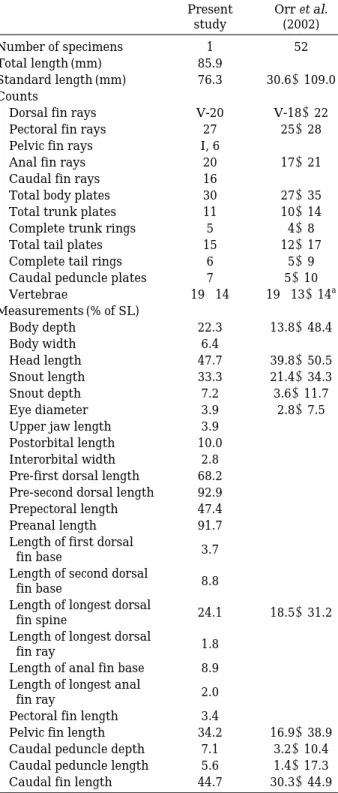
Description. Meristic and morphometric cha- racters are shown in Table 1.
Body compressed, depth greatest between ori- gin of first dorsal fin and pelvic fin, very slender between first and second dorsal fin; head elon- gated; snout long, tubular, and oriented to down-
A B
C D
Fig. 1. Solenostomus cyanopterus Bleeker, NFRDI 20071022-01, female, 76.3 mm SL, 129�25′E, 36�32′N, off coastal waters of Gyomuyeok-ri, Byeonggok-myeon, Yeongdeck-gun, Korea. (A) Underwater photograph; (B) Lateral view; (C) Ven- tral view of brood pouch; (D) X-ray photograph.
ward obliquely; depth of snout deeper than eye diameter; interorbital space concave; mouth small, oriented vertically; teeth absent; two dorsal fins well separated, first dorsal fin spines weak and elongated; first dorsal fin inserted a little poste-
rior to pelvic fin; second dorsal fin located oppo- site anal fin, both on a raised base; pectoral and anal fins very small and rounded; pelvic fins lar- ge, the upper margin of fin fused to body surface and the lower margin fused to each other, form- ing a brood pouch; lateral line absent; scales ab- sent; caudal peduncle very short; caudal fin long and rounded; body surface covered with star-shap- ed bony plates, anterior plate bigger than poste- rior one.
Color of fresh specimen. Body overall red- dish black, with a large number of rounded violet spots; first dorsal fin dark red, with two large black blotches on the membrane between the first and the third spines; upper margin of first dorsal fin light scarlet; pelvic and caudal fins more darker than body, with the bigger violet spots; second dorsal and anal fins translucent.
Body color is highly variable, ranging from light- color to dark-color phase (Fishelson, 1966; Araga, 1984). The coloration of present specimen corres- ponds to dark-color phase, however, that of speci- men at Hwasoon port, Jeju Island is light-color phase, light green body with reddish fins (Park and Choi, 2001).
Sexual dimorphism. This species displays remarkable sexual dimorphism in having a brood pouch formed by the modified pelvic fins in female (Fig. 1B). However, pelvic fins of male are sepa- rated from the ventral part of body. Furthermore, The male is slender and smaller than the female in body form (Fishelson, 1966). The pouch of pre- sent specimen showed no eggs (Fig. 1C).
Distribution. Known from Indo-West Pacific:
Korea (off Yeongdeck, present study), Japan (Senou, 2002), Taiwan (Shen et al., 1993), South China Sea (Randall and Lim, 2000), Micronesia (Myers, 1991), Indonesia (Bleeker, 1854), Tropi- cal Pacific (Allen et al., 2003), South Pacific (Ran- dall, 2005), and Red Sea (Fishelson, 1966). The occurrence of S. cyanopterus at Yeongdeck, East Sea of Korea is the northernmost record of the species.
Ecological notes. This specimen is found over sandy bottom near rocks in pairs, swimming slowly head downward close to each other. This species has a perfectly camouf lage and looks like the drifting pieces of algae, such as Undaria pin- natifida, or fallen leaf (Fig. 1A).
Remarks. This species is a unique in both mor- phology and reproduction. Meristic and morpho- metric characters of the present specimen agree well with the descriptions given by Orr et al. (2002)
Table 1. Comparison of meristic and morphometric cha- racters of Solenostomus cyanopterus
Present Orr et al.
study (2002)
Number of specimens 1 52
Total length (mm) 85.9 -
Standard length (mm) 76.3 30.6~109.0
Counts
Dorsal fin rays V-20 V-18~22
Pectoral fin rays 27 25~28
Pelvic fin rays I, 6 -
Anal fin rays 20 17~21
Caudal fin rays 16 -
Total body plates 30 27~35
Total trunk plates 11 10~14
Complete trunk rings 5 4~8
Total tail plates 15 12~17
Complete tail rings 6 5~9
Caudal peduncle plates 7 5~10
Vertebrae 19++14 19++13~14a
Measurements (% of SL)
Body depth 22.3 13.8~48.4
Body width 6.4 -
Head length 47.7 39.8~50.5
Snout length 33.3 21.4~34.3
Snout depth 7.2 3.6~11.7
Eye diameter 3.9 2.8~7.5
Upper jaw length 3.9 -
Postorbital length 10.0 -
Interorbital width 2.8 -
Pre-first dorsal length 68.2 -
Pre-second dorsal length 92.9 -
Prepectoral length 47.4 -
Preanal length 91.7 -
Length of first dorsal
fin base 3.7 -
Length of second dorsal
fin base 8.8 -
Length of longest dorsal
fin spine 24.1 18.5~31.2
Length of longest dorsal
fin ray 1.8 -
Length of anal fin base 8.9 -
Length of longest anal
fin ray 2.0 -
Pectoral fin length 3.4 -
Pelvic fin length 34.2 16.9~38.9
Caudal peduncle depth 7.1 3.2~10.4 Caudal peduncle length 5.6 1.4~17.3
Caudal fin length 44.7 30.3~44.9
aData from Orr and Fritsche (1993)
(Table 1). Among three species from Japan, Soleno- stomus cyanopterus is easily distinguished from S. paradoxus by having no slender simple cirri and striped markings. The former differs from S.
leptosoma in having 25~27 pectoral fin rays (vs.
22~24 in the latter), deep snout (vs. narrow), and short caudal peduncle (vs. long) (Senou, 2002).
Since Jordan and Thompson (1914) described S. paegnius as a new species on the basis of one specimen from Misaki, Araga (1967) reported one additional specimen of that species from Tanabe Bay, Japan. However, Orr and Fritzsche (1993) revealed S. paegnius as a junior synonym of S.
cyanpterus, as a result of reexamination of the holotype.
Fishelson (1966) investigated an embryonic and larval development of S. cyanopterus in aquari- um, as a result, he revealed a brood pouch keep- ing ca. 350 eggs and larvae in various develop- mental stages. Ten days after mating the first larvae were expelled with the water flow through the pouch, the fertilized eggs are 0.5~0.75 mm in diameter and the newly hatched larvae are 11.5~12.5 mm in total length (Fishelson, 1966).
The new Korean name follows its English name, ghost pipefish.
References
Allen, G., R. Steene, P. Humann and N. Deloach. 2003.
Reef fish identification-Tropical Pacific. New World Publications, Florida, pp. 1~457.
Araga, C. 1967. The third specimen of the ghost pipefish, Solenostomus paegnius Jordan & Thompson, from Ta- nabe Bay. Publ. Seto. Mar. Biol. Lab., 15 : 1~4.
Araga, C. 1984. Family Solenostomidae. In: Masuda, H., K.
Amaoka, C. Araga, T. Uyeno and T. Yoshino (eds.), The fishes of the Japanese archipelago, English text. Tokai Univ. Press, Tokyo, 85 pp.
Bleeker, P. 1854. Vijfde bijdrage tot de kennis der ichthyol- ogische fauna van Amboina. Natuurkd. Tijdschr. Neder.
Indië, 6 : 455~508.
Fishelson, L. 1966. Solenostomus cyanopterus Bleeker (Tel- eostei, Solenostomidae) in Elat (Gulf of Akaba). Israel J. Zool., 15 : 95~103.
Jordan, D.S. and J.O. Snyder. 1901. A review of the hypo- stomide and lophobranchiate fishes of Japan. Proc. U.
S. Natl. Mus., 24 : 1~20.
Jordan, D.S. and W.F. Thompson. 1914. Record of the fishes obtained in Japan in 1911. Mem. Carnegie Mus., 6 : 205
~313.
Kuiter, R.H. 1996. Guide to sea fishes of Australia. New Holland Publishers (Australia), Sydney, pp. 1~434.
Myers, R.F. 1991. Micronesian reef fishes, 2nd ed. Coral Graphics, Guam, pp. 1~298.
Myers, R.F. and T.J. Donaldson. 2003. The fishes of the Mariana Islands. Micronesica, 35, 36: 598~652.
Nakabo, T. 2002. Introduction of Ichthyology. In: Nakabo, T. (ed.), Fishes of Japan with pictorial keys to the spe- cies, English ed. Tokai Univ. Press, Tokyo, pp. xxi~xlii.
Nelson, J.S. 2006. Fishes of the world, 4th ed. John Wiley
& Sons, New York, pp. 1~601.
Orr, J.W. and R.A. Fritzsche. 1993. Revision of the ghost pipefishes, family Solenostomidae (Teleostei: Syngna- thoidei). Copeia, 1993 : 168~182.
Orr, J.W., R.A. Fritzsche and J.E. Randall. 2002. Solenos- tomus halimeda, a new species of ghost pipefish (Teleo- stei: Gasterosteiformes) from the Indo-Pacific, with a revised key to the known species of the family Solenos- tomidae. Aqua, J. Ichthy. Aquat. Biol., 5 : 99~108.
Pallas, P.S. 1770. Spicilegia Zoologica quibus novae imprim- is et obscurae animalium species iconibus, descriptioni- bus atque commentariis illustrantur. Berolini, Gottl.
August. Lange. Spicilegia Zool., 1 : 1~56, pls. 1~5.
Park, H.S. and S.S. Choi. 2001. Guide book to marine life of Korea. Poongdeung Publishing Co., Seoul, pp. 1~290.
Randall, J.E. 2005. Reef and shore fishes of the South Paci- fic. Hawaii Univ. Press, Hawaii, pp. 1~707.
Randall, J.E. and K.K.P. Lim. 2000. A checklist of the fishes of the South China Sea. Raffles Bull. Zool., Suppl. 8 : 569~667.
Senou, H. 1994. A review of the ghost pipefishes, genus Solenostomus (Teleostei: Solenostomidae) from Japan.
I.O.P. Diving News, 5 : 2~6. (in Japanese)
Senou, H. 2002. Family Solenostomidae. In: Nakabo, T.
(ed.), Fishes of Japan with pictorial keys to the species, English ed. Tokai Univ. Press, Tokyo, pp. 518~519.
Shen, S.C., K.T. Shao, C.T. Chen, C.H. Chen, S.C. Lee and H.K. Mok. 1993. Fishes of Taiwan. Depart. Zool., Natl.
Taiwan Univ., Taipei, pp. 1~960. (in Chinese)
Tanaka, S. 1908. Descriptions of eight new species of fishes from Japan. Annot. Zool. Japon., 7 : 27~47.
Weber, M. 1913. Die Fische der Siboga-Expedition. E.J.
Brill, Leiden. Fische Siboga Exped., pp. 1~710, pls. 1~
12.
Received : October 16, 2007 Accepted : November 29, 2007
한국산 큰가시고기목, Solenostomidae과 어류 1 미기록종, Solenostomus cyanopterus
임 후 순∙박 정 호1∙한 경 호2,*
포항지방수산청, 1국립수산과학원 자원연구팀, 2전남대학교 해양기술학부
큰가시고기목, Solenostomidae (국명신칭: 유령실고기과)에 속하는 Solenostomus cyanopterus 암 컷 1개체(표준체장 73.6 mm)가 경북 영덕연안의 수중에서 처음 채집되었다. 다른 실고기류와는 달리, 유령실고기류는 암컷의 배지느러미가 융합되어 변형된 육아낭을 가지고 등지느러미에 극 조를 가지는 특징이 있다. 본종은 주둥이의 폭이 넓고 꼬리자루가 짧고 폭이 넓으며, 피질돌기와 줄무늬가 없는 것이 특징이다. 또한 수중에서 관찰한 바로는, 암수 짝을 지어 머리를 아래로 하여 마치 떠다니는 해조류나 낙엽같이 느리게 유영하였다. 본종의 신한국명을“유령실고기”라고 명명 하였다.