—331—
INTRODUCTION
The genus Alectrias Jordan and Evermann, 1898, being charcterized by having a dermal crest on head, posterior free fold of the gill membrane, and scales in the poster- ior part of the body has been considered as comprising nominal six species i.e., A. alectrolophus (Palls, 1814), A. benjamini (Jordan and Snyder, 1902), A. cirratus (Lind- berg, 1938), A. gallinus (Lindberg, 1938), A. mutsuensis, Shiogaki, 1985, A. markevichi, Sheiko, 2012, (Sheiko, 2012).
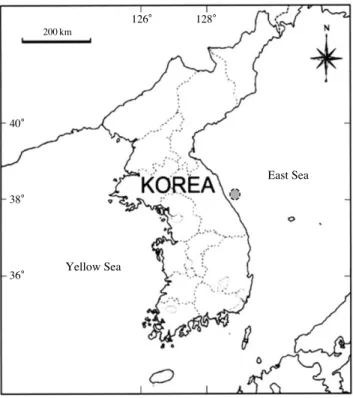
In Korean waters, since the Alectrias species, A. ben- jamini was firstly recorded from Shinan-gun, southern Sea, Korea (Kim and Kang, 1991), there have been no report of the others in the genus (Kim et al., 2011). How- ever, in November 2013, a single specimen of A. alectro- lophus, only known from the coast of the Tartary Strait to East Alaska through the Okhotsk and Bering Seas (Shiogaki, 1985) was caught from the shallow waters at about 15 m depth off Gangneung, East Sea, Korea, using SCUBA gears (Fig. 1). Because this is the first record of the species from Korea, the specimen is described here.
Specimen examined for this paper was deposited in fish collection of National Institute of Biological Resources (NIBR-P), Korean as voucher. Counts and measurements
were generally followed Hubbs and Lagler (2004) and Shiogaki (1985). Counts and terminology of cephalic sen- sory pores follow Makushok (1958). Vertebrae and ver- tical fin rays were counted from radiographs.
Alectrias alectrolophus (Pallas, 1814) (New Korean name: “Ga-neun-byeo-seul-be-do-ra-chi”)
(Figs. 2, 3A; Table 1)
Blennius alectrolophus Pallas, 1814: 174, fig. 1 (type loc- ality: Okhotsk Sea, Russia).
Alectrias alectrolophus: Jordan and Evermann, 1898:
2421 (Tareinsky bay, Russia); Makushok, 1958: 96 (Russia); Shiogaki, 1985: 305 (Russia and Japan); Lind- berg and Krasyukova, 1989: 128 (Okhotsk Sea, Russia);
Kolpakov and Miroshnik, 2007: 194 (Shtormovaya Bight, Russia); Sheiko, 2012: 308 (Russia and Japan).
Material examined. NIBR-P19805, 52.2 mm in stan- dard length (SL), 6 Nov. 2013, Yeongjin-ri, Yeongok- myeon, Gangneung-si, Gangwon-do, East Sea, Korea.
Comperative materials. Alectrias benjamini: NIBR- P3852, 2 specimens, 59.7~68.5 mm SL, 9 Jan. 2008, Sowon-myeon, Taean-gun, Chungcheongnam-do, Korea.
Description. Dorsal fin rays LXIII; anal fin rays I, 44; pectoral fin rays 10; total vertebrae 68.
Body elongate and greatly compressed, its depth 10.0 in SL; body depth at anal origin 11.3. Head small with- out filament, its length 7.5 in SL. Eye moderate, its diam- eter 5.8 in HL. Snout short, equal to eye diameter; its
New Record of the Stone Cockscomb Alectrias alectrolophus (Perciformes: Stichaeidae) from off Gangneung City,
East Sea, Korea
By Hyun-Geun Cho and Seon-Man Kweon*
Animal Resources Division, National Institute of Biological Resources
ABSTRACT A single specimen of the stone cockscomb, Alectrias alectrolophus (Pallas, 1811) was collected from off Gangneung-si, East Sea, Korea. The present Korean specimen is characterized in having a dermal crest on dorsal median line of head, LXIII dorsal fin rays, I, 44 anal fin rays, 68 verte- brae, slender and flexible dorsal spines in its anterior parts, and scales on the posterior portion of body, and fused gill membranes forming a free fold across the isthmus. We report A. alectrolophus based on a single specimen collected from the Korean water as the first record from Korea.
Key words : Alectrias alectrolophus, first record, East Sea
*Corresponding author: Seon-Man Kweon Tel: 82-32-590-7151 Fax: 82-32-590-7250, E-mail: [email protected]
Accepted: December 22, 2014
http://www.fishkorea.or.kr
posterior nostril small pore. Mouth oblique; posterior margin of upper jaw nearly reaching posterior end of iris.
Lower jaw slightly extend forward upper jaw. Dermal crest on head well developed. Dermal crest base moder- ate, its length 1.7 in HL. Crest-dorsal origin length short, smaller than eye diameter, 0.7 in eye diameter. Gill mem- branes fused to each other, forming a free fold across isth- mus. Dorsal fin very long and confluent to caudal fin base, but notched. Length of dorsal spine gradually inc- reasing toward posterior and abruptly decreasing at last 4 spine; longest spine length 3.9 in HL. Anterior dorsal spines very slender and flexible to 11th, but strong toward posterior (Fig. 3A). Anterior flexible spines elongated and very weak, buried under skin. Anal fin low, its length gradually increasing toward posterior; longest spine leng- th 4.3 in HL. Origin of anal fin located in front of mid- point of dorsal fin base. End of anal fin confluent to ca- udal fin base, but notched. A single of anal spine very short and embedded in skin. Anal rays branched. Pectoral fin small, its length 3.0 in HL. Pelvic fin absent. Caudal fin small and rounded, its length 2.4 in HL, 10 branched ray. Caudal peduncle depth low, 3.1 in body depth. Ante- rior body and head without scales. Posterior body cov-
Fig. 1. A map showing sampling site of A. alectrolophus from the East Sea of Korea.
Table 1. Comparison of counts and measurements between Alectrias alectrolophus and A. benjamini
A. alectrolophus A. benjamini
Present study Pallas (1814) Makushok (1958) Shiogaki (1985) Present study Jordan and Shiogaki (1985) Snyder (1902)
Number of specimens 1 - - 67 2 - 58
Standard length (mm) 52.2 - - 71.8~108.4 59.7~68.5 - 66.3~91.0
Dorsal fin rays LXIII 63 LXI~LXIII LX~LXV
LVII LV LVII~LIX (57.8)
(mean 62.0)
Anal fin rays I, 44 44 I, 44 I, 42~45 (43.3) I, 40 I, 41 I, 39~42 (40.7)
Pectoral fin rays 10 - - 9~11 (10.0) 10~11 - 10~11 (10.1)
18~19++47~48 17~19++47~50
16++44~45 15~17++45~47
Vretebrae 19++49==68 - ==65~67 ==65~69 ==60~61 - ==60~63
(18.0++48.5==66.5) (16.0++45.7==61.7) End of anal fin Confluent to Confluent to Confluent to Confluent to Confluent to Confluent to
caudal fin -
caudal fin caudal fin caudal fin caudal fin caudal fin Fig. 2. Alectrias alectrolophus, NIBR-P23336, 52.2 mm SL, from the East Sea, Korea.
40�
38�
36�
East Sea
Yellow Sea
200 km
ered with very small cycloid scales embedded in the skin and arranged irregularly. Teeth on both jaws, small and conical. Head sensory canals well developed and number of openings in each canal consistent to all known spec- ies of Alectrias (Shiogaki, 1985). Number of openings in each canal: nasal 2, interorbital 4, infraorbital 6, pos- torbital 7, occipital 5, preopercular 6 and mandibular 4.
Coloration when fresh. Head and body reddish brown.
Small blown dots on head and dermal crest densely scat- tered. Crossbars on lower jaw and cheek finely arrang- ed. Obvious vertical white stripe descending from lower margin of each eye to lower cheek. Dorsal parts of body light brown with irregular white speckle. Dorsal and anal fin reddish brown with many yellowish white blotches.
Pectoral fin translucent color, its Inner parts relatively big white spot. Membrane of caudal fin translucent color, its rays reddish color with two transverse white stripes.
Coloration in ethanol. Head and body uniformly light brown, darker dorsally. Small dark brown dots on head and cheek scattered. Dark brown stripe on cheek. Mem- brane of all fins with light brown blotches translucent color.
Ecological notes. The stone cockscomb species grow- ing to the maximum 150 mm SL is known that it inhab- its pebbles surfaces primarily from 50 to 100 m depth in littoral zone (Kolpakov and Miroshnik, 2007). The pre- sent specimen was found between pebbles and stones substrates about 15 m depth in the East Sea’s costal area.
Distribution. Known from North Pacific: Bering and Okhotsk Sea (Shantarskie Islands, Yerinei and Taui bays), southern Kuriles (Kunashir, Shikotan) southeastern Kam- chatka, and southern Sakhalin, Primorskii Krai, Shator- movaya Bight (Russia), Hokkaido (Japan) (Hatooka, 2002;
Mecklenburg and Sheiko, 2004; Kolpakov and Mirosh- nik, 2007), and North eastern coast of Korea (Fig. 1).
Remarks. Morphological characteristics of the present Korean specimen well agree to those of original descrip- tion as well as the previous records of Alectrias alectrolo- phus given by Makusok (1958) and Shiogaki (1985) (Table 1). Therefore, we identified the specimen collect- ed from Korea as A. alectrolophus, and proposed a new Korean name of A. alectrolophus as “Ga-neun-byeo-seul- be-do-ra-chi”.
Although the present specimen collected from Gang- neung-si, Korea is closely related to the other congener A. benjamini in having the gill membranes forming a fold across the isthmus and end of anal fin, confluent to cau- dal fin, the former is easily distinguished from the latter as having very elongated body, LXIII dorsal fin rays, I, 44 anal fin rays, 68 vertebrae, slender and flexible dor- sal spines in its anterior parts (Table 1; Fig. 3A).
A. alectrolophus have been reported to occur from De- Kastri Bay to Peter the Great Bay, Russia along the con- tinental coast of the East Sea (Kolpakov and Miroshnik, 2007). However, the findings of the Korean A. alectrolo- phus species extends the distributional range of the spe- cies to the southward.
The Korean name “Ga-neun-byeo-seul-be-do-ra-chi”
means elongated species of the genus.
ACKNOWLEDGMENTS
We thank to Dr. Eun-Ye and Mr. Tae-Seo Park for col- lecting the specimen.
This research was supported by a grant from the Na-
Fig. 3. X-ray photograph of the two Alectrias species from Korea, A. Alectrias alectrolophus, NIBR-P23336, 52.2 mm SL; B. A. benjamini, NIBR-P3852, 59.7 mm SL. Arrows indicate anterior dorsal spines.
A
B
No. 201401101).
REFERENCES
Hatooka, K. 2002. Stichaeidae. In: Nakabo, T. (ed.), Fishes of Japan with pictorial keys to the species, English edition. Tokai University Press, Tokyo, 1046-1054.
Hubbs, C.L. and K.F. Lagler. 2004. Fishes of the Great Lake region. University of Michigan press, Ann Arbor, 332pp.
Jordan, D.S. and B.W. Evermann. 1898. The fishes of North and Middle America. Bulletin United States Natio- nal Museum, 47: v-xxiv+2183-3136.
Jordan, D.S. and J.O. Snyder. 1902. A review of the blennoid fishes of Japan. Proceedings of the United States National Museum, 25: 44-504.
Kolpakov, E.V. and V.V. Miroshnik. 2007. Stone Cockcomb Alectrias alectrolophus (Stichaedae) a New Repre- sentative of Cold-Water Ichthyofauna in the Waters of Northern Primorskii Krai. Journal of Ichthyology, 47: 194-197.
Kim and Kang. 1991. Taxonomic Revision of the Suborders Blennioidei and Zoarcoidei (Pisces, Perciformes) from Korea. Korean Journal of Zoology, 34: 500-525.
Kim, B.J., S.G. Lee and J.H. An. 2011. Fish species of Korea.
In: National List of species of Korea (Vertebrates),
Lindberg, G.U. and Z.V. Krasyukova. 1989. Fishes of the Sea of Japan and Adjacent Areas of the Sea of Okho- tsk and Yellow Sea. 4. Part 4. Teleostomi. XXIX.
Perciformes. 2. Blennioidei - 13. Gobioidei. (CXLV.
Fam. Anarhichadidae - CLXXV. Fam. Periophthal- midae). I-xxxvi+602pp.
Makushok, V.M. 1958. The morphology and classification of the northern blennioid fishes (Stichaeoidae, blen- nioidei, Pisces). Proceedings Zoological Institute Academy Nauka SSSR., 25: 3-129. (in Russian) Mecklenburg, C.W. and A. Sheiko. 2004. Family Sticahei-
dae Gill 1864, Pricklebacks. California Academy of Sciences Annotated Checklists of Fishes, 35: 1-36.
Pallas, P.S. 1814. Zoographia Rosso-Asistica, sistensomni- um aniamlium in extenso Imperio Rossico et adja- centibus maribus observatorum recensionem, domi- cilia, mores et descriptiones anatomen atque icones plurimorum. Officina Caes. Academiae Scientiarum Impress, Petropoli, Vol. 3. 428pp.
Sheiko, B.A. 2012. Alectrias markevichi sp. Nov. A New Species of Cockcombs (Perciformes: Stichaeidae:
Alectriinae) from the Sublittoral of the Sea of Japan and Adjacent Waters. Journal of Ichthyology, 52:
308-320.
Shiogaki, M. 1985. A New Stichaeid Fish of the Genus Alectrias from Mutsu Bay, Northern Japan. Japanese Journal of Ichthyology, 32: 305-315.
Alectrias속 어류의 1 미기록종, Alectrias alectrolophus
조현근∙권선만
국립생물자원관 동물자원과
요 약 :우리나라 강릉 연안에서 채집된 벼슬베도라치속 어류 1개체(체장 52.2 mm SL)의 표본을 근거로 Alectrias alectrolophus를 한국미기록종으로 기재하였다. 본 종은 등지느러미 기조수 LXIII, 뒷지느러미 기조수 I, 44, 척추골수 68이고, 가늘고 긴 체형을 가진다는 점에서 동속의 다른 종과 쉽게 구별된다. 본 종의 신한국명으 로 “가는벼슬베도라치”를 제안한다.
찾아보기 낱말 :Alectrias alectrolophus, 한국미기록종, 강릉, 기재