The genus Chelidoperca Boulenger, 1895, be- longing to the subfamily Serraninae of the family Serranidae, occurs on sand-muddy bottom of the continental shelf and slope in the western Pacific (Nelson, 2006). Akazaki (1972) reviewed the ge- nus Chelidoperca, in which he recognized three species, C. pleurospilus (Günther, 1880), C. hirun- dinacea (Valenciennes in Cuvier and Valenci- ennes, 1831), and C. margaritifera Weber, 1913 in Japan, being followed by Senou (2002). How- ever, only one species, C. hirundinacea, has been reported from Korea (Chyung, 1977; Kim et al., 2001, 2005) until now.
The genus Parapercis Bleeker, 1863 is known to be the largest group of the family Pinguipedi- dae (Randall and Francis, 1993), and includes
about 54 species in the world (Johnson, 2006), 23 species with 2 unidentified species in Japan (Shi- mada, 2002) and 6 species in Korea (Youn, 1998;
Kim et al., 2005). Because of many taxonomic confusion, the genus has been often reviewed by several authors, e.g., Kamohara (1960), Cantwell (1964), and Shen (1983), but still remains some unresolved taxa (Shimada, 2002).
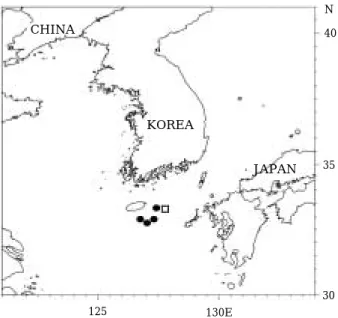
During a bottom trawl survey in the southern sea of Korea in 2006 and 2007, we collected two specimens of Chelidoperca pleurospilus and 21 specimens of Parapecis muronis (Tanaka, 1918) (Fig. 1). They are herein described as new to Kor- ean fish fauna based on the specimens.
Measurement methods are followed those of Hubbs and Lagler (1964) and Nakabo (2002). The number of vertebrae and some fin rays were count- ed from radiographs. The examined specimens
First Record of Two Perciform Fishes, Chelidoperca pleurospilus (Serranidae) and Parapercis muronis (Pinguipedidae) from Korea
Jeong-Ho Park, Jin Koo Kim*, Jung Hwa Choi, Dae Soo Chang
1and Jong Hwa Park
Fisheries Resources Research Team, National Fisheries Research and Development Institute, 408-1 Sirang-ri, Gijang-gun, Busan 619-902, Korea
1Fisheries Resources Management and Promotion Team, East Sea Fisheries Research Institute, 30-6 Dongdeok-ri, Yeongok-meon, Gangrung, Gangwon 210-681, Korea
Two specimens (56.3~~61.1 mm SL) of the serranid fish, Chelidoperca pleurospilus and 21 specimens (34.0~~93.6 mm SL) of the pinguipedid fish, Parapercis muronis were collected around Jeju Island, southern Korea. C. pleurospilus is characterized by having five dark blotches along lateral line, truncated caudal fin, and scaleless interorbital space. P. muronis is characterized by having five oblique dark bands on body side, five spines on dorsal fin, and no notch between spinous and soft-rayed portions of dorsal fin. We describe these specimens as the first record from Korea, and propose the new Korean name, “Byeol-gak-si-dom” for the former and “Da-seos- jul-yang-dong-mi-ri” for the latter.
Key words : Chelidoperca pleurospilus, Parapercis muronis, Serranidae, Pinguipe- didae, first record
*Corresponding author: [email protected]
─
─ 246 ──
are deposited in the National Fisheries Research and Development Institute (NFRDI) of Korea.
Chelidoperca pleurospilus (Günther, 1880)
(New Korean name: Byeol-gak-si-dom)
(Fig. 2; Table 1)
Centropristis pleurospilus Günther, 1880: 37, pl.
16-D (type locality: Kai Islands, Indonesia).
Chelidoperca pleurospila: Senou in Okamura and Amaoka, 1997: 277, fig. 1 (Kochi, Japan); Shino- hara et al., 2001: 321 (listed, Tosa Bay, Japan);
Senou in Nakabo, 2002: 692 (Key, description, Japan); Shinohara et al., 2005: 430 (listed, Ryu- kyu, Japan).
Chelidoperca pleurospilus: Akazaki, 1972: 277, figs. 1A, 2B, 3 (Tanegashima, Japan); Katayama in Masuda et al., 1984: 133, pl. 120-B (Japan);
Fig. 1. Map showing the sampling area of Chelidoperca pleurospilus (□) and Parapercis muronis (●) from southern sea of Korea.
N 40
35
30 125 130E
Fig. 2. Chelidoperca pleurospilus (Günther), NFRDI 20070601-01, 56.3 mm SL, 127�43′E, 33�19′N, around Jeju Island, southern sea of Korea.
Fig. 3. Parapercis muronis (Tanaka), NFRDI 20070601-19, 93.6 mm SL, 126�41′E, 32�48′N, around Jeju Island, southern sea of Korea.
CHINA
KOREA
JAPAN
Yamakawa in Okamura, 1985: 468 (Okinawa, Japan); Shen et al., 1993: 296, pl. 76-6 (Taiwan);
Wu et al., 1999: 198 (listed, China); Randall and Lim, 2000: 609 (listed, South China Sea).
Material examined. NFRDI 20070601-01~
02, 2 specimens, 56.3
~61.1 mm in standard leng- th (SL), 127
�43
′E, 33
�19
′N, southern sea of Korea, 130 m depth, 3 May 2007, R/V Tamgu-1, bottom trawl, collected by J.H. Park.
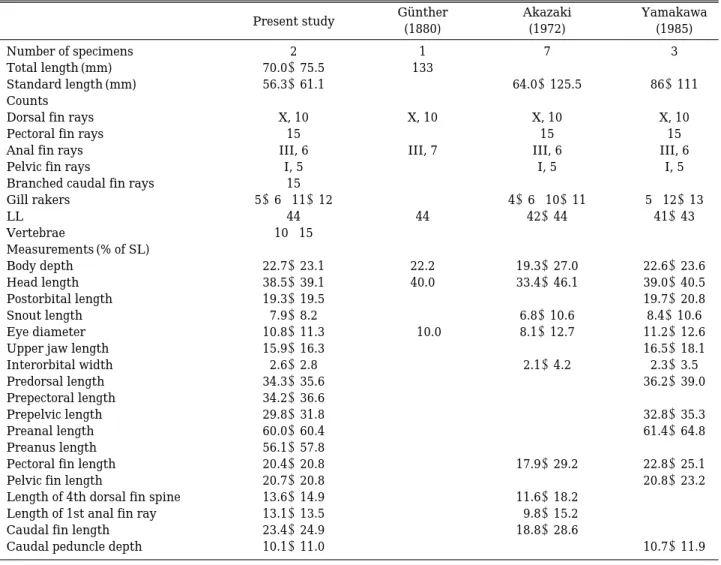
Description. Counts and measurements are shown in Table 1.
Body elongated and cylindrical; snout pointed;
eyes very large, its diameter longer than snout length, located dorsally; interorbital space flat and very narrow, scaleless; mouth oblique, lower jaw slightly protruding; upper jaw extending
posterior to a little beyond middle of eye; upper region of opercle with two spines; posterior mar- gin of preopercle serrated; dorsal fin base long;
pelvic fin insert anterior to pectoral fin; lateral line almost straight; caudal fin truncate; scales relatively large, ctenoid.
Color when fresh. Body overall orange-pink, paler ventrally; five dark blotches along lateral line; dorsal and caudal fins brownish yellow;
pectoral, pelvic, and anal fins yellowish; white at origin of pectoral fin; about eight white blotches ventrally.
Color after preservation. Body color paler;
five dark blotches more clear; white at origin of pectoral fin; black spots on caudal fin; pectoral and pelvic fins translucent.
Distribution. Western Pacific: Korea (around
Table 1. Comparison of counts and measurements of Chelidoperca pleurospilus
Present study Günther Akazaki Yamakawa
(1880) (1972) (1985)
Number of specimens 2 1 7 3
Total length (mm) 70.0~75.5 133 - -
Standard length (mm) 56.3~61.1 - 64.0~125.5 86~111
Counts
Dorsal fin rays X, 10 X, 10 X, 10 X, 10
Pectoral fin rays 15 - 15 15
Anal fin rays III, 6 III, 7 III, 6 III, 6
Pelvic fin rays I, 5 - I, 5 I, 5
Branched caudal fin rays 15 - - -
Gill rakers 5~6++11~12 - 4~6++10~11 5++12~13
LL 44 44 42~44 41~43
Vertebrae 10++15 - - -
Measurements (% of SL)
Body depth 22.7~23.1 22.2 19.3~27.0 22.6~23.6
Head length 38.5~39.1 40.0 33.4~46.1 39.0~40.5
Postorbital length 19.3~19.5 - - 19.7~20.8
Snout length 7.9~8.2 - 6.8~10.6 8.4~10.6
Eye diameter 10.8~11.3 ¤10.0 8.1~12.7 11.2~12.6
Upper jaw length 15.9~16.3 - - 16.5~18.1
Interorbital width 2.6~2.8 - 2.1~4.2 2.3~3.5
Predorsal length 34.3~35.6 - - 36.2~39.0
Prepectoral length 34.2~36.6 - - -
Prepelvic length 29.8~31.8 - - 32.8~35.3
Preanal length 60.0~60.4 - - 61.4~64.8
Preanus length 56.1~57.8 - - -
Pectoral fin length 20.4~20.8 - 17.9~29.2 22.8~25.1
Pelvic fin length 20.7~20.8 - - 20.8~23.2
Length of 4th dorsal fin spine 13.6~14.9 - 11.6~18.2 -
Length of 1st anal fin ray 13.1~13.5 - 9.8~15.2 -
Caudal fin length 23.4~24.9 - 18.8~28.6 -
Caudal peduncle depth 10.1~11.0 - - 10.7~11.9
Jeju Island, present study), Japan (Akazaki, 1972;
Senou, 2002), China (Wu et al., 1999), Taiwan (Shen et al., 1993), and Indonesia (Günther, 1880).
Remarks. Chelidoperca pleurospilus has often been confused with C. hirundinacea because of the morphological similarities between them (Akazaki, 1972). However, the former differs from the latter in having the five dark blotches along lateral line (vs. indistinct one or none for C. hirundinacea), truncated caudal fin (vs. emar- ginate), and scaleless interorbital space (vs. scal- ed) (Akazaki, 1972; Senou, 2002). The present specimens agree well with those of several pre- vious descriptions of C. pleurospilus (Table 1).
We propose a new Korean name, “Byeol-gak-si- dom” for this species.
Parapercis muronis (Tanaka, 1918)
(New Korean name:
Da-seos-jul-yang-dong-mi-ri) (Fig. 3; Table 2)
Neopercis muronis Tanaka, 1918: 227 (type locali- ty: Wakayama, Japan).
Parapercis muronis: Kamohara, 1960: 9 (Kochi, Japan); Cantwell, 1964: 254, figs. 1S, 4S, 6A (Kochi, Japan and China Sea); Shen, 1983: 30, fig. 8 (Taiwan); Okamura in Masuda et al., 1984: 446, fig. 375-M (Japan); Shen et al., 1993:
488, pl. 164-4 (Taiwan); Shinohara in Okamura and Amaoka, 1997: 553, fig. 4 (Kochi, Japan);
Wu et al., 1999: 680 (listed, China); Randall and Lim, 2000: 631 (listed, South China Sea);
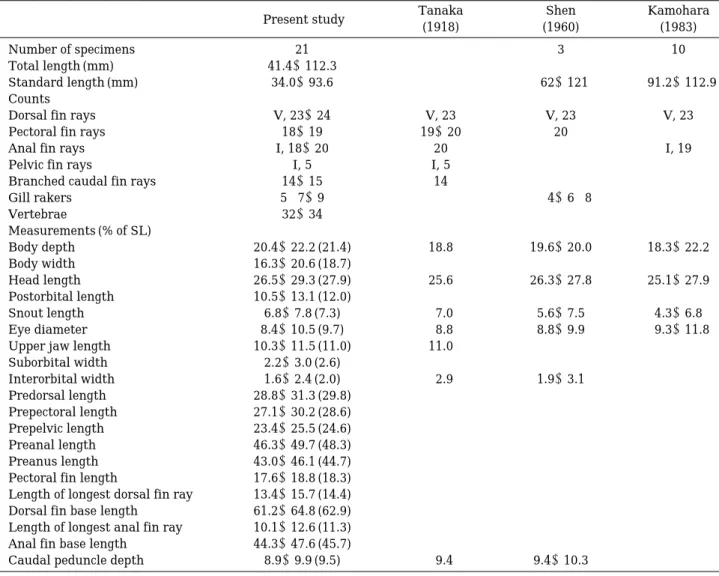
Table 2. Comparison of counts and measurements of Parapercis muronis. Data in parentheses are the mean
Present study Tanaka Shen Kamohara
(1918) (1960) (1983)
Number of specimens 21 - 3 10
Total length (mm) 41.4~112.3 - - -
Standard length (mm) 34.0~93.6 - 62~121 91.2~112.9
Counts
Dorsal fin rays V, 23~24 V, 23 V, 23 V, 23
Pectoral fin rays 18~19 19~20 20 -
Anal fin rays I, 18~20 20 - I, 19
Pelvic fin rays I, 5 I, 5 - -
Branched caudal fin rays 14~15 14 - -
Gill rakers 5++7~9 - 4~6++8 -
Vertebrae 32~34 - - -
Measurements (% of SL)
Body depth 20.4~22.2 (21.4) 18.8 19.6~20.0 18.3~22.2
Body width 16.3~20.6 (18.7) - - -
Head length 26.5~29.3 (27.9) 25.6 26.3~27.8 25.1~27.9
Postorbital length 10.5~13.1 (12.0) - - -
Snout length 6.8~7.8 (7.3) 7.0 5.6~7.5 4.3~6.8
Eye diameter 8.4~10.5 (9.7) 8.8 8.8~9.9 9.3~11.8
Upper jaw length 10.3~11.5 (11.0) 11.0 - -
Suborbital width 2.2~3.0 (2.6) - - -
Interorbital width 1.6~2.4 (2.0) 2.9 1.9~3.1 -
Predorsal length 28.8~31.3 (29.8) - - -
Prepectoral length 27.1~30.2 (28.6) - - -
Prepelvic length 23.4~25.5 (24.6) - - -
Preanal length 46.3~49.7 (48.3) - - -
Preanus length 43.0~46.1 (44.7) - - -
Pectoral fin length 17.6~18.8 (18.3) - - -
Length of longest dorsal fin ray 13.4~15.7 (14.4) - - -
Dorsal fin base length 61.2~64.8 (62.9) - - -
Length of longest anal fin ray 10.1~12.6 (11.3) - -
Anal fin base length 44.3~47.6 (45.7) - - -
Caudal peduncle depth 8.9~9.9 (9.5) 9.4 9.4~10.3 -
Randall in Carpenter and Niem, 2001: 3502 (Western Central Pacific); Shinohara et al., 2001: 329 (listed, Tosa Bay, Japan); Shimada in Nakabo, 2002: 1064 (Key, description, Japan);
Shinohara et al., 2005: 437 (listed, Ryukyu, Japan).
Material examined. NFRDI 20061121-10, 1 specimen, 93.3 mm SL, 126
�44
′E, 32
�45
′N, south- ern sea of Korea, 118 m depth, 27 October 2006, R/V Tamgu-1, bottom trawl; NFRDI 20070123- 10~15, 6 specimens, 34.0~90.4 mm SL, 127
�10
′E, 32
�47
′N, southern sea of Korea, 118 m depth, 27 October 2006, R/V Tamgu-1, bottom trawl; NFRDI 20070123-16, 1 specimen, 77.9 mm SL, 127
�42
′E, 33
�22
′N, southern sea of Korea, 117 m depth, 26 October 2006, R/V Tamgu-1, bottom trawl; NFRDI 20070601-19~31, 13 specimens, 52.1~93.6 mm SL, 126
�41
′E, 32
�48
′N, southern sea of Korea, 116 m depth, 30 April 2007, R/V Tamgu-1, bottom trawl, collected by J.H. Park.
Description. Counts and measurements are shown in Table 2.
Body elongate, cylindrical anteriorly and com- pressed posteriorly; eyes very large, located dorsal- ly; mouth oblique, upper and lower jaws protrud- ing equally; upper jaw reach anterior to middle of eye; length of rays longer than that of spines on dorsal fin; dorsal and anal fins base long;
pelvic fin insert anterior to pectoral fin; lateral line curved slightly upward near pectoral fin and pass straight through middle of posterior body;
no notch between spinous and soft-rayed por- tions of dorsal fin; caudal fin rounded; scales cte- noid.
Color when fresh. Body yellowish pink, paler ventrally; five slightly oblique black bands on each side extending from dorsal to below the lateral line, with lower part of each band yellow;
1~2 dark blotches among bands dorsally; dorsal and anal fins white, with yellowish oblique ban- ds; white at origin of pectoral fin; a black blotch at the upper base of caudal fin; 4~5 yellow verti- cal bands in caudal fin; bluish blotch on middle of pelvic fin.
Color after preservation. Body color paler;
five dark bands, with upper part of each band black and the lower part of each band bleaching;
white at origin of pectoral fin; black blotch on middle of pelvic fin.
Distribution. Northwest Pacific: Korea (aro- und Jeju Island, present study), Japan (Shimada, 2002), Taiwan (Shen et al., 1993), and China (Wu et al., 1999).
Remarks. Within the genus Parapercis, P.
muronis is characterized by having five dark transverse bands, five spines on dorsal fin, and no notch between spinous and soft-rayed por- tions of dorsal fin. The present specimens agree well with those of several previous descriptions of P. muronis (Table 2).
P. muronis is easily different from P. multi- fasciata Döderlein in Steindachner and Döder- lein, 1884, in having five (vs. 8~10 for P. multi- fasciata) dark bands (Shimada, 2002; Kim et al., 2005).
We propose a new Korean name, “Da-seos-jul- yang-dong-mi-ri” for this species.
Acknowledgements
This work was funded by the National Fish- eries Research and Development Institute (NF- RDI) of Korea. We express our thanks to the captain and crews of R/V Tamgu-1.
References
Akazaki, M. 1972. A critical study of the serranid fishes of the genus Chelidoperca found in Japan. Jpn. J. Ich- thyol., 19 : 274~282. (in Japanese)
Bleeker, P. 1863. Onzième notice sur la faune ichthy-ologi- que de l’ île de Ternate. Neder. Tijdschr. Dierk., 1 : 228
~238.
Boulenger, G.A. 1895. Catalogue of the perciform fishes in the British Museum, 1 : 1~394, pls. 1~15.
Cantwell, G.E. 1964. A revision of the genus Parapercis, Family Mugiloididae. Pac. Sci., 18 : 239~280.
Chyung, M.K. 1977. The fishes of Korea. Ilji-sa, Seoul, pp.
1~727. (in Korean)
Cuvier, G. and A. Valenciennes. 1831. Histoire naturelle des poissons. Tome septieme. Livre sèptieme. Des Squ-
amipennes. Livre huitieme. Des poissons a pharyngiens labyrinthiformes, 7 : 1~531, pls. 170~208.
Günther, A. 1880. Report on the shore fishes procured during the voyage of H.M.S. Challenger in the years 1873~1876. In: Report of the scientific results of the voyage of H.M.S. Challenger during the years 1873
~1876. Zool., 6 : 1~82, pls. 1~32.
Hubbs, C.L. and K.F. Lagler. 1964. Fishes of the Great Lake Region. Bull. Cranbrook Inst. Sci., 26 : 19~27.
Johnson, J.W. 2006. Two new species of Parapercis (Perci- formes: Pinguipedidae) from north-eastern Australia, and rediscovery of Parapercis colemani Randall &
Francis, 1993. Mem. Mus. Victoria, 63 : 47~56.
Kamohara, T. 1960. A review of the fishes of the family Parapercidae found in the waters of Japan. Rep. Usa Mar. Biol. Sta., 7 : 1~14, pls. 1~2.
Katayama, M. 1984. Family Serranidae. In: Masuda, H., K.
Amaoka, C. Araga, T. Uyeno and T. Yoshino (eds.), The fishes of the Japanese archipelago, English text. Tokai Univ. Press, Tokyo, pp. 126~138.
Kim, I.S., Y. Choi, C.L. Lee, Y.J. Lee, B.J. Kim and J.H.
Kim. 2005. Illustrated book of Korean Fishes. Kyohak Publishing, Seoul, pp. 1~615. (in Korean)
Kim, Y.U., J.G. Myoung, Y.S. Kim, K.H. Han, C.B. Kang, J.K. Kim and J.H. Ryu. 2001. Marine fishes of Korea.
Hanguel Publishing, Busan, pp. 1~382. (in Korean) Nakabo, T. 2002. Introduction of Ichthyology. In: Nakabo,
T (ed.), Fishes of Japan with pictorial keys to the species, English ed. Tokai Univ. Press, Tokyo, pp. xxi
~xlii.
Nelson, J.S. 2006. Fishes of the world, 4th ed. John Wiley
& Sons, New York, pp. 1~601.
Okamura, O. 1984. Family Mugiloididae. In: Masuda, H., K. Amaoka, C. Araga, T. Uyeno and T. Yoshino (eds.), The fishes of the Japanese archipelago, English text.
Tokai Univ. Press, Tokyo, pp. 290~292, 446.
Randall, J.E. 2001. Family Pinguipedidae. In: Carpenter, K.E. and V. Niem (eds.), FAO species identification guide for fishery purposes. The living marine resources of the Western Central Pacific vol. 6. FAO, Rome, pp.
3501~3510.
Randall, J.E. and K.K.P. Lim. 2000. A checklist of the fishes of the South China Sea. Raffles Bull. Zool., Suppl. 8 : 569~667.
Randall, J.E. and M.P. Francis. 1993. Parapercis colemani, a new Pinguipedidae fish from Norfolk Island, south-
western Pacific Ocean. N. Z. J. Mar. Freshw. Res., 27 : 209~214.
Senou, H. 1997. Family Serranidae. In: Okamura, O. and K. Amaoka (eds.), Sea fishes of Japan. Yama-kei Publishers, Tokyo, pp. 251~279. (in Japanese)
Senou, H. 2002. Family Serranidae. In: Nakabo, T. (ed.), Fishes of Japan with pictorial keys to the species, English ed. Tokai Univ. Press, Tokyo, pp. 690~731.
Shen, S.C. 1983. Study on sand perch (Mugiloididae) from Taiwan. J. Taiwan Mus., 36 : 23~36.
Shen, S.C., K.T. Shao, C.T. Chen, C.H. Chen, S.C. Lee and H.K. Mok. 1993. Fishes of Taiwan. Depart. Zool., Natl.
Taiwan Univ., Taipei, pp. 1~960. (in Chinese)
Shimada, K. 2002. Family Pinguipedidae. In: Nakabo, T.
(ed.), Fishes of Japan with pictorial keys to the species, English ed. Tokai Univ. Press, Tokyo, pp. 1059~1064.
Shinohara, G., H. Endo, K. Matsuura, Y. Machida and H.
Honda. 2001. Annotated checklist of the deepwater fishes from Tosa Bay, Japan. Natl. Sci. Mus. Monogr., 20 : 283~343.
Shinohara, G., T. Sato, Y. Aonuma, H. Horikawa, K. Mat- suura, T. Nakabo and K. Sato. 2005. Annotated chec- klist of the waters around the Ryukyu Islands, Japan.
Natl. Sci. Mus. Monogr., 29 : 385~452.
Shinohara, N. 1997. Family Mugiloididae. In: Okamura, O.
and K. Amaoka (eds.), Sea fishes of Japan. Yama-kei Publishers, Tokyo, pp. 549~553. (in Japanese)
Steindachner, F. and L. Döderlein. 1884. Beiträge zur Kenntniss der Fische Japan’s. (III). Denkschr. Akad.
Wiss. Wien, 49 : 171~212, pls. 1~7.
Tanaka, S. 1918. Twelve new species of Japanese fishes.
Zool. Mag., 30 : 223~227. (in Japanese)
Weber, M. 1913. Die Fische der Siboga-Expedition. E. J.
Brill, Leiden. Fische Siboga Exped., pp. 1~710, pls. 1~
12.
Wu, H.L., K.T. Shao and C.F. Lai. 1999. Latin-Chinese dictionary of fishes names. Sueichan Press, Keelung, pp. 1~1028.
Yamakawa, T. 1985. Family Serranidae. In: Okamura, K.
(ed.), Fishes of the Okinawa trough and the adjacent waters. II. Japan Fisheries Resource Conservation As- sociation, Tokyo, pp. 462~475.
Youn, C.H. 1998. New record of three percoids (Pisces: Per- ciformes) from Cheju Island, Korea. Korean J. Ichthyol., 10 : 260~267.
Received : June 28, 2007 Accepted : August 28, 2007
한국산 농어목 어류
2
미기록종, Chelidoperca pleurospilus
및Parapercis muronis
박정호∙김진구*∙최정화∙장대수1∙박종화
국립수산과학원 자원연구팀
1국립수산과학원 동해수산연구소 어업자원팀
농어목 바리과에 속하는 Chelidoperca pleurospilus 2개체(체장 56.3~61.1 mm)와 양동미리과 에 속하는 Parapercis muronis 21개체(체장34.0~93.6 mm)가 제주도 주변해역에서 채집되었다. C. pleurospilus는 체측에 5개의 검은 반점이 있고 꼬리지느러미 후단부가 절단형이며, 양눈사이 에 비늘이 없는 것이 특징이다. P. muronis는 체측에 5줄의 검은 띠가 비스듬히 있고 등지느러미 극조가 5개이며, 등지느러미의 극조부와 연조부 사이에 결각이 없는 것이 특징이다. 두 종에 대 해 각각 “별각시돔”과“다섯줄양동미리”라고 신한국명을 부여하였다.