—132—
INTRODUCTION
The genus Arnoglossus, belonging to the family Bothi- dae, is widely distributed in tropical and temperate waters of the world and usually they occur on sea bottom in depths less than 400 m (Fukui et al., 1990). More than 37 species have been known worldwide (Amaoka and Mihara, 2000). They were characterized by having large mouth in size, much maxilla longer than eye diameter, and cycloid or feebly ctenoid scales on ocular side. Six species have been recorded from the coastal waters of Japan (Nakabo, 2002), of which only one species, A.
japonicus, has been reported from Korea (Mori, 1952;
Kim et al., 2005).
Recently, one specimen of A. polyspilus was collected from the coastal waters of Jeju Island, Korea. We descri- bed its morphological characteristics based on a speci- men and newly added it to the Korean fish fauna.
Counts and measurements followed Hubbs and Lagler (1964). The examined specimen was deposited at the Fish Genetics and Breeding Laboratory, Jeju National University (JNU), Korea.
Arnoglossus polyspilus (Günther), 1880 (New Korean name: No-rang-ban-jeom-ga-ja-mi)
(Fig. 1; Table 1)
Anticitharus polyspilus Günther, 1880: 48 (type locality:
Kai Islands, Indonesia).
Arnoglossus polyspilus: Norman, 1927: 20 (India);
Amaoka 1969: 191 (Japan); Amaoka in Masuda et al., 1984: 350 (Japan); Okamura et al., 1985: 611, 735 (Japan); Randall and Lim, 2000: 645 (South China Sea); Nakabo in Nakabo, 2002: 1369 (Japan).
Material examined. JNU 20040618, one specimen, 229.0 mm in standard length (SL), off Mara Island, Jeju Island, Korea, with long line, 18 June 2004.
Description. Counts for the present specimen are shown in Table 1.
Measurements are presented as percentage against SL:
Body depth 40.4; body width 6.0; head length 24.0;
upper jaw length 9.7; lower jaw length 8.5; eye dimeter 6.0; snout length 5.4; predorsal fin length 3.3; prepector- al fin length 25.2; preanal fin length 25.3; preventral fin length 16.2; dorsal fin base length 98.2; anal fin base length 76.2; length of longest dorsal fin ray 10.1; length of longest pectoral fin ray 12.0; length of longest anal fin ray 10.3; caudal peduncle depth 9.4; straight lateral length 62.7; curved lateral length 17.5.
Body elliptical, its depth about two-fifths of SL; dorsal and anal contours evenly arched except for dorsal profile of head; dorsal fin starting on blind side, its origin in front of lower eye; anal fin starting below pectoral base;
pectoral fin smaller on blind side than on ocular side;
ventral fin base longer on ocular side than on blind side;
caudal fin rounded, 2 simple rays on both upper and
First Record of the Bothid Flounder Arnoglossus polyspilus (Bothidae, Pleuronectiformes) from Korea
By Maeng Jin Kim
1, Chan-Moon Choi
2and Choon Bok Song
1,2,*
1Marine and Environmental Research Institute, Jeju National University, Jeju 690-968, Korea
2College of Ocean Sciences, Jeju National University, Jeju 690-756, Korea
ABSTRACT A specimen of Arnoglossus polyspilus (Günther) (229.0 mm standard length) belonging to the family Bothidae, collect from the coastal waters of Jeju Island, represents the first record of the species from Korea. This species is characterized by having caudal fin with two simple rays on both upper and lower margins, several anterior dorsal fin rays somewhat elongated, upper jaw extending to below anterior 1/3 of lower eye, and one gill raker on the upper limb of the first gill arch. We add this species to the Korean fish fauna and propose its new Korean name, “No-rang-ban-jeom-ga-ja-mi”.
Key words : Bothidae, Arnoglossus polyspilus, first record, Jeju Island, Korea
*Corresponding author: Choon Bok Song Tel: 82-64-754-3471, Fax: 82-64-756-3493, E-mail: [email protected]
KOREAN JOURNAL OF ICHTHYOLOGY, Vol. 22, No. 2, 132-135, June 2010 ISSN: 1225-8598
Received : March 21, 2010 Revised : May 12, 2010 Accepted : March 25, 2010
http://www.fishkorea.or.kr
First Record of Arnoglossus polyspilus 133
lower margins; lateral line on ocular side gently arched above pectoral fin but no lateral line on blind side; head rather small; snout length smaller than eye diameter;
upper jaw extending to below anterior one-third of lower
eye; teeth in both jaws pointed, arranged in a single row;
two nostrils existed on ocular side in front of upper mar- gin of lower eye and the other two was on blind side below origin of dorsal fin; anterior nostril on ocular side tubular with flap and posterior one tubeless without flap;
scales moderate and deciduous; both sides covered with ctenoid scales.
Color when fresh. Body uniformly light greenish brown; many yellowish-green spots on ocular site includ- ing around eyes (Fig. 2); body on blind side white except for part of abdominal cavity which stained with pale blue.
Color in formalin. Body uniformly light brown; all fins light brown with dusky spots; body on blind side white.
Distribution. Known from Indo-West Pacific Ocean:
northwestern Australia to Indonesia, Taiwan (Hensley and Amaoka, 2001), South China Sea (Randall and Lim, 2000), Korea (Jeju Island, Present study), southern Japan and western Pacific (Okamura et al., 1985).
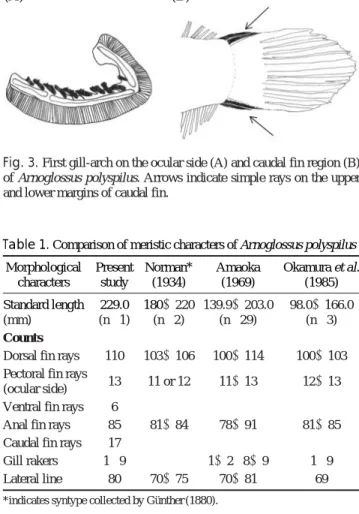
Remarks. The present specimen was characterized by having caudal fin with 2 simple rays on both upper and lower margins, several anterior dorsal fin rays somewhat elongated, upper jaw extending to below anterior one- third of lower eye, and 1 gill raker on the upper limb of
Fig. 1. Arnoglossus polyspilus (Günther), JNU 20060618, 229.0 mm SL, Jeju Island, Korea.
Fig. 2. Yellowish-green spots on ocular side including eyes of Arno- glossus polyspilus.
A
B
the first gill arch (Fig. 3). Although the number of dorsal fin rays and lateral line of the present specimen show a little difference with those of the previous report (Nor- man, 1934; Okamura et al., 1985), all counts of the pre- sent specimen coincide with those of Amaoka (1969) (Table 1). Amaoka (1969) also reported that this species has sexual dimorphism in the dorsal fin ray. That is, the anteriormost several dorsal rays are elongate in male, but scarcely ever elongate in female. When we consider such a sexual dimorphism, our specimen is most likely
to be female. On the other hand, A. polyspilus is easily distinguishable from other species of Arnoglossus distri- buted in the coastal waters of Korea and Japan by having 1 to 2 gill rakers on the upper limb of the first gill arch (vs. none in other species) and caudal fin with two sim- ple rays both uppermost and lowermost (vs. three simple rays except for one) (Table 2).
REFERENCES
Amaoka, K. 1969. Studies on sinistral flounders found in the waters around Japan. -taxonomy, anatomy and phylo- geny-. J. Shimonoseki Univ. Fish., 18: 1-276.
Amaoka, K. 1984. Family Bothidae. In: Masuda, H., K.
Amaoka, C. Araga, T. Uyeno and T. Yoshino (eds.), The fishes of the Japanese archipelago. Tokai Univ.
Press., Tokyo, pp. 347-350.
Amaoka, K. and E. Mihara. 2000. Pisces Pleuronectiformes:
flatfishes from New Caledonia and adjacent waters.
genus Arnoglossus. In: Crosnier, A (ed.), Résultats des Campagnes Musorstom, vol. 21. Mém. Mus. Natl.
Hist. Nat., 184: 783-813.
Arai, M. and K. Amaoka. 1996. Arnoglossus macrolophus Alcock (Pleuronectiformes: Bothidae); a valid species distinct from A. tapeinosomus (Bleeker). Ichthyol.
Res., 43: 359-365.
Fukui, A., U. Yamada and T. Ozawa. 1990. Redescription of Arnoglossus yamanakai (Pleuronectiformes, Bothi- dae) with description of the adults. Japanese J. Ich- thyol., 215-223.
Günther, A. 1880. Report on the shore fishes procured during the voyage of H.M.S. “Ghallenger” in the years 1873- 76. Rep. Sci. Expl. Voy. H. M. S. “Challenger”, Zool., 1: 82pp.
Hensley, D.A. and K. Amaoka. 2001. Bothidae. Lefteye flounder. In: Carpenter, K.E. and V. Niem (eds.), FAO species identification guide for fishery purposes.
The living marine resources of the Western Central Pacific. Vol. 6. Bony fishes part 4 (Labridae to Lati- meriidae), estuarine crocodiles. FAO, Rome, pp.
3799-3841.
Hubbs, C.L. and K.F. Lagler. 1964. Fishes of the Great Lake Region. Bull. Granbrook Inst. Sci., 26: 19-27.
Kim, I.S., Y. Choi, C.L. Lee, Y.J. Lee, B.J. Kim and J.H.
Kim. 2005. Illustrated book of Korean fish. Kyo-Hak Publishing Co. Ltd., Seoul, pp. 469-471.
Mori, T. 1952. Check list of the fishes of Korea. Mem. Hyo- go Univ. Agric., Biol. Ser., 1: 1-228.
Nakabo, T. 2002. Bothidae. In: Nakabo, T. (ed.), Fishes of Japan with pictorial keys to the species, English edi- tion. Tokai Univ. Press, Tokyo, pp. 1358-1370.
Norman, J.R. 1927. The flatfishes (Heterosomata) of India, 134 Maeng Jin Kim, Chan-Moon Choi and Choon Bok Song
Table 1. Comparison of meristic characters of Arnoglossus polyspilus Morphological Present Norman* Amaoka Okamura et al.
characters study (1934) (1969) (1985) Standard length 229.0 180~220 139.9~203.0 98.0~166.0
(mm) (n==1) (n==2) (n==29) (n==3)
Counts
Dorsal fin rays 110 103~106 100~114 100~103 Pectoral fin rays
13 11 or 12 11~13 12~13
(ocular side)
Ventral fin rays 6 - - -
Anal fin rays 85 81~84 78~91 81~85
Caudal fin rays 17 - - -
Gill rakers 1++9 - 1~2++8~9 1++9
Lateral line 80 70~75 70~81 69
*indicates syntype collected by Günther (1880).
Fig. 3. First gill-arch on the ocular side (A) and caudal fin region (B) of Arnoglossus polyspilus. Arrows indicate simple rays on the upper and lower margins of caudal fin.
Table 2. Comparison of gill rakers and simple rays on caudal fin margins of Arnoglossus species occurring Korean and Japanese waters
Species Gill rakers Simple rays on
References caudal fin margins
A. polyspilus 1~2++8~9 2 Amaoka (1969)
A. japonicus 0++7~9 3 Amaoka (1969)
A. oxyrhynchus 0++8~9 3 Amaoka (1969)
A. macrolophus 0++10~13 2 Arai and Amaoka (1996)
A. tenuis 0++8~9 3 Amaoka (1969)
A. yamanakai 0++7~10 3 Fukui et al. (1990)
(A) (B)
First Record of Arnoglossus polyspilus 135
with a list of the specimens in the Indian museum.
Rec. Indian Mus., 29: 7-48.
Okamura, O., Y. Machida, T. Yamakawa, K. Matsuura and T. Yatou. 1985. Fishes of the Okinawa trough and the adjacent waters II. Japan Fisheries Resource Con-
servation Association, Tokyo, 781pp.
Randall, J.E. and K.K.P. Lim. 2000. A checklist of the fishes of the South China Sea. Raffles Bull. Zool. Suppl., 8: 569-667.
한국산 둥글넙치과 어류 1미기록종, Arnoglossus polyspilus
김맹진1∙최찬문2∙송춘복1,2
1제주대학교 해양과환경연구소, 2제주대학교 해양과학대학
요 약 :둥글넙치과에 속하는 Arnoglossus polyspilus 1개체(표준 체장 229.0 mm)가 제주도 주변 해역에서 처 음으로 채집되었다. 본 종은 꼬리지느러미 상엽과 하엽에 두 개의 작은 연조가 있으며, 등지느러미 앞부분의 연 조는 약간 연장되었다. 위턱은 전체 길이의 좌측 눈 아래 1/3 앞까지 도달하고, 첫 번째 새궁의 상지에는 1개의 새파를 갖는다. 본 종의 신한국명을 “노랑반점가자미”라고 명명하였다.
찾아보기 낱말 :둥글넙치과, 노랑반점가자미, 미기록종, 제주도