INTRODUCTION
The snake mackerels (family Gempylidae), comprising 16 genera with about 24 species, are widely distributed in tropical and temperate seas of the world. This family is characterized by having very compressed body, strong teeth, and rudimentary or no pelvic fin (Nelson, 2006).
Within the family three species including Thyrsitoides marleyi (Fowler, 1929), Rexea prometheoides (Bleeker, 1856) and Gempylus serpens Cuvier, 1829 have been reported in Korea so far (Kim et al., 2012; Myoung et al., 2013). The genus Ruvettus Cocco, 1833, comprises single species, Ruvettus pretiosus worldwide (Froese and Pauly, 2016). This species was usually caught as bycatch in the tuna longline fishery at depths from 200 to 400 m (Nakamura and Parin, 1993).
In the present study, two specimens of R. pretiosus col- lected from the northern coast of Jejudo Island, Korea.
The morphological features of this species have not been
reported in Korea until now. Therefore, the morphologi- cal characters of R. pretiosus were described based on the collected specimens, and nucleotide sequencing of the mitochondrial cytochrome c oxidase subunit I (COI) gene were carried out to confirm the correctness of species identification of the specimens. This species was then added to the list of Korean fish fauna.
MATERIALS AND METHODS
Identification procedure was basically followed by the method of Nakabo et al. (2002). After a partial tissue was isolated from two specimens of R. pretiosus to extract ge- nomic DNA, the specimens were fixed in 10% formalin and the preserved in 70% ethanol. Counts and measure- ments followed the method of Hubbs and Laglar (2004).
The examined specimen is deposited at the Fish Genet- ics and Breeding Laboratory of Jeju National University (JNU), Korea.
Molecular identification of the specimens was conduct- ed by using the DNA sequences (552 bp) of COI gene.
—224 — http://www.fishkorea.or.kr
* Corresponding author: Choon Bok Song Tel: 82-64-754-3471, Fax: 82-64-756-3493, E-mail: [email protected]
First Record of the Oilfish, Ruvettus pretiosus (Perciformes: Gempylidae) from Korea
By Byeong Yeob Kim and Choon Bok Song*
College of Ocean Sciences, Jeju National University, Jeju 63243, Republic of Korea
ABSTRACT
Two specimens of Ruvettus pretiosus (227.0 and 238.3 mm in standard length), belonging to the family Gempylidae, was firstly collected by using a gill net from the eastern coastal waters of Jejudo Island, Korea in November 2013. This species is characterized by having the following morphological traits: XV, 17~19 +2 dorsal fin rays; II, 15~16+2 anal fin rays; belly keeled between pelvic fin and anus; body covered with cycloid scales, interspaced with rows of sharp bony tubercles. R. pretiosus can be easily distinguished from three Korean Snake mackerels (Thyrsitoides
marleyi, Rexea prometheoides and Gempylus serpens) by having belly keeled between pelvic finand anus, and cycloid scales covered the body and interspaced with rows of sharp bony tubercles.
Based on morphological and molecular approaches, the specimens were identified as R. pretiosus.
We propose new Korean names, “Gi-reum-chi-sok” and “Gi-reum-chi” for the genus and species, respectively.
Key words: First record, Ruvettus pretiosus, Gempylidae, Jejudo Island
Genomic DNA extraction and PCR were performed ac- cording to Chang et al. (2016). The DNA sequence (Ac- cession no.: MF959466 and MF959467) of the COI gene obtained from the present specimens were compared with those of R. pretiosus (Mediterranean sea, LN907525;
South Africa, JF494392; Turkey, KY176596; Germany, KY018767; Taiwan, KU945002) deposited at the Nation- al Center for Biological Information (NCBI) database.
Genus Ruvettus Cocco, 1833 (New Korean genus name: Gi-reum-chi-sok) Ruvettus Cocco, 1833: 18 (type species: Rvettus pretiosus
Cocco, 1833).
The genus is characterized by having skin very rough, interspersed with spinous bony tubercles, mid-ventral keel on belly and single obscure lateral line (Nakamura and Parin, 1993).
Ruvettus pretiosus Cocco, 1833 (New Korean name: Gi-reum-chi)
(Fig. 1; Table 1)
Ruvettus pretiosus Cocco, 1833: 19 (type locality: Strait of Messina, Sicily, Italy, Mediterranean Sea); Esch- meyer and Herald, 1983: 269 (North America); Paulin et al., 1989: 227 (New Zealand); McAllister, 1990: 178 (Canada): Pakhorukov, 1999: 658 (Atlantic Ocean);
Nakabo, 2002: 1338 (Japan); Bilecenoglu et al., 2002:
139 (Turkey); Moore et al., 2003: 230 (New England);
Mundy, 2005: 501(Hawaii).
Material examined. JNU-1128 and JNU-1129, 227.0 and 238.3 mm in standard length (SL), gill net, Hallim- eup, Jeju-do, Korea, 28 November, 2013.
Description. Measurements of morphological traits for the present specimen are shown in Table 1. Measure- ments are revealed as a percentage against SL: Body
Table 1. Morphological traits compared between present and previous studies on Ruvettus pretiosus
Morphological characters Present study(N=2) Machidae(1985)(N=3) Nakabo(2002)
Total length(mm)
Standard length(mm) 267.1~280.1
227.0~238.3 -
226~398 -
- In % of standard length
Head length Body depth at ventral Body width
29.4~30.5 20.7~21.5 9.6~9.7
21.5~22.529.5 9.6~10.6
- - - In % of head length
Snout length Orbital diameter Interorbital length Upper jaw length
31.2~34.1 18.1~18.4 22.1~26.0 55.2~53.0
33.6~35.7 19.8~20.7 23.9~29.1 53.2~54.6
- - - - Counts
Dorsal fin rays Pectoral fin rays Pelvic fin rays Anal fin rays
XV, 17~18+2 15~16 II, 15~16+2I, 5
XIV~I, 17+2 15~16 I, 17+2I, 5
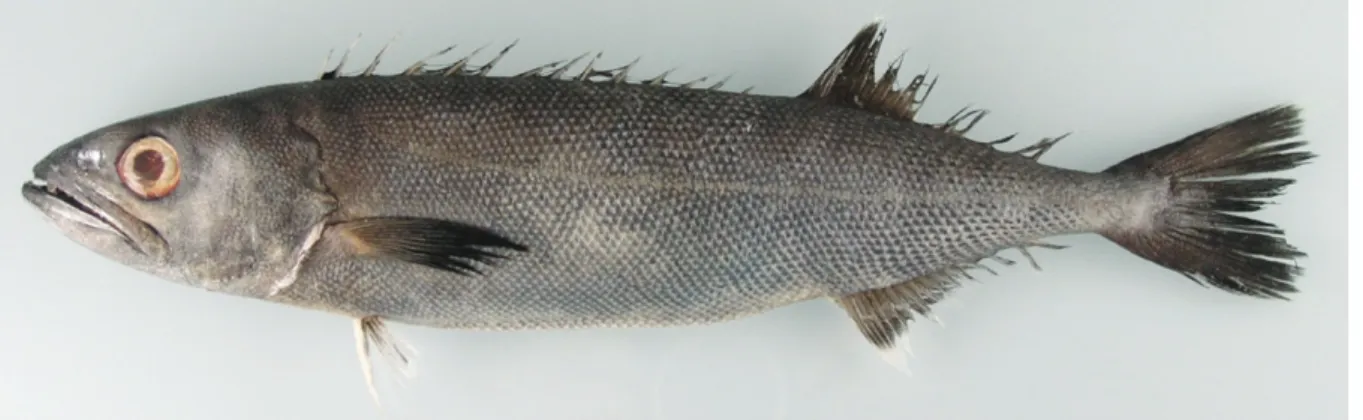
XIII~XV, 16~20+2 13~15 II, 15~17+2I, 5 Fig. 1. Ruvettus pretiosus, JNU-1128, 238.3mm standard length(SL), gill net, Hallim-eup, Jeju-do, Korea, 28 November, 2013.
depth, 20.7~21.5; body width, 9.6~9.7; head length, 29.4~30.5; upper jaw, 15.6~15.9; snout length, 9.5~
10.0; eye dimeter, 5.3~5.6; interorbital width, 6.7~7.6;
predorsal fin, 23.9~27.3; prepectoral fin length, 28.6~
29.5; preanal fin length, 68.3~69.8; length of longest dorsal fin ray, 10.0~11.1; pectoral fin length, 14.9~16.7;
length of longest anal fin ray, 9.4~10.6; caudal peduncle length, 6.3~6.8; caudal peduncle depth, 4.5~50; caudal peduncle width, 3.4~3.9; length of dorsal fin base, 62.9~
64.1; length of pectoral fin base, 3.4~3.5; length of anal fin base, 18.4~19.1.
Body fusiform, slightly compressed; body covered with cycloid scales, interspaced with rows of sharp bony tu- bercles; lateral line singe, nearly straight; dorsal profile of head sloping gently; head large, 3.3~3.5 in body length, interorbital space slightly concave; parietal region semi- transparent; mouth large, posterior of upper jaw extend- ing backward slightly beyond posterior margin of eye;
eye large, circular; a single series of canine-like teeth on both jaws and four fangs on front of upper jaw; teeth on palatine conical, uniserial; two dorsal, dorsal spinous fin started above at upper preopercle; pectoral fin moderate- ly, reached at seventh dorsal spins; pelvic fin short; dor- sal and anal soft rays opposite each, anal origin slightly behind a vertical from origin of soft dorsal fin; last two dorsal and anal fin is separated as finlets, respectively;
belly-keeled between pelvic fin and anus; no keels on caudal peduncle; caudal fin widely forked.
Color when fresh. Body and head entirely dark brown;
pelvic fin white; soft dorsal fin black with posterior mar- gin white; caudal fin black with tip of forked fin white.
Color after preservation. Body entirely pale brown;
pectoral fin black; soft dorsal fin brown with posterior margin white; caudal fin dark brown with tip of forked fin white.
Distribution. Widely distributed in tropical and tem- perate waters of the world (Nakamura and Parin, 1993).
In Korea, it occurs around Jejudo Island (present study).
Remarks. The present specimens belonging to the family Gemphylidae are characterized by having caudal peduncle without keel, a single line obscure, belly keeled between pelvic fin and anus, scales cycloid with bony tubercles. After the morphological characteristics of pres- ent specimen were compared with those in the previous report on R. pretiosus (Nakamura and Parin, 1993; Table 1), our specimens were identified as R. pretiosus base on the morphological characters. Although we could not compared our measured meristic counts with original de- scription lacking the data on counts, meristic characters of the present specimens corresponded well with the pre-
vious reports shown in Table 1, except for the number of anal fin spines (II in present study and Nakabo, 2002 vs. I in Machidae, 1985). This difference seems to be intraspe- cific variation, but it needs further studies on geographic variation of the species with more specimens. In addition, we adopted molecular identification method based on COI DNA sequences to make sure of the accurate species identification. The result indicated that COI sequences of present specimens were almost identical (99.6~100.0%) to those of R. pretiosus from NCBI (data not shown).
In Korea, R. pretiosus can be easily distinguished from the other three species (Thyrsitoides marleyi, Rexea prometheoides and Gempylus serpens) by having belly keeled between pelvic fin and anus (vs. none for three species) and scales cycloid with bony tubercles (vs. none) (Nakabo, 2002). Also, R. pretiosus is morphologically very similar to Lepidocybium flavobrunneum, but the former is distinguishable from the latter by the shape of keel (a prominent keel for R. pretiosus vs. two small sup- plemental keels for L. flavobrunneum), dorsal fin spines (more than XII vs. VIII~IX) and lateral line (obscure vs.
sinuous) (Nakamura and Parin, 1993). When the Korean name for R. pretiosus was given, we used “Gi-reum-chi”
which was previously suggested by Yamada et al. (2009).
ACKNOWLEDGMENTS
This research was supported by the 2017 scientific pro- motion program (to C.B. Song) by Jeju National Univer- sity.
REFERENCES
Bilecenoglu, M., E. Taskavak, S. Mater and M. Kaya. 2002. Check- list of the marine fishes of Turkey. Zootaxa, 113: 1-194.
Bleeker, P. 1856. Beschrijvingen van nieuwe en weinig bekende vischsoorten van Amboina, verzameld op eene reis door den Molukschen Archipel, gedaan in het gevolg van den Gouverneur Generaal Duymaer van Twist, in September en Oktober 1855. Acta Societatis Regiae Scientiarum Indo- Neêrlandicae, 1: 42-44.
Chang, C.H., K.T. Shao, H.Y. Lin, Y.C. Chiu, N.Y. Lee, S.H. Liu and P.L. Lin. 2016. DNA barcodes of the native ray-finned fishes in Taiwan. Mol. Ecol. Resour., 17: 796-805.
Cocco, A. 1833. Cenni sul genere Ruvettus e sui caratteri che lo dis- tinguone. Osservationes Peloritani, 8: 18.
Cuvier, G. 1829. Le Règne Animal, distribué d’après son organisa- tion, pour servir de base à l’histoire naturelle des animaux et d’introduction à l’anatomie comparée. Edition 2, 2: i-xv+
1-406.
Eschmeyer, W.N. and E.S. Herald. 1983. A field guide to Pacific Coast fishes of North America from the Gulf of Alaska to Baja California. Peterson Field Guide Series. No. 28.
Houghton-Mifflin Co., Boston. i-xii+1-336, Pls. 1-48.
Fowler, H.W. 1929. New and little-known fishes from the Natal coast. Annals of the Natal Museum, 6: 245-264.
Froese, R. and D. Pauly(Editors). 2016. Fishbase. World Wide Web electronic publication. www.fishbase.org. version(01/2016).
Hubbs, C.L. and K.F. Lagler. 2004. Fishes of the Great Lake region.
University of Michigan press, Ann Arbor, 332pp.
Machida, Y. 1985. Fishes of the Okinawa through and the Adjacent Waters II. In: Okamura, O., Y. Machida, T. Yamakawa, K.
Matsuura and T. Yatou(eds.), Japan Fisheries Resource Conservation Association, Tokyo, 781pp.
McAllister, D.E. 1990. A list of the fishes of Canada. Syllogeus, 64:
1-310.
Moore, J.A., K.E. Hartel, J.E. Craddock and J.K. Galbraith. 2003.
An annotated list of deepwater fishes from off the New England region, with new area records. Northeastern Natu- ralist, 10: 159-248.
Mundy, B.C. 2005. Checklist of the fishes of the Hawaiian Archi- pelago. Bishop Museum Bulletins in Zoology, 6: 1-703.
Myoung, S.H., J.H. Ryu and J.K. Kim. 2013. New record of the
snake mackerel. Gempylus serpens(Perciformes: Gempyli- dae) from Jeju Island, Korea. Korean J. Ichthyol., 25: 178- 181.
Nakabo, T. 2002. Gempylidae, Nakabo(ed.), Fishes of Japan with pictorial keys to the species, English edition, Tokai Univ.
Press, Tokyo, pp. 1338-1341.
Nakamura, I. and N.V. Parin. 1993. FAO Species Catalogue. Vol. 15.
Snake mackerels and cutlassfishes of the world(families Gemylidae and Trichiuridae. FAO Fish. Synop., 125, 136pp.
Nelson, J.S. 2006. Fishes of the world. 4th ed. John Wiley & Sons, New York., i-xix+1-601.
Pakhorukov, N.P. 1999. Observations of deep-sea fishes from sub- mersibles in the Sierra Leone Rise area(Atlantic Ocean).
Voprosy Ikhtiologii, 39: 653-660.
Paulin, C.D., A. Stewart, C.D. Roberts and P.J. McMillan. 2001.
New Zealand fish a complete guide. National Museum of New Zealand Miscellaneous Series. No. 19: i-xiv+1-279, 8 pls.
Yamada, U.K., K. Tokimura, K. Hoshino, S. Deng, Y. Zheng, S. Li., Y.S. Kim and J.K. Kim. 2009. Names and illustrations of fishes from the East China Sea and the Yellow Sea, -Japa- nese·Chinese·Korean-. Overseas Fishery Cooperation of Japan, Tokyo, 784pp.
한국산 갈치꼬치과 어류 1미기록종, Ruvettus pretiosus
김병엽
·
송춘복제주대학교 해양과학대학
요 약 :
갈치꼬치과에 속하는 Ruvettus pretiosus 2개체(표준 체장 227.0mm와 238.3mm)가 2013년 11월에 제주도 연안에서 자망으로 처음 채집되었다. 이 종의 특징은 등지느러미 기조수 XV, 17~19+2개를 갖는 점, 뒷지느
러미 기조수 Ⅱ, 15~16+2개를 갖는 점, 거의 직선인 한 개의 측선을 갖는 점, 그리고 배지느러미와 항문 사이에 융
기선이 있다는 점이다. 이 종은 우리나라에서 서식하는 갈치꼬치과 어류 3종(갈치꼬치, 통치 및 세장갈치꼬치)과
배지느러미와 항문 사이에 융기선이 있는 점(3종은 융기선 없음)과 둥근 비늘이 날카로운 관 사이에 널리 퍼져 있
는 점(3종은 피부가 매끈함)으로 쉽게 구분할 수 있다. 이 미기록종의 속명과 국명은 각각 “기름치속”과 “기름치”
로 제안한다.