INTRODUCTION
The family Congridae of the order Anguilliformes is widely distributed throughout the world, with 194 species in 30 genera recognized worldwide (Nelson, 2016). Ten species in seven genera occur in Korea (NIBR, 2011) and 25 species in 13 genera in Japan (Hatooka, 2013). The family Congridae is characterized by a lack of scales on the whole body (Masuda, 1984), a well-developed bran- chial aperture, the presence of pectoral and caudal fin, anterior nostrils located at the tip of the snout, and pos- terior nostrils located on the upper lip (Asano, 1962).
Within the family, three species of the genus Ariosoma Swainson, 1838 occur in Korea (A. anagoides, A. major, A. shiroanago) (Kim et al., 2005; NIBR, 2011), five spe- cies in Taiwan (Ho, 2015), and four species in Japan (Ha- tooka, 2013). The genus Ariosoma is characterized by a pointed snout, nostrils forming an elevated tubercle, the origin of the pectoral fin located before or just below the origin of the dorsal fin, the dorsal and anal fin connected to the caudal fin, a brownish body, and a reddish pecto- ral fin (Swainson, 1838). We describe the morphological characteristics of Ariosoma meeki collected from Korea and suggest its Korean name.
MATERIALS AND METHODS
On June 10, 2015, a single specimen of A. meeki (Jordan and Snyder, 1900) was collected for the first time in Jin- hae-gu, Changwon-si, Gyeongsangnam-do, Korea. The morphological characteristics of A. meeki are described based on this specimen. Its identification was according to Toshio (2002) and Hatooka (2013). Counts and mea- surements were made with digital Vernier calipers ac- cording to Smith (2003), and rounded to 0.1 mm. The fin rays and vertebrae were counted with radiography (Sehwa Medical System SMS-CM, Korea) and the specimen was deposited in the Ichthyology Laboratory Collection, Pu- kyong National University (PKU).
Ariosoma meeki (Jordan and Snyder, 1900) (Fig. 1)
(Korean name: nun-te-bung-jang-eo)
Congrellus meeki Jordan and Snyder, 1900: 347 (type lo- cality: Tokyo Bay, Japan).
Ariosoma meeki: Yamada et al., 2009: 78 (East China Sea); Hatooka, 2013: 279 (Japan); Shinohara et al., 2014: 236 (Japan).
Materials. PKU 12278, one specimen, 485.2 mm in total length (TL), Jinhae-gu, Changwon-si, Gyeongsang- nam-do, Korea, 10 June 2015, collected by Jin-Koo Kim,
—121 — http://www.fishkorea.or.kr
* Corresponding author: Jin-Koo Kim Tel: 82-51-629-5927, Fax: 82-51-629-5931, E-mail: [email protected]
Korean Journal of Ichthyology, Vol. 28, no. 2, 121-124, June 2016 ISSn: 1225-8598(Print), 2288-3371(online)
received: May 19, 2016 revised: June 23, 2016 accepted: June 26, 2016
New Record of Ariosoma meeki (Anguilliformes: Congridae) from Korea
By Sooeun Yeo and Jin-Koo Kim*
Department of Marine Biology, Pukyong National University, Yongso-ro 45, Nam-gu, Busan 48513, Korea
ABSTRACT
A single specimen of Ariosoma meeki, belonging to the family Congridae, was collected for the first time from Jinhae-gu, Changwon-si, Gyeongsangnam-do, Korea, on June 10, 2015. Ariosoma
meeki is characterized by an absence of scales on its whole body, dorsal and anal fin connected tothe caudal fin, blackish margins of the dorsal and anal fin, posterior nostrils not covered with a dermal flap, 60 preanal lateral-line pores, 15 pectoral fin rays, no cephalic sensory pore between the interorbital region and dorsal fin origin, and two dark brown dots behind the eyes. We described it as the new Korean record, and proposed the Korean name “nun-te-bung-jang-eo” for this species A. meeki.
Key words: New record, Ariosoma meeki, Congridae, Korea
122 Sooeun yeo and Jin-Koo Kim
fish trap.
Description. Counts and measurements are shown in Table 1.
Body elongated (Fig. 1). Dorsal fin and anal fin clearly connected with caudal fin, pectoral fin present but pelvic fin absent, origin of dorsal fin behind pectoral fin; anus located in front of anal fin and in the middle of the body;
60 preanal lateral-line pores; upper jaw slightly longer than lower jaw; upper and lower lips with well-defined
upturned labial flange; tubular anterior nostril located on tip of snout, small and elliptical posterior nostril located in front of eye at mid-eye level; teeth anteriorly arranged in narrow band on maxillary and mandibular; no sensory pores between the interorbital region and dorsal fin origin.
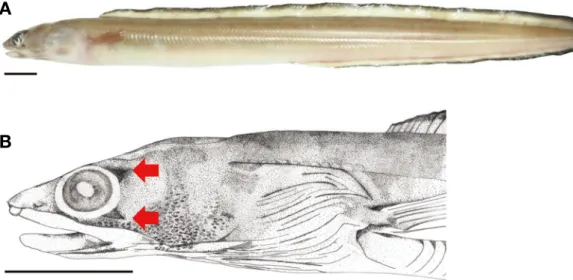
Color. When fresh, dorsal part brown; ventral region whitish; pectoral fin reddish; margins of the dorsal and anal fin blackish, but tip of caudal fin not black; head brown with small dots but not on lips; two dark brown
Table 1. Comparison of the morphological characters of Ariosoma meeki
Present study Jordan & Snyder(1900) Toshio(2002) Hatooka(2013)
Total length(TL, mm) 485.2 530.0 382.6 -
Counts Pectoral fin rays Preanal lateral line pores Vertebrae
Dorsal+upper caudal fin Anal+lower caudal fin
15 60 156222 165
- - - - -
15 60 153232 159
12~16 58~64 149~159
- - Measurement(% of TL)
Head length Body depth Body width Predorsal length Preanal length Trunk length Eye diameter Interorbital width Snout length Upper jaw length Pectoral fin length Snout to anterior nostril Snout to posterior nostril
16.0 7.0 5.0 17.249.3 31.5 3.4 3.2 3.1 5.3 5.8 0.8 2.5
15.4 6.2 - - - - - 3.1- 5.5- - -
15.8 6.8 5.8 17.649.0 32.3 2.9 2.4 2.9 4.9 5.4 1.0 2.5
- - - - - - - - - - - - - Fig. 1. The photograph(A) and illustration(B) of Ariosoma meeki, PKU 12278, 485.2mm TL. Scale bar: 30mm. Arrows indicated dark brown dots on upper and lower part just behind eye.
A
B
occurrence of Ariosoma meeki in Korea 123
dots behind the eye. After fixation, body and head overall dark beige; all fins opaque, margins of dorsal and anal fin blackish, tip of caudal fin not black, pectoral fin light brown.
Distribution. Indo-western Pacific: Jin-hae in Korea (pre sent study), Japan (Hatooka, 2013), and Peng-hu Is- lands in Taiwan (Chen, 2004).
Remarks. The present specimen was identified as be- longing to the genus Ariosoma Swainson, 1838 by its moderately stout body, its dorsal fin inserted near the lev- el of the pectoral fin base, a preanal length greater than 40% of total length, a small anterior nostril located on the snout, and a posterior nostril located below the mid axis of the eye, with no covering dermal flap (Shen, 1998). It was identified as A. meeki by its lack of sensory pores on the head, 15 pectoral fin rays, 60 preanal lateral-line pores, and 156 vertebrae (Toshio, 2002; Hatooka, 2013). The morpholog ical characteristics of this specimen correspond to those of the original description by Jordan and Snyder (1900). However, there are some differences between the present specimen and that described by Toshio (2002);
e.g., the eye diameter and interorbital width of the pres- ent speci men are slightly larger than those of Toshio’s specimen (2002) (Table 1). This may be attributable to ontogenetic changes or geographic variations. To clarify these differences between the Korean and Japanese spec- imens, further research is required based on more speci- mens. Ariosoma meeki is distinguishable from the conge- neric species, A. anagoides and A. major, by the number of vertebrae (156 in A. meeki vs 143 in A. anagoides vs 144~147 in A. major) and the number of preanal lateral- line pores (60 in A. meeki vs 53~54 in A. anagoides vs 51~53 in A. major) (Masuda, 1984). Ariosoma meeki also differs from A. shiroanago in the number of pectoral fin rays (15 in A. meeki vs 11~13 in A. shiroanago) (Asa- no, 1958). In this study, we identified our specimen as A.
meeki based on its morphological characters, and propose the Korean name “nun-te-bung-jang-eo” for this species, following Yamada et al. (2009).
ACKNOWLEDGMENTS
The authors are grateful to anonymous reviewers for valuable advice and suggestions for improvement of the paper. This research was supported by the project on In- stitute of Marine Bio-resources of Marine-Bio Technolo- gy Programme under the Ministry of Oceans and Fisher- ies, Korea.
REFERENCES
Asano, H. 1958. Studies on the conger eels of Japan. I. Description of two new subspecies referable to the genus Alloconger.
Zool. Meg., 67: 191-196.(in Japanese)
Asano, H. 1962. Studies on the congrid eels of Japan. Bull. Misaki Mar. Biol. Inst. Kyoto Univ., 1: 1-143.
Chen, C. 2004. Checklist of the fishes of Penghu. Special Publica- tion of Fisheries Research Institute, 4: 1-175.
Hatooka, K. 2013. Congridae. In: Nakabo, T.(ed.), Fishes of Japan with pictorial keys to the species. 3rd ed. Tokai Univ. Press, Kanagawa, pp. 279-287.(in Japanese)
Ho, H.-C., D.G. Smith, J.E. McCosker, Y. Hibino, K.-H. Loh, K.
Tighe and K.-T. Shao. 2015. Annotated checklist of eels (orders Anguilliformes and Saccopharyngiformes) from Taiwan. Zootaxa, 4060: 140-189.
Jordan, D.S. and J.O. Snyder. 1900. List of fishes collected in Japan by Keinosuke Otaki, and by the United States steamer Al- batross, with descriptions of fourteen new species. Proc. US Natl. Mus., 23: 335-380.
Kim, I.S., Y. Choi, C.L. Lee, Y.J. Lee, B.J. Kim and J.H. Kim. 2005.
Illustrated book of Korean fishes. Kyohak Publishing Co.
Seoul, p. 90.(in Korean)
Masuda, H., K. Amaoka, C. Araga, T. Uyeno and T. Yoshino. 1984.
The fishes of the Japanese Archipelago. Tokai Univ. Press., Tokyo, p. 27.
Nelson, J.S. 2016. Fishes of the world. 5th ed. John Wiley and Sons, Inc., Hoboken, NJ, pp. 147-148.
NIBR(National Institute of Biological Resources). 2011. National list of species of Korea. Vertebrate Natl. Inst. Biol. Res., Incheon, p. 22.(in Korean)
Shen, S.C. 1998. A review of congrid eels of the genus Ariosoma from Taiwan, with description of a new species. Zool. Stud., 37: 7-12.
Shinohara, G., M. Nakae, Y. Ueda, S. Kojima and K. Matsuura.
2014. Annotated checklist of deep-sea fishes of the Sea of Japan. National Museum of Nature and Science Mono- graphs, 44: 225-291.
Smith, D.G. and E.S. Karmovskaya. 2003. A new genus and two new species of congrid eels(Teleostei: Anguilliformes:
Congridae) from the Indo-west Pacific, with a redescription and osteology of Chiloconger dentatus. Zootaxa, 343: 1-19.
Swainson, W. 1838. The natural history and classification of fishes, amphibians, and reptiles, or monocardian animals. Long- mans, London, 1: 220.
Toshio, K., I. Hisashi, I. Yoshio and N. Kazuhiro. 2002. Records of a conger eel, Ariosoma meeki(Anguilliformes) and a berycid, Beryx decadatylus(Beryciformes), from the Pacific coast of Aomori prefecture, northern Japan. Bull Fish Sci.
Hokkaido Univ., 53: 83-86.
Yamada, U., K. Hoshino, M. Tokimura, S. Deng, Y. Zheng, S. Li, Y.S. Kim and J.K. Kim. 2009. Names and illustrations of fishes from the East China Sea and the Yellow Sea. Overseas Fishery Cooperation Foundation, Tokyo, JP, p. 78.
124 Sooeun yeo and Jin-Koo Kim
한국산 붕장어과 어류 1 미기록종, Ariosoma meeki
여수은
·
김진구부경대학교 자원생물학과
요 약 :
뱀장어목 붕장어과에 속하는 Ariosoma meeki 1개체(전장 485.2mm)가 2015년 6월 경상남도 창원시에서 처음으로 채집되었다. 본 종은 몸 전체에 비늘이 없고, 등지느러미와 뒷지느러미가 꼬리지느러미와 연결되어 있
으며, 후비공이 피판으로 덮여 있고, 60개의 항문 전 측선공 및 15개의 가슴지느러미 연조를 가지며, 두부에 감각공
이 없고, 눈 뒤쪽에 2개의 검은 점을 가진다. 한국에서 새롭게 보고되는 A. meeki의 국명으로 “눈테붕장어”를 제안
한다.