INTRODUCTION
The family Monacanthidae of the order Tetraodonti
formes is widely distributed throughout the world, with 107 species in 28 genera(Nelson et al., 2016). There are 31 species in 17 genera in Japan(Hagiwara and Hayashi, 2013), and 12 species in 9 genera in Korea(Kim, 2011).
The monacanthid fishes are characterized by oval to circular compressed body, tough skin covered in rough spines, two dorsal spines; the second spine is usually much smaller than first it(Matsuura, 2015; Nelson et al., 2016). In the western Pacific, the genus Thamnaconus Smith, 1949 is represented by five species: T. fijiensis (Hutchins and Matsuura, 1984), T. hypargyreus(Cope, 1871), T. modestus(Günther, 1877), T. modestoides(Bar
nard, 1927), and T. tessellatus(Günther, 1880)(Hutchins, 2001b). Of them, two species, T. modestus and T. hypar- gyreus had reported in Korea. The genus Thamnaconus
is characterized by fully erected first dorsalfin spine(not enveloped in a loose, prominent flap of skin), pelvic fin rudiment moderate and located at posterior end of pelvis, body depth equal to or greater than length of head length, second dorsal fin rays 31 to 41, anal fin rays 26 to 37 (Hutchins and Matsuura, 1984). The fishes of the genus Thamnaconus are poorly known because of their gener
ally deepwater habitats between 72~248m(Hutchins, 2001a) and normally on the trawling grounds(Peristi
wady, 2008).
A single specimen(273.1mm in standard length) hav
ing many dark brown dots that looked like T. hypargyreus by oneboat trawl from western Jeju Island in Korea.
The specimen was identified as Thamnaconus tessellatus (Günther, 1880), based on many darkbrownish spots on the head and body, blackish caudal fin, gill opening be
low the middle of the eye, and small and fixed pelvic spine. Brief morphological characters and Korean name of this species using Japanese samples were previously described by Yamada et al.(1995), subsequently Yamada et al.(2009). This is the first record of T. tessellatus in
—277 — http://www.fishkorea.or.kr
* Corresponding author: JinKoo Kim Tel: 82516295927, Fax: 82516295931, Email: [email protected] ISSn: 1225-8598(Print), 2288-3371(online)
accepted: December 5, 2017
First Record of a Filefish, Thamnaconus tessellatus
(Monacanthidae: Tetraodontiformes) from Jeju Island, Korea
By Jeong-Ho Park, Seo Ha Jang, Do Gyun Kim
1, Jae-Mook Jeong
2, Sukyung Kang and Jin-Koo Kim
3,*
Fisheries Resource Research Division, National Institute of Fisheries Science(NIFS), Busan 46083, Republic of Korea
1Department of Seafood and Aquaculture Science, Gyeongsang National University, Gyeongnam 53064, Republic of Korea
2Fisheries Resources Research Center, National Institute of Fisheries Science, Gyeongnam 53064, Republic of Korea
3Department of Marine Biology, Pukyong National University, Busan 48513, Republic of Korea
ABSTRACT A single specimen(273.1mm in standard length) of the monacanthid Thamnaconus tessellatus was caught by oneboat trawl from western Jeju Island and then collected at Busan Cooperative Fish Market(BCFM) on 30 May 2015. The specimen is characterized by both head and body with many dark brown spots densely, posterior margin of caudal fin no black, first dorsal spine originates the posterior half of eye, and 34~37 dorsal fin rays. This is the first record of T. tessellatus in Korea; we therefore add the species to the Korean fish fauna. According to the Yamada et al.(1995), we propose the Korean name,
“Nambyeoljwichi” for this species.
Key words: Monacanthidae, Thamnaconus tessellatus, deep-water leatherjacket, new Korean record, Jeju Island
Korean waters. We therefore add the species to the Ko
rean fish fauna. Methods of counts and measurements follow those of Hutchins(1977) with a vernier caliper to the nearest 0.1mm. This specimen was deposited in the Fisheries Resources Management Division in National Institute of Fisheries Science(NIFS), Korea.
Thamnaconus tessellatus(Günther, 1880) (Korean name: Nambyeoljwichi)
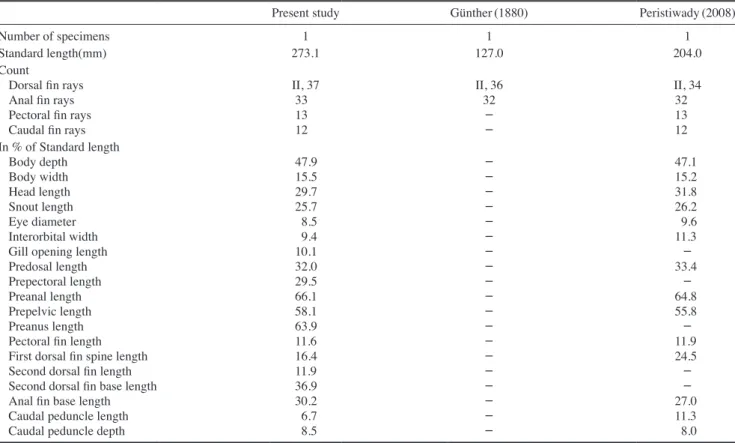
(Fig. 1; Table 1)
Monacantus tessellatus Günther, 1880: 54(Type locality:
Challenger station 204, Philippines).
Thamnaconus tessellatus(Günther, 1880): Matsuura and Tyler, 1997: 193(New Caledonia); Randall and Lim, 2000: 648(South China Sea); Hutchins, 2001a: 48 (western Australia); Hutchins, 2001b: 3947(western Central Pacific); Peristiwady, 2008: 41(Indonesia);
Larson et al., 2013: 235(northern Australia); Hagiwara and Hayashi, 2013: 1716(Japan); Matsuura, 2015: 84 (western Pacific and southeastern Indian Ocean).
Material examined. NIFS00002, single specimen, 273.1 mm in standard length(SL), western Jeju Island, 30 May 2015, oneboat trawl, collected by D.G. Kim.
Description. Counts and measurements are shown in Ta
ble 1. Body compressed and moderately deep(depth 2.09 in SL and width 6.46 in SL); mouth small and terminal without fleshy libs; snout long; profile of snout slightly concave; teeth almost exposed; gill slit and origin of pec
toral fin below the middle of the eye; eye large and locat
ed dorsally; first dorsal spine very strong and moderate (1.94 in head length), originating posterior half of the eye; pelvic fin rudiment nonmobile, projecting promi
nently rearward of ventral flap; dorsal and anal fin rays moderately elevated anteriorly; anus located before of the origin of the anal fin; posterior of caudal fin rounded and rays thick; skin coarse, without scales.
Color of specimen. Head and body covered with many darkbrown spots, those on the body slight bigger than them on the head; first spine on dorsal fin blackish; dor
sal and anal fin rather bright; caudal fin blackish. No col
oration change after fixation with formalin and alcohol.
Distribution. Western Pacific; Jeju Island, Korea(pres
ent study), Japan(Hagiwara and Hayashi, 2013), China (Randall and Lim, 2000), Philippines(Günther, 1880), Indonesia(Peristiwady, 2008), New Caledonia(Matsuura and Tyler, 1997), and Australia(Hutchins, 2001a; Larson et al., 2013).
Remarks. The present monacanthid specimen was eas
ily identified Thamnaconus tessellatus on the basis of by many darkbrown spots on the side of the body, first dorsal spine originating posterior half of the eye, black
ish caudal fin with no spots. Counts and measurements of this specimen well correspond with those of previous descriptions by two authors(Table 1). Comparing with two species, T. modestus and T. hypargyreus, of genus Thamaconus in Korean waters, this species most resem
bles the latter. In addition, two species have been con
fused(e.g. Okamura et al., 1985 and Yoon, 2002). Both are similar in having many spots on the body, however,
Fig. 1. Thamnaconus tessellatus(Günther, 1880), NIFS00002, 273.1mm SL, western Jeju Island, Korea.
the number of spots are greater in T. tessellatus than in T. hypargyreus. The coloration of spots in fresh speci
men has dark brown in T. tessellatus and dark yellow or yellowish brown in T. hypargyreus. Also, T. tessellatus differs from T. hypargyreus in the color pattern of head;
T. tessellatus has dark brown spots on the snout, whereas, T. hypargyreus has no spots on the snout but has longitu
dinal blue lines on the snout(Matsuura and Tyler, 1997;
Hagiwara and Hayashi, 2013). We add the species to the Korean fish fauna and follow “Nambyeoljwichi” pro
vided by Yamada et al.(1995) for a Korean name of T.
tessellatus.
ACKNOWLEDGMENTS
This study was funded by a grant from National Insti
tute of Fisheries Science(NIFS)(No: R2017035), Korea.
REFERENCES
Barnard, K.H. 1927. Diagnoses of new genera and species of South African marine fishes. Ann. Mag. Nat. Hist. 9, 20: 66-79.
Cope, E.D. 1871. Contribution to the ichthyology of the Lesser An
tilles. Trans. Amer. Philos. Soc.(new ser.), 14: 445483.
Günther, A. 1877. Preliminary notes on new fishes collected in Ja
pan during the expedition of H. M.S. Challenger. Ann. Mag.
Nat. Hist.(Ser. 4), 20: 433446.
Günther, A. 1880. Report on the shore fishes procured during the voyage of H.M.S. Challenger in the years 18731876. In:
Report on the scientific results of the voyage of H. M. S.
Challenger during the years 187376. Zool., 1: 182.
Hagiwara, K. and M. Hayashi. 2013. Family Monacanthidae. In:
Nakabo, T.(ed.), Fishes of Japan with pictorial keys to the species, 3rd ed. Tokai Univ. Press, Kanagawa, pp. 1712
1721.(in Japanese)
Hutchins, J.B. and K. Matsuura. 1984. Description of a new mo
nacanthid fish of the genus Thamnaconus from Fiji. Rec.
West. Aust. Mus., 11: 38739l.
Hutchins, J.B. 1977. Descriptions of three new genera and eight new species of monacanthid fishes from Australia. Rec. West.
Aust. Mus., 5: 313.
Hutchins, J.B. 2001a. Checklist of the fishes of Western Australia.
Rec. Wes. Aus. Mus. Suppl., 63: 950.
Hutchins, J.B. 2001b. Family Monacanthidae. In: Carpenter, K.E.
and Niem, V.H.(eds), Species identification guide for fish
ery purposes. The living marine resources of the western central Pacific. Bony fishes part 4(Labridae to Latimerii
dae), estuarine crocodiles, sea turtles, sea snakes and ma
rine mammals. FAO, Rome, pp. 33814218.
Table 1. Comparison of meristic and morphometric characters of T. tessellatus
Present study Günther(1880) Peristiwady(2008)
Number of specimens 1 1 1
Standard length(mm) 273.1 127.0 204.0
Count
Dorsal fin rays II, 37 II, 36 II, 34
Anal fin rays 33 32 32
Pectoral fin rays 13 - 13
Caudal fin rays 12 - 12
In % of Standard length
Body depth 47.9 - 47.1
Body width 15.5 - 15.2
Head length 29.7 - 31.8
Snout length 25.7 - 26.2
Eye diameter 8.5 - 9.6
Interorbital width 9.4 - 11.3
Gill opening length 10.1 - -
Predosal length 32.0 - 33.4
Prepectoral length 29.5 - -
Preanal length 66.1 - 64.8
Prepelvic length 58.1 - 55.8
Preanus length 63.9 - -
Pectoral fin length 11.6 - 11.9
First dorsal fin spine length 16.4 - 24.5
Second dorsal fin length 11.9 - -
Second dorsal fin base length 36.9 - -
Anal fin base length 30.2 - 27.0
Caudal peduncle length 6.7 - 11.3
Caudal peduncle depth 8.5 - 8.0
Kim, B.J. 2011. Fish species of Korea. In: NIBR(ed.), National list of species of Korea: vertebrates. National Institution of Bi
ological Resources, Incheon, pp. 3189.(in Korean) Larson, H.K., R.S. Williams and M.P. Hammer. 2013. An annotated
checklist of the fishes of the northern Territory, Australia.
Zootaxa, 3696: 1293.
Matsuura, K. and J.C. Tyler. 1997. Tetraodontiform fishes, mostly from deep waters, of New Caledonia. In: B. Séret(ed.) Résultats des Campagnes Musorstom, vol. 17. Mém. Mus.
Natl. Hist. Nat., 174: 173208.
Matsuura, K. 2015. Taxonomy and systematics of tetraodontiform fishes: a review focusing primarily on progress in the period from 1980 to 2014. Ichthyol. Res., 62: 72113.
Nelson, J.S., T.C. Grande and M.V.H. Wilson. 2016. Fishes of the world, 5th ed. John Wiley & Sons Inc., New Jersey, 707pp.
Okamura, O., Y. Machida, T. Yamakawa, K. Matsuura and T. Yatou.
1985. Fishes of the Okinawa trough and the adjacent wa
ters. Japan Fisheries Resource Conservation Association, Tokyo, 781pp.
Peristiwady, T. 2008. Occurrence of deep-water leatherjacket fish
Thamnaconus tessellatus(Günther, 1880)(Tetraodonti
formes: Monacanthidae) from Bitung, Indonesia. J. Ikiologi Indonesia, 8: 4150.
Randall, J.E. and K.K.P. Lim. 2000. A checklist of the fishes of the South China Sea. Raffles Bull. Zool. Suppl., 8: 569-667.
Smith, J.L.B. 1949. The sea fishes of southern Africa. Central News Agency, Cape Town, 550pp.
Yamada, U., M. Tokimura, K. Hoshino, S. Deng, Y. Zheng, S. Li, Y.S. Kim and J.K. Kim. 2009. Names and illustrations of fishes from the East China Sea and the Yellow Sea, new ed.
Overseas Fishery Cooperation Foundation of Japan, Tokyo, 784pp.
Yamada, U., S. Shirai, T. Irie, M. Tokimura, S. Deng, Y. Zheng, C.
Li, Y.U. Kim and Y.S. Kim. 1995. Names and illustrations of fishes from the East China Sea and the Yellow Sea.
Overseas Fishery Cooperation Foundation of Japan, Tokyo, 288pp.
Yoon, C.H. 2002. Fishes of Korea with pictoral key and systematic list. Academy Book, Seoul, 747pp.
한국산 쥐치과 미기록종 , Thamnaconus tessellatus의 최초 보고
박정호
·
장서하·
김도균1·
정재묵2·
강수경·
김진구3국립수산과학원 연근해자원과, 1국립경상대학교 해양식품생명의학과,
2국립수산과학원 수산자원연구센터, 3국립부경대학교 자원생물학과
요 약 : 복어목 쥐치과에 속하는 Thamnaconus tessellatus 1개체(표준 체장 273.1mm)가 제주도 서쪽 해역에
서 외끌이중형저인망으로 어획되어 부산공동어시장에서 2015년 5월 30일에 채집되었다. 이 개체는 두부와 몸 모
두 암갈색 점이 밀집하여 분포하고 꼬리지느러미 말단이 검지 않으며, 등지느러미 첫 번째 극조가 눈 중앙의 뒤쪽
에서 시작하고 등지느러미 연조가 34~37개인 것이 특징이다. 우리나라에서 처음 보고되는 이 쥐치류의 국명으로
Yamada et al.(1995)에 따라 “남별쥐치”를 제안한다.
찾아보기 낱말 : 쥐치과, 남별쥐치, 심해 쥐치류, 한국 미기록종, 제주도