—129—
INTRODUCTION
A total of 22 species has been reported worldwide in the genus Carangoides Bleeker, 1851. This genus is characterized by having both jaws with a band of teeth and breast being naked ventrally to scaled completely (Lio and Shoa, 1999). In Korea, four species of Ca- rangoides have been reported so far. That is, C. dinema and C. uii were collected from Busan (Mori, 1952; Park et al., 2007), whereas C. ferdau and C. orthogrammus from Jeju Island (Yoo et al., 1995; Kim et al., 1999).
In this study, a single specimen of C. oblongus was firstly collected by a set net from the northern coastal waters of Jeju Island, Korea. The morphological chara- cters of C. oblongus were described and newly added to the Korean fish fauna.
Counts and measurements were followed by the me- thods of Gushiken (1983) and Hubbs and Lagler (1964).
The examined specimen was deposited at the Fish Gene- tics and Breeding Laboratory, Cheju National Univer- sity (CNU), Korea.
Carangoides oblongus (Cuvier, 1833) (New Korean name: Chae-jjik-yu-jeon-gaeng-i)
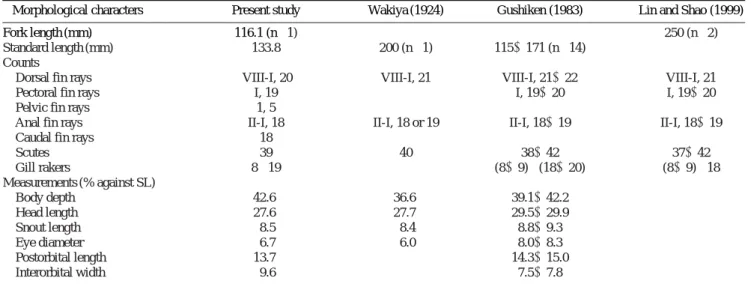
(Fig. 1; Table 1)
Caranx oblongus Cuvier in Cuvier and Valenciennes, 1833: 128 (type locality: Vaniclo, New Guinea).
Carangoides oblongus: Bleeker, 1852: 62 (Sumatra);
Fowler, 1928: 151 (Oceania); Shen et al., 1993: 335 (Taiwan); Lin and Shao, 1999: 54 (Taiwan); Fricke 1999: 246 (Mascarene Islands); Smith-Vaniz 1999:
2705 (Western Central Pacific); Smith-Vaniz in Ran- dall and Lim 2000: 616 (listed, South China Sea).
Carangichthys oblongus: Gushiken, 1983: 223 (Japan);
Gushiken in Masuda et al., 1984: 140 (Japan); Senou in Nakabo, 2002: 804 (Japan).
Material. CNU 20070815, one specimen, 133.8 mm in standard length (SL), Aewol-eup, Jeju-si, Jeju-do,
First Record of Carangid Fish, Carangoides oblongus (Carangidae, Perciformes) from Korea
By Maeng Jin Kim, Byung-Yeob Kim, Song-Hun Han, Chang Heon Lee and Choon Bok Song*
College of Ocean Sciences, Cheju National University, Jeju 690-756, Korea
ABSTRACT A single specimen of Carangoides oblongus (133.8 mm SL) belonging to the family Carangidae was firstly collected by a set net from the coastal waters of Jeju Island, Korea. This species resembles Carangoides dinema, but the former is morphologically distinguishable from the latter by lateral line being shorter than straight part, the number of lateral line scutes (37 ~ ~45 in C.
oblongus vs. 20~
~30 in C. dinema), second dorsal fin rays (20~ ~22 vs. 17~ ~19), and anal fin rays (18~ ~ 19 vs. 15~ ~17). We newly add this species to the Korean fish fauna and propose its new Korean name
“Chae-jjik-yu-jeon-gaeng-i”.
Key words : Carangoides oblongus, Carangidae, first record, Jeju Island, Korea
*Corresponding author: Choon Bok Song Tel : 82-64-754-3471, Fax : 82-64-756-3493 E-mail : [email protected]
KOREAN JOURNAL OF ICHTHYOLOGY, Vol. 20, No. 2, 129-132, June 2008 ISSN: 1225-8598
Received : March 29, 2008 Revised : June 23, 2008 Accepted : June 25, 2008
http://www.fishkorea.or.kr Fig. 1. Carangoides oblongus (Cuvier), CNU 20070815, 133.8 mm SL, Jeju Island, Korea.
130 Maeng Jin Kim, Byung-Yeob Kim, Song-Hun Han, Chang Heon Lee and Choon Bok Song
Korea, set net, about 15 m depth, 15 August 2007.
Description. Counts and measurements are shown in Table 1. Measurements are revealed as a percentage aga- inst standard length (SL): body depth 42.6; head length 27.6; snout length 8.5; eye dimeter 6.7; postorbital length 13.2; interobital width 9.6; upper jaw length 11.1;
first predorsal fin length 31.5; second predorsal fin length 46.4; prepectoral fin length 28.1; prepelvic fin length 30.7; preanal length 55.8; length of longest dorsal fin ray 43.8; length of longest pectoral fin ray 32.2; length of longest anal fin ray 35.0; length of curved lateral line scale 35.1; length of straight part of lateral line scale 40.2.
Body oblong, compressed; dorsal profile more convex than ventral profile; dorsal profile evenly and gently curving down from second dorsal fin to tip of snout;
orbit diameter smaller than snout length; both jaws with bands of small teeth; chord of curved part of lateral line shorter than straight part and straight part start from the eighth or ninth soft ray of second dorsal fin; first soft ray of both dorsal and anal fins much prolonged; length of longest dorsal fin ray longer than that of longest anal fin ray; breast naked ventrally to origin of pelvic fins;
laterally, naked area of breast separated from naked pectoral fin base by having a moderate to narrow band of scales (Fig. 2).
Color when fresh. Head and body bluish green above, silver below; small pale black blotches among second dorsal fin base; opercular spot diffuse; dorsal fin yellow with dusky dark posterior margin; pectoral, pelvic and anal fins yellow; upper lobe and posterior end of lower lobe of caudal fin dusky blue and the other region of caudal fin yellowish.
Color after preservation. Body pale brownish gray above, white ventrally; beneath eye brownish; pale
black blotches among second dorsal fin base; upper lobe of caudal fin darker; lower lobe pale ivory with a darker posteriorly; dorsal fin edged darker; pectoral fin, pelvic fin and anal fin pale ivory.
Distribution. Known from the Indo-West Pacific Ocean: Japan, Korea (present study) to Australia and eastward to the Fiji Islands (Simth-Vaniz, 1986; Smith- Vaniz, 1999).
Remarks. The morphological characteristics of the present specimen agreed well with those in the previous reports on C. oblongus. They included small pale black blotches between bases of second dorsal fin rays, curv- ed part of lateral line shorter than straight part (Smith- Vaniz, 1999; Senou, 2002), and counts (see Table 1).
However, the generic name Carangoides is still contro- versial. Gushiken (1984) and Senou (2002) used the
Table 1. Comparison of the morphological characters of Carangoides oblongus
Morphological characters Present study Wakiya (1924) Gushiken (1983) Lin and Shao (1999)
Fork length (mm) 116.1 (n==1) - - 250 (n==2)
Standard length (mm) 133.8 200 (n==1) 115~171 (n==14) -
Counts
Dorsal fin rays VIII-I, 20 VIII-I, 21 VIII-I, 21~22 VIII-I, 21
Pectoral fin rays I, 19 - I, 19~20 I, 19~20
Pelvic fin rays 1, 5 - - -
Anal fin rays II-I, 18 II-I, 18 or 19 II-I, 18~19 II-I, 18~19
Caudal fin rays 18 - - -
Scutes 39 40 38~42 37~42
Gill rakers 8++19 - (8~9)++(18~20) (8~9)++18
Measurements (% against SL)
Body depth 42.6 36.6 39.1~42.2 -
Head length 27.6 27.7 29.5~29.9 -
Snout length 8.5 8.4 8.8~9.3 -
Eye diameter 6.7 6.0 8.0~8.3 -
Postorbital length 13.7 - 14.3~15.0 -
Interorbital width 9.6 - 7.5~7.8 -
n: the number of specimens examined.
Fig. 2. Black parts indicate the naked area of breast.
First Record of Carangoides oblongus 131
genus Carangichthys instead of Carangoides because this group of fish has teeth on the ectopteryogid, which is unique to Carangichthys (Gushiken, 1983). In con- trast, many taxonomists have prevalently used Caran- goides rather than Carangichthys as a genus name (Smith- Vaniz, 1999; Lin and Shao, 1999). Thus, we used the genus Carangoides in this study, not Carangichthys.
Although this species resembles Carangoides dinema, it is distinguished from C. dinema by having the second dorsal fin with 20~22 soft rays (vs. 17~19 for C. dine- ma), anal fin with 18~19 soft rays (vs. 15~17), 37
~45 scutes (vs. 23~30), and longer straight part of lateral line than curved part (vs. straight part shorter than curved part) (Senou, 2002). We suggest a new Ko- rean name “Chae-jjik-yu-jeon-gaeng-i” for C. oblongus.
ACKNOWLEDGEMENTS
We thank Jeong-Ho Park, National Fisheries and Re- search and Development Institute, for providing useful references.
REFERENCES
Bleeker, P. 1851. Over eenige nieuwe geslachten en soorten van Makreelachtige visschen van den Indischen Archipel. Tijdschr. Neder. Indië, 1: 341-372.
Bleeker, P. 1852. Bijdrage tot de kennis der Makreelachtige visschen van den Soenda-Molukschen Archipel.
Verh. Bat. Gen., 24: 93pp.
Cuvier, G. and A. Valenciennes. 1833. Histoire naturalle des poissons. F.G. Levrault, Paris, 9: xxix
++512pp.
Fowler, H.W. 1928. The fishes of Oceania. Mem. Bernice P. Bishop Museum, 10: iii
++540pp.
Fricke, R. 1999. Fishes of the Mascarene Islands (Re`union, Mauritius, Rodriguez): an annotated checklist, with descriptions of new species. Koetz. Scientific Books, Koenigstein, Theses Zoologicae, 31: 759pp.
Gushiken, S. 1983. Revision of the carangid fishes of Japan.
Galaxea, Publ. Sesoko Mar. Sci. Cent. Univ. Ryu- kyus, 2: 135-264.
Gushiken, S. 1984. Family Carangidae. In: Masuda, H., K.
Amaoka, C. Araga, T. Uyeno and T. Yoshino (eds.), The fishes of the Japanese archipelago. Takai Univ.
Press, Tokyo, pp. 153-158.
Hubbs, C.L. and K.F. Lagler. 1964. Fishes of the Great Laker Region. Bull. Granbrook Inst. Sci., 26: 19-27.
Kim, Y.U., Y.S. Kim, G. Ahn and J.K. Kim. 1999. New re- cords of the two carangid fishes (Perciformes, Caran- gidae) from Korea. Korean J. Ichthyol., 11: 17-22.
Lin, P.L. and K.T. Shao. 1999. A review of the carangid fishes (Family Carangidae) from Taiwan with descrip- tions of four new records. Zool. Stud., 38: 33-68.
Mori, T. 1952. Check list of the fishes of Korea. Mem.
Hyogo Univ. Agric., Biol. Ser., 1: 1-228.
Park, J.H., J.H. Kim, J.H. Moon and C.B. Kim. 2007. Three unrecorded marine fish species from Korean waters.
Ocean Sci. J., 42: 231-240.
Randall, J.E. and K.K.P. Lim. 2000. A checklist of the fishes of the South China Sea. Raffles Bull. Zool.
Suppl., 8: 569-667.
Senou, H. 2002. Carangidae. In: Nakabo, T. (ed.), Fishes of Japan with pictorial keys to the species, English edi- tion. Tokai Univ. Press, Tokyo, pp. 791-808.
Shen, S.C., S.C. Lee, K.T. Shao, H.C. Mok, C.H. Chen, C.C.
Chen and C.S. Tzeng. 1993. Fishes of Taiwan. Dept.
Zool., Nat. Taiwan Univ., xx
++960 pp. (in Chinese) Smith-Vaniz, W.F. 1986. Family No. 210: Carangidae. In:
Smith, M.M. and P.C. Heemstra (eds.), Heemstra Smith’s sea fishes. Springer-Verlag, Grahamstown, pp. 209-661.
Smith-Vaniz, W.F. 1999. Carangidae. Jacks and scads (also trevallies, queenfishes, runners, amberjacks, pilot- fishes, pampanos, etc.). pp. 2659-2756. In: Carpen- ter, K.E. and V.H. Niem (eds.), FAO species identifi- cation guide for fishery purposes. The living marine resources of the Western Central Pacific. Vol. 4.
Bony fishes part 2 (Mugilidae to Carangidae). Rome, FAO, pp. 2069-2790.
Wakiya, Y. 1924. The carangid fishes of Japan. Ann. Carne- gie Mus., 15: 139-244.
Yoo, J.M., S. Kim, E.K. Lee, W.S. Kim, C.S. Myoung and S.M. Lee. 1995. Marine Fishes around Cheju Island.
Hyunamsa, Seoul, 248pp. (in Korean)
132 Maeng Jin Kim, Byung-Yeob Kim, Song-Hun Han, Chang Heon Lee and Choon Bok Song
한국산 전갱이과 어류 1 미기록종, Carangoides oblongus
김맹진∙김병엽∙한송헌∙이창헌∙송춘복
제주대학교 해양과학대학 해양과학부
요 약 : 전갱이과에 속하는 Carangoides oblongus 1개체(표준체장 133.8 mm)가 제주연안의 정치망에서 처음 으로 채집되었다. 이 종은 형태적으로 C. dinema와 유사하지만 옆줄의 직선부가 곡선부보다 길고, 미병부의 옆 줄 위 모비늘 수, 등지느러미 연조 수 및 뒷지느러미 연조 수에서 차이를 나타내었으며, 이 미기록종의 신한국명 을 “채찍유전갱이”라고 명명하였다.
찾아보기 낱말 :전갱이과, 채찍유전갱이, 미기록종, 제주도