—178—
INTRODUCTION
The family Gempylidae belonging to order Perciformes consists of about 24 species and 16 genera in the World (Nelson, 2006), 10 species and 10 genera in Japan (Na- kabo, 2002), 2 species and 2 genera in Korea (Kim et al., 2012): Rexea prometheoides (Bleeker, 1856), Thyrsitoides marleyi (Fowler, 1929). They are distributed worldwide in the tropical and subtropical seas. This family is char- acterized by having very elongated and compressed body, strong teeth, rudimentary or no pelvic fin (Nakamura and Parin, 1993). In the family, the genus Gempylus contains single species (Gempylus serpens) worldwide. The genus Gempylus is characterized by having two lateral lines originating below first dorsal fin spine, rudimentary pel- vic fin and several finlets behind the dorsal and anal fins (Masuda et al., 1984).
In the present study, a single specimen of Gempylus serpens Cuvier, 1829 was collected from the coastal waters of Jeju Island, Korea, and we described the spec- ies as the first record based on specimen (Fig. 1). Counts and measurements followed Nakabo (2002) and the ver- tebrae were counted by radiograph (SOFTEX HA-100, Japan). The specimen is deposited at National Institute of Biological Resources (NIBR), Korea.
SYSTEMATIC ACCOUNTS
Genus Gempylus Cuvier, 1829
(New Korean genus name: Se-jang-gal-chi-ggo-chi-sok) Gempylus Cuvier, 1829: 200 (type species, Gempylus
serpens Cuvier, 1829).
Description. Body very elongated and compressed;
lateral line bifurcated; pelvic fin minute; maxillary large- ly hidden under the infraorbital membrane; lower jaw protruded than upper jaw. Only one species recognized worldwide (Matsubara and Iwai, 1952; Nakamura, 1986;
Nakamura and Parin, 1993).
Gempylus serpens Cuvier, 1829 (New Korean name: Se-jang-gal-chi-ggo-chi)
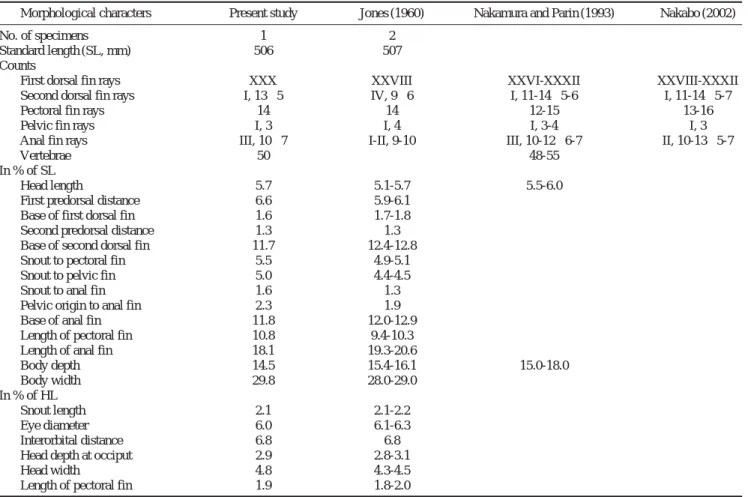
(Figs. 1, 2; Table 1)
Gempylus serpens Cuvier, 1829: 200 (type locality: Slo- ane); Jones, 1960: 85 (Laccadive sea); Nakamura and Parin, 1993: 27 (Rome); Nakabo, 2002: 1339 (Japan).
Material examined. NIBR-P0000020418, one speci- men, 506 mm in standard length (SL), with a bottom trawl, 127�72E, 33�34N, eastern sea of Jeju Island, Korea, 18 April 2013.
Description. First dorsal fin rays XXX; second dorsal fin rays II, 13++5; anal fin rays III, 10++7; pectoral fin rays 14; pelvic fin rays I, 3; vertebrae 50 (Table 1).
Body very elongated and compressed, body depth 14.5
New Record of the Snake Mackerel, Gempylus serpens (Perciformes: Gempylidae) from Jeju Island, Korea
By Se Hun Myoung, Jung-Hwa Ryu
1and Jin-Koo Kim*
Department of Marine Biology, Pukyong National University, 599-1 Busan 608-737, Korea
1RUMI, Busan 614-811, Korea
ABSTRACT A single specimen (506 mm SL) of Gempylus serpens, belonging to the family Gempyli- dae, order Perciformes, was firstly collected from Jeju Island, Korea in April 2013. This specimen was characterized by having the lower jaw protruded than upper jaw; three big fangs on upper jaw; five dorsal finlets and seven anal finlets; two lateral lines split at the dorsal origin, upper line interrupted at the end of the first dorsal fin, but lower line extend to the caudal fin base. The new Korean name “Se- jang-gal-chi-ggo-chi-sok” is proposed for the genus Gempylus, and “Se-jang-gal-chi-ggo-chi” for the species G. serpens.
Key words : Gempylus serpens, new record, Gempylidae, Korea, Jeju Island
*Corresponding author: Jin Koo Kim Tel: 82-51-629-5927, Fax: 82-51-629-5931, E-mail: [email protected]
KOREAN JOURNAL OF ICHTHYOLOGY, Vol. 25, No. 3, 178-181, September 2013 ISSN: 1225-8598 (Print), 2288-3371 (Online)
Received: June 20, 2013 Revised: September 16, 2013 Accepted: September 25, 2013
http://www.fishkorea.or.kr
% in standard length (SL); head length 5.7% in SL; eye large, located laterally, its length 6.0% in head length (HL); snout very long, its length 2.1% in HL; lower jaw
extruded than upper jaw; 3 fangs (2 fangs on right side and 1 fang on left side) on upper jaw; no fangs on lower jaw; single series of canine-like, small and compress
New Record of Gempylus serpens from Korea 179
Table 1. Comparison of counts and measurements of Gempylus serpens
Morphological characters Present study Jones (1960) Nakamura and Parin (1993) Nakabo (2002)
No. of specimens 1 2 - -
Standard length (SL, mm) 506 507 - -
Counts
First dorsal fin rays XXX XXVIII XXVI-XXXII XXVIII-XXXII
Second dorsal fin rays I, 13++5 IV, 9++6 I, 11-14++5-6 I, 11-14++5-7
Pectoral fin rays 14 14 12-15 13-16
Pelvic fin rays I, 3 I, 4 I, 3-4 I, 3
Anal fin rays III, 10++7 I-II, 9-10 III, 10-12++6-7 II, 10-13++5-7
Vertebrae 50 - 48-55 -
In % of SL
Head length 5.7 5.1-5.7 5.5-6.0 -
First predorsal distance 6.6 5.9-6.1 - -
Base of first dorsal fin 1.6 1.7-1.8 - -
Second predorsal distance 1.3 1.3 - -
Base of second dorsal fin 11.7 12.4-12.8 - -
Snout to pectoral fin 5.5 4.9-5.1 - -
Snout to pelvic fin 5.0 4.4-4.5 - -
Snout to anal fin 1.6 1.3 - -
Pelvic origin to anal fin 2.3 1.9 - -
Base of anal fin 11.8 12.0-12.9 - -
Length of pectoral fin 10.8 9.4-10.3 - -
Length of anal fin 18.1 19.3-20.6 - -
Body depth 14.5 15.4-16.1 15.0-18.0 -
Body width 29.8 28.0-29.0 - -
In % of HL
Snout length 2.1 2.1-2.2 - -
Eye diameter 6.0 6.1-6.3 - -
Interorbital distance 6.8 6.8 - -
Head depth at occiput 2.9 2.8-3.1 - -
Head width 4.8 4.3-4.5 - -
Length of pectoral fin 1.9 1.8-2.0 - -
Fig. 1. Gempylus serpens Cuvier, 1829, NBIR0000020418 (Previously PKU 8588), 506 mm SL, Jeju Island, Korea.
Fig. 2. (A) Lateral line is splited at the first dorsal fin origin; (B) upper lateral line is interrupted at the end of first dorsal fin.
A
B
180 Se Hun Myoung, Jung-Hwa Ryu and Jin-Koo Kim
teeth on both jaw; no teeth on vomer. First dorsal fin starts above edge of opercle, end above the anus; second dorsal fin short and starts backside of the first dorsal fin;
5 finlets behind the second dorsal fin; anal fin similar to second dorsal fin; 7 finlets behind anal fin; small pelvic fins present below pectoral fins. Two lateral lines start below the first dorsal fin origin (Fig. 2); upper line run- ning near dorsal contour to end of the first dorsal fin, lower line along middle of body to end of caudal fin base;
caudal fin large and forked.
Coloration. When fresh, body dark brown dorsally and white ventrally, and all fins dark. Coloration shows no change after fixation.
Distribution. Jeju Island, Korea (Present study), Paci- fic Ocean, Atlantic Ocean, Indian Ocean, Caribbean Sea and worldwide in tropical and subtropical seas (Jones, 1960; Masuda et al., 1984; Nakamura, 1986; Nakamura and Parin, 1993).
Remarks. The present specimen, collected around Jeju Island, is characterized by having compressed and very elongated body, two lateral lines, protruded lower jaw, 3 fangs on upper jaw, rudimentary pelvic fin, several finlets behind dorsal and anal fins, and very large forked caudal fin. When compared with other references (Nakamura, 1984; Nakamura, 1986; Nakamura and Parin, 1993; Na- kabo, 2002), most of counts of our specimen were cor- responded well. Although we did not compare meristic counts with original description because it did not pre- sented counts, our specimen corresponded well in counts and measurements presented by Jones (1960) except the number of second dorsal fin spines, anal fin spines and pelvic fin rays. These differences seem to be intraspeci- fic variation, but it needs to study geographic variation of the species after collecting more specimens. There are 2 genera in Korea (Kim et al., 2012): Rexea prometheo- ides (Bleeker, 1856), Thyrsitoides marleyi (Fowler, 1929).
Gempylus serpens is easily distinguished to R. prometh- eoides (Bleeker, 1856) in having the dorsal fins (XVIII- XIX vs XXX), a slender body (vs. not slender) (Nakabo, 2002; Kim et al., 2012). G. serpens is similar to T. mar- leyi (Flower, 1929) in morphological characters such as body shape and the number of lateral line, but differed in size of pelvic fins (rudimentary in G. serpens vs. devel- opment in T. marleyi), presence of finlets behind dorsal and anal fins (present vs. absent), starting point of bifur- cated lateral line (first dorsal spine vs. forth dorsal spine) (Nakabo, 2002; Kim et al., 2012). Therefore, we suggest the new Korean name “Se-jang-gal-chi-ggo-chi-sok” for the genus Gemplyus, and “Se-jang-gal-chi-ggo-chi” for G. serpens.
ACKNOWLEDGMENTS
This research was supported by the project on survey and excavation of Korean indigenous species of the National Institute of Biological Resources (NIBR) under the Ministry of Environment, Korea.
REFERENCES
Bleeker, P. 1856. Beschrijvingen van nieuwe en weinig be- kende vischsoorten van Amboina, verzameld op eene reis door den Molukschen Archipel gedaan in het gevolg van den Gouverneur Generaal Duymaer van Twist, in September en Oktober 1855. Acta Societatis Regiae Scientiarum Indo-Neêrlandicae, 1: 1-76.
Cuvier, G. 1829. distribué d’après son organisation, pour ser- vir de base à l’histoire naturelle des animaux et d’in- troduction à l’anatomie compare. Le Règne Animal, 2: 200.
Fowler, H.W. 1929. New and little known fishes from the Natal coast. Ann. Natal. Mus., 6: 245-264.
Jones, S. 1960. On the snake mackerel, Gempylus serpens Cuvier from the laccadive Sea. J. Mar. Biol. Ass. In- dia, 2: 85-88.
Kim, M.J., J.H. Choi, J.N. Kim, T.Y. Oh and D.W. Lee. 2012.
First Record of the Black Snoek, Thyrsitoides marleyi (Pisces: Gempylidae) from Korea. Fish. Aquat. Sci., 15: 251-253.
Matsubara, K. and T. Iwai. 1952. Studies on some Japanese fishes of the family Gempylidae. Pac. Sci., 6: 193- 212.
Machida, Y. 1984. Ilyophis brunneus Gilbert. In: Masuda, H., K. Amaoka, C. Araga, T. Uyeno and T. Yoshino (eds.), The fishes of the Japanes Archipelago. Tokai Univ. Press, Tokyo, pp. 226-227.
Nakabo, T. 2002. Fishes of Japan with pictorial keys to the species, English edition. Tokai Univ. press, Tokyo, i-Ixi++1749.
Nakamura, I. 1986. Family No. 247: Gempylidae. In: Smith, M.M. and P.C. Heemstra (eds.), Smiths’ Sea Fishes.
Macmillan South Africa, Johannesburg, South Africa, pp. 825-829.
Nelson, J.S. 2006. Fishes of the world. 4thed. John Wiley and Sons, Inc., Hoboken, New Jersey, p. 431.
한국 제주도에서 채집된 갈치꼬치과(Gempylidae) 어류 1 미기록종, Gempylus serpens
명세훈∙유정화1∙김진구
부경대학교 자원생물학과, 1유정화해양연구소
요 약 : 농어목 갈치꼬치과에 속하는 Gempylus serpens 1개체가 2013년 4월 18일 제주도 동부지역에서 채집 되었다. 본종은 아래턱이 위턱보다 돌출되어 있고 위턱에는 3개의 송곳니가 있으며, 등지느러미와 뒷지느러미 뒤에는 각각 5개 및 7개의 토막지느러미를 가지며, 측선은 첫번째 등지느러미 제1극조에서 2갈래로 갈라지는 특징을 가진다. 본 연구에서 본종의 새로운 속명 및 종명으로 “세장갈치꼬치속” 및 “세장갈치꼬치”를 제안한다.
찾아보기 낱말 :Gempylus serpens, 미기록종, 세장갈치꼬치, 갈치꼬치과, 한국, 제주도
New Record of Gempylus serpens from Korea 181