—224—
INTRODUCTION
The clingfishes (Family Gobiesocidae), comprising about 36 genera and 140 species in the world, are charac- terized by having pelvic fins modified into a thoracic suction disc (Briggs, 1955; Allen, 1984; Nelson, 2006).
In Korea, two clingfish species (Aspasmichthys ciconiae Regan, 1921 and Lepadichthys frenatus Waite, 1904) have been collected and reported from the coastal waters of Jeju Island so far (Uchida and Yabe, 1939; Kim et al., 2005).
In this study, one specimen of Aspasma minima was collected from the Hamdeok coastal waters of Jeju Is- land, Korea. The habitat is mainly rocky shore with sporadically having some sands. As A. minima has not been reported from Korea yet, the morphological des- criptions of the species were provided based on the spe- cimen and it was newly added to the Korean fish fauna.
Counts and measurements were followed by the me- thod of Hubbs and Lagler (1964). The examined speci- men is deposited at the Fish Genetics and Breeding La- boratory, Cheju National University (CNU), Korea.
Genus Aspasma Jordan and Fowler, 1902 (New Korean name: Kko-ma-hak-chi-sok) Aspasma Jordan and Fowler, 1902: 414 (type species:
Lepadogaster minimus Döderlein, 1887).
The monotypic genus Aspasma comprises a single spe-
cies (The Catalog of Fishes On-line: www.calacademy.
org); no prominent vertical ridges on sides of body;
about 8 well-developed rakers on second gill arch; dor- sal rays 7~9; disc length 4.8~5.2 in standard length;
head length 3.2~3.6 in standard length; a short and blunt snout and small mouth; upper jaw with 2 rows of inci- sors; disc small and rounded (Briggs, 1955).
Aspasma minima (Döderlein), 1887 (New Korean name: Kko-ma-hak-chi)
(Fig. 1; Table 1)
Lepadogaster minimus Döderlein in Steindachner and Döderlein, 1887: 270 (type locality: Sagami Bay, Ja- pan).
Aspasma minima: Briggs, 1955: 135 (Japan); Yoshino in Masuda et al., 1984: 341 (Japan); Hutchins in Randall and Lim, 2000: 598 (listed, South China Sea); Haya- shi in Nakabo, 2002: 1122 (Japan).
Material examined. CNU 20051125, one specimen, 25.4 mm in standard length (SL), Hamdeok-ri, Jocheon- eup, Jeju-si, Jeju-do, Korea, 25 November 2005.
Description. Counts for the present specimen are shown in Table 1. Measurements are presented as a per- centage against SL: Body depth 12.2; body width 15.2;
head length 30.5; head depth 12.4; head width 17.7;
snout length 7.1; eye diameter 5.7; interorbital width 9.1; snout to dorsal fin origin 74.8; snout to anal fin ori- gin 79.7; snout to anus 56.9; snout to disc 20.7; dorsal fin base 13.8; anal fin base 11.4; first disc length 7.1;
second disc length 6.7; first disc width 12.8; second disc
First Record of a Clingfish, Aspasma minima (Perciformes:
Gobiesocidae) from Korea
By Song-Hun Han, Maeng Jin Kim, Byung-Yeob Kim, Chan-Moon Choi and Choon Bok Song*
College of Ocean Sciences, Cheju National University, Jeju, 690-756, Korea
ABSTRACT A specimen of Aspasma minima (25.4 mm SL) belonging to the family Gobiesocidae was collected from coastal waters near Hamdeok in Jeju Island, Korea. This species is characterized by having 6~~9 dorsal fin rays, 5~~9 anal fin rays, 20~~24 pectoral fin rays, many red spots on head and body when fresh, and posterior end of upper jaw not reaching anterior margin of eye. Our specimen is well matched in its morphological characteristics with previous descriptions of A. minima. Thus, we newly add this species to the Korean fish fauna and propose its new Korean name, “Kkoma-hak-chi”.
Key words : Gobiesocidae, Aspasma minima, first record, Jeju Island, Korea
*Corresponding author: Choon Bok Song Tel: 82-64-754-3471, Fax: 82-64-756-3493, E-mail: [email protected]
KOREAN JOURNAL OF ICHTHYOLOGY, Vol. 20, No. 3, 224-227, September 2008 ISSN: 1225-8598
Received : July 18, 2008 Revised : September 5, 2008 Accepted : September 24, 2008
http://www.fishkorea.or.kr
First Record of Aspasma minima 225
width 8.7; pectoral fin length 8.5. Measurements are presented as a percentage against head length: head depth 40.7; head width 58.1; body depth 40.0; body width 49.0; snout length 23.2; eye diameter 18.7; inter- orbital width 29.7.
Body slender and slightly depressed anteriorly; head and body scaleless; head slender and well depressed;
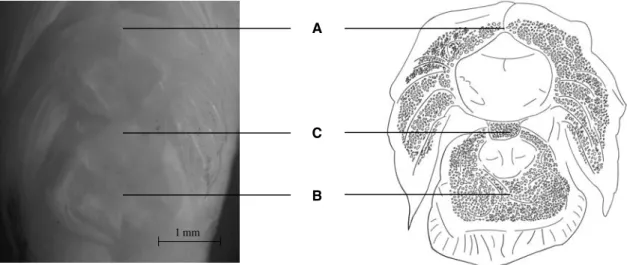
mouth rounded and posterior end of upper jaw not rea- ching anterior margin of eye; dorsal and anal fins consist- ing of unbranched rays; anus little closer to posterior margin of ventral disc than to origin of anal fin; pelvic fins modified into a thoracic sucking disc with double round-shaped which divided by region C (Fig. 2); many ventral disc papillae on regions both B and C but no pa- pilae in the central region of A (for details, see Briggs, 1955).
Color when fresh. Body pinkish; many reddish spots on head and body; upper head reddish and down pale; a somewhat reddish line from snout passing backward through eye; dorsal and anal fins brownish pink; caudal fin brownish yellow; ventral part on head and sucking disc white.
Color after preservation. Head and body uniformly yellowish; no spots on head and body.
Distribution. Korea (Jeju Island, present study), Japan (Hayashi, 2002), and South China (Hutchins, 2000).
Remarks. Aspasma minima is characterized by having pectoral fin modified into a sucking disc of pelvic fins
“double” type, head with 3 pairs of preopercular canal pores and posterior end of upper jaw not reaching anteri- or margin of eye (Briggs, 1955; Hayashi, 2002). Morpho- logical characters of the present specimen were agreed
A
B
Fig. 1. Aspasma minima (Döderlein), CNU 20051125, 25.4 mm SL, Ham- deok-ri, Jocheon-eup, Jeju-si, Jeju- do, Korea. A: lateral view, B: dorsal view.
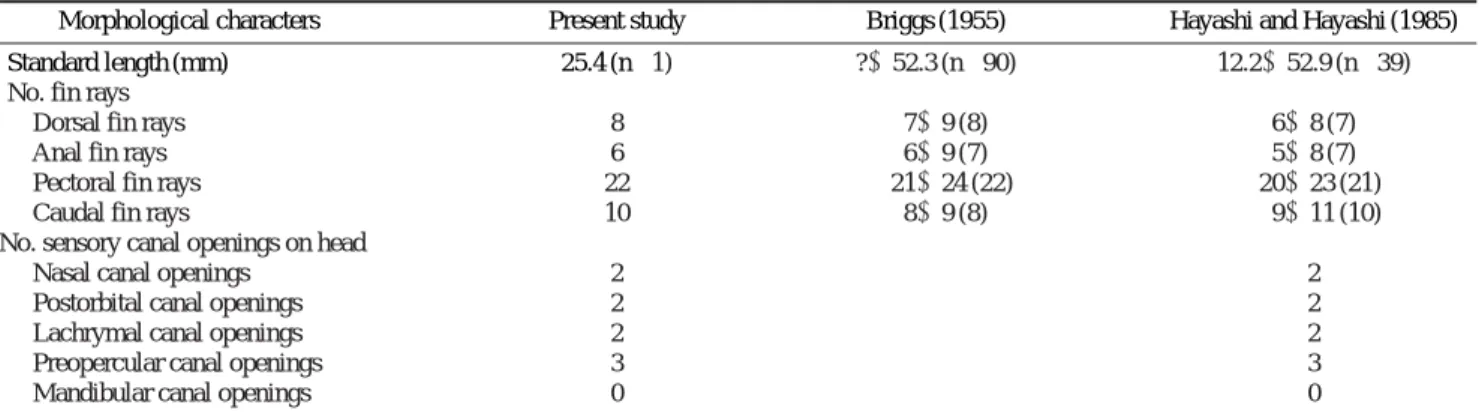
Table 1. Morphological characters of Aspasma minima observed and reported previously
Morphological characters Present study Briggs (1955) Hayashi and Hayashi (1985)
Standard length (mm) 25.4 (n==1) ?~52.3 (n==90) 12.2~52.9 (n==39)
No. fin rays
Dorsal fin rays 8 7~9 (8) 6~8 (7)
Anal fin rays 6 6~9 (7) 5~8 (7)
Pectoral fin rays 22 21~24 (22) 20~23 (21)
Caudal fin rays 10 8~9 (8) 9~11 (10)
No. sensory canal openings on head
Nasal canal openings 2 - 2
Postorbital canal openings 2 - 2
Lachrymal canal openings 2 - 2
Preopercular canal openings 3 - 3
Mandibular canal openings 0 - 0
The values in parenthesis indicate mean.
226 Song-Hun Han, Maeng Jin Kim, Byung-Yeob Kim, Chan-Moon Choi and Choon Bok Song
well with those of the previous reports on A. minima (see Table 1).
A. minima is easily distinguished from the other Korean gobiesocids, A. ciconiae and L. frenatus, in having 6~9 dorsal fin rays (vs. 11~12 in A. ciconiae and 16~17 in L. frenatus), many red spots on body and head (vs. hori- zontal bands in A. ciconidae and no spots and bands in L. frenatus) (Hayashi, 2002; Kim et al., 2005). This spe- cies is also distinguished from its most similar species, Propherallodus briggsi in having posterior end of upper jaw not reaching anterior margin of eye (vs. posterior end of upper jaw extending beyond anterior margin of eye) (Hayashi, 2002).
REFERENCES
Allen, L.G. 1984. Gobiesociformes: development and rela- tionships. In: Moser, H.G., W.J. Richards, D.M. Co- hen, M.P. Fahay, A.W. Kendall, Jr. and S.L Richard- son (eds.), Ontogeny and systematic of fishes. Spec.
Publ. No. 1, Amer. Soc. Ichthyol. and Herp., pp. 629- 636.
Briggs, J.C. 1955. A monograph of the clingfishes (Order Xenopterygii). Stanford Ichthyol. Bull., pp. 132-136.
Kim, B.J., Y.B. Go and K. Nakaya. 2005. First record of a clingfish, Lepadichthys frenatus (Perciformes: Gob- iesocidae), from Korea. Korean J. Ichthyol., 17: 255- 257.
Hayashi, M. and H. Hayashi. 1985. Two new records of gobiesocid fishes from Japan, and the morphological study of their key characters. Sci. Rep. Yokosuka City Mus., 33: 49-67. (in Japanese)
Hayashi, M. 2002. Gobiesocidae. In: Nakabo, T. (ed.), Fishes of Japan with pictorial keys to the species, English edition. Tokai Univ. Press, Tokyo, Japan, 1749pp.
Hubbs, C.L. and K.F. Lagler. 1964. Fishes of the great lake region. Bull. Granbrook Inst. Sci., 26: 19-27.
Jordan, D.S. and H.W. Fowler. 1902. A review of the cling- fishes (Gobiesocidae) of the waters of Japan. Proc.
U.S. Natl. Mus., 25: 413-416.
Nelson, J.S. 2006. Fishes of the world, 4th ed., John Wiley
& Sons, New York, 601pp.
Randall, J.E. and K.K.P. Lim. 2000. A checklist of the fishes of the South China Sea. Raffles Bull. Zool. Suppl., 8:
569-667.
Steindachner, F. and L. Döderlein. 1887. Beiträge zur Kennt- niss der Fische Japan’s. IV. Denkschr. Akad. Wiss.
Wien, 53: 257-296, pls. 1-4.
Uchida, K. and H. Yabe. 1939. The fish-fauna of Saisyu-to (Quelpart Island) and its adjacent waters. J. Chosen Natl. Hist. Soc., 25: 3-16. (in Japanese)
Yoshino, T. 1984. Family Gobiesocidae. In: Masuda, H., K.
Amaoka, C. Araga, U. Uyeno and T. Yoshino (eds.), The fishes of the Japanese Archipelago. Tokai Univ.
Press, Tokyo, pp. 326-327.
Fig. 2. Ventral disc diagram of Aspasma minima. A, B, and C indicate disc regions mentioned in the text.
First Record of Aspasma minima 227
한국산 학치과(농어목) 어류 1 미기록종, Aspasma minima
한송헌∙김맹진∙김병엽∙최찬문∙송춘복
제주대학교 해양과학대학 해양과학부
요 약 : 학치과(Family Gobiesocidae)에 속하는 Aspasma minima 1개체가 제주도 조천읍 함덕리 연안에서 처 음 채집되어 형태형질을 조사하였다. 이 종은 등지느러미 기조수 6~9개, 뒷지느러미 기조수 5~9개, 가슴지느러 미 기조수 20~24개, 그리고 몸과 머리에는 많은 붉은 점이 산재하고, 위턱의 뒤 가장자리가 눈의 앞부분까지 도달하지 않는 특징을 갖고 있다. 이 미기록종의 신한국명을 “꼬마학치”라고 명명하였다.
찾아보기 낱말 :학치과, 꼬마학치, 미기록종, 제주도