INTRODUCTION
The gobiid genus Clariger Jordan and Snyder, 1901, is characterized by the following combination of characters:
an elongated body; broad and flattened head; three slender spines on the first dorsal fin; one or two free filamentous rays on the upper part of pectoral fin; a few barbels below the eyes except for C. sirahamaensis(Jordan and Snyder, 1901; Shiogaki, 1988; Jang-Liaw et al., 2012). The genus comprises currently six valid species, i.e., C. cosmurus Jordan and Snyder 1901, C. exilis Snyder, 1911, C. siraha- maensis Sakamoto, 1932, C. papillosus Ebina, 1935, C.
chionomaculatus Shiogaki, 1988, C. taiwanensis Jang-Li- aw, Gong and Chen, 2012, and most of them usually in- habit in the rocky intertidal or subtidal zones with grav- els and stones of the Northwest Pacific including Japan, Korea, and Taiwan(Jang-Liaw et al., 2012; Akihito et al., 2013; Choi and Cho, 2013). In Korean waters, no addi- tional Clariger species has been discovered to date, since C.
cosmurus was recorded from the Southern coast of Korea (Choi and Cho, 2013).
Surveying on the benthic fauna of subtidal zone in the
Hallyeohaesang National Park of Korea, a single specimen of Clariger chionomaculatus was accidentally caught on the gravelly mud bottom off Southern coasts of Korea. So far, the species has been known from the rocky subtidal zone of Japanese waters only(Shiogaki, 1988; Akihito et al., 2013). Therefore, we report C. chionomaculatus as the first record and the second species of Clariger from Korea in this study.
MATERIALS AND METHODS
The specimen was collected by a Van Veen grab(0.025 m2) sampling from operating Kuklipgongwon-yeongu 1(R/
V) on 11 October 2016, and deposited in Marine Research Center, Korea National Park Service(KNPS). Morpho- metric and meristic methods generally followed Akihi- to et al.(1984) and Hubbs and Lagler(2004) except for body depth was taken vertically at the origin of the pelvic fin and, body width was measured at the origin of both pectoral fins. Counts of the dorsal and anal fin rays, and vertebrae were determined from radiograph(Softex VIX- 100, Japan). The formula for the relation between the pte- rygiophores of the dorsal fin and vertebrae followed those of Akihito et al.(1984). The cephalic sensory canal sys-
—110 — http://www.fishkorea.or.kr
저자 직위: 조현근(연구원), 김병직(환경연구관)
* Corresponding author: Byung-Jik Kim Tel: 82-32-590-7475, Fax: 82-32-590-7250, E-mail: [email protected]
First Record of the Gobiid fish, Clariger chionomaculatus (Perciformes: Gobiidae) from off Geojedo Island, Korea
By Hyun-Geun Cho and Byung-Jik Kim
1,*
Marine Research Center, Korea National Park Research Institute
1Animal Resources Division, National Institute of Biological Resources, Incheon 22689, Republic of Korea
ABSTRACT A single specimen(40.5mm in SL) of Clariger chionomaculatus was collected at 4 m depth on mud bottom from off Geojedo Island, Korea. This species is characterized by having an elongated body without scales, several barbels below eyes, I, 12~15 second dorsal fin rays, I, 12~14 anal fin rays; 19~20 pectoral fin rays with one free soft ray on upper part, and a unique color pattern with numerous white blotches on dorsal part of body. Because it has been known from Japan only to date, we describe in detail C. chionomaculatus as the first record from Korea. A new Korean name,
“Huin-jeom-wae-mang-dug”, is proposed for the species.
Key words: Gobiidae, Clariger chionomaculatus, first record, Geojedo Island, Korea
tem was observed by stained cyanine blue(Akihito et al., 2013). Terminology of cephalic sensory papillae followed Wongrat and Miller(1991).
SYSTEMATIC ACCOUNTS Clariger chionomaculatus Shiogaki, 1988 (New Korean name: Huin-jeom-wae-mang-dug)
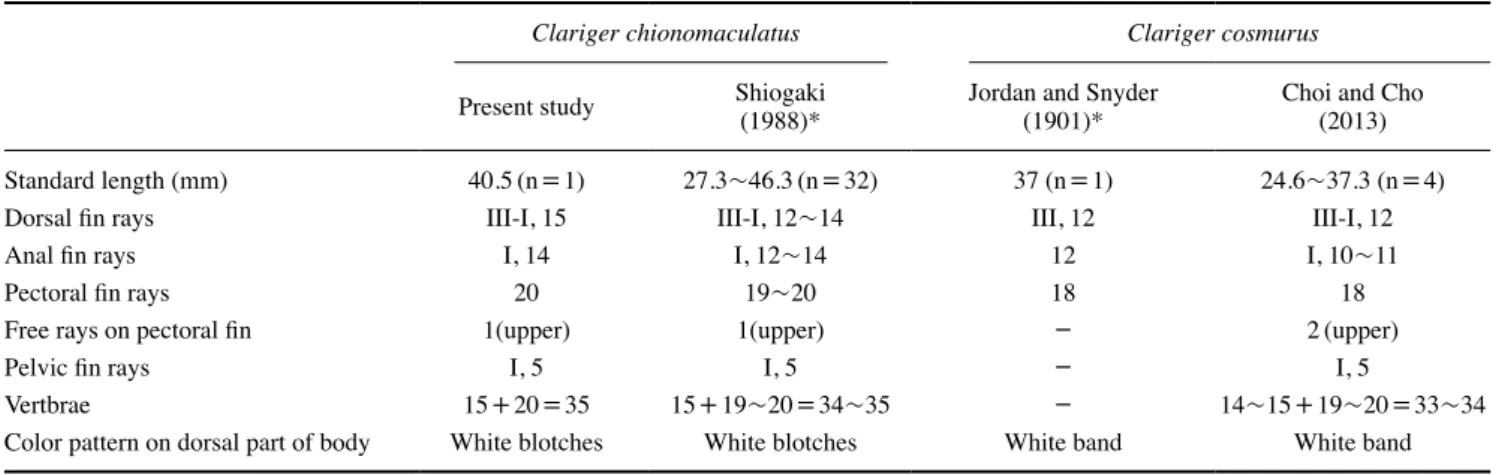
(Figs. 1~2; Table 1)
Clariger chionomaculatus Shiogaki, 1988: 127(type lo- cality: Mutsu Bay of Japan); Akihito et al., 2013: 1380 (Japan).
Material examined. KNPS-P766, 40.5mm in standard length(SL), 11 October 2016, Nambu-myeon, Geoje- si, Gyeongsangnam-do, Korea(34°44ʹ41.68ʺN, 128°40ʹ 0.73ʺE), Van Veen grab sampler(0.025m2), 4m depth, col- lected by Sang-Ho Shin.
Diagnosis. Body naked; several well developed barbels below eyes; numerous broad white blotches on dorsal part of body; I, 12~15 second dorsal fin rays; I, 12~14 anal fin rays; 19~20 pectoral fin rays with only one filament ray on its upper part.
Description. Comparison of meristic counts are given in Table 1. Dorsal fin rays III-I, 15; anal fin rays I, 14; pec- toral fin rays 20 with one free ray, respectively on upper and lower parts; pelvic fin rays, I, 5, forming sucking disk;
dorsal pterygiophore formula, P-V 7/111000/13; vertebrae (AV+CV) 15+20=35. Measurements in % SL: head length(HL) 26.7; body depth 11.6; body width 10.4; pre- dorsal length 43.2; preanal length 56.5; second dorsal fin base 28.6; anal fin base 26.2; longest pectoral fin ray(ninth) 16.0; longest second dorsal fin ray(ninth) 4.9; longest anal fin ray(11th) 4.2; length of caudal peduncle 13.6; depth of caudal peduncle 9.9. Mesurements in % HL: snout length 21.3; eye diameter 12.0; interorbital width 18.5.
Body elongate; cylindrical anteriorly and somewhat compressed posteriorly. Head moderately large and de- pressed; its width wider than body width. Eyes small, lo- cated on dorso-lateral part of head. Interorbital region flat, its width 1.5 in eye diameter. Snout relatively short. Mouth superior and oblique; posterior tip of upper jaw extending to vertical at posterior margin of eye. Teeth on both jaws with one outer row and three to four rows conical teeth arranged irregularly; outer row teeth on both jaws larger than those of inner rows. Tongue deeply notched. Anteri- or nostril short tube and posterior nostril simple opening.
Fig. 1. Dorsal(A), lateral(B), and ventral(C) views of Clariger chionomaculatus, KNPS-P766, 40.5 mm SL, from Geojedo Island, Korea.
A
B
C
pectoral fin. Infraorbital dermal ridge running from tip of snout to cheek with four short barbels(Fig. 2). Dorsal fin two, not united by membrane; first dorsal fin spines ex- tremely short. Origin of second dorsal fin inserted slightly anterior to that of anal fin. Pectoral fin rounded; its hind
fin; one free ray, respectively on upper and lower margins.
Pelvic fin sucking disk with connection membrane. Cau- dal fin slightly oblong and posterior margin rounded. No scales on head and body.
Cephalic sensory system. Sensory canal and pore absent.
Sensory papillae present on head(Fig. 2); row a long, lon- gitudinally extending from snout to posterior orbit; row a1 short, anteriorly reaching row a; row b long, longitudinally extending from snout along the base of dermal ridge under eye; row c short and below row b; row d extending from snout along upper lip to vertically anterior orbit; longitu- dinal row e and i, extending along the cheek to the ven- tro-lateral surface of lower jaw; transverse row oi and lon- gitudinal ot on anterior part of opercle slightly separated;
longitudinal row os short and well separated from row ot;
row p surrounding orbit on interorbital region; two longi- tudinal row(x1, x2) and transversal row z on oculoscapular.
Coloration in preservative. Ground color of head and body dark brown dorsally; yellowish-white ventrally and irregularly scattered small dark brown spots laterally. Dor- sal side of head with yellowish-white marking; six yel- lowish-white saddle-like blotches on dorsal part of body extending from nape to posterior part of second dorsal fin base; anteriorly three and posteriormost blotches broad and distinct; middle two blotches irregularly-shaped. All fins yellowish-white; first dorsal fin with dark brownish band on anterior part; pectoral fin with narrow, dark brown band basally; dark brown dots scattered on second dorsal fin and middle of caudal fin; distinct and broad dark brown blotch on caudal fin base.
Ecological notes. The present specimen was collected on mud substrate with numerous gravels, small rocks, and shells about 4 m depth from the subtidal zone at high tide.
(A)
(B)
Fig. 2. Dorsal(A) and lateral(B) views of the cephalic sensory sys- tem in Clariger chionomaculatus, KNPS-P766, 40.5mm SL. AN and PN, anterior and posterior nasal pores, respectively; a, a1, b, c, d, e, p, i, x1, x2, z, oi, os, and ot sensory papillae rows. The arrow shows po- sition where the gill membranes are attached to the isthmus and bar indicates 1mm.
Table 1. Comparison of diagnostic characters between Clariger chionomaculatus and C. cosmurus
Clariger chionomaculatus Clariger cosmurus Present study Shiogaki
(1988)* Jordan and Snyder
(1901)* Choi and Cho
(2013)
Standard length (mm) 40.5(n=1) 27.3~46.3(n=32) 37 (n=1) 24.6~37.3 (n=4)
Dorsal fin rays III-I, 15 III-I, 12~14 III, 12 III-I, 12
Anal fin rays I, 14 I, 12~14 12 I, 10~11
Pectoral fin rays 20 19~20 18 18
Free rays on pectoral fin 1(upper) 1(upper) - 2(upper)
Pelvic fin rays I, 5 I, 5 - I, 5
Vertbrae 15+20=35 15+19~20=34~35 - 14~15+19~20=33~34
Color pattern on dorsal part of body White blotches White blotches White band White band
*original description
Distribution. Known from Geojedo Island southern coast- al waters of Korea; Mutsu Bay of Amori Pref., Otsuchi Bay of Iwate Pref., Miyazaki Pref., Hiroshima Pref., Japan (Shiogaki, 1988; Akihito et al., 2013; Yoshigou and Yoshi- gou, 2016).
Remarks. The present specimen collected from Geojedo Island belongs to the genus Clariger in having its cylindri- cal and elongated body, three spined first dorsal fin, and one free ray on upper margin of pectoral fin, and the first dorsal pterygiophore inserted between the neural spines of seventh and eighth vertebrae(Akihito et al., 1984, 2013;
Shiogaki, 1988; Jordan and Snyder, 1901). In addition, it agrees well with the diagnostic characters of Clariger chi- onomaculatus presented by Shiogaki(1988), and was iden- tified as this species, especially in having six saddle-like white blotches on dorsal part of body, four barbels below eye, III-I, 15 dorsal fin rays, I, 14 anal fin rays, and 20 pectoral fin rays with one free ray on its upper part(Table 1). There is a slight difference with the number of second dorsal fin rays between the original description given by Shiogaki(1988) and present specimen(12~14 in original description vs. 15 in Korean specimen). It may be regarded as a geographical or intraspecific variation, because there could not be found out the remarkable difference between them in the other characters. The further examination is needed as to number of dorsal fin.
In Korean waters, Clariger chionomaculatus is similar to C. cosmurus in having an infraorbital dermal ridge with several barbels on cheek, arrangement of cephalic sensory papillae, and overall coloration pattern on lateral and ven- tral body(Akihito et al., 1984). However, the former can be easily distinguished from the latter by higher second dorsal and anal fin rays(12~15, 12~14, respectively, in former vs. 10~11, 10 in latter), lower free rays on upper part of pectoral fin(1 vs. 2), and coloration pattern on the back of body(numerous white blotched vs. white banded) (Fig. 1; Table 1).
A new Korean name, “Huin-jeom-wae-mang-dug”, meaning the having “white spot”(=huin-jeom) in the genus Clariger(=wae-mang-dug) is proposed for C. chi- onomaculatus.
ACKNOWLEDGEMENTS
We thank to Mr. Sang-Ho Shin for collecting the spec- imen. This work was supported from the Korea National Park Service.
REFERENCES
Akihito, P., M. Hayashi, T. Yoshino, K. Shimada, H. Senou and T.
Yamamoto. 1984. Gobioidei. In: Masuda, H., K. Amaoka, C. Araga, T. Uyeno and T. Yoshino(eds.), The fishes of the Japanese Archipelago(English ed., 2nd ed.). Tokai Univer- sity Press, Tokyo, Japan, pp. 236-289.
Akihito, P., K. Sakamoto, Y. Ikeda and M. Aizawa. 2013. Gobioi- dei. In: Nakabo, T.(ed.), Fishes of Japan with pictorial keys to the species, 3rd edition. Tokai University Press, Tokyo, Japan, pp. 1347-1541.
Choi, S.H. and H.G. Cho. 2013. First record of the gobiid fish, Clariger cosmurus(Perciformes: Gobiidae) from Korea.
Korean J. Ichthyol., 25: 141-144.
Hubbs, C.L. and K.F. Lagler. 2004. Fishes of the Great Lake region.
University of Michigan Press, Ann Arbor, U.S.A., 332pp.
Jang-Liaw, N.H., Y.H. Gong and I.S. Chen. 2012. A new marine go- biid species of the genus Clariger Jordan & Snyder(Gobii- dae, Teleostei) from Taiwan. ZooKeys, 199: 13-21. https://
doi.org/10.3897/zookeys.199.2645.
Jordan, D.S. and J.O. Snyder. 1901. A review of the gobioid fishes of Japan, with descriptions of twenty-one new species.
Proceedings of the United States National Museum, 24: 33- Shiogaki, M. 1988. A new gobiid fish of the genus Clariger from 132.
Mutsu Bay, northern Japan. Japan. J. Ichthyol., 35: 127- Wongrat, P. and P.J. Miller. 1991. The innervation of head neuro-132.
mast rows in eleotridine gobies(Telelostei: Gobioidei). J.
Zool., 225: 27-42.
Yoshigou, H. and H. Yoshigou. 2016. Fishes of Hiroshima, Japan 3 (Laiphognatus longispinis, Lepadichthys frenatus, Clarger chionomaculatus and C. cosmurus). Hibakagaku, 258: 25- 27.
우리나라 거제도 연안에서 채집된 망둑어과 첫기록종 , Clariger chionomaculatus
조현근
·
김병직1국립공원연구원 해양연구센터, 1국립생물자원관 동물자원과
요 약 : 우리나라 거제도 연안 수심 4m 진흙바닥에서 Clariger chionomaculatus 1개체(체장 40.5mm)를 채집하 였다. 본 종의 특징은 가늘고 긴 체형에 비늘이 없고, 눈 아래에 수염이 있으며, 제2등지느러미 기조수가 I, 12~15,
뒷지느러미 기조수는 I, 12~14, 가슴지느러미 상부에 1개의 유리연조, 등 쪽에 다수의 흰색 반점들이 있는 채색패
턴을 갖는 점이다. 본 종은 지금까지 일본에서만 보고된 종으로 우리나라에서는 거제도 연안에서 처음 출현하였다.
본종의 신한국명으로 ‘흰점왜망둑’을 제안한다.
찾아보기 낱말 : 망둑어과, 흰점왜망둑, 첫기록, 거제도, 한국