저작자표시-비영리-변경금지 2.0 대한민국 이용자는 아래의 조건을 따르는 경우에 한하여 자유롭게
l 이 저작물을 복제, 배포, 전송, 전시, 공연 및 방송할 수 있습니다. 다음과 같은 조건을 따라야 합니다:
l 귀하는, 이 저작물의 재이용이나 배포의 경우, 이 저작물에 적용된 이용허락조건 을 명확하게 나타내어야 합니다.
l 저작권자로부터 별도의 허가를 받으면 이러한 조건들은 적용되지 않습니다.
저작권법에 따른 이용자의 권리는 위의 내용에 의하여 영향을 받지 않습니다. 이것은 이용허락규약(Legal Code)을 이해하기 쉽게 요약한 것입니다.
Disclaimer
저작자표시. 귀하는 원저작자를 표시하여야 합니다.
비영리. 귀하는 이 저작물을 영리 목적으로 이용할 수 없습니다.
변경금지. 귀하는 이 저작물을 개작, 변형 또는 가공할 수 없습니다.
이학박사 학위논문
백금 기반 촉매에 의한 메탄올의 전기화학적 산화 반응에 관한 연구
Pt-based Catalysts for Electrochemical Oxidation of Methanol
2017년 8월
서울대학교 대학원 화학부 전기화학전공
우 승 희
A Ph. D. Dissertation
Pt-based Catalysts for Electrochemical Oxidation of Methanol
By Seunghee Woo
Supervisor: Professor Taek Dong Chung Major: Electrochemistry
School of Chemistry Graduate School of Seoul National University
August 2017
ABSTRACT
This research mainly focuses on low temperature fuel cells. In detail, this research can be divided into following parts: i) Research on synthesis of low Pt loading catalyst, ii) Design of a new support material, iii) Development of one-step synthesis of Pt/graphene catalyst.
Part 1. Synthesis of Low Pt Loading Catalyst
Pt-based electrodes for proton exchange membrane fuel cells have been prepared by various methods such as polyol, impregnation, microemulsion. However, inactive catalyst sites are always present in the catalyst layer prepared by the conventional method. These inactive sites are not available for fuel cell reaction because the electrochemical reaction is limited only at the interface between the polymer electrolyte and the catalyst that is exposed to the reactant, known as the triple-phase reaction zone. In order to overcome this limitation, the electrodeposition method was applied on a surface of a substrate. Low loading Pt- Co cathode catalyst on a Nafion(Na+)-bonded carbon layer was fabricated by using galvanostatic pulse technique to show the advantage of electrodeposition for high utilization of catalyst in proton exchange membrane fuel cell. The chemical composition of the electrodes could be controlled by varying the concentration of Co precursor. The Pt-Co catalysts evenly exist on the surface on the surface of
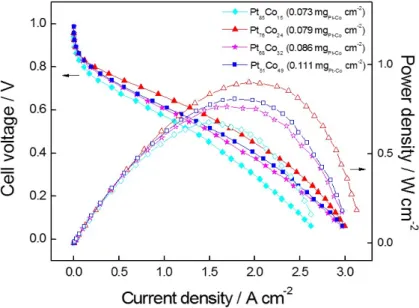
carbon electrode and its thickness was about 5.8 µm, which is four times thinner than conventional Pt/C. From XPS studies, Pt 4f spectrum of catalyst indicated the presence of oxidation states Pt2+ in addition to metallic Pt. The Pt-Co catalyst with a ratio of 3.2:1 was found to provide the highest single cell performance among the compositions studies. Therefore, the electrodeposition technique offers not only enhanced catalyst utilization but also simplification of preparation.
Keywords: Platium-cobalt cathode catalyst, Galvanostatic pulse electrodeposition, Cost-effective electrocatalyst
Part 2. A New Support Material
Carbon is an ideal material for supporting nano-sized metallic particles in a catalyst for low temperature polymer fuel cells. No materials other than carbon have the essential properties of electronic conductivity, corrosion resistance, surface properties, and low cost requied for the commercialization of fuel cells. However, carbon supports are relatively easy to be corroded under harsh fuel cell operation conditions, which would cause a rapid decay of electrochemical performance. To circumvent this shortcoming, the rational construction of carbon-based electrode materials with more advanced architectural design has been identified as the major solution. In this part, we designed a well-arranged structure of graphene-Vulcan carbon composite to prepare highly dispersed 40 wt.% PtRu electrocatalyst. Vulcan carbon was added as a nano spacer to enhance the utilization and electrochemical
activites of graphene-based materials. The results show that a PtRu catalyst loaded onto the graphene-Vulcan carbon (3:1 w/w) composite exhibits high electrocatalytic activity and high stability toward methanol electrochemical oxidation owing to the special structure of the graphene-Vulcan carbon composite.
Also, we investigated the feasibility of a chemically activated graphene-supported electrocatalyst. The modified graphene sheets were synthesized by chemical activation using KOH. The chemically activation of graphene resulted in the creation of pores of various sized and increased the number of edge sites. The chemically activated graphene-supported PtRu catalyst shows a high electrocatalytic activity and stability toward methanol oxidation because of its three-dimensional and porous structure that facilitates the efficient access of reactants. These results indicate that a graphene-Vulcan carbon composite and chemically activated graphene can be used as a catalyst support in fuel cells.
Keywords: Graphene, Vulcan carbon, Nano spacer, Platinum, Ruthenium, Methnaol oxidation
Part 3. One-Step Synthesis of Pt/graphene Catalyst
Graphene-metal nanoparticle catalysts have typically been prepared by chemical or thermal reduction of mixture of GO (or graphene) and metallic precursors. These methods involve hazardous chemical, or high temperatures and complicated procedures. In this part, we demonstrate the one step co-electrodeposition synthesis
of the Pt/graphene catalyst using a galvanostatic pulse technique. Pt/graphene catalyst was uniformly deposited on a glassy carbon substrate, which facilitated the simultaneous electrochemical reduction of graphene oxide and formation of Pt nanoparticles. Compared to the commercial Pt/C catalyst, the electrochemically reduced Pt/graphene catalyst exhibited improved electrocatalytic activity for methanol oxidation due to the synergistic effects of an increase in the number of catalytic reaction sites and an enhancement of the charge transfer rate.
Keywords: Platinum, Graphene, Co-electrodeposition, Methanol oxidation
Student number: 2007-30082
TABLE OF CONTENTS
ABSTRACT………i
GENERAL INTRODUCTION 1. ELECTROCATALYSIS OF METHANOL OXIDATION………2
2. ELECTROCATALYST………..7
2. 1. Catalyst support………...9
2. 2. Triple phase boundary………10
3. ELECTROCHEMICAL CHARACTERIZATION………...11
3. 1. Cyclic voltammetry………...11
3. 2. Single cell test………...15
4. REFERENCES………...………...18
PART 1. SYNTHESIS OF LOW Pt CATALYST BY PULSED GALVANOSTATIC ELECTRODEPOSITION 1. INTRODUCTION……….24
2. LITERATURE SURVAY……….28
2. 1. Electrodeposition process………..28
(1) Effect of Peak Current Density……….32
(2) Effect of Duty Cycle……….32
(3) Effect of Surface Concentration………33
(4) Effect of Temperature………...33
3. EXPERIMENTAL………34
3. 1. Electrode preparation………34
3. 2. Characterization……….35
3. 3. Single cell test………...36
4. RESULTS AND DISCUSSION………...37
5. CONCLUSION AND PERSPECTIVE………48
6. REFERENCES………..49
PART 2. DESIGN OF A NEW SUPPORT MATERIAL 1. INTRODUCTION……….54
2. LITERATURE SURVAY……….56
2. 1. Various carbon supports for fule cells………...56
(1) Activated carbon………...56
(2) Carbon nanotube………...57
(3) Carbon nanofiber………...58
(4) Graphene………...60
(5) Porous graphene………62
2. 2. Preventing graphene sheets from restacking………..62
3. EXPERIMENTAL………64
3. 1. Preparation of graphene oxide………...64
3. 2. Preparation of chemically activated graphene………...64
3. 3. Synthesis of PtRu/graphene-Vulcan carbon and PtRu/chemically activated graphene……….65
3. 4. Charaterization………..66
3. 5. Electrochemical measurements……….66
3. 6. Single cell test………...68
4. RESULTS AND DISCUSSION………...69
4. 1. Addition of a nano-sized spacer between graphene sheets………69
4. 2. Chemically activated graphene supported PtRu electrocatalyst………79
5. CONCLUSION AND PERSPECTIVE……….92
6. REFERENCES………..94
PART 3. ONE-STEP SYNTHESIS OF Pt-GRAPHENE CATALYST 1. INTRODUCTION………...102
2. EXPERIMENTAL………..103
2. 1. Preparation of graphene and Pt/graphene electrocatalyst………103
2. 2. Characterization………...105
3. RESULTS AND DISCUSSION……….107
4. CONCLUSION AND PERSPECTIVE………...123
5. REFERENCES………124
ABSTRACT (in Korean)………...128
GENERAL INTRODUCTION
1. Electrocatalysis of methanol oxidation
The electro-oxidation of small organic molecules on Pt electrocatalysts based electrodes has received more attention in the last decades due their application for electrochemical energy conversion in direct liquid feed fuel cells [1-3]. Among these molecules; methanol is used as liquid fuel for direct methanol fuel cells (DMFCs). Methanol is an attractive fuel for fuel cells due to its low price and easy handling, storage, and transport. DMFCs have an advantage over polymer electrolyte fuel cells utilizing hydrogen gas generated through a methanol reformer, because the system can be made much simpler. However, in order to accomplish the DMFC reaction, the methanol fuel should undergo the six-electron oxidation process on the electrode catalyst given follow
CH3OH + H2O → CO2 + 6H+ + 6e- Eo = 0.02 V
It is at the anode surface where methanol is oxidized to CO2, preferably at a 100 % yield, releasing six electron per methanol molecule to be harvested in the DMFC.
Consequently, the oxidation kinetics is inherently slower. The slower kinetics are a result of intermediates formed during methanol oxidation [4]. Oxidation of the intermdiates to carbon dioxide requires the adsorption of an oxygen containing species (e.g., OH, H2O). Methanol oxidation is a slow reaction that requires active multiple sites for the adsorption of methanol and the sites that can donate OH
species for desorption of the adsorbed methanol residues [5, 6]. The electro- oxidation of methanol has been studied on many electrode fabricated from unsupported metals and metal supported onto different supporting materials. Pt catalysts are still the most active catalysts materials for electro-oxidation of methanol [3, 7-11]. The electro-oxidation of methanol on Pt electrode surface is combined with several steps of dehydrogenation to form CO which is oxidized into CO2 [12, 13]. Figure 1 shows a proposed reaction network for methanol oxidation [14]. The mechanism for methanol oxidation has been debated significantly over the years, [15, 16] with research continuing to define the most significant pathways for different reaction conditions both experimentally [17, 18]
and numerically [19]. There are multiple paths by which methanol oxidation can proceed. The selectivity of the reaction to formaldehyde, formic acid, and CO2
depends on the reaction conditions, the catalyst used and the electrolyte. The selectivity of methanol oxidation over Pt to CO2 is very high and formation of other byproducts will be neglected.
It should be noted in Figure 1 that all reaction pathways to form CO2 involve formation of adsorbed CHO or CO. It is believed that these species poison the catalyst surface and that their oxidation is the rate-limiting step for methanol oxidation. The mechanism shows that oxidation of the surface intermediates involves the addition of a hydroxyl group before the final oxidation to CO2. The mechanism for the oxidation of CO is very important in the reaction mechanism for methanol oxidation and this step. This means that with a platinum catalyst electro-
adsorption of water is fairly slow and therefore addition of an OH- group to the CO adsorbed on the reaction site must come from an attack of a liquid phase water molecule.
Figure 1. Reaction network for methanol oxidation.
The poisoning of the electrode surface (anode) by CO molecules formed during the methanol oxidation is one of the obstacles in the development of DMFCs for commercial applications. The modification of Pt catalysts with other metals or metal oxides which have higher tendency to form surface oxygenated species at lower potential is considered as one of the best ways to solve this problem [20, 21].
In order to improve the catalyst performance, many efforts have been done by many groups to synthesis new catalysts systems for methanol oxidation based on bimetallic catalysts such as PtRu [22-25], PtSn [26, 27], PtNi [28, 29], PtMo [30, 31], ternary alloy; PtRuNi [32-34], PtRuMo [33, 35, 36], and PtMOx (where M is, Ti, V, Mn, W) [37-40] which show higher catalytic activities than Pt alone have been investigated. Compared to pure Pt, the most active electrocatalysts known so far are alloys of Pt and Ru exhibiting lower overpotentials and extended life-time [41, 42]. The high catalytic activity of PtRu alloys for the electro-oxidation of methanol is described very well by the bifuctional action [41] of the alloy surface,
where the adsorption of methanol occurs on Pt ensembles and the further electro- oxidation of methanol dehydrogenation fragments is catalyzed by oxygen-like species adsorbed on adjacent Ru atoms.
The potential dependent discharge of water on Pt and Ru, respectively, to form oxygen-like surface species (symbolized by OH) will be approximated by the following two equations:
H2O + Pt → PtOH + H+ + e- (1) H2O + Ru → RuOH + H+ + e- (2) On the basis of cyclic voltammetry and ellipsometry, the adsorption of oxygen-like species in Pt (equation 1) will not occur to any appreciable extent below about 0.7 V, while it occurs on Ru at potentials as low as about 0.2 V (equation 2) [43].
Finally, given that the electrode potential is sufficiently positive to co-adsorb these oxygen-like species the electro-oxidation of the electrode poisoned by CO to CO2
will be express as [44]
P t + C H3OH → Pt-(CH3O H )a d s ( 3) P t - ( C H3O H )a d s → Pt-( CH3O )a d s + H+ + e- ( 4 a ) P t - ( C H3O )a d s → Pt-(CH2O )a d s + H+ + e- ( 4 b ) P t - ( C H2O )a d s → Pt-(CHO)a d s + H+ + e- ( 4 c ) P t - ( C H O )a d s → Pt-(CO)a d s + H+ + e- ( 4 d ) Ru + H2O → Ru-(H2O)a d s (5) R u - ( H2O )a d s → Ru-(OH)a d s + H+ + e- ( 6 ) P t - ( C O )a d s + R u - ( O H )a d s → Pt + Ru + CO2 + H+ + e- ( 7 )
The rate determining step at 25oC is methanol adsorption/dehydrogenation (equation 3 or 4) [45, 46], while at elevated temperatures (i.e., 60oC) the bimolecular surface reaction involving -OHads (equation 7) becomes rate limiting.
The affinity of Ru for oxygen, as reflected in the Ru-O bond strength, will affect both the ability to oxidatively adsorb water [47] (equation 5 and 6) and the ease for Ru-O bonds to be broken in the formation of CO2 (equation 7). The scheme of dehydrogenation on Pt surface is shown in Figure 2. The first step involves the adsorption of methanol from the bulk of the solution onto the electrode surface and its successive dehydrogenation to form linearly bonded CO.
Figure 2. Scheme of methanol oxidation on Pt showing the consecutive stripping of hydrogen atoms.
Stripping voltammetry and potentiostatic stripping revealed that the adsorption of CO is equally facile on both Pt and Ru surface atoms and suggested that about 0.2 V negative shift of the onset of CO oxidation on the most active PtRu alloy electrode compared to pure Pt is related to the nucleation of oxygen-containing species on Ru atoms at low electrode potentials, thereby promoting the oxidation of CO to CO2 [48].
2. Electrocatalyst
Electrochemical reactions for which no adsorbed intermediate exists are very rare and the electron transfer step or steps usually involve adsorbed species [49].
These kind of species that are necessary for a reaction to take place but do not seem to participate in the global equation, are called catalysts. Hydrogen oxidation reaction occurs easily on Pt. Since the metallic surface plays an active role in the formation of intermediates, the nature and particular state of the surface is crucial for the success of the reaction. The metallic surface is then an electrocatalyst, a catalyst for the electron transfer reaction. If the rate-determining step of the reaction involves adsorbed species, and this is probably the case, then the nature and structure of the metallic surface will determine the speed of the reaction (Figure 3).
Figure 3. Traditional potential energy curve illustrating the lowering of the activation energy as the addition of a catalyst. The catalyzed activation energy is distinctively lower than that of an uncatalyzed reaction. As a result, the catalyzed reaction rate is increased; products are formed quicker and with greater yields over time [49].
The requirements of the catalyst for fuel cells are as follows: (Figure 4, 5)
1) High intrinsic activity for hydrogen/methanol oxidation reaction at the anode and for oxygen reduction reaction at the cathode.
2) Good durability to minimize the loss of electrocatalytic activity.
3) Good electrical conductivity to minimize resistive losses in the catalyst layer.
4) Thermal and acidic stability for maintaining the electrocatalytic activity.
Considering the requirements of suitable catalyst materials for the low temperature fuel cell, Pt and Pt-based catalysts are found to meet these requirements, in both activity and stability. Especially, Pt nanoparticles supported on carbon (Pt/C) have advantages such as larger relative surface area, higher efficiency, and good intrinsic activity.
Figure 4. Anode and cathode reactions.
Figure 5. Essential criteria for electrocatalyst.
2. 1. Catalyst support
Many industrial catalyst consists of metals or metal compounds supported on an appropriate support, the basic role of which is to maintain the catalytically active phase in a highly dispersed state (Figure 6). Carbon materials have been used for a long time in heterogeneous catalysis, because they can act as direct catalyst or, more important, they can satisfy most of the desirable properties required for a suitable support [50]. The advantage of spreading the active phase on a support is to disperse it throughout the pore system, thus making it possible to obtain a large active surface per unit weight used. A supported catalyst facilitates the flow of gases through the reactor and the diffusion of reactants through the pores to the active phase. The performance and stability of fuel cells are known to strongly depend on the carbon support used as well as the catalytically active species [51].
Figure 6. Carbon supported platinum catalyst.
The requirements of ideal support materials for Pt-based electrocatalysts should have the following characteristics: a high surface area for a high degree of dispersion of nanosized catalysts, a high electrical conductivity to facilitate electron transport during the redox reaction, a suitable pore structure and large pore volume to provide an open highway network around the active catalyst for a facile diffusion of fuels and products toward and away from the catalyst sites and low cost to make an inexpensive fuel cells. High surface area and a well-developed porosity are essential for achieving large metal dispersion, which usually results in a high catalytic activity.
2. 2. Triple phase boundary
The idea of the triple phase boundary is extensively employed in the fuel cell literature, especially with respect to solid oxide fuel cells and polymer electrolyte membrane fuel cells. The triple phase boundary concept holds that the hydrogen/methanol oxidation reaction and the oxygen reduction reaction can only
occur at confined spatial sites, called “triple phase boundaries” where ionomer, reactant, and electrically connected catalyst regions contact. A simplified schematic of the triple phase boundary is shown in Figure 7. The reaction kinetics often present a significant limitation to fuel cell performance. Therefore, understanding, characterizing, and optimizing the triple phase boundary content in fuel cells provides excellent opportunities for performance enhancement [52].
Figure 7. A simplified schematic diagram of the catalyst particle, ionomer and reactant.
3. Electrochemical characterization
3. 1. Cyclic voltammetry
Cyclic voltammetry (CV) technique is applied to a three electrode cell. Thus, the electrode potential is controlled by an applied driving potential difference Ed
between the reference and working electrodes. The reference electrode connections must have a very high input impedance, so that the current flows only between the working and counter electrodes. The reference input of the potentiostat is
connected to the working electrode in the cell, and the potential of the working electrode is measured against the reference electrode. The potential scan is applied in one direction (positive or negative), starting at chosen values, and then the sweep rate is inverted at selected reversing points which are selected in such a way that one has oxygen evolution in the positive and hydrogen evolution in the negative part. In PtRu alloy working electrode, 800 mV vs. SHE (standard hydrogen electrode) is typically selected for the positive limit because Ru atoms are dissolved over the limit and 0 mV vs. SHE is selected for the negative limit because hydrogen evolution starts below the limit. CV at given electrodes without active species in the electrolyte such as sulfuric acid or perchloric acid results in current/potential relations that are very characteristic for the electrode material used. Primarily, there is a contribution due to the charging of the double layer. Due to a fast attainment of the equilibrium, the double layer capacity is not a function of scan rate, but it can depend on potential. A second contribution, and in general a much larger one, is given by charging a pseudo-capacitance of value, e.g., capacity effects due to faradaic reactions like the formation and dissolution of hydride and oxide layers on the surface. This capacity does not also depend on the scan rate.
The voltammogram presented in Figure 8 was taken using a polycrystalline Pt electrode in 1 M KOH [53]. In this voltammogram, the potential is referred to a reversible hydrogen electrode (RHE) in the same solution. Following the current starting at + 450 mV, we observe that between this potential and 550 mV the only current that flows is tat required to charge the electrolytic double layer. Above 550
mV, oxygen chemisorption start with
Pt + OH- → Pt-OH + e- and above ca. 800 mV
Pt-OH + OH- → Pt-O + H2O + e-
Above ca. 1600 mV oxygen evolution begins, and in addition, a phase oxide may form on the Pt surface (with a thickness larger than a monolayer). At lower potentials oxide may also be formed, if a constant potential is applied. After the reversion of potential, oxygen molecules near the surface are reduced together with the chemisorbed oxide layer. At lower potentials there is a small “double layer”
region followed by the underpotential deposition of H-atoms Pt + H2O + e- → Pt-H + OH-
Finally, close to the thermodynamic H2/OH- potential, a strong evolution of hydrogen starts. After scan reversion, H2 molecules near the electrode and the layer of adsorbed hydrogen are oxidized again.
Figure 8. Cyclic voltammogram of polycrystalline platinum in 1 M KOH, 20oC, nitrogen purged, sweep rate = 100 mV s-1 [53].
Electrochemical active surface area (ECA) of electrodes is measured by CV either using the area under the hydrogen adsorption/desorption peaks or CO adsorption/stripping peaks. To determine the ECA, CV is carried out on the electrode of interest over a range between 0 and 1600 mV. The specific charge transfer due to hydrogen adsorption and desorption can be obtained from
QH = 21(QT -QDL),
where QT is the total specific charge transfer in the hydrogen adsorption/desorption potential region and QDL is the specific capacitive charge in the double layers of both Pt and carbon support. QT can be obtained by integration of the CV curves in the relevant potential region [54]:
QT = I I dE v ( d a) 1 0.4
05 .
0 −
∫
,where v is the scan rate, Id and Ia are the specific current of desorption and adsorption, respectively, and E is the potential. QDL can be similarly obtained by integrating the double layer charging region. Assuming the charge per real cm2 of Pt with monolayer adsorption of hydrogen [55] is QH˚=210 μC cm-2, then the active specific areas can be obtained from
SECA = o H H
Q Q
Although the above method is commonly used for Pt/C catalysts, it cannot be applied to PtRu/C catalysts because Ru absorbs hydrogen. Real surface area can be characterized by COad stripping analysis. As for PtRu/C, the surface area can be estimated assuming a monolayer of linearly adsorbed CO and the coulombic charge
necessary for oxidation as 420 μC cm-2, because the hydrogen adsorption/desorption peak of the PtRu/C is not well defined comparing to that of the Pt/C.
3. 2. Single cell test
The MEA (membrane electrode assembly) of a low temperature fuel cell usually consists of five layers which include gas and liquid diffusion layers, and electrocatalyst layers with a polymeric proton conducting acidic membrane in between. The proton conducting membrane acts as an electronic insulator between the electrodes, but allows protons to migrate efficiently from the anode to the cathode. The membrane also functions as a physical barrier to prevent mixing of the reactants. In addition, a soluble form of the membrane material is used to impregnate the electrocatalyst layers to extend the membrane interface. This provides a proton conducting pathway. The overall schematic diagram of a low temperature is shown in Figure 9. The cell consists of two electrodes which are separated by the electrolyte and which are connected in an external circuit. The electrodes are exposed to gas or liquid flows to supply the electrodes with fuel or oxidant. The electrodes have to be gas or liquid permeable and therefore possess a porous structure. The structure and content of the gas diffusion electrodes is quite complex and requires considerable optimization for the practical application.
Electrons flow in the external circuit during these reactions.
Figure 9. Schematic diagram of a low temperature fuel cell.
The factors which limit a low temperature fuel cell efficiency is show in Figure 10.
Several sources contribute to irreversible losses in a practical fuel cell. The losses, which are often called polarization, overpotential or overvoltage (η), originate primarily from three sources: (i) activation polarization (ηact), (ii) ohmic polarization (ηohm), and (iii) concentration polarization (ηconc). These losses result in a cell voltage (V) for a fuel cell that is less than its ideal potential, E (V=E-losses).
The activation polarization loss is dominant at low current density. At this point, electronic barriers have to be overcome prior to current and ion flow. Activation losses show some increase as current increases. Ohmic polarization (loss) varies directly with current, increasing over the whole range of current because cell resistance remains essentially constant. Mass transport losses occur over the entire range of current density, but these losses become prevalent at high limiting currents
where it becomes difficult to provide enough reactants flow to the cell reaction sites. The improvement of cell performance is approached by modifications to fuel cell design (improvement in electrode structures, better electrocatalysts, more conductive electrolyte and, thinner cell components, etc.). In this study, the improvement in better electrocatalysts is focused to.
Figure 10. Ideal and actual fuel cell voltage/current characteristic.
4. REFERENCES
[1] E.L. Gyenge, Chapter 4: Electrocatalytic oxidation of methanol, ethanol and formic acid’, in PEM Fuel Cell Electrocatalysts and Catalyst Layers, editor; Jiujun Zhang, Springer, New York, p. 165-270 (2008).
[2] A.O. Neto, R.W.R. Verjulio-Silva, M. Linardi, E.V. Spinacé, Int. J.
Electrochem. Sci., 4 (2009) 954.
[3] A.B. Kashyout, A.A.A. Nasr, M.S. Mohy Eldin, Alexandria Engineering Journal, 48 (2009) 491.
[4] M. Leger, C. Lamy, B. Bunsenges, J. Phys Chem., 94 (1990) 1021.
[5] V.S. Bagotzsky, B. Yu. Vassiliev, O.A. Khazova, J. Electroanal. Chem., 81 (1997) 229.
[6] G.T. Burstein, C.J. Barnett, A.R. Kucernak, K.R. Williams; Catal. Today, 38 (1997) 425.
[7] T. Iwasita, Electrochim. Acta, 47 (2002) 3663.
[8] M. Brandalise, M.M. Tusi, R.M. Piasentin, M. Linardi, E.V. Spinacé, A.O.
Neto, Int. J. Electrochem. Sci., 5 (2010) 39.
[9] H. Liu, C. Song, L. Zhang, J. Zhang, H. Wang, D.P. Wilkinson, J. Power Sources, 155 (2006) 95.
[10] W.M. Martínez, T.T. Thompson, M.A. Smit, Int. J. Electrochem. Sci., 5 (2010) 931.
[11] A. Hamnett; Catal. Today, 38 (1997) 445.
[12] J.L. Go´mez de la Fuente, M.V. Martı´nez-Huerta, S. Rojas, P. Terreros, J.L.G.
Fierro, M.A. Pena, Catal. Today, 116 (2006) 442.
[13] E.A. Bagotski, Y.B. Vassiliev, O.A. Khazova, J. Electroanal. Chem., 81 (1977) 229.
[14] L. Carrette, K.A. Friedrich, U. Stimming, ChemPhysChem, 1 (2000) 162.
[15] R. Parsons, T. Vandemoot, J. Electroanal. Chem., 257 (1988) 9.
[16] T. Iwasita, Electrochim. Acta, 47 (2002) 3663.
[17] E.A. Batista, G.R.P. Malpass, A.J. Motheo, T. Iwasita, J. Electroanal. Chem., 571 (2004) 273.
[18] E.A. Batista, G.R.P. Malpass, A.J. Motheo, T. Iwasita, Electrochem. Commun., 5 (2003) 843.
[19] S. Desai, M. Neurock, Electrochim. Acta, 48 (2003) 3759.
[20] G. Stalnionis, L. Tamasauskaite-Tamasiunaite, V. Pautieniene, A. Sudavicius, Z. Jusys, J. Solid State Electrochem., 8 (2004) 892.
[21] B. Gurau, R.Viswanathan, R.Liu, T.J. Lafrenz, K.L. Ley, E.S. Smotkin, E.Reddington, A.Sapienza, B.C. Chan, T.E. Mallouk, S. Sarangapani, J. Phys.
Chem. B, 102 (1998) 9997.
[22] Z. Liu, J.Y. Lee, W. Chen, M. Han, L.M. Gan, Langmuir, 20 (2004) 181.
[23] T. Maiyalagan Int. J. Hyd. Energy., 34 (2009) 2874.
[24] T. Maiyalagan, J. Solid State Electrochem., 13 (2009) 1561.
[25] S. Jingyu, H. Tianshu, C. Yanxia, Z. Xiaogang, Int. J. Electrochem. Sci., 2
(2007) 64.
[26] A.O. Neto, R.R. Dias, M.M. Tusi, M. Linardi, E.V. Spinacé, J. Power Sources, 166 (2007) 87.
[27] H.B. Hassan, J. Fuel Chem. Tech., 37 (2009) 346.
[28] T.C. Deivaraj, W. Chen, J.Y. Lee. J. Mater. Chem., 13 (2003) 2555.
[29] Z.C. Wang, Z.M. Ma, H.L. Li, Appl. Surf. Sci., 254 (2008) 6521.
[30] S.A. Lee, K.W. Park, J.H. Choi, B.K. Kwon, Y.E. Sung, J. Electrochem. Soc., 149 (2002) A1299.
[31] T.Y. Morante-Catacora, Y. Ishikawa,C. R. Cabrera, J. Electroanal. Chem., 621 (2008) 103.
[32] M.V. Martínez-Huerta, S. Rojas, J.L. Gómez de la Fuente, P. Terreros, M.A.
Peña, J.L.G. Fierro Appl. Catal. B: Environ., 69 (2006) 75.
[33] S. Pasupathi, V. Tricoli, J. Solid Sate Electrochem., 12 (2007)1093.
[34] T. Huang, J. Liu, R. Li, W. Cai, A. Yu, Electrochem. Commun., 11 (2009) 643.
[35] A. Oliveira Neto, E.G. Franco, E. Aricó, M. Linardi, Portug. Electrochim.
Acta, (2004) 93.
[36] Z. B.Wang1, P.J. Zuo, G.P. Yin, Fuel Cells, 9 (2009) 106.
[37] T. Maiyalagan, B. Viswanathan, U.V. Varadaraju, J. Nanosci. Nanotechnol. 6 (2006) 2067.
[38] T. Maiyalagan, B. Viswanathan J. Power Sources, 175 (2008) 789.
[39] T. Maiyalagan, F.N. Khan, Catal. Commun. 10, (2009) 433.
[40] C. Zhou, H. Wang, F. Peng, J. Liang, H. Yu, J. Yang, Langmuir, 25 (2009) 7711.
[41] O. Nishikawa, K. Doyama, K. Miyatake, H. Uchida, M. Watanabe, Electrochim. Acta, 50 (2005) 2719.
[42] J.B. Goodenough, A. Hamnett, B.J. Kennedy, R. Manoharan, S.A. Weeks, J.
Electroanal. Chem., 240 (1988) 133.
[43] E. Ticanelli, J.G. Beery, M.T. Paffett, S. Gottesfeld, J. Electroanal. Chem., 258 (1989) 61.
[44] T. Frelink, W. Visscher, J.A.R. van Veen, Surf. Sci., 335 (1995) 353.
[45] J. Sobkowski, K. Franaszczuk, A. Piasecki, J. Electroanal. Chem., 196 (1985) 145.
[46] N.I. Il'chenko, G.I. Golodets, J. Catal., 39 (1975) 73.
[47] J.O.m. Bockris, H. Wroblowa, J. Electroanal. Chem., 7 (1964) 428.
[48] H.A. Gasteiger, J.E. Panels, S.G. Yan, J. Power Sources, 127 (2004) 162.
[49] W. Vielstich, A. Lamm, H.A. Gasteiger, Handbook of fuel cells- fundamentals technology and applications, John Wiley & Sons, (2003).
[50] L.R. Radovic, F. Rodriguez-Reinoso, Chemistry and physics of carbon, P.A.
Thrower. Marcel Dekker, New York, (1997).
[51] P.J. Britto, K.S.V. Santhanam, A. Rubio, J.A.A. Alonso, P.M. Ajayan, Adv.
Mater., 11 (1999) 154.
[52] R. O’Hayre, D.M. Barnett, F.B. Prinz, J. Electrochem. Soc., 152 (2005) A439.
[53] C.H. Hamann, A. Hamnett, W. Vielstich, Electrochemistry, Wiley-VCH,
Weinheim (1998).
[54] F.C. Nart, W. Vielstich, in Handbook of Fuel Cells, Wiley, New York, 2003.
[55] M. Freemantle, Chem. Eng. News, 74 (1996) 62.
PART 1
SYNTHESIS OF LOW Pt LOADING CATALYST BY
PULSED GALVANOSTATIC ELECTRODEPOSITION
1. INTRODUCTION
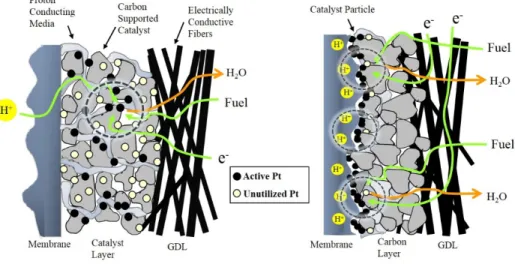
Highly dispersed Pt on carbon black has been widely employed in polymer electrolyte membrane fuel cell (PEMFC). For commercial application, it is necessary to develop inexpensive catalysts that exhibit higher performance and stability than Pt/C catalysts. Low Pt loading and improved mass activity are required since Pt, which is used as the catalyst, is rare and expensive. For these reasons, many studies have been directed towards the development of electrodes with high performance with low Pt loadings [1-4]. Anode and cathode electrodes for PEMFC have been prepared by various methods such as the impregnation [14], polyol [15], microemulsion [16] and electrodeposition methods [17-21]. Catalyst powders synthesized by means of the impregnation, polyol, and microemulsion methods were well mixed with an ionic binder and then apply the paste on a porous support by a decal or a blade or a spray method. After this procedure, the membrane electrode assembly (MEA) was generally fabricated by using the prepared electrode and a Nafion membrane. Inactive catalyst sites are always present in the catalyst layer prepared by the conventional method (Figure 1). This method does produce a large number of inactive catalyst sites. These inactive sites are not available for fuel cell reaction because the electrochemical reaction is limited only at the interface between the polymer electrolyte and the catalyst that is exposed to the reactant, known as the triple-phase reaction zone [22].Also, an ionic binder is added to the electrode in order to extend the triple-phase boundaries. As a
result, it increases the production cost of the electrode.
Figure 1. Structure of electrode prepared by (a) conventional method and (b) electrodeposition method and transport of fuel, protons, and electrons.
In order to overcome this limitation, the electrodeposition method was applied on a surface of a substrate. Therefore, it offers not only enhanced catalyst utilization but also simplification of preparation. Taylor et al. [23] developed an electrochemical catalyzation technique to improve the utilization of Pt catalyst. Antoine and Durand [24] impregnated carbon with H2PtCl4 and applied an electrochemical pulsed current to deposit Pt on the Nafion active layer. This process guarantees a smaller active layer thickness and high Pt mass fraction up to 40 wt.%. Kim et al. [20] used a pulse electrodeposition technique to prepare MEA. In this technique, Pt was deposited on the surface of the carbon electrode, followed by heat treatment and Nafion impregnation. In this case, the impregnated polymer electrolyte covered the
Pt particles, and thus, some Pt particles were not exposed to the reactant. In addition, some Pt particles were not always in good contact with the electrolyte phase because Nafion could not penetrate into the catalyst layer easily. In terms of the triple-phase boundary reaction zone, these electrodes may face problems of poor electrolyte contact or poor reactant diffusion. In order to overcome these problems, the electrodeposition technique was applied on a Nafion-bonded uncatalyzed carbon electrode. Thus use of Nafion as a proton conducting binder in the catalyst layer has been demonstrated to increase the Pt utilization significantly.
In first-grneration PEMFCs, catalyst layers containing PTFE (polytetrafluoroethylene)-bonded Pt catalysts with a high loading of 4 mgpt cm-2 were used as the PEMFC electrodes [25]. Srinivasan et al. reported high performance electrodes with a low catalyst loading of 0.35 mgpt cm-2 [26, 27]. This achievement was made possible mainly by using Nafion instead of PTFE as the catalyst binder. For using a Nafion-bonded carbon electrode, it is necessary to modify the heat treatment process because Nafion is thermally unstable above 150
oC [28]. Another approach for the heat treatment is improving the mechanical properties of Nafion ionomer. It is reported that if the protons in Nafion ionomer are exchanged by other cations, the thermal stability of Nafion ionomer is improved [29, 30-33]. The molecular structure of Nafion (Figure 2) consists of a poly (tetrafluoroethylene) (PTFE) backbone with perfluorinated pendant chanins terminated by sulfonate groups in the acid form. Mauritz and Moore performed DMA (dynamic mechanical analysis) studies of various Nafion membranes
including the acid form and other cationic forms [28]. After the conversion of Nafion to the sodium sulfonated form (Nafion-Na+), the ionomer exhibited a significant shift in the α relaxation to temperature near 250 oC. Due to this thermal stability, the Nafion (Na+)-bonded electrodes are possible to treat to 250 oC.
Figure 2. Chemical structure of Nafion (sulfonic acid form).
In general, electrodeposition can be carried out by using either a potentiostatic or a galvanostatic technique, which involves direct and pulse techniques.
Electrodeposition via the galvanostatic pulse technique is considered convenient to improve the current distribution. Therefore, it is easy to control the particle size and composition of the alloy simply by varying experimental parameters such as on/off time and peak current density [34, 35]. Electrode fabrication by electrodeposition results in the increase of catalyst utilization and low cost requirement. An advantage point of electrodeposition is also the simplification of electrode preparation reducing the catalyst synthesis step. Therefore, electrode fabrication using the electrodeposition method can increase the efficiency of PEMFC [36].
In this part, we study on the electrode preparation method for low Pt-Co loading on Nafion (Na+)-bonded carbon electrodes using a current pulsed electrodeposition
technique and the optimal ratio of Pt-Co cathode catalyst. The main feature of this method is the location of the Pt-Co deposition that is limited only to the triple- phase boundary reaction zone areas and thereby we can get improved performance with low Pt-Co loading.
2. LITERATURE SURVAY
2. 1. Electrodeposition process
In an electrodeposition process, metal ions are transferred from the solution to the cathode and adsorbed at the electrode surface and adatoms are formed by the change transfer reaction. An adatom deposited on the surface of a perfect crystal stays on the surface as an adion only temporarily because of its low binding energy to the crystal. And formation of clusters occurs to increase is stability and finally incorporated into the crystal lattice [37]. At this time, two competing steps occur at the surface of electrode. One is the growth of crystals and another is the creating nucleation. These two steps can be influenced by the surface diffusion rate of adatom and the rate of charge transfer reaction.
When the charge transfer step in an electrodeposition reaction is fast, the rate of growth of nuclei (crystallites) is determined by the lattice incorporation step of diffusion of electrodeposition ions into the nucleus (diffusion in the solution). In the initial stages of growth of the nuclei it can be assumed that nuclei grow
independency of each other. In this case the rate of growth of a single 3D hemispherical nucleus is given by
ν= (𝑛𝑛𝑛𝑛𝑘𝑘3𝜌𝜌2𝜋𝜋𝑀𝑀2 2)𝑡𝑡2 ……… (i)
Where k is the rate constant of 3D nucleus growth (mol cm-2 s-1), M is molecular weight, and ρ is the density of deposit (mass/volume) [37].
However, in order to obtain uniform and small sized catalyst particles, formation of nuclei is preferred growth of existing crystal. The rate of nuclei formation, ν, is given by:
ν = k1 exp (-k2/h2) ……… (ii) where k1 and k2 are constants and h is the overpotential [34]. Therefore, the rate of nuclei formation depends on the overpotential that is given by the Tafel expression,
h = a + b log i ……… (iii)
where a and b are constants, and i is the current density. From the above equations, it can be indicated that as the applied current density increases.
Pulsed electrodeposition can raise the limiting current density, because the metal ion can be supplied from the bulk solution during the off time of the pulse.
Consequently, this effect of off time bring out increase of nucleation rate based on equation [34, 38, 39] but the galvanostatic direct technique has only one variable such as current density. As current density for deposition increases, the metal ions near cathode are quickly exhausted and these concentrations become zero. Finally, the galvanostatic direct technique has lower limit current density and overpotential
for nucleation compared to the galvanostatic pulse technique [34].
In general, electrodeposition can be largely divided into galvanostatic [40, 41] and potentiostatic method (Table 1). The galvanostatic method is more convenient to high geometric surface area electrodes because of two-electrode system and arbitrary waveform generator [42]. The galvanostatic method with two-electrode system assorts direct and pulse technique. Especially, the galvanostatic pulse technique show many advantages. For example, improvement of the current distribution and possibility of adjustment for the particle size of catalyst and composition of alloy by varying independent parameters, such as on-time (ton), off- time (toff) and peak current (ip) density as shown in Figure 5. The duty cycles that is related to on-time and off-time is defined as follows.
Duty cycle (%) = 𝑡𝑡𝑜𝑜𝑜𝑜
𝑡𝑡𝑜𝑜𝑜𝑜+𝑡𝑡𝑜𝑜𝑜𝑜𝑜𝑜 × 100 ……… (iv)
During on time, growth of existing crystal and formation of nuclei occur at the surface of electrode as shown in Figure 6.
Table 1. Galvanostatic technique and potentiostatic technique.
Figure 5. General concept of galvanostatic pulsed electrodeposition.
Figure 6. Effect of duty cycle in galvanostatic pulsed electrodeposition.
(1) Effect of Peak Current Density
A decrease in particle size by application of the current density has often been reported in the literature [35]. There are several ways of examining the effect of pulsed current density on the particle size. One of the ways is an increase in pulsed current density at constant pulse charge and at constant average current density.
This method has the advantage that ambiguity in interpretation of the results due to the influence of the off-time can be avoided. Increased pulsed current density amplitude leads to increased adatom concentrations, corresponding to equation (iii) to higher overpotentials and therefore, according to equation (ii), to higher nucleation rates.
(2) Effect of Duty Cycle
The duty cycle can be changed by increasing the off-time when the peak current density, on-time and total charge density are fixed. Duration of the off-time plays an important role in the deposition since the recovery of concentration of the electroactive species on the surface electrode occurs in this period. As the off-time decrease, a large increase of the particle size of the deposit is observed [34]. The results can be explained by taking into account that the limiting current density decreases with an increase of the duty cycle.
(3) Effect of Surface Concentration
Reaction rate and deposit structure depend on the surface concentration of the reacting species. Mass transport limits the maximum rate of deposition and influences the structure and the properties of obtained deposits. The maximum rate of mass transport in plating system corresponds to the limiting current density at which the surface concentration of the reacting species at the electrode is zero. And the limiting current density is proportional to the bulk concentration of the reacting species. That is to say, the surface concentration of the reacting species has influence on the rate of deposition and the current efficiency.
(4) Effect of Temperature
An effective control of the deposition process operating temperature is vital for the consistent performance of any deposition bath. Deviations of more than 5 oC from optimum temperature are sufficient to harm plate quality, deposition rates, and other properties. The higher temperature provides higher plating rates and the ability to operate more dilute baths without the loss of current efficiency. We have focused on the optimization of the deposition conditions using the uncatalyzed electrode, which decide the deposition parameters; current density, duty cycle, charge density and concentration of chemical species. As the deposition parameters are optimized, the fuel cell performance can be increased with higher utilization of the catalyst.
3. EXPERTIMENTAL
3. 1. Electrode preparation
The carbon slurry was made by mixing 0.1 g Vulcan XC-72 carbon powder, 0.43 mL Nafion solution (Aldrich, 5 wt.% in lower aliphatic alcohols and water, 1100 EW) with 6 mL isopropyl alcohol in an ultrasonic bath (Figure 7).
Figure 7. Preparation of uncatalyzed carbon layer.
Then, excess sodium hydroxide was added to the mixture in order to change the H+-form of Nafion to the Na+-form. Figure 8 illustrates the schematic diagram of pulse electrodeposition method. To apply a uniform and flat electrode surface, the commercial gas-diffusion layer (GDL; E-TEK, LT 1200-W, Electrochem Inc.) was used as a backing layer. These steps were used to increase the current and thermal stability, respectively. The resulting carbon electrode had a hydrophilic surface due to the addition of the glycerol. The hydrophilic carbon layer was loaded with 0.3 mg cm-2 of carbon by spraying.
Galvanostatic pulsed electrodeposition of Pt-Co electrodes was carried out in a two-electrode cell by using an electrochemical instrument (VoltaLab80,
Radiometer). The uncatalyzed carbon electrode served as a working electrode and Pt mesh as a counter electrode. Electrodeposition was performed in a plating bath which contains the solution of 40 mM K2PtCl4 and various concentrations of CoCl2
(20, 40, 60, 120 mM) dissolved in 0.5 M NaCl. The parameters for galvanostatic pulse electrodeposition were a peak current density of 300 mA cm-2, an on/off time of 10/100 ms and a total charge density of 1 C cm-2. After the electrodeposition process, the electrodes were heated at 250 oC in H2 atmosphere for 30 min to remove organic solvent and reduce the oxidized catalysts. Subsequently, the electrode catalysts were performed for protonation in 0.1 M H2SO4 solution at 80oC for 30 min in order to exchange again the Na+-form of Nafion to the H+-form.
Figure 8. Schematic diagram of pulsed electrodeposition method.
3. 2. Characterization
The amount of deposited Pt-Co on the electrode was determined by using an electron probe micro-analyzer (EPMA, JEOL Co., JXA-8900R) and inductively coupled plasma-atomic emission spectroscopy (ICP-AES). The morphology and particle size of the electrodeposited Pt-Co catalysts were obtained with a high-
resolution transmission electron microscope (HR-TEM, JEOL Co., JEM-200CX).
Before and after the heat treatment, the oxidation states of Pt were analyzed by X- ray photoelectron spectroscopy (XPS, Pohang Accelerator Laboratory, Beam line 4B1). Data from X-ray diffraction measurements (XRD, Philips, X’pert APD) were analyzed for the degree of alloying and lattice parameters.
3. 3. Single cell test
The catalyst slurry for the conventional electrode was prepared by thoroughly mixing the supported catalyst (40 wt.% HP Pt/C, E-TEK), Nafion solution (5 wt.%), and an appropriate amount of isopropyl alcohol. The well-mixed slurry was sprayed on a GDL (E-TEK, LT 1200-W) with 0.4 mgpt cm-2. The electrodeposited electrode and the sprayed electrode were placed on either side of the Nafion 112 membrane (DuPont) as the cathode and anode, respectively. The membrane electrode assembly (MEA) was hot-pressed at 100 kgf cm-2 for 3 min at 130oC. For comparison, conventional MEA was also prepared by spraying both electrodes using the same GDL on both sides with a Pt loading of 0.4 mg cm-2. The cell performance and operating conditions were measured and controlled by a fuel cell test station (Globe Tech, Inc. 890 series, GT-500). The cell temperature was maintained at 70oC with the H2 and air gases humidified at 80oC for anode and 75oC for cathode, respectively. The pressure on both electrodes was maintained at 2 bar.
4. RESULTS AND DISCUSSION
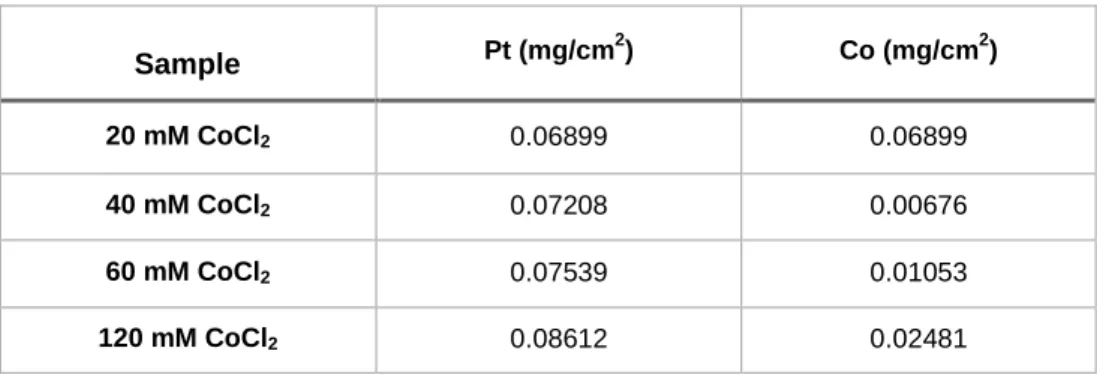
Under optimized conditions, Pt-Co alloy catalysts were prepared on Nafion(Na+)- bonded carbon layers by means of a galvanostatic method. The amount of loaded Pt and Co was controlled by changing CoCl2 concentration and it was determined by ICP-AES, as shown in Table 2. Concentrations of Co precursor were varied from 20 to 120 mM while the concentration of Pt precursor is fixed at 40 mM. The data in Table 1 show that amounts of Pt and Co increase as the concentration of Co precursor is increased and these values are used to calculate the chemical composition. Also, the chemical composition of Pt-Co electrode was measured from energy dispersive x-ray spectroscopy (EDS) results where average results were calculated from several different data points. The compositions of electrode were observed from ICP-AES and EDS, as reported in Table 3. From these results, reliable chemical compositions of electrode from two analytical methods were obtained.
Table 2. Amount of Pt and Co deposits from 40 mM Pt and various concentration of CoCl2. (Measured by ICP-AES)
Sample Pt (mg/cm
2) Co (mg/cm2)
20 mM CoCl2 0.06899 0.06899
40 mM CoCl2 0.07208 0.00676
60 mM CoCl2 0.07539 0.01053
120 mM CoCl2 0.08612 0.02481
Table 3. ICP-AES and EDS results of chemical composition for prepared catalysts.
Sample
Pt : Co atomic ratio
ICP-AES Measurement EDS Measurement
20 mM CoCl2 85 : 15 83 (±4) : 17 (±4)
40 mM CoCl2 76: 24 78 (±3) : 22 (±3)
60 mM CoCl2 68 : 32 64 (±3) : 36 (±3)
120 mM CoCl2 51 : 49 52(±4) : 48 (±4)
Figure 9. XRD patterns of the electrodeposited Pt-Co alloy catalysts after heat treatment (250 oC, 30 min, H2 10% / N2 90%).
XRD patterns were analyzed to investigate the structural change of Pt-Co alloy catalyst. As indicated in Figure 9, XRD patterns show the Pt (111), (200), (220), and (311). The lattice parameter values of Pt are 3.887 Å (Pt), 3.861 Å (Pt85Co15),
3.863 Å (Pt76Co24), 3.860 Å (Pt68Co32), and 3.859 Å (Pt51Co49) for Figure 9, respectively. The lattice parameter of the Pt-Co alloy catalysts smaller than that of pure Pt. The decreasing of lattice parameter results from the interpenetration of transition metals which are smaller than Pt. Also, the Pt (111) peak of Pt-Co electrodes shifts to a higher angle compared to a pure Pt peak due to the incorporation of Co atoms into Pt atoms [13, 43].
An XPS study was carried out to investigate the oxidation state of deposits before and after the heat treatment. Figure 10 shows the x-ray photoelectron spectra of Pt 4f of the prepared electrodes after the heat treatment.
Figure 10. X-ray photoelectron spectra of Pt 4f of electrodeposited Pt-Co alloy catalysts after heat treatment: (a) Pt85Co15, (b) Pt76Co24, (c) Pt68Co32, and (d) Pt51Co49. The spectra were deconvoluted into two components labeled as Pt and Pt2+.
The spectra can be deconvoluted into two components, labeled as Pt and Pt2+ (as PtO or Pt(OH)2). The relative intensities (%) of metallic Pt deposited from different Co concentrations are almost the same and these values increases in general after heat treatment, as shown in Table 4. It is reasonable to assume that the reduction of oxidized Pt occurs during the heat treatment. Based on XPS measurements, the electrodeposited Pt-Co alloy catalyst was found to have originated from the higher degree of relative intensity for metallic Pt on the catalyst surface compared to that of commercial 40 wt.% Pt-Co/C catalyst (E-TEK) in the XPS measurements of previous study [43]. The XPS results on electrodeposited Pt-Co alloy catalyst showed the presence of a relatively lower Pt-oxide content on the alloys.
Table 4. Binding energies and relative intensities of deposits as observed from the Pt 4f X- ray photoelectron spectra in Figure 10.
Sample Species Binding Energies of 4f 7/2 (eV)
Relative Intensities (%) Before
Heat Treatment
After Heat Treatment
Pt85Co15
Pt 71.0 83.6 85.3
Pt2+ 73.2 16.4 14.7
Pt76Co24
Pt 71.0 83.2 85.2
Pt2+ 73.1 16.8 14.8
Pt68Co32
Pt 71.0 83.6 85.5
Pt2+ 73.2 16.4 14.5
Pt51Co49
Pt 71.0 83.3 85.4
Pt2+ 73.0 16.7 14.6
Unfortunately, we can’t find any reliable peak of cobalt 2p due to low loading catalysts. A trace metal loading causes weak signal on XPS experiment.
Figure 10. HR-TEM images of electrodeposited Pt-Co alloy catalysts after heat treatment:
(a) Pt85Co15, (b) Pt76Co24, (c) Pt68Co32, and (d) Pt51Co49. Insets indicate the particle size distribution.
The morphology of Pt-Co particles was observed by HR-TEM, and the images are presented in Figure 11. These images were obtained from a series of deposits with a total charge density of 1 C cm-2 and various compositions. The average particle
sizes were calculated by particle distributions. Before heat treatment, size of those catalysts were 3-4 nm regardless of Co concentration (not shown here) while the average particle size of Pt-Co electrode after heat treatment at 250oC in H2
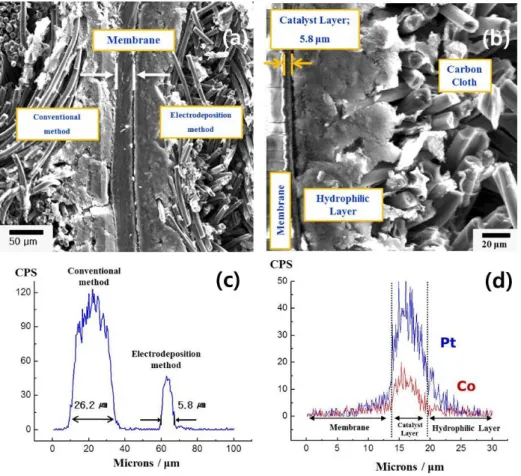
atmosphere for 30 min grew a little (3-5 nm). In order to estimate the thickness of catalyst layer, SEM images and line scan were obtained by using EPMA coupled with SEM. Figure 11 (a) shows the cross-sectional image of MEA consisting of a conventional anode (left), pulse electrodeposited cathode (right) and Nafion membrane (middle). Figure 11 (b) displays the cross section image of the electrodeposited electrode from Pt76Co24 catalyst. The cross section image clearly shows the three layers consisting of catalyst layer, carbon layer and carbon cloth.
The thickness of catalyst layer is measured to be 5-6 μm. The thickness of the Pt catalyst layer of anode and cathode is confirmed to be 26.2 μm and 5.8 μm, as shown in Figure 11 (c). The thickness of deposited cathode is about four times thinner than that of the E-TEK anode prepared by conventional method. Namely, the pulse electrodeposited cathode shows a high intensity of Pt peak in the thin area from the membrane. Figure 11 (d) shows the Pt-Co concentration profile of electrodeposited cathode electrode. The electrodeposited electrode increases the number of triple-phase boundaries where reactant is in contact with catalyst and ionomer. Therefore, there is the possibility of a higher Pt-Co utilization because of the existence of abundant triple phase boundaries.
Figure 11. Cross-sectional SEM images and EPMA concentration profiles of the electrodeposited electrode from Pt76Co24 catalyst: (a) Cross-sectional image of MEA consisting of a conventional anode (left), pulse electrodeposited cathode (right) and Nafion 112 membrane (middle), (b) Cross-sectional image of pulse electrodeposited cathode, (c) Pt concentration profile of MEA, and (d) Pt-Co concentration profile of electrodeposited electrode for cathode.
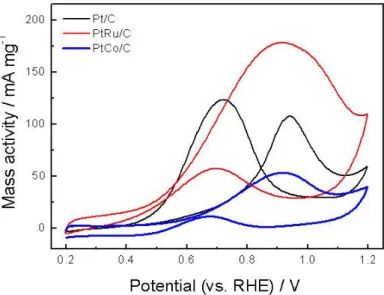
Figure 12. Voltammograms of deposited Pt/C, Pt-Ru/C, Pt-Co/C catalysts in 0.5 M CH3OH and 0.5 M H2SO4 solution.
Methanol crossover results in a significant loss in coulombic efficiency and voltage efficiency of a DMFC because the Pt/C is commonly used as the cathodic catalyst, and methanol would be oxidized at the cathode [44, 45]. To avoid this problem, one is the use of oxygen reduction catalysts, which are inactive towards methanol oxidation or have a high methanol tolerance strategy is the use of oxygen reduction catalysts, which are inactive towards methanol oxidation or have a high methanol tolerance. Previous studies have proved that the use of some Pt alloy catalysts could be an efficient route to meet this requirement because the carbon-supported Pt-Cr alloy catalyst [46, 47] and bulk Pt70Ni30 alloy catalyst [48] have been found to exhibit a high methanol tolerance during oxygen reduction in comparison to pure Pt.Figure 12 presents potential sweep voltammograms in a 0.5 M CH3OH and 0.5
M H2SO4 solution at Pt/C, Pt-Ru/C, and Pt-Co/C catalysts. It is seen that the Pt- Ru/C and Pt/C catalysts exhibit enhanced catalytic activity toward methanol oxidation. However, the Pt-Co/C catalyst showed a high methanol tolerance.
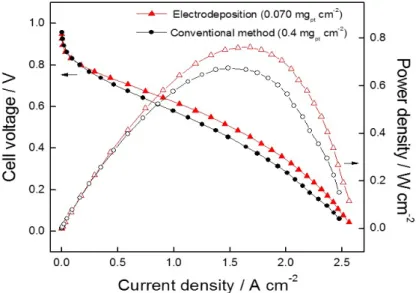
Figure 13. Current-voltage polarization curves of electrodeposited cathode catalysts and conventional method using the 40 wt.% HP Pt/C E-TEK catalyst. The anode catalyst loading was maintained at 0.4 mgpt cm-2. The cell temperature was maintained at 70oC with the anode H2 and cathode air gases. The pressure on both electrodes was maintained at 2 bar:
(●) pulse electrodeposited cathode with catalyst loading of 0.070 mgPt cm-2, (▲) conventional electrode with Pt loading of 0.4 mgpt cm-2.
Figure 13 shows the polarization curves from the PEM fuel cell prepared by using two different types of cathodes. One was prepared by using the electrodeposited Pt on uncatalyzed carbon electrode and the other was prepared by conventional method using the 40 wt.% Pt/C E-TEK catalyst. The total amount of metals in the cathode was determined as 0.070 mgPt cm-2 by ICP-AES. While conventional MEA
were fabricated by spraying the catalyst slurry with 0.4 mgPt cm-2 on GDL on the cathode side. The current densities are 1.051 A cm-2 and 0.858 A cm-2 at 0.6 V for pulse electrodeposited electrode and conventional electrode, respectively. In comparison with the conventional electrode made with catalysts from the E-TEK, the electrode prepared by electrodeposition contains only 17.5 % of catalyst of the E-TEK shows a better performance in almost the entire current density regions. It is certain that a less amount of Pt is required with the electrodeposition method to exhibit the same performance as the electrodes prepared by the conventional method.
Figure 14. Current-voltage polarization curves of the electrodes prepared with different Pt- Co compositions. The electrodeposited electrodes were used as the cathode. The anode catalyst loadings were maintained at 0.4 mgpt cm-2. The cell temperature was maintained at 70 oC with the anode H2 and cathode air gases. The pressure on both electrodes was maintained at 2 bar: (◆) Pt85Co15, (▲) Pt76Co24, (★) Pt68Co32, and (■) Pt51Co49.
![Figure 8. Cyclic voltammogram of polycrystalline platinum in 1 M KOH, 20 o C, nitrogen purged, sweep rate = 100 mV s -1 [53]](https://thumb-ap.123doks.com/thumbv2/123dokinfo/11750778.0/23.808.231.578.712.917/figure-cyclic-voltammogram-polycrystalline-platinum-nitrogen-purged-sweep.webp)