저작자표시-비영리-변경금지 2.0 대한민국 이용자는 아래의 조건을 따르는 경우에 한하여 자유롭게
l 이 저작물을 복제, 배포, 전송, 전시, 공연 및 방송할 수 있습니다. 다음과 같은 조건을 따라야 합니다:
l 귀하는, 이 저작물의 재이용이나 배포의 경우, 이 저작물에 적용된 이용허락조건 을 명확하게 나타내어야 합니다.
l 저작권자로부터 별도의 허가를 받으면 이러한 조건들은 적용되지 않습니다.
저작권법에 따른 이용자의 권리는 위의 내용에 의하여 영향을 받지 않습니다. 이것은 이용허락규약(Legal Code)을 이해하기 쉽게 요약한 것입니다.
Disclaimer
저작자표시. 귀하는 원저작자를 표시하여야 합니다.
비영리. 귀하는 이 저작물을 영리 목적으로 이용할 수 없습니다.
변경금지. 귀하는 이 저작물을 개작, 변형 또는 가공할 수 없습니다.
공학석사 학위논문
Electrochemical Carbon Dioxide
Reduction to Methyl Formate in Methanol
메탄올 전해질에서 전기 화학적 이산화탄소 환원으로 메틸포르메이트 생산에 관한 연구
2020년2월
서울대학교대학원 재료공학부
Yeo Jia Bin
(여지아빈)
i
Abstract
Electrochemical Carbon Dioxide Reduction to Methyl Formate in
Methanol
Yeo Jia Bin Department of Materials Science and Engineering The Graduate School Seoul National University
Atmospheric carbon dioxide levels have been steadily on the rise since the Industrial Revolution, bringing along the phenomenon of global warming, leading to extreme climate changes, melting of ice caps, destruction of ecosystems, and many other severe environmental issues. In nature, carbon is released from respiration of living things and is recycled by green plants through photosynthesis. In the dark reactions of photosynthesis, CO2 is incorporated into the structures of sugars by the Calvin cycle. Taking inspiration from this biochemical reaction, an artificial electrochemical CO2
reduction system utilizing renewable energy sources is proposed to reduce atmospheric carbon dioxide levels and to convert CO2 to various useful forms.
Electrochemical CO2 reduction research has been mostly done in aqueous electrolyte, and the major reaction products are identified as carbon monoxide,
ii
formic acid, methanol, methane and some highly reduced products such as ethylene and ethanol. The large number of electrons required in CO2
reduction to ethylene results in low price per electron, and sufficiently high Faradaic efficiencies for economically viable ethylene production from CO2 reduction is yet to be achieved. While carbon monoxide and formic acid have the highest prices per electron, carbon monoxide is highly toxic and requires special handling, and the separation of formic acid from aqueous electrolytes is very difficult due to the formation of an azeotrope. Thus, we turned to a new strategy of CO2 reductive functionalization to produce new reaction products from CO2 reduction by the formation of C-C, C-N and C-O bonds.
In the case of C-O bond formation, CO2 is reacted with methanol over a transition metal catalyst at high pressure conditions to form methyl formate.
Instead of thermal methods, electrochemical methods have advantages over thermal methods in terms of reaction product tunability, recyclability of the heterogeneous catalyst and mild reaction conditions. Thus, we propose the electrochemical reduction of CO2 in methanol for the production of methyl formate as a value added product that is easily separable from the reaction solvent.
In order to conduct the experiments in a one-pot cell, an anodic material that does not produce methyl formate from methanol oxidation was selected. Methanol partial oxidation to methyl formate is known to occur on platinum surface, thus the commonly used Pt anode in electrochemical CO2
reduction systems could not be used in the system to investigate CO2
reduction in methanol to methyl formate in a one-pot cell. Titanium was found to show little to none methyl formate formation and was thus selected as the anode material in further experiments. For the cathode material, metals not active in CO2 reduction, CO producing metals, formate producing metals and also hydrocarbon producing Cu were tested and it was determined that Sn showed the highest methyl formate efficiency, thus Sn was chosen as the
iii
cathode material for further experiments. The formation of methyl formate from CO2 reduction was directly confirmed by isotopic 13CO2 experiments.
The activity of CO2 reduction on Sn surface in methanol with sodium perchlorate (NaClO4) supporting electrolyte was confirmed by cyclic voltammetry, and the Faradaic efficiency of methyl formate was fairly unaffected by applied potential and was determined to be 11% to 13% in the range of -1.9V to -2.5V vs Ag/Ag+. The presence of moisture was also shown to be detrimental to the formation of methyl formate from CO2 reduction in methanol. In attempt to increase methyl formate Faradaic efficiency, other supporting electrolytes were tested. The effect of the type of cation was tested and it was determined that Na+ cations yields the highest current efficiency for methyl formate in comparison to Li+ and TBA+. The effect of anions was also investigated. BF4- anions were determined to yield even higher Faradaic efficiencies in comparison to ClO4- anion. It is hypothesized that weakly coordinating anions that have little to none interaction on the cathodic surface are crucial to the formation of methyl formate on Sn surface. Further potential dependency experiments in 0.1M NaBF4 methanol showed methyl formate formation at high current efficiencies at 69% to 79% in the potential range of -2.2V to -2.7V vs Ag/Ag+.
Key words: Electrochemical CO2 Reduction, Methanol, Methyl Formate, Reductive Functionalization
Student Number: 2018-18752
iv
Contents
Chapter 1: Introduction…...……1
1.1 The Global Carbon Cycle...1
1.2 Electrochemical CO
2Reduction...6
1.2.1 The Aqueous System...7
1.2.2 The Non-Aqueous System...14
1.2.3 Challenges in Electrochemical CO2 Reduction...16
1.3 CO2 Reductive Functionalization...21
1.3.1 C-O Bond Formation to Produce Methyl Formate...22
1.3.2 Methyl Formate Production by Electrochemical CO
2Reduction in Methanol ...29
Chapter 2: Study on Electrochemical CO2 Reduction to
Methyl Formate in Methanol at Ambient Temperature and
Pressure………...36
v
2.1 C-O Bond Formation by the Formation of Methyl Formate by Electrochemical CO2 reduction in
Methanol...36
2.2 Experimental Procedures...38
2.2.1 Chemicals and Materials...38
2.2.2 Electrochemical Analysis...38
2.2.3 Analytical Methods...39
2.3 Results and Discussions...41
2.3.1 Defining a Non-Methyl Formate Producing Anode...41
2.3.2 Defining a Methyl Formate Producing Cathode Material...48
2.3.3 Formation of Methyl Formate from CO2 Reduction on the Cathode...50
2.3.4 Electrochemical CO
2Reduction on Sn...52
2.3.5 Effect of Water Concentration...56
2.3.6 Effect of Supporting Electrolyte...59
2.3.6.1 Cation Effect...59
2.3.6.2 Anion Effect...65
Chapter 3: Conclusion………...71
vi
References...74
국문초록 ...82
vii
List of Tables
Table 1.1: Solubility of CO2 in various solvents at 25°C. ...15 Table 1.2: Market price and normalized price of CO2 reduction products. ...20 Table 2.1: Methyl formate concentration produced on various anodic materials in the anolyte after the respective amount of charge is passed.
Among the tested materials, Sn and Ti foil showed methyl formate concentration of one order lower than other anodic materials. ...47 Table 2.2: Data obtained from REF [40] displaying the effective cation radii (Å ), showing the decreasing effective interfacial cation radii with increasing metallic cationic radius, and increasing effective interfacial cation radii with increasing organic cation radius. ...64
viii
List of Figures
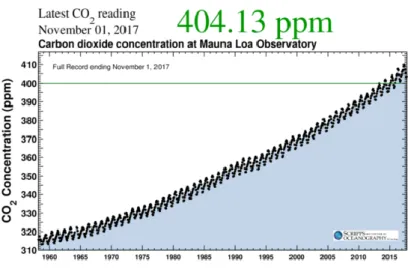
Figure 1.1. Atmospheric CO2 concentrations since the 1960’s to 2017.
Measurements taken at the Mauna Loa Observatory in Hawaii. ...3 Figure 1.2. The carbon cycle, showing net carbon emission sources and uptake in the environment. The amount of carbon emission and uptake are shown in units of teragrams per year (Tg/year), resulting with a final net increase in atmospheric carbon dioxide amount by 1009 Tg/year. ...4 Figure 1.3 (a) A simplified scheme showing uptake of CO2 in the chloroplast of green plants to be converted to sugars by the Calvin cycle. ...5 (b) The Calvin cycle. ...5 Figure 1.4 Scheme showing electrochemical CO2 reduction to fuels and industrially useful chemicals, coupled with renewable CO2
free energy sources to create a CO2 neutral energy cycle. ...10 Figure 1.5 Oxygen plasma treated copper catalyst for selective C2H4
formation. ...11 Figure 1.6 Anodized Ag electrode for highly selective CO formation. ...12 Figure 1.7 (a) STEM image of carbon supported BiOx nanoparticles. ...13 (b) Potential dependence of Faradaic Efficiencies for HCOO-, H2, and CO production on the BiOx/C catalysts and commercial Bi2O3. ...13
ix
Figure 1.8 (a) Faradaic efficiencies of CO, formate, methanol, methane from years 1980 to 2019...18 (b) Faradaic efficiencies of ethylene, ethanol, n-propanol achieved from years 1980 to 2019. ...18 Figure 1.9 Net Present Value (NPV) plots for CO2 reduction products (carbon monoxide, formic acid, ethylene and ethanol) at various applied overpotentials and the achievable Faradaic efficiencies. ...19 Figure 1.10 Vertical and horizontal utilization, and also reductive functionalization or diagonal utilization of CO2. ...25 Figure 1.11 (a) C-C bond formation between CO2 and halobenzene to form
benzaldehyde ...26 (b) C-N bond formation between CO2 and dimethyl amine or diethyl amine to form dimethylformamide or diethylformamide ...26 (c) C-O bond formation between CO2 and methanol to form methyl formate. ...26 Figure 1.12 Methyl formate synthesis routes – 1) Carbonylation of methanol, 2) Dimerization of formaldehyde, 3) Oxidative dehydrogenation of methanol, 4) Hydrocondensation of CO2
with methanol, 5) Dehydrogenation of methanol and 6) Direct synthesis from syngas. ...27 Figure 1.13 C-O bond formation between CO2 and methanol to form methyl formate through a formic acid intermediate. ...28
x
Figure 1.14 Concentration and mole fraction of CO2 in methanol at different applied pressures. ...33 Figure 1.15 The observed product distribution for electrochemical CO2 reduction at 25°C, 41atm on various transition metal electrodes in methanol. ...34 Figure 1.16 The suggested mechanism of the formation of methyl formate from methanol oxidation on Pt surface, which differs from previous reports suggesting that methyl formate formation is due to chemical reaction step between formaldehyde formed from methanol oxidation and a methanol molecule, instead of direct oxidation steps on Pt surface. ...35 Figure 2.1 (a) Chronopotentiometric measurements at -1.9V vs Ag/Ag+
with Sn cathode and Sn anode, in which a sharp current increase is observed, indicating Sn ion deposition on the Sn cathode surface ...44 (b) Ti anode, where no sharp increases in current is observed, indicating that no ion deposition occurred on the Sn cathode surface. ...44 Figure 2.2 GC spectrum showing methyl formate peaks at retention time
of 3.05min for Ar and CO2 purged electrolytes respectively after bulk electrolysis at -1.9V vs Ag/Ag+ and 10C charge has passed. The concentration of methyl formate for the Ar purged condition was 0.009mM, while for the CO2 purged condition was 0.6mM. ...45 Figure 2.3 (a) GC spectrum showing gas products before bulk electrolysis ...46
xi
(b) GC spectrum after bulk electrolysis in Ar purged 0.5M NaClO4 methanol with Sn cathode and Ti anode at -1.9V vs Ag/Ag+ after 10C charge is passed. ...46 Figure 2.4 Product distribution of chronoamperometric experiments at - 1.0mA in CO2 purged 0.5M NaClO4 methanol after 10C charge is passed on Ti, Au, Pb, In, Hg, Sn and Cu. ...49 Figure 2.5 Comparison of methyl formate mass spectrum of 12CO2 and
13CO2 purged electrolyte. The mass/charge ratio peak at 29 corresponds to the formate part (CHO+) of the methyl formate molecule, while the 60 m/z peak corresponds to the whole methyl formate molecule. The presence of isotopic 13C results in the 30 and 61 m/z peak. ...51 Figure 2.6 Cyclic voltammetry (CV) curves comparison in Ar and CO2
purged 0.5M NaClO4 methanol on Sn cathode and Ti anode.
The scan rate was 0.05V/s and the cycle shown was the 8th cycle. ...54 Figure 2.7 Product Faradaic efficiencies distribution of CO2 reduction on Sn cathode in 0.5M NaClO4 methanol. The products are represented by ■ CHOOCH3; ●H2; ♦CO; ▲CH4; ★ total Faradaic efficiency. ...55 Figure 2.8 Product Faradaic efficiencies distribution of CO2 reduction on
Sn according to the concentration of water added prior to bulk electrolysis from 0M to 1M in 0.5M NaClO4
methanol. ...57 (a) shows the all the product distributions of H2, CO and CHOOCH3 ...57 (b) shows the Faradaic efficiency of CHOOCH3 ...57
xii
(c) shows the Faradaic efficiency of H2 ...58 (d) shows the Faradaic efficiency of CO according to increasing water concentration. Bulk electrolysis was conducted at -2.0V vs Ag/Ag+ until 10C charge has passed. ...58 Figure 2.9 CV curves for CO2 purged 0.1M LiClO4, NaClO4 and TBAClO4 in methanol at scan rate 0.05V/s. The displayed cycle is the 8th cycle. ...61 Figure 2.10 Product distribution of bulk electrolysis in CO2 purged 0.1M LiClO4, NaClO4 and TBAClO4 methanol on Sn cathode at - 2.0V vs Ag/Ag+. Products are analysed when 10C charge is passed. ...62 Figure 2.11 Scheme obtained from REF [40] showing the bigger hydrated cation radius of smaller cations such as Li+, while the bigger cations such as Cs+ results in smaller hydrated cation radius. ...63 Figure 2.12 Product distribution of bulk electrolysis at -2.0V vs Ag/Ag+ in CO2 reduction in 0.1M NaClO4, NaCl, NaOCH3 and NaBF4
methanol respectively after 10C charge has passed. ...68 Figure 2.13 Mass spectrum of methyl formate formed from 12CO2 (black)
and isotopic 13CO2 (red) purged 0.1M NaBF4 methanol electrolyte after 10C charge is passed, at -2.2V vs Ag/Ag+. ...69 Figure 2.14 Potential dependency and product dependency of CO2
reduction in 0.1M NaBF4 methanol after 10C charge is passed.
xiii
The products are represented by ■ CHOOCH3; ●H2; ♦CO;
▲CH4; ★ total Faradaic efficiency. ...70
1
Chapter 1. Introduction
1.1 The Global Carbon Cycle
Carbon dioxide (CO2) is a well-known greenhouse gas that traps heat in the Earth’s atmosphere, keeping the Earth warm. Atmospheric CO2 levels have been steadily on the rise since the Industrial Revolution in the 19th century. There has been a sharp increase especially in recent years due to excessive carbon dioxide release from industrial activities such as product manufacturing. According to data published by NASA, obtained from the Mauna Loa Observatory, atmospheric CO2 levels have surpassed a 400ppm threshold in the year 2014, as shown in Figure 1.1. This rapid increase in atmospheric CO2 levels has a close correlation with increase in global temperatures, leading to environmental problems of global warming and climate change.
In attempt to tackle the problem of climate change, global agreements have been signed. The Paris Agreement, for example, has been initially signed in December 2015 and has been adopted under the United Nations Framework Convention on Climate Change (UNFCCC). The aim of the agreement is to keep global warming to well below 2 degrees Celcius and to make efforts to limit increases in global temperatures to below 1.5 degrees Celcius. Countries involved have agreed to submit Intended Nationally Determined Contributions (INDC) to outline their strategies to address a wide range of climate change issues, for example their targets and actions for reducing greenhouse gas emissions. 1 In spite of the many efforts taken by the international community, more in depth research is still needed to tackle global warming from the more fundamental scientific levels.
2
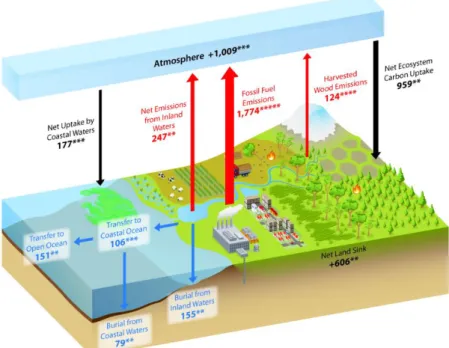
Shown in Figure 1.2 is a simplified scheme of the atmospheric carbon cycle. The numbers indicate the amount of carbon released into or absorbed from the atmosphere per year in units of teragrams (Tg/year). Carbon release into the atmosphere through natural processes such as the respiration of living things and the decomposition of organic materials are balanced by natural carbon uptaking processes such as the photosynthesis of green plants.
However, human activities such as industrial manufacturing activities have largely lead to increase in CO2 release into the atmosphere. The burning of fossil fuels to provide energy required for such activities have led to an approximate of 1774 Tg of carbon released per year into the atmosphere, in addition to other carbon emission sources, resulting in a net increase in atmospheric CO2 content by about 1009 Tg of carbon per year.
This leads to an unclosed carbon cycle due to the insufficient uptake of atmospheric carbon by natural processes, leading to an unprecedented increase in atmospheric gaseous carbon levels, consequentially worsening the global warming and climate change scenario. In nature, photosynthesis is the process which enables the capture of atmospheric CO2 and converting CO2
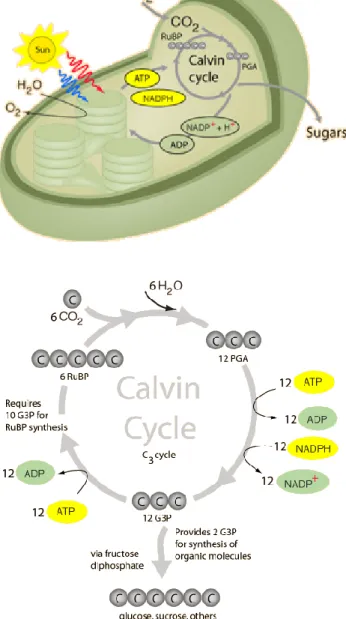
into hydrocarbons. Figures 1.3 (a) and (b) show the process of the absorption of CO2 into the chloroplasts of green plants, which then undergoes the Calvin cycle to incorporate the CO2 molecule into the structure of sugars, such as glucose. The process of photosynthesis can be expressed in the net reaction:
6CO2 + 6H2O + light → C6H12O6 + 6O2
Taking inspiration from the natural process of photosynthesis, artificial methods to mimic the bioprocesses can be developed to further reduced atmospheric carbon content at a faster rate so as to close the carbon cycle.
3
Figure 1.1: Atmospheric CO2 concentrations since the 1960’s to 2017.
Measurements taken at the Mauna Loa Observatory in Hawaii.
4
Figure 1.2: The carbon cycle, showing net carbon emission sources and uptake in the environment. The amount of carbon emission and uptake are shown in units of teragrams per year (Tg/year), resulting with a final net increase in atmospheric carbon dioxide amount by 1009 Tg/year.
5
Figure 1.3 (a) A simplified scheme showing uptake of CO2 in the chloroplast of green plants to be converted to sugars by the Calvin cycle, with the utilization of enzymes and sunlight. (b) The Calvin cycle.
(a)
(b)
6 1.2 Electrochemical CO2 Reduction
Taking inspiration from the natural process of photosynthesis to capture and utilize atmospheric CO2, artificial methods to capture and utilize atmospheric CO2 can be developed to balance out the excessive gaseous carbon released from fossil fuel burning. One method is by electrochemical CO2 reduction to other useful chemical forms. Shown in Figure 1.4 is a simplified scheme for electrochemical CO2 reduction, in which if renewable, carbon free energy sources can be coupled with the electroreduction system, CO2 can be chemically reduced to industrially useful chemicals, such as carbon monoxide, formic acid and ethylene, or to fuels, such as methane and methanol, thereby closing the carbon loop. 2,3,4 While CO2 reduction can be achieved by chemical or thermal methods with homogeneous catalysts, electrochemical reduction provides the advantages of using heterogeneous catalysts with high recyclability and separation from the electrolyte, tunability of reaction products, and allows engineering of the catalyst to allow high product selectivity. 5,6
The CO2 molecule however, is in the fully oxidized form, which makes it very stable and requires high overpotentials to chemically reduce it to more reduced forms. Listed below are the chemical equations and standard electrode potentials for the reduction of CO2 to other carbon-based products, estimated from thermodynamic data in aqueous media at 25°C with respect to Standard Hydrogen Evolution (S.H.E) reference electrode: 7,8,9
CO2 + 2H+ + 2e- → CO + H2O E°’ = -0.53V CO2 + 2H+ + 2e- → HCOOH E°’ = -0.61V CO2 + 6H+ + 6e- → CH3OH + H2O E°’ = -0.38V CO2 + 8H+ + 8e- → CH4 + 2H2O E°’ = -0.24V 2CO2 + 12H+ + 12e- → C2H4 + 4H2O E°’ = -0.34V
7
Electrochemical CO2 reduction on various metal electrodes have been widely studied in various systems, which can largely be divided into the aqueous solvent system and the non-aqueous solvent system.
1.2.1 The Aqueous System
Electrochemical CO2 reduction on various transition metal catalysts are mostly studied and the product distributions are largely established based on the aqueous system. Transition metal catalysts such as copper, zinc, gold, iron and so on are used as the cathode material to test for their CO2 reduction activity in aqueous medium, mostly with KHCO3 as the supporting electrolyte. Hori’s research group have categorized the studied transition metal catalysts into four main categories: 10
Group 1: CO producing metals – Au, Ag, Zn, Pd, Ga
Group 2: Formate producing metals – Pb, Hg, In, Sn, Cd, Tl Group 3: Hydrocarbon producing metal – Cu
Group 4: Metals inactive for CO2 reduction – Ni, Fe, Pt, Ti
Based on this categorization, depending on the target product, specific metals are selected as the electrocatalyst to be studied and many catalyst engineering efforts have been reported to increase the product selectivity and to lower the overpotential for CO2 reduction to the desired products. 11, 12, 13, 14, 15 Jia et. al., for instance, reported a Cu-Au catalyst for the production of alcohols (methanol and ethanol) from CO2 reduction in aqueous electrolyte.
16 Le at. al. on the other hand, reported the formation of methanol from CO2
reduction on copper oxide surfaces at Faradaic efficiencies as high as 38%. 17 While the achieved efficiencies are yet to be high enough for commercialization, these research efforts provide many insights into catalyst
8
design and engineering that can be attempt to achieve selective CO2 reduction to value added products at high efficiencies.
Hydrocarbon products such as ethylene are considered to be highly valuable and much research focus into the selective production of ethylene from CO2 reduction using copper based catalysts have been attempted. 18, 19,
20, 21 The highest reported current efficiency for ethylene has been done by H.
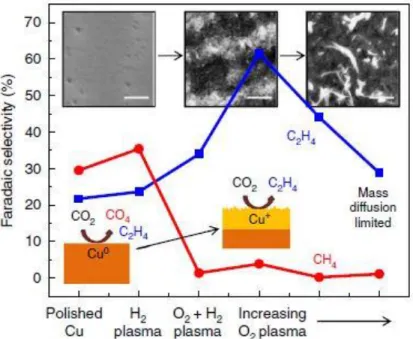
Mistry about an oxygen plasma treated Cu catalyst for the selective production of ethylene from CO2 reduction. The oxygen plasma treatment can be adjusted to manipulate the catalyst surface for more selective ethylene formation. The overpotential for ethylene formation in aqueous solution was reported to be lowered to -0.9V vs R.H.E and the highest ethylene Faradaic efficiency or product selectivity was improved to 60% (Figure 1.5). 18
Carbon monoxide (CO) is another valuable product from CO2
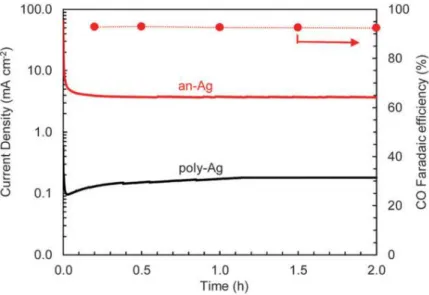
reduction that is industrially important for the manufacture of various chemicals. Highly selective catalysts have been developed based on CO producing metals such as Ag, Au, and even bimetallic catalysts such as Pd- Cu. 22, 23, 24, 25, 26 One of the most facile fabrication method with very high CO current efficiency instance was reported by Q.Z. Li about an anodized polycrystalline Ag electrode to reduce CO2 to CO at a low overpotential of 0.5V at a high selectivity of 92.8% (Figure 1.6). The selectivity was reported to be due to a preferred (220) orientation and the thin oxide layer due to anodization on the catalyst surface. 22
Formate or formic acid is important as fuel for direct formic acid fuel cells, or as reactant for other chemical synthesis. Selective formate producing catalysts also have been developed based on formate producing transition metals such as Sn, Pb and Bi. 27, 28, 29, 30, 31,32, 33, 34 Lee et. al. reported a Bi- based catalyst for selective formate production from CO2 reduction in aqueous electrolyte. The carbon-supported BiOx nanoparticles showed formate current efficiencies as high as 93.4% in bicarbonate solutions, while
9
current efficiencies as high as 96% was achieved in NaCl solutions as shown in Figure 1.7. 34
10
Figure 1.4: Scheme showing electrochemical CO2 reduction to fuels and industrially useful chemicals, coupled with renewable CO2 free energy sources to create a CO2 neutral energy cycle.
11
Figure 1.5: Oxygen plasma treated copper catalyst for selective C2H4
formation.
12
Figure 1.6: Anodized Ag electrode for highly selective CO formation.
13 (a)
(b)
Figure 1.7: (a) STEM image of carbon supported BiOx nanoparticles and (b) Potential dependence of Faradaic Efficiencies for HCOO-, H2, and CO production on the BiOx/C catalysts and commercial Bi2O3.
14 1.2.2 The Non-Aqueous System
Electrochemical CO2 reduction in the non-aqueous system has also been researched as an alternative system to the aqueous system. Since CO2
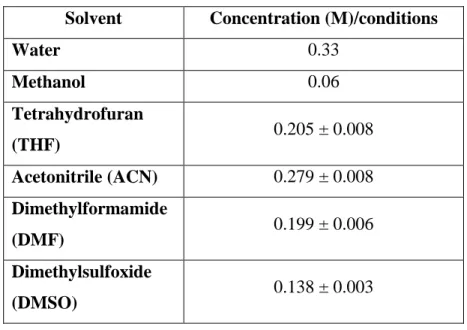
solubility in non-aqueous organic solvents are much higher than in water at ambient pressure and temperature conditions, CO2 reduction is expected to occur at higher selectivity and hydrogen evolution reaction (HER) is expected to be suppressed compared to the aqueous system. Table 1 shows the solubility of CO2 in various solvents at 25°C. 35 Methanol has 5 times higher CO2 solubility compared to water, while organic solvents such as acetonitrile (ACN) and dimethylformamide (DMF) has 6 to 8 times higher CO2 solubility.
The electrochemical reduction of CO2 in non-aqueous organic solvents however did not yield hydrocarbon products as in the aqueous solvent system due to the lack of proton donors in organic solvents. S. Ikeda reported selective formation of oxalic acid and carbon monoxide in organic solvents, which are propylene carbonate (PC), DMSO and ACN. The formation of oxalic acid is reported to be highest when Pb is used as the electrocatalyst in all 3 organic solvents (73% in PC and 65% in DMSO and ACN), while CO is produced the most selectively on In also in all tested organic solvents (85% in PC, 90% in DMSO, and close to 100% in ACN). 36
Despite these reports, electrochemical CO2 reduction in organic solvents is currently less explored compared to aqueous solvents. Since the reacting system is fundamentally different compared to aqueous system, other new reaction products can still be possibly formed and thus opens up further exciting new possibilities for electrochemical CO2 reduction. 37, 38, 39, 40
15
Solvent Concentration (M)/conditions
Water 0.33
Methanol 0.06
Tetrahydrofuran
(THF) 0.205 ± 0.008
Acetonitrile (ACN) 0.279 ± 0.008 Dimethylformamide
(DMF) 0.199 ± 0.006
Dimethylsulfoxide
(DMSO) 0.138 ± 0.003
Table 1.1: Solubility of CO2 in various solvents at 25°C.
16
1.2.3 Challenges in Electrochemical CO2 Reduction
While the major products of electrochemical CO2 reduction in aqueous solvents have been well identified, which are carbon monoxide, formic acid or formate, methanol, and also some highly reduced products such as ethylene and ethanol, the value of the products vary greatly. Highly reduced products, especially ethylene, is often regarded as highly value added and much focus on research has been given to improving Faradaic efficiency to produce ethylene from CO2 reduction.
Considering the price of the major CO2 reduction products, ethylene indeed has the highest market price among other less reduced products such as carbon monoxide and formic acid, as shown in Table 1.2. 41 However, considering the normalized price, or the price per electron involved in the reaction, the price of ethylene ($1.3 x 10³/electron) is actually much lower than that of carbon monoxide ($8.0 x 10³/electron) and formic acid ($16.1 x 10³/electron).
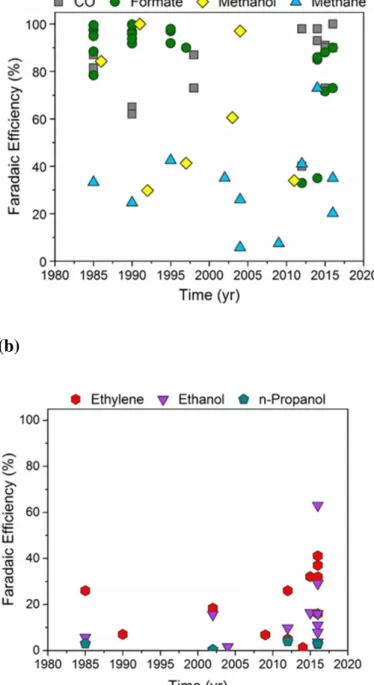
Furthermore, while highly selective CO and formic acid producing catalysts have been widely researched and developed, and very high Faradaic efficiencies of these products have been achieved, the Faradaic efficiencies achieved for highly reduced products like ethylene and ethanol remains low to this day, as shown in Figure 1.8. 41 While many attempts to develop catalysts to selectively produce ethylene and ethanol, high Faradaic efficiencies for these value added products remain elusive and thus, difficult to be commercialized. 42, 43, 44
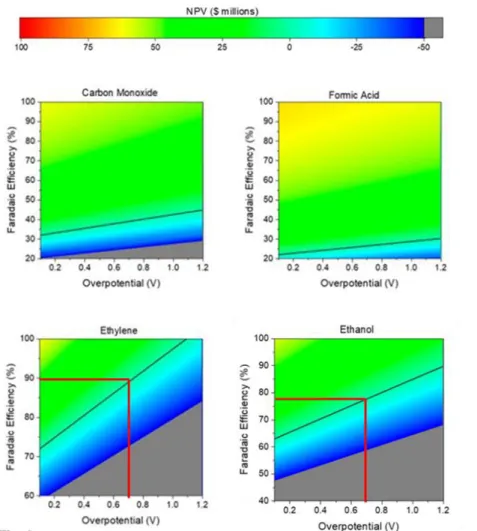
In order to evaluate the economic viability of these CO2 reduction products, the Net Present Value (NPV) of the chemicals at a defined overpotential and the achieved Faradaic efficiency is considered. For a reaction product to be economically feasible, the NPV of the product needs to be greater than zero.
17
Products like carbon monoxide and formic acid has been shown to be economically viable at all overpotentials, while for ethylene and ethanol, considering a reasonable overpotential at 0.7V, the Faradaic efficiency has to be at least 89% and 77% respectively for the NPV to be greater than zero, as seen in Figure 1.9 12. Such high Faradaic efficiencies for ethylene and ethanol has yet to be achieved, and thus these products are deemed to be economically not viable for the moment.
While the major reaction products for CO2 reduction have been mostly identified, there are still challenges in realizing electrochemical CO2
reduction in an economically viable sense. While highly reduced products such as ethylene is valuable, economic viability remains low. Even though CO and formic acid are economically viable products, CO is highly toxic and requires special care in handling, and formic acid, or formate are difficult to separate from aqueous electrolytes. 45, 46, 47, 48 Thus, a different strategy is required to obtain new value-added products from CO2 reduction. New products or chemicals can possibly be synthesized from CO2 if a new strategy is adopted by using non-aqueous solvents or by coupling with other chemicals.
18 (a)
(b)
Figure 1.8: Faradaic efficiencies of (a) CO, formate, methanol, methane and (b) ethylene, ethanol, n-propanol achieved from years 1980 to 2019.
19
Figure 1.9: Net Present Value (NPV) plots for CO2 reduction products (carbon monoxide, formic acid, ethylene and ethanol) at various applied overpotentials and the achievable Faradaic efficiencies.
20 Product
Number of Required Electrons
Market Price ($/kg)
Normalized Price ($/electron)
x 103 CO
(syngas) 2 0.06 0.8
CO 2 0.6 8.0
Formic
acid 2 0.74 16.1
Methanol 6 0.58 3.1
Methane 8 0.18 0.4
Ethylene 12 1.30 3.0
Ethanol 12 1.00 3.8
n-Propanol 18 1.43 4.8
Table 1.2: Market price and normalized price of CO2 reduction products.
21 1.3 CO2 Reductive Functionalization
CO2 reductive functionalization is a new perspective that has been gaining much interest of late. Instead of direct reduction of CO2, CO2
recycling can be achieved in the vertical way or the horizontal way as shown in Figure 1.10 49, 50, 51, 52, 53. The vertical approach is the direct reduction of CO2 to more reduced forms like methanol and methane. The more reduced the product, the higher the energy density of the product, and the oxidation number of the carbon center increases. In contrast, the horizontal approach can be done by pairing with amine groups or carbonate groups to form urea or dicarbonates. However, the oxidation number of the carbon center remains unchanged in the horizontal utilization, thus the energy density of the chemicals formed in this manner has low energy density and are typically not used as fuels as the more reduced chemical forms are.
In between the vertical and horizontal approaches, there is the diagonal utilization or reductive functionalization of CO2. Reductive functionalization of CO2 is achieved by pairing of a reduced form of CO2 with other functional groups to produce a wide range of organic molecules such as esters and amines by the formation of C-C, C-N and C-O bonds. Such reports of C-C, C-N and C-O bond formations so far are all achieved by thermal methods.
An example of C-C bond formation is the production of benzaldehyde from CO2 and halobenzene by a Pd molecular catalyst at ambient pressure as shown in Figure 1.11 (a). A C-N bond example is shown by the formation of dimethylformamide or diethylformamide from the coupling between CO2 and dimethyl amine and diethyl amine respectively as shown in Figure 1.11 (b).
Also, C-O bond formation is exemplified by the coupling between CO2 and methanol to form methyl formate.
22
1.3.1 C-O Bond Formation by Production of Methyl Formate
As shown in the previous section, formic acid is a valuable product and has high normalized price per electron. The production of formic acid or formate from CO2 reduction in aqueous electrolyte however presents an unexpected problem. Formic acid is difficult to separate from the aqueous electrolyte due to the formation of an azeotrope, which is a liquid mixture that maintains its composition and boiling point during distillation, as formic acid and water have very similar boiling points (100.8°C and 100°C respectively).
Formic acid and water mixture separation becomes complicated when special techniques such as extractive distillation, in which the extractive distillation agent used is a sulfone, is required. This adds on to the costs of production of formic acid from CO2 reduction in aqueous electrolyte, even if high Faradaic efficiencies can be achieved with the reported catalysts.
Formic acid however, is known to react easily with methanol by esterification reaction to form methyl formate. The esterification reaction between methanol and formic acid occurs readily at slightly elevated temperatures (ca. 60°C) in the presence of an acid catalyst such as sulphuric acid. If CO2 reduction is conducted in methanol electrolyte, the resulting methyl formate and methanol mixture can be easily separated by slight heating due to the large differences in their boiling points (31.5°C and 64.7°C respectively).
Furthermore, methyl formate has the highest market price ($20/kg) in comparison with methanol ($0.58/kg) and formic acid ($0.74/kg). By the production of methyl formate from CO2 reduction, value addition can be achieved from reacting materials with low cost such as methanol. The normalized price per electron of methyl formate as a reaction product is also not decreased since the formation of formic acid or formate as an intermediate species requires only 2 electrons per molecule formed, in comparison with 12 electrons that is required for the formation of ethylene.
23
Methyl formate has a wide range of industrial applications and has a wide range of chemistry, thus is considered as a building block molecule in C1 chemistry. Methyl formate is used as a precursor chemical for several industrially important chemicals. By reacting with ammonia (NH3) at 80 to 100°C and elevated pressures at 400 to 600kPa, formamide (CHONH2) can be produced, which is a chemical feedstock for the manufacture of drugs, pharmaceuticals, herbicides, pesticides and also for the manufacture of hydrocyanic acid. Dimethylformamide (DMF, CHON(CH3)2), which is a commonly used organic solvent, is produced by reacting methyl formate with dimethyl amine ((CH3)2NH) at 50°C and 500kPa. Formic acid (HCOOH), which is used as fuel in direct methanol fuel cells, and also as a useful organic synthetic reagent, can be manufactured from methyl formate by heating at 25 to 120° over an inorganic acid catalyst. The rich chemistry of methyl formate also allows it to be used as a building block molecule for various organic molecules. By coupling methyl formate with carbonyl compounds, such as formaldehyde, methyl glycolate (HOCH2CO2CH3) can be produced, which can be further reacted to produce malonate ester or polyglycolate, which are useful materials in the medical filed. Methyl formate can also be coupled with olefins such as ethylene (CH2=CH2) to produce methyl propionate. The halogenation of methyl formate with chlorine produces methyl chloroformate, which when reacted with olefins produces methoxy carbonyl compounds.
The oxidation of methyl formate in the presences of sodium methoxide meanwhile, produces dimethyl carbonate. 54
Methyl formate can be synthesized through many reaction routes. The commercialized method developed by BASF involves the carbonylation of methanol, by reacting CO and CH3OH in the presence of sodium methoxide as the catalyst, at 60 to 120°C and 20 to 70 bar CO to produce methyl formate.
Other alternative methods, as shown in Figure 1.12, such as the dimerization of formaldehyde in the presence of a Cu or Zn catalyst, the oxidative
24
dehydrogenation of methanol, the dehydrogenation of methanol or direct synthesis from synthesis gas (syngas) have also been suggested, but these methods have problems with low product yield. Another interesting pathway is by the hydrocondensation of CO2 with methanol to produce methanol. This method however has a problem as it uses H2 gas as one of the reactants, which is more expensive than CO gas. 54
The utilization of CO2 in the production of methyl formate however, is interesting and relatively unexplored. Previous reports of CO2 utilization in the formation of methyl formate are all conducted by thermal methods, and some suggests that the formation of methyl formate is the result of the conversion of CO2 to formic acid and subsequently reacts with methanol to produce methyl formate at high pressure conditions under the presence of a transition metal catalyst. As shown in Figure 1.13, CO2 is reacted with hydrogen gas as the reducing reagent in the presence of a Fe-based molecular catalyst at high pressure conditions in methanol. Formic acid is suggested to be formed from this reduction. The formic acid then reacts with alcohol, or methanol in this case to form methyl formate. 53
In this research thesis, electrochemical methods is employed to reduce CO2 to methyl formate in methanol as the electrolyte. Methyl formate can be achieved in a one-step procedure at ambient pressure and temperature conditions. To the best of our knowledge, electrochemical methods targeting the synthesis of methyl formate utilizing CO2 as the reactant molecule has yet to be reported.
25
Figure 1.10: Vertical and horizontal utilization, and also reductive functionalization or diagonal utilization of CO2.
26 (a)
(b)
(c)
Figure 1.11: (a) C-C bond formation between CO2 and halobenzene to form benzaldehyde, (b) C-N bond formation between CO2 and dimethyl amine or diethyl amine to form dimethylformamide or diethylformamide, (c) C-O bond formation between CO2 and methanol to form methyl formate.
27
Figure 1.12: Methyl formate synthesis routes – 1) Carbonylation of methanol, 2) Dimerization of formaldehyde, 3) Oxidative dehydrogenation of methanol, 4) Hydrocondensation of CO2 with methanol, 5) Dehydrogenation of methanol and 6) Direct synthesis from syngas.
28
Figure 1.13: C-O bond formation between CO2 and methanol to form methyl formate through a formic acid intermediate.
29
1.3.2 Methyl Formate Production by Electrochemical CO2 Reduction in Methanol
A fair amount of research into electrochemical CO2 reduction in methanol has been conducted since 1993. The starting initiative of conducting electrochemical CO2 reduction in methanol is due to hopes incorporating the reaction into the Rectisol process, which is a chemical process that is often incorporated into chemical synthesis plants to remove acid gases such as carbon dioxide and hydrogen sulphide from valuable feed gas streams. The Rectisol process is done at low temperature conditions, and since CO2
solubility in methanol is increased at high pressures as shown in Figure 1.14
55, majority of the reports of CO2 reduction are conducted at low temperature or high pressure conditions.
While various transition metal catalysts have been investigated for their reactivity for CO2 reduction in methanol, there were no particular advantages over CO2 reduction in aqueous solvent that is being reported. The main products that were produced by CO2 reduction in methanol were mainly the same as in aqueous solvent, which are carbon monoxide, methane, formate or formic acid, and some level ethylene. Furthermore, the Faradaic efficiency achieved in methanol solvent is not much better than in aqueous solvent. 55 – 65
There were nevertheless, three papers that reported the formation of methyl formate on copper and a number of other transition metals at high pressure conditions.
Saeki et. al. reported the electrochemical reduction of CO2 with high current density in a CO2 methanol medium at various transition metal electrodes at ambient temperature and high pressure conditions (41atm). 59 The reaction products were reported as CO, CH4, C2H4, and methyl formate (CHOOCH3). The resulting product distribution is reported to be similar to as
30
observed in aqueous systems as shown in Figure 1.15. At W, Ti and Pt electrodes, CO2 reduction is inactive and hydrogen evolution was prevalent.
At Ag, Zn and Pd the main reaction products were CO. Hydrocarbon products (C2H4) is produced on Cu surface, but the efficiency is less than that observed in aqueous system. Sn and Pb are known as formate producing metals in aqueous electrolyte. Here, it reported that methyl formate formation is observed instead. The formation of methyl formate is predicted to be formed due to the formation of formic acid on Sn and Pb electrodes, which then reacts with methanol chemically to form methyl formate (Faradaic efficiency of 40%
on Sn and 80% on Pb). Note that however in later reports on formate producing metals such as Pb 60 and In 65, in which the reaction was conducted in KOH-methanol medium a ambient pressure and temperature conditions, methyl formate was not reported. Instead, formic acid was reported as the observed product at high current efficiencies (66% on Pb and 76% on In).
Despite the high current efficiencies of methyl formate reported at the high pressure conditions, not data confirming the origin of the methyl formate observed is from CO2 reduction is provided. Of course, the reaction between formic acid formed from CO2 and methanol to form methyl formate could have easily occurred under high pressure conditions, but the anode material used was Pt, and the reaction cell used was an unseparated one pot cell. It is reported that methyl formate formation from methanol oxidation on Pt surface is observed as shown in Figure 1.16. 66 Thus the reported efficiency of methyl formate could possibly be include the amount of methyl formate that is being produced on the anodic methanol oxidation reaction. Other than methyl formate which is being produced at high efficiencies on Sn and Pb, CO is also observed to be produced at high current efficiencies in comparison with aqueous solvents. Considering the fact that the supporting electrolyte used in these reports were tetrabutylammonium perchlorate (TBAP), it was suggested that the enhanced formation of CO on Sn and Pb was due to the promoting effect of the TBA cation.
31
Despite that methyl formate formation from CO2 reduction in methanol on Sn and Pb electrodes were reported at high current efficiencies, no further investigations were reported on Sn electrode. Instead, it appeared that ethylene was considered as a more value-added product, and thus CO2
reduction on Cu surface was given more attention. The only other two papers that reported methyl formate formation at high pressure conditions were obtained on Cu electrode surface. Kimura et. al. reported the electrochemical reduction of CO2 with high current density in a CO2-methanol medium with Cu as the electrocatalyst and tetrabutylammonium tetrafluoroborate (TBABF4) as the supporting electrolyte. In this report, the formation of methyl formate was observed to occur at high pressures, and even ambient pressure at current efficiency around 20%. 55
In another paper by Saeki et. al., electrochemical reduction of CO2
with high current density in a CO2 + medium with CO formation promoted by tetrabutylammonium cation was reported. 58 Under 40atm and 25°C, it was observed that electrochemical CO2 reduction in methanol on Cu surface yielded CO as the main reaction product when TBABF4 and TBAClO4 were used as the supporting electrolyte. Meanwhile, when Li salts such as LiBF4
and LiClO4 were used as the supporting electrolyte, methyl formate was obtained as the major reaction product at Faradaic efficiencies as high as 54.5%
and 46.7% respectively. Again, the reported high current efficiencies for methyl formate could be due to the fact that a one-pot cell was employed in the experiments and that a portion of the observed methyl formate current efficiency could originate from the anodic methanol oxidation reaction. The difference between the product distribution when Li salts and TBA salts were used were explained by the hydrophobicity / hydrophilicity of the near cathode surface environment created by the employed cations. It was suggested that the presence of TBA+ cations resulted in a hydrophobic
32
environment, in which the CO production was enhanced since CO can be produced without hydrogenation by the reaction:
CO2-· + CO2 + e- CO + CO32-
Meanwhile when Li salts are used, a hydrophilic environment is formed, leading to the prevalent formation of methyl formate since protonation step is involved in its formation as follows:
CO2-· + 2H+ + CH3OH + e- CHOOCH3 + H2O
Li+ ions are smaller and is considered to be more solvated by methanol than TBA+, and thus the electrode vicinity may be more hydrophilic than when TBA+ salts are used. Thus taking hint from the important role of the cation species, metallic cation salts were given priority for investigation.
33
Figure 1.14: Concentration and mole fraction of CO2 in methanol at different applied pressures.
34
Figure 1.15: The observed product distribution for electrochemical CO2 reduction at 25°C, 41atm on various transition metal electrodes in methanol.
35
Figure 1.16: The suggested mechanism of the formation of methyl formate from methanol oxidation on Pt surface, which differs from previous reports suggesting that methyl formate formation is due to chemical reaction step between formaldehyde formed from methanol oxidation and a methanol molecule, instead of direct oxidation steps on Pt surface.
36
Chapter 2: Study on Electrochemical CO2 Reduction to Methyl Formate in Methanol at Ambient Temperature and Pressure
2.1 C-O Bond Formation by the Formation of Methyl Formate by Electrochemical CO2 reduction in Methanol
As previously mentioned in Chapter 1, electrochemical CO2 reduction on various transition metal catalysts have been investigated. The development and engineering of electrocatalysts, and consequently the study of electrochemical CO2 reduction on these electrocatalysts have been mostly done in aqueous electrolytes due to the abundance and low cost of using water as the solvent for CO2. However, the solubility of CO2 in water is low, and thus non-aqueous electrolytes and ionic liquids have also been considered as electrolytes for CO2 reduction due to their much high solubility for CO2. Electrochemical CO2 reduction in organic solvents however is relatively different from in aqueous solvents due to the lack of a proton source if non is added. Though the major reactant products in aprotic solvents like DMF and propylene carbonate are identified as CO and oxalate, the reaction mechanisms are largely not studied as the use of such organic solvents are also relatively expensive in comparison with water. Electrochemical CO2
reduction in organic solvents however could offer new possibilities considering the wide range of organic solvents available. New products can possibly be obtained by CO2 reduction in the organic solvents or by pairing with other chemicals other than the well-established major products obtained from electrochemical CO2 reduction in aqueous electrolyte, which are CO, formic acid, methane, methanol, and ethylene.
37
Instead of the direct reduction of CO2 to more reduced forms, diagonal functionalization or reductive functionalization by coupling a reduced form of CO2 with other chemicals by the formation of C-C, C-N or C-O bond opens up various new possibilities of new value added products obtainable from CO2 reduction without the involvement of large number of electrons such as ethylene. The formation of C-O bond is exemplified by methyl formate formation from CO2 which is predicted to form formic acid, and subsequently reacts with methanol by esterification reaction. CO2 reductive functionalization however, is reported only by chemical / thermal methods and at high pressure conditions.
Reactions at ambient pressure and temperature conditions are economically more advantageous due to less energy consumption in the reaction process, and thus electrochemical CO2 reduction at ambient pressure and temperature conditions in methanol to produce methyl formate is attempted. While previous reports on electrochemical CO2 reduction in methanol has been numerous, only at high pressure conditions that methyl formate formation was reported. Similarly, methyl formate was predicted to be formed through the formate pathway from CO2 reduction due to the high current efficiencies observed when formate producing metals such as Sn and Pb are used. However, since the reaction cell used in these investigations was a one-pot cell and the anode used was Pt, methanol oxidation on Pt surface could occur and the reported methyl formate Faradaic efficiency may be higher than the actually achieved value.
Thus for the scope this thesis, electrochemical CO2 reduction in methanol on Sn surface at ambient pressure and temperature conditions was conducted in a one-pot cell with an anode material that has been determined to suppress methyl formate formation. The product distribution, effect of water content, effect of supporting electrolyte, and also a comparison with different transition metal catalysts are discussed.
38 2.2 Experimental Procedures
2.2.1 Chemicals and Materials
Methyl alcohol (99.9%), sodium perchlorate, sodium nitrate and sodium hydrogen carbonate were purchased from Daejung Chemicals (Gyeonggido, Korea). Lithium perchlorate, sodium hydroxide, sodium sulfate, methyl formate and Nafion N-117 membrane (0.18mm thick) were purchased from Alfa Aesar (MA, USA). Tetrabutylammonium perchlorate, sodium methoxide were purchased from TCI Chemicals (Tokyo, Japan).
Sodium chloride was purchased from Sigma-Aldrich (Milwaukee, WI, USA).
13CO2 (99%) was purchased from Cambridge Isotope Laboratories Inc. (MA, USA). Methyl alcohol was dried with 3Å molecular sieves (purchased from Daejung Chemicals) for more than 48 hours prior to usage, sodium perchlorate was dried at 220°C in air for more than 24 hours prior to usage.
Other chemicals are opened in Ar environment, stored in glove box and used as received. Tin foil (Sn, 0.25mm thick), titanium foil (Ti, 0.127mm thick), gold foil (Au, 0.1mm thick), lead foil (Pb, 0.25mm thick), indium foil (In, 0.127mm), copper foil (Cu, 0.025mm thick), nickel foil (Ni, 0.1mm thick), platinum foil (Pt 0.025mm thick), glassy carbon plate and mercury acetate (Hg(O2CCH3)2) were purchased from Alfa Aesar. Dimensionally Stable Anodes (DSA, Ru oxide coated on Ti) was purchased from Siontech (Daejeon, Korea).
2.2.2 Electrochemical Analysis
An undivided three-electrode cell (Gamry Dr. Bob’s cell) was used in all the voltammetric measurements and electrolysis, while a custom-made H- cell with a Nafion 117 membrane (1cm diameter) fitted in between the cathodic and anodic compartment was used in anode material determining experiments. Sn, Ti, Au, Pb, In, and Cu foils with surface dimensions 2cm x
39
0.5cm x 2 were used as the working electrodes. Hg / Cu amalgam electrode is made by immersing Cu foil with the same dimensions in 0.01M Hg(O2CCH3)2 solution for 10 minutes and then taken out and left for 3 hours prior to usage. Pt, Au, Ni, Sn, Ti, Dimensionally Stable Anode (DSA, Ru oxide coated on Ti) and glassy carbon plates were tested as the counter electrodes. Prior to usage, all metal foils are cleaned by sonication in methanol except for In foil and Hg amalgam, which were only rinsed with methanol. The reference electrode was Ag/Ag+ (0.1M TBABF4 + 0.01M AgNO3) in acetonitrile. The electrolytes were all prepared in the glove box and taken out sealed until transferred to the electrochemical cell. For the electrolyte, sodium perchlorate (and other respective supporting electrolytes) were dissolved in 10ml methanol at the required concentrations, transferred into the reaction cell and then purged with Ar gas or CO2 gas for 10 minutes prior to reaction. During purging, the gas is passed through a moisture trap consisting of molecular sieves and silica beads. The headspace of the cell was determined to be 65cm3, and was ventilated with CO2 gas and then sealed tightly under CO2 at atmospheric pressure. All reactions were performed at room temperature under vigorous stirring of the electrolyte. After electrolysis, 0.1ml of the headspace gas was transferred by syringe for gas chromatography (GC) analysis. 5ml of the electrolyte is then collected in 10ml headspace vials for gas chromatography-mass spectrometry (GC-MS) analysis.
2.2.3 Analytical Methods
A potentiostat (VSP-300, BioLogic Science Instruments) was used for all voltammetric measurements and bulk electrolysis. All potentials were controlled against the reference electrode. The quantitative measurement of the gas phase from the headspace pf the electrochemical cell was performed by GC (PerkinElmer, Clarus 580 GC). Liquid products in the electrolyte were
40
detected by GC-MS (Agilent 5977) using the headspace sampler. NMR spectra was also obtained on a Bruker 600MHz NMR spectrometer (Bruker Advance 600) at room temperature.
41 2.3 Results and Discussions
2.3.1 Defining a Non-Methyl Formate Producing Anode
In order to construct a one-pot system for electrochemical CO2
reduction experiments in methanol, the anodic reaction of methanol oxidation to methyl formate needs to be suppressed so as to make sure that all methyl formate detected are originating from the cathodic CO2 reduction reaction.
To determine the suitable anode for reaction in a one-pot cell, the anodic material needs to fulfil the following conditions:
1. The anode material does not produce methyl formate as a major reaction.
2. The anodic reaction products should not interfere with the cathodic reaction.
3. In the case of using a sacrificial anode (as Mg is used as a sacrificial anode in electrochemical reactions in organic solvents), the metal ions from the anode should be deposited on the cathode surface.
Prior to tests in the one-pot cell, Pt foil, Au foil, DSA, Ni foil, glassy carbon plate, Sn foil and Ti foils were tested as the counter electrode in a custom made H-cell, with the catholyte and anolyte separated by a Nafion 117 membrane. The catholyte and anolyte were 10ml each 0.5M NaClO4 in methanol. The working electrode used was Sn foil, and the catholyte and anolyte were purged with CO2 prior to experiment so as to simulate the actual environment in later CO2 reduction experiments. The anolyte was collected after bulk electrolysis at -1.9V vs Ag/Ag+ after about 10C charged is passed and analysed by GC-MS to determine the methyl formate concentration. The concentrations of methyl formate produced on each respective anode materials were listed and shown in Table 2.1. Methanol partial oxidation is known to occur on Pt and Au, and thus showing the highest methyl formate
42
concentrations. Methanol partial oxidation to methyl formate also apparently occurred on the DSA, glassy carbon, and Ti foil anodes, especially DSA which showed the highest methyl formate concentration after bulk electrolysis which indicates that methyl formate formation on Ru oxide by methanol oxidation might be even more active than Pt or Au. For these methyl formate producing anodes, dimethoxymethane (DMM) is also detected at high concentrations, which matches with the hypothesis that in methanol oxidation, the fully oxidized state is CO2. Partial oxidation of methanol occurs on metals that do not adsorb methanol molecules strong enough, which then desorbs from the metal surface as DMM or methyl formate. 67, 68, 69 Since methyl formate concentration is the lowest on Sn and Ti foil anodes, Sn and Ti were further tested in the one pot cell as the counter electrode.
Bulk electrolysis is conducted at -1.9V vs Ag/Ag+ in CO2 purged 0.5M NaClO4 methanol electrolyte with Sn cathode and Sn or Ti anode respectively in the one pot cell. When Sn anode is used as the anode, the current increases sharply during bulk electrolysis as seen in Figure 2.1(a). The sharp current increase in current is due to the dissolution of ions from the Sn anode, which consequently is deposited onto the Sn cathode surface, leading to the formation of small particles on the Sn cathode surface, increasing the reaction surface area, and thus the current increases sharply. After the chronopotentiometric measurement is stopped, the Sn anode surface becomes rough and uneven, indication of Sn oxidation, while the Sn cathode surface becomes a darker shade, showing that electrodeposition of Sn ions originating from the Sn anode oxidation has occurred.
For the Ti anode case, there were no sharp current increases during the bulk electrolysis. In contrast to the Sn anode case, this indicates that no ion deposition on the Sn cathode surface has occurred. Bulk electrolysis in Ar and CO2 purged electrolytes were conducted respectively at the same potential. After 10C charge is passed, the electrolyte is then analysed by GC-
43
MS. The concentration of methyl formate observed for Ar purged electrolyte was 0.006mM, which is much lower than that observed for CO2 purged condition (0.1mM). This clearly indicates that methanol oxidation to methyl formate barely occurred on Ti surface (shown by the Ar purged case) and majority of the methyl formate observed originated from CO2 reduction (shown by the CO2 purged case). The major reaction that occurred was deduced to be complete methanol oxidation to CO2 gas, as shown by the appearance of CO2 peak after bulk electrolysis in Ar purged 0.5M NaClO4
methanol in the GC spectrum shown in Figure 2.3. Furthermore, the originally shiny, metallic grey Ti anode surface after bulk electrolysis became coated with a layer of multi-coloured oxide, as is often observed when Ti electrochemical anodization is done depending on the applied potential.
There were also black dots and lines on the Ti anode surface and the edges of the anode appeared to be corroded, with small black particles that could be observed falling off the Ti ano