Vol. 28, No. 1, pp. 24-29, February, 2012
Analysis of the Stumpage Valuation for Pinus koraiensis Stands in the Research Forest of Kangwon National University
Hee-Sung Woo, Sang-Hyun Choi, Seung-Il Ahn and Jong-Choon Woo*
Department of Forest Management, Kangwon National University, Chuncheon 200-701, Republic of Korea
Abstract
This paper assesses the stmpage value of Korean white pine (Pinus koraiensis) stands in the Research Forest of Kangwon National University. Assessment was done by means of the cost value method (Faustmann formula) for age class I, Glaser method for age class II-V, and inversion market method for age class over VI. Generally the value of stumpage is calculated by the inversion market method in the market. However, immature trees and middle age class trees are not assessed in market, and the Korean forest is not old enough to harvest. So, when forests are damaged by attacks from forest fire, blight and harmful insects, the forest cannot be compensated for the loss from the government or insurance company. For this reason, the value of all-age class trees are calculated by using appropriate methods. As a result, the value of age I class stands (0.3 ha) is calculated as 1,786,305 (won), age II-Vclass stands (22.1 ha) 206,677,975 (won) and age VI class and over stands (24.8 ha) 523,789,603 (won).
Key Words: forest valuation, cost value, glaser, inversion market, Pinus koraiensis
Received: January 25, 2012. Revised: February 10, 2012. Accepted: February 13, 2012.
Corresponding author: Jong-Choon Woo
Department of Forest Management, Kangwon National University, Chuncheon 200-701, Korea Tel: 82-33-250-8335, Fax: 82-33-243-4484, E-mail: [email protected]
Introduction
Korea was ruined during the colonization by Japan and the Korea War, but continuous restoration policies have re- covered the Korean forest. As a result, Korea is one of the successful afforestation countries of the world. However, timber harvest profitability is very low due to the relatively low timber prices of wage growth in the forest industry.
For this reason, the economical value of forest is under- estimated by the people. In addition, economic valuation of forest has not been standardized, so calculating national sta- tistics and forestry household incomes are not properly evaluated.
Usually, forestry valuation is assessed by using the in-
version market method. stumpage valuation method exists for each age class but actual estimation factors are not re- corded so those methods cannot be used in forestry valuation.
In this study, stumpage valuation is based on Pinus kor- aiensis stands in the research forest of Kangwon National University. Proper estimation methods were used for each age class. As a result, a better forest valuation method was found.
Materials and Methods
Study site
The 32nd compartment covers 4.2% (132 ha) of the re-
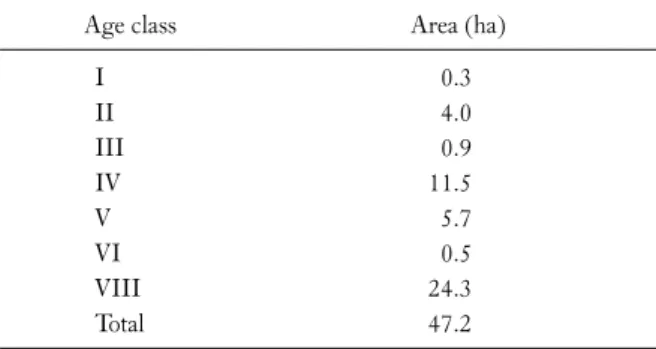
Table 1. Area of Pinus koraiensis in each age class in the 32 compart- ment of Research Forest of KNU
Age class Area (ha)
I II III IV V VI VIII Total
0.3 4.0 0.9 11.5 5.7 0.5 24.3 47.2
search forest of Kangwon National University (KNU) (3,146 ha). 65 ha of broadleaves and 73 ha of coniferous trees occupy the Research Forest of KNU and Pinus kor- aiensis occupies 47.2 ha (33.6%) of the coniferous trees (Table 1).
Methods
The stumpage valuation by using cost value method (Faustmann)
The Faustmann formula gives the present value of the income stream for forest rotation. It was derived by the German forester Martin Faustmann in 1849. The rotation problem, deciding when to cut down the forest, means solv- ing the problem of maximising Faustmann's formula and this was solved by Bertil Ohlin in 1921 to become the Faustman-Ohlin theorem, although other German fores- ters were aware of the correct solution in 1860 (John, 1995).
However, the Faustmann formula does not include data for forest planting expenses. For this reason Faustmann for- mula is not suitable for the calculation of immature forests.
The formula has the following problems.
First, Faustmann formula is based on the development costs of timber so that it needs data on the annual cost and revenue of thinning and reforestation over long terms.
Second, Faustmann formula uses the same high bank in- terest rates and price increases as in the Glaser method, so the stumpage value is overestimated.
To solve these problems, reforestation fee was calculated from the fee difference of 2010 and 2011, and then the in- creased or decreased cost was averaged and that average change rate was used in this paper.
The land rental fee was calculated by using the officially posted land cost. Since the officially posted cost were avail- able for years of 1997 and 2011, the land costs for 80 years ago were estimated from the average cost gap 2.5 (won) and 4% land rental fee for when the government compensated for forest fire (Fig. 1).
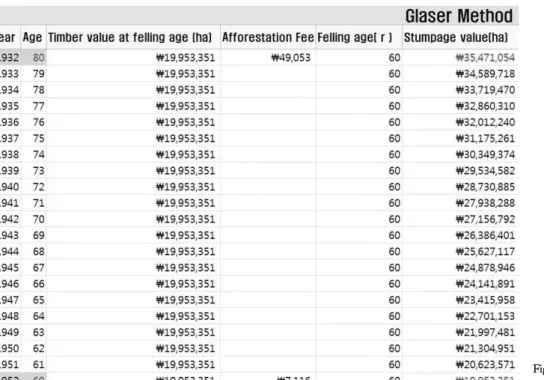
Calculating stumpage valuation by using Glaser formula Glaser formula (G. formula) is the appropriate method for evaluating stumpage value of trees in middle age G. for- mula doesn't use interest rate, which makes the evaluation problem less prone to subjectivity and also very simple be- cause it doesn't need to compute at compound interest.
Generally on young age forest which cost high in establishment. This thesis also evaluate forestry value by using G. formula on 32 nd Pinus koraiensis occupies com- partment. stumpage value of felling age applied 1,995,335 (won) to all age class, which of stumpage value that result of Inversion market formula and cost of establishment applied result of Faustmann formula either (Fig. 2).
Calculating by inversion market method to felling age stands
There are some factors are needed when calculating with I.M method.
Those factors are volume of Ⅵ-class, assessd stadard about expecting sale price of national forest product. These factors are put as well as value. Then these values could make evaluation of 4 sub compartment through the Factor Research of Price Estimation.
Calculating order as following;
First, cutting down the targeted tree, then make some wood product like furniture.
Second, assume one transportation that transport the product to neighboring market. then estimate harvesting cost of the product.
Third, estimate market price of like product to this prod- uct then deduct harvesting cost from like product’s market price. This value is the stumpage price.
Pinus koraiensis’ price was substituded 136,500 won (November. 2011 market price of Yuju forest product mar- ket). And the Standard of Estimated Price of National Forest Product (28. August. 2009. established rule of Forest Service, No 566), the report of Research forest of
Fig. 1. Calculating stumpage by using Faustmann formula.
Fig. 2. Calculating forest valuation by using Glaser formular.
Kangwon National University’s estimating factors on sales were used too.
Application proper forest valuation formulae for each age classes
Using the cost of establishment silviculture from the in- terest rate -4%, the stumpage price of immature forest
stands were evaluated by applying F. formula.
The last and middle aged forest stumpage price was cal- culated by inputting stumpage prices of final aged and young aged stands in the G. formula.
Table 2 shows the formulae for evaluating the stumpage price 2 types of aged stands. Each formula needs various factors.
Table 2. Proper stumpage valuation formulae for each age classes
Immature Young matured stand Felling age
F. formular G. formular Inversion market formula
× × · Hi=value
Ck=total inputed cost of afforestation and growth at K=(forest age at stumpage valuation)
r=rate
i=present forest age
Am=value
Ar=felling age value
Co=estimated value by using F. formulat at 10 years old
r=felling age m=present forest age
X= value
v= timber volume (m3) f= cutting rate
A= timber market value each volume (m3) B= total cost for timber manufacture (m3) l= payback period (month)
r= rate of return
Table 3. Stumpage valuation using the F. formula (won/ha)
Year Age Age class Area
(ha) Land rent Interest rate (1.0P)
Afforestation cost (won/ha)
Hkm (won/ha) -Faustmann (1984)- 1932
1952 1962 1977 1982 1992 2002
80 60 50 35 30 20 10
VIII VI V IV III II I
24.3 0.5 5.7 11.5 0.9 4 0.3
₩174,138,288
₩3,926,846
₩37,418,702
₩49,126,034
₩3,180,016
₩8,695,199
₩298,952
1.04 1.04 1.04 1.04 1.04 1.04 1.04
₩2,019
₩14,232
₩37,791
₩163,513
₩266,444
₩707,482
₩1,878,557
₩ 7,168,203
₩ 7,867,925
₩ 6,602,476
₩ 4,435,342
₩ 3,799,795
₩ 2,881,282
₩ 2,875,064 Standardizing these factor values was the most difficult
problem in this study.
To solve this problem, something with generality was needed. So, in this study we referred to the 'Forest-tree cost' case of Korea Forest Service (KFS) Reseach forest of KNU.
Results and Discussion
Valuation by F. formula
Maintenance-cost and thinning-income was excluded in the evaluation process by F. formula. The Research forest is run for non-profit. Maintenance-cost was excluded for ob- jectivity, because not enough data exists for this factor.
To evaluate a practical value, thinning income and main- tenance cost need to be considered. Since the purpose of this research is finding out the difference between each aged-stand's value among the evaluation systems, costs cal- culated from the evaluating system were not considered.
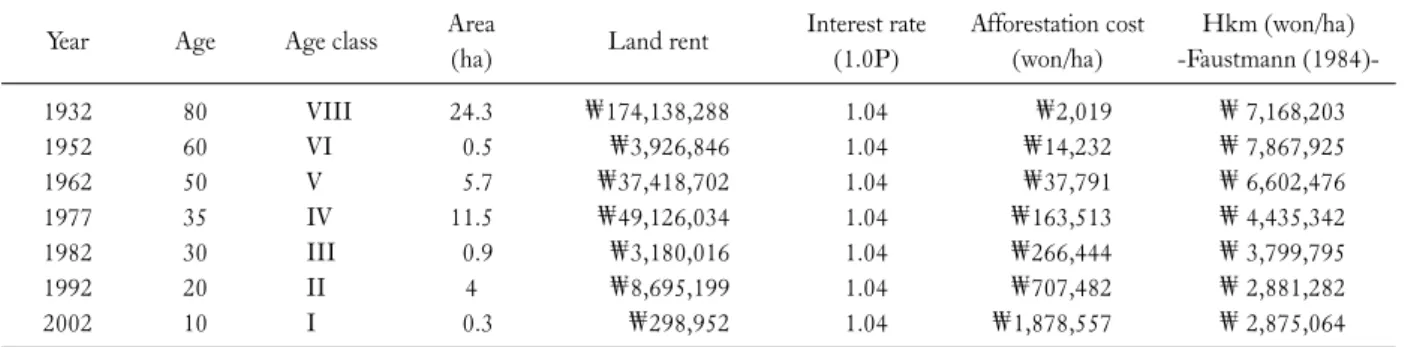
Hkm in Table 3 is the value of each area were estimated in won/ha for comparison of the stumpage price of each age-class (Table 3).
As shown in Table 3, the cost of class I and II are similar.
On the other hand, comparing class-VII and class VI, class VI was evaluated to be more valuable.
Stumpage valuation by G. formula
The cost evaluated by G. formula also estimated by won/ha for comparison.
As a result, the value of class VIII is 14times valuable than that of class I. The results by the G. formula showed the largest gap among the age class and valuation (Table 4).
Value estimation of each age class using the appro- priate evaluating system
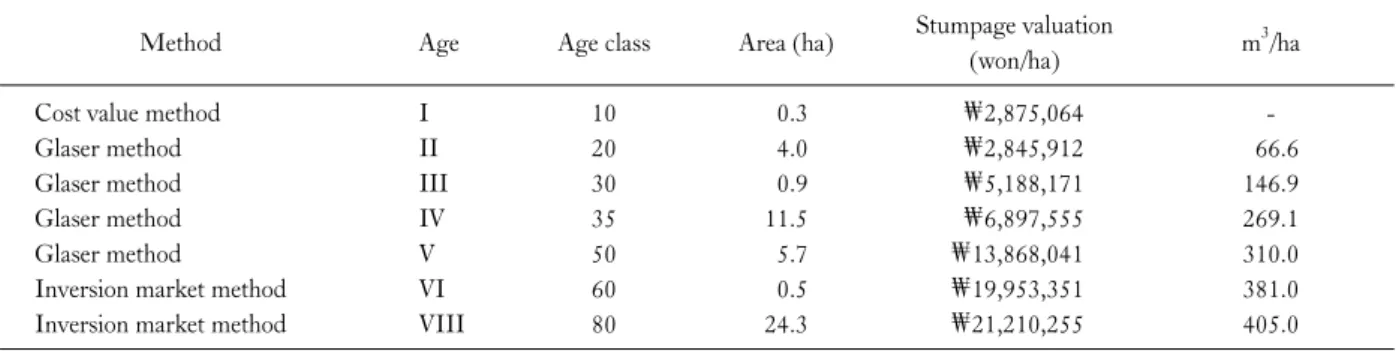
The values of class I, classes II-V and classes VI and over were estimated by F. formula, G. formula and Inversion Market formula, respectively (Table 5).
Table 4. Stumpage valuation using the G. formula (won/ha)
Year Age Age class At rotation age
cost (ha)
Afforestation cost (won/ha)
Rotation period
Forest valuation (won/ha) 1932
1952 1962 1977 1982 1992 2002
80 60 50 35 30 20 10
VIII VI V IV III II I
₩19,953,351
₩19,953,351
₩19,953,351
₩19,953,351
₩19,953,351
₩19,953,351
₩19,953,351
₩2,019
₩14,232
₩37,791
₩163,513
₩266,444
₩707,482
₩1,878,557
60 60 60 60 60 60 60
₩35,471,054
₩19,953,351
₩13,868,041
₩6,897,555
₩5,188,171
₩2,845,912
₩2,380,635
Table 5. Value estimation using the evaluating-system for each age class in 32nd compartment (won/ha)
Method Age Age class Area (ha) Stumpage valuation
(won/ha) m3/ha
Cost value method Glaser method Glaser method Glaser method Glaser method
Inversion market method Inversion market method
I II III IV V VI VIII
10 20 30 35 50 60 80
0.3 4.0 0.9 11.5 5.7 0.5 24.3
₩2,875,064
₩2,845,912
₩5,188,171
₩6,897,555
₩13,868,041
₩19,953,351
₩21,210,255
- 66.6 146.9 269.1 310.0 381.0 405.0
Table 6. Comparison of value in each evaluating system (won/ha)
Year Age Age class Area (ha) Cost value Glaser Proper
1932 1952 1962 1977 1982 1992 2002
80 60 50 35 30 20 10
VIII VI V IV III II I
24.3 0.5 5.7 11.5 0.9 4 0.3
₩7,168,203
₩7,867,925
₩6,602,476
₩4,435,342
₩3,799,795
₩2,881,282
₩2,875,064
₩35,471,054
₩19,953,351
₩13,868,041
₩6,897,555
₩5,188,171
₩2,845,912
₩2,380,635
₩21,210,255
₩19,953,351
₩13,868,041
₩6,897,555
₩5,188,171
₩2,845,912
₩2,875,064
This table shows the stumpage price of class I, estimated by F. formula is larger that of class II, estimated by G.
formula.
And the stumpage price of the class VI and over, esti- mated by the inversion market formula is similar to the sale price in the real market.
Comparison of the values from each evaluating sys- tem
As shown in this table, the value by F. formula is larger than that by G. formula concerning the evaluation of the
stumpage prices of class I and class III and over. Also, the value by inversion market formula, the most practical meth- od, is smaller than the value by G. formula.
In other words, G. formula overestimates the value of the age class VII compared to the real market (Table 6).
Conclusions
The kind of hardwood that is currently in sales in Korea is timber wood, plywood and pulpwood. The forest prod- ucts of timber wood won't be expected practically due to the
circumstances of immature forest and middle age forest.
Especially, the majority of immature forest is young growths. This makes computing young growth price ac- company many errors.
In this study, the value of class I by F. formula evaluated higher than that of middle aged forest (class II), even only considering the cost of establishment. That is to say, it makes a large difference in the value when the same for- mula is applied to forests of different age. In other words, evaluating forest tree by one formula lacks objectivity.
Applying only one standardized value is the problem in the aspect of making big gap in price due to region position characteristic or the accumulation.
The most immediate issue to solve under this difficult situation is establishing a standardized method, suitable for difference in region/position character and the accumu- lation when evaluate young age forest and matured forest.
If approaching in the view of the value evaluation of for- est tree, 'Value' of immature forest, middle age forest and felling age forest could be evaluated but if approaching in the view 'price' of forest tree that considered market, the formula would be adduced that calculate with same calcu- lating factor to each stands. Under the current circum- stances, it is important to establish a standardized method to evaluate the costs of forests of each age.
References
Forest Service. 2010. Forest Planting Costs in 2010 Notice No.
2010-9. Creation and Management of Forest Resources Act.
Ministry of Government Legislation, Seoul.
Forest Service. 2010. Implementation Guidelines of Afforestation Design, Supervision. Creation and Management of Forest Re- sources Act. Ministry of Government Legislation, Seoul.
Forest Service. 2011. Valuation Standards Enforcement Tips of State-owned forest Products for Sale. Creation and Management of Forest Resources Act. Ministry of Government Legislation, Seoul.
Kim YH, Won HK, Lee HS, Chong SK. 2008. A Study on Appraisal Methods of Timber Forestry Household Economy Survey Assets for the in Korea. Journal of Korean Forestry Society 97: 77-82.
Kim YH, Won HK, Lee HS, Chong SK, Shin MY. 2008. Analysis of Forest Valuation Process for the Forestry Household Economy Survey in Korea. Journal of Korean Forestry Society 97: 274-284.
Korea Land Information System. 2010. Gangwon Province Land Open Posted Price. http://klis.gwd.go.kr. Accessed 10 Oct 2011.
National Forestry Cooperatives Federation. 2011. Pinus Koraiensis Listed Items Timber Prices, Currency of Forest Products Information System of National Forestry Cooperatives Federation.
http://www.forestinfo.or.kr. Accessed 10 Oct 2011.
Research Forest of Kangwon National University. 2004. 32 Compartment Pinus Koraiensis Timber Price Expectation.
Kangwon National University, Chuncheon.
Seok HD, Woo JC. 2003. Insurance Scheme for a Phased Introduction of Forestry Research. Korea Rural Economic Institute, Seoul, C2003-30/2003.12.
Shon CH, Seok HD, Jang WH. 2001. Study on the Evaluation of Stumpage Values. Korea Society of Forest Economics 9: 33-48.
Woo JC. 1999. Construction Information System for Forest Resource Management Plan in Research Forest of Kangwon National University, Chuncheon.