* Corresponding author: (E-mail) [email protected]
※Advance in Forest Management and Inventory-selected papers from the international conference of IUFRO (Div. 4.01, 4.02, 4.04), Chuncheon, Korea, Oct. 13-17, 2008.
Forest Resources of the Korea Based on National Forest Inventory Data
Dong-Hyuk Kim1, Dae-Kyun Nor1, Jin-Hyun Jeong2, Sung-Ho Kim2, and Dong-Jun Chung1*
1National Forestry Cooperatives Federation, 104-4 Birae-dong, 49 Dongseoro, Daejeon-si, 306-808, Korea
2Korea Forest Research Institute, 207 Cheongnyangni 2-dong, dongdaemun-gu Seoul 130-712, Korea
ABSTRACT : Forest inventory is a commercial term meaning the preparation of detailed descriptive list of articles with number, quantity and value of each item included. Forest inventory deals with the measurement of trees and stands, the estimation of their volume, growth prediction, biomass, carbon stocks and the description tree characteristics, as well as the land upon which they are growing. National Forest Inventory Center (NFIC) in Korea conducts national forest inventory every 5 years to obtain accurate baseline data for national forest policy. The permanent sample plot data used in were collected by NFI. The objective of this study was to develop methods for quantifying forest resources at national scale based on 5th National Forest Inventory (NFI) data in Korea. Forest land area decreased from 6.44 to 6.38 million ha between 1997 and 2007, continuing a slight downward trend in area beginning in the late 1990s. However forest resources of the Korea have continued improving in general condition and quality, as measured by increased average size and volume of trees. Growing-stock volume of the Korea increased from 17 to 123.79 cubic meter per ha between 1976 and 2007. The biomass in Korea was estimated to be 153.81 tons per hectare and carbon stocks in Korea was estimated to be 84.36 tons per hectare by NFI data. This information is important for government officials, public administration, the private business sector, and the researcher. Forest Inventory should be implemented in a way to be able to monitor and assess the forests continuously.
Keywords : National Forest Inventory (NFI), Forest resources, Permanent sample plot
INTRODUCTION
Korea’s forest area has gradually decreased with indu- strialization and urbanization. Consequently, the propor- tion of industrial, residential and non-forested public land has increased. Traditionally, monitoring of forest resources has focused on estimation of stem volume to quantify wood resources for the forest industry. However, many inter- national statistics, process, agreements require information about development of forest resources. Nowadays, forest inventory is the procedure for obtaining information on the quantity and quality of the forest resource and many of the characteristics of the land area on which trees are growing (Husch et al., 2003).
Unlike human or animal populations, trees are sessile
organisms and there is no immigration or emigration to consider. However, tree populations vary widely in their species composition, age, size, site requirements, potential value, longevity, and growth. These all factors may in- fluence the design of a forest inventory. Forest inventory is the systematic collection of data and forest information for assessment or analysis.
Data and information about forest resources, including state and changes of forest, required by various users including forest owners, forest managers, politicians, environ- mental organizations and research institutes, and a diffe- rent scales such as local, provincial, national, and global level with the objective of ensuring the sustainable mana- gement of the natural resources. Forest inventories are an effective means providing this information to the interest
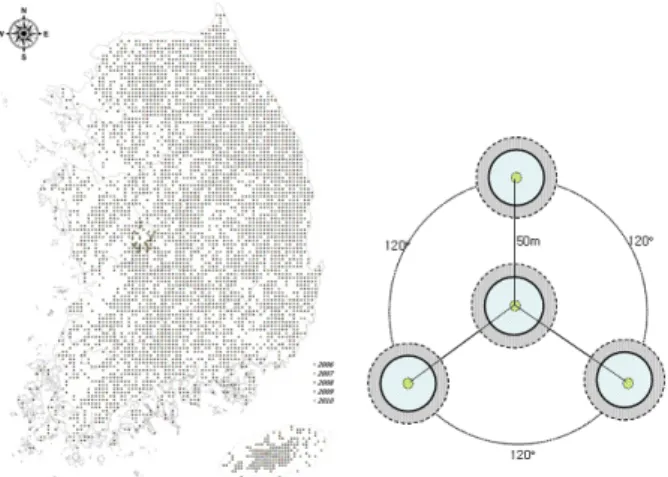
Fig. 1. Permanent sample plot and sampling design in Korea.
parties (Yim and Shin, 2006). The prevailing reason for conducting a forest inventory is to make informed deci- sions about forest management. National Forestry Re- sources Inventory Center conducts national forest inven- tory every 5 years to obtain accurate baseline data for national forest policy. The forest inventory is carried out by the ground sampling and state of the art technology to produce accurate forest statistics acceptable and reliable to international forest community. Forest inventory is used for many purposes, but different procedures are required to satisfy various needs of different users. The objective of this study was to develop methods for quantifying forest resources at national scale based on 5th National Forest Inventory (NFI) data in Korea.
When taking forest inventory the following are impor- tant things to measure and note species, diameter at breast height (DBH), height, site quality, age, and defects. From the data collected one can calculate the number of trees per ha, the basal area, the volume of trees in an area, and the value of the timber. Especially, biomass components of all live trees, in addition to stem, were studied more intensively when increasing interest was shown in bio- mass as an energy source (Hakkila, 1989). Also, the national forest inventory provides an overview of available regio- nal and national resources, as well as a carbon balance of Korea’s forests. This information is important for govern- ment officials, public administration, the private business sector and the general public.
National Forest Inventory
Forest Inventory is used for many purposes, but diffe- rent procedures are required to satisfy various needs of different users in an efficient way. The NFI of Korea began from 1972 at about 10 year intervals. National forest inventory in Korea began a new annual forest inventory in 2006. Forest inventory designs can range from very simple tree-based methods such as systematically sampling every nth tree encountered in a given area, to very com- plex multi-stage design and multiphase sampling methods
incorporating remote sensing and unequal probability sampling. Forest inventory is a set of objective sampling methods designed to quantify the spatial distribution, composition, and rates of change of forest parameters within specified levels of precision for the purpose of management. The new inventory system measures a 20%
sample of Korea’s forests every year. Fieldwork under the inventory system began in April 2006 and the full 100%
sample will be completed in 2010. Measurement variables were measured for tree species, dbh, height, 5 year growth, crown class, quality, bark thickness, etc. New variables were measured saplings, soil, vegetation, stump, deadwood, litter, etc. Tree-level data consists of obser- vations of individual trees, where trees with DBH more than 6cm were measured from plots.
Permanent sample plot
Sampling is a necessary technique used for economical and technical reasons, when preparing most forest inven- tories. Permanent sample plots provide basis for growth modeling, yield prediction and sustainable yield manage- ment, and there liability of these data is crucial to these and many other aspects of forest management. The per- manent sample plot data used in were collected by NFI.
Sampling was denser in Korea, with clusters every 4 km.
The subplots are configured as a central subplot and three
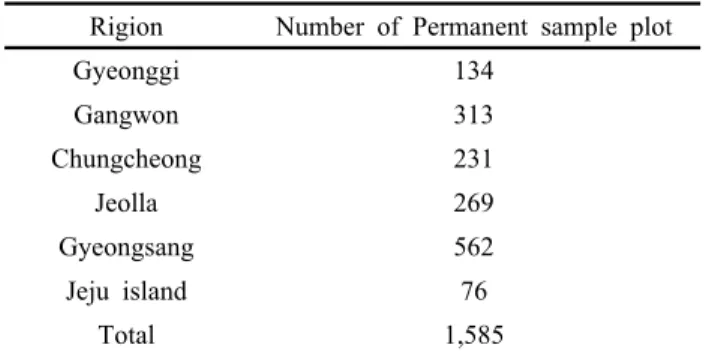
Table 1. Distribution of PSP
Rigion Number of Permanent sample plot
Gyeonggi 134
Gangwon 313
Chungcheong 231
Jeolla 269
Gyeongsang 562
Jeju island 76
Total 1,585
Table 2. Summary from PSP data
Variables Mean Minimum Maximum
Age (years) 34.2 9.0 200.0
Height (m) 10.9 1.5 37.5
DBH (cm) 14.1 6.0 130.0
Altitude (m) 377.4 10.0 1760.0
Slope (DEG) 28.7 0.0 68.0
peripheral subplots with centers located at 50 m and azi- muths of 0°, 120°, 240° from center of the central sub- plot. Plot- and compartment-specific data consisted of information on the stand such as land area, site type, vegetation, stand age, soil type, habitat data, land use, etc.
Data collection
The data used in this study were obtained from mea- surements of permanent sample plots maintained by Na- tional Forestry Inventory Center in Korea. The best use of all available data is combining the 2006 sample of 800 plots with the 2007 sample of 793 plots. The dataset consists of about 1,579 sample plots on forest land, and measurements from 2006 to 2007 used. The data set in- cluded measurements from six forests growing regions:
the Gyeonggi set comprised 134 plots; Gangwon 313 plots;
Chungcheong 231 plots; Jeolla 269 plots; Gyeongsang 562 plots; Jeju island 76 plots. The data set consists of about 1,585 sample plots on forest land, and measure- ments data from 2006 to 2007 used.
Summary data of PSP
Mean of tree ages was 34 years, minimum and maxi- mum ages were 9 and 200 years respectively. Mean Heights was 10.9 m, minimum and maximum was 9.0 m and 37.5 m respectively. DBH ranged from 6 cm to 130 cm.
Altitude reflects largely influences of temperature, soil fertility, rainfall and winds, which environmental factors contribute directly to the growth of trees at a given lo- cation. Altitude has the range of from 10 m to 1,760 m, with a mean of 377.4 m. Slope was ranged from 0 degree to 68 degree with a mean of 28.7 degree.
FOREST RESOURCES
Forest land area decreased from 6.44 to 6.39 million hectare between 1997 and 2007, continuing a slight down- ward trend in area beginning in the late 1990s. However forest resources of the Korea have continuously improved in general condition and quality, as measured by increased average size and volume of trees. The resources of the Korea have 6.39 million ha of forest covering about 64.2%
of total land area. The coniferous forest make up nearly 42.3% (2.70 million ha) of the total forest cover. The broadleaved forest and mixed forest cover 25.9% (1.66 million ha) and 29.3% (1.87 million ha) respectively. The remaining 2.5% (0.16 million ha) is classified as others.
The total growing stock 791 million m3 and the volume per ha is estimated at 123.79 m3. However, nearly 60%
of forest stands are aged less than 40 years. Thus, Korea has largely depended on imported timber, supplying about 94% of the domestic timber consumption.
Numbers of trees
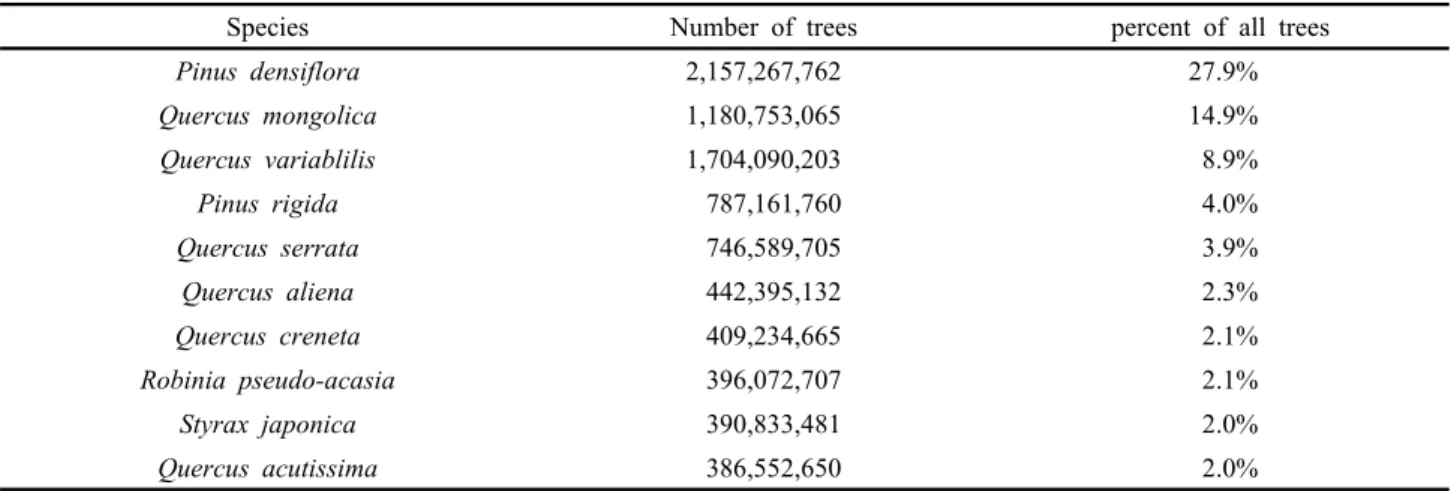
The live tree species of NFI data appeared to be 253 species. Tree-level data consists of observations of indi- vidual trees, where trees with DBH more than 6 cm were measured from plots. The most abundant live tree species in Korea are pinus densiflora. Major tree species of coni-
Table 3. Top 10 species by umber of trees in Korea
Species Number of trees percent of all trees
Pinus densiflora 2,157,267,762 27.9%
Quercus mongolica 1,180,753,065 14.9%
Quercus variablilis 1,704,090,203 8.9%
Pinus rigida 787,161,760 4.0%
Quercus serrata 746,589,705 3.9%
Quercus aliena 442,395,132 2.3%
Quercus creneta 409,234,665 2.1%
Robinia pseudo-acasia 396,072,707 2.1%
Styrax japonica 390,833,481 2.0%
Quercus acutissima 386,552,650 2.0%
Table 4. Sapling trees by NFI data Classification Number of
Sapling trees N/ha Population Species
Conifer 20 646 11,333
Pinus densiflora, Juniferous rigida, Pinus koraiensis, Pinus thunbergii,
Cryptomeria japonica etc.
Broad-leaved 147 9,224 166,615
Quercus serrata, Quercus mongolica, Fraxinus sieboldiana, Quercus aliena,
Rhus trichocarpa etc.
Total 164 9,870 177,948
ferous are Pinus densiflora, Pinus rigida, Major tree species of Broad-leaved Quercus mongolica, Quercu- svariablilis, Quercus serrata, Quercus aliena, Quercus creneta, Robinia pseudo-acasia, styrax japonica, Quercus acutissima.
Sapling trees
When it comes to saplings data in Korea, it is im- portant to get the information for changing forests. Sapling data consists of observations of individual trees, where trees with sapling I (< 2 cm of DBH), sapling II (2 cm
< DBH < 4 cm) and sapling III (4 cm < DBH < 6 cm) were measured from all plots. Major sapling trees of coniferous are Pinus densiflora, Juniferous regida, Pinus Koraiensis, Pinus thunbergii, Cryptomeria japonica etc.
Major sapling trees of broad-leaved are Quercus serrata, Quercus mongolica, Fraxinus sieboldiana, Quercus aliena,
Rhus trichocarpa etc. It was considered that Pinus desiflora forest changed potentially as Quercus spp forests due to rapid success of Quercus spp below the lower layer.
Growing stocks
When associated with volume, include only tree 6cm dbh and larger. Growing stock volume of the Korea in- creased from 17 to 123.79 cubic meter per hectare between 1976 and 2007. Growing stock of Gangwon was 149.65 cubic meter per hectare, what was the highest growing stock in Korea. Jeju island was in second level with the growing stock of 144.48 cubic meter per hectare (Figure 2).
Biomass estimation
Biomass is total biomass for all live tree components above ground. This includes stem wood, stem bark, branches,
Fig. 2. Growing stock per hectare on timberland by region
Table 5. Biomass by forest type (Tons per hectare)
NFI unit Forest type
Conifer Broad-leaved Mixed Total
Biomass 188.08 139.01 222.51 153.81
- Ground BEFs: Conifer (1.29), Broad-leaved (1.22) - Underground BEFs: Conifer (0.28), Broad-leaved (0.41)
Table 6. Carbon by forest type (tons per-hectare)
NFI unit Forest type
Conifer Broad-leaved Mixed Total
Carbon stock 107.2 78.57 125.98 84.36
- Carbon coefficient : 0.5 (FAO, 2004)
and foliage. Biomass estimation for national reports of GHG in most European countries has relied on simple conversion factors that convert stem volumes to biomass (Tomppo 2000, IPCC 2003). To estimate tree biomass of forests, biomass expansion factors with uncertainty esti- mate were developed for Korea. Biomass per hectare is estimated from existing equation. Biomass estimates see Eqs (1)
Ba= Bs× BEFs (1)
Where Ba is above ground biomass; Bs is Stem bio-
mass; BEFs is biomass expansion factors. The table 2 is shows the unit total biomass by forest type. The biomass in Korea was estimated to be 153.81 tons per hectare.
Carbon stock
In addition to measured deadwood, it is available of estimating carbon stock. It is important to climate change, and carbon is included in the NFI data. The table 3 is shows the unit total carbon stock by forest type. More carbon is stored in the broad-leaved forest type in Korea.
Carbon stocks in Korea was estimated to be 84.36 tons per hectare.
SUMMARY
Fieldwork under the inventory system began in April 2006 and will be completed over a five-year. When the 2006 plots are again revisited and completely premea- sured in the sixth inventory year (2011). Forest resources of the Korea obtained from NFI data are outlined below.
1. The live tree species appeared to be 253 species and the most abundant live tree species are Pinus densiflora by NFI data.
2. It was considered that pinus densiflora forest changed potentially as Quercus sserata forest.
3. Growing stock in Korea increased from 17 to 126.23
cubic meter per hectare between 1976 and 2007.
4. The biomass in Korea was estimated to be 153.8 tons per hectare.
5. Carbon stocks in Korea were estimated to be 84.36 tons per hectare.
National forest inventory are need to meet DB process of international organizations such as Food and Agricul- ture organization (FAO), Montreal process (MP), Kyoto protocol (KP) under United Nations Framework Con- vention on Climate Change (UNFCCC), etc. Moreover, verified carbon sinks can be used partially to offset emissions. NFI data is important for government officials, public administration, the private business sector, and the researcher.
LITERATURE CITED
Yim, J. S., and M. Y. Shin. 2006. Comparison of plot sizes for forest inventory in natural deciduous natural deciduous forest in Korea. Journal of Korea Forest Society 95 : 595-600.
Hakkila, P. 1989. Utilization of residual forest biomass. Springer- verlag, Berlin. 557 pp.
Husch, B., Beers T. W., and J. A. Kershaw, Jr. 2003. Forest men- suration. 4th Ed. John Wiley and Sons. Hoboken, New Jersey.
150-160 pp.
IPCC 2003. Good practice guidance for land use, land-use change and forestry. IPCC National Greenhouse Gas Inventories Pro- gramme. 295 pp.
Lyke, J. and D. J., Brooks. 1995. World supply and demand for forest products. Journal of Forestry 93: 22-26.
Tomppo, E. 2000. National forest inventory in Finland and its role in estimating the carbon balance of forests. Biotechnology, Agro- nomy, Society and Environment 4: 241-320.