Regular Article
J F E S
Journal of Forest and Environmental Science
pISSN: 2288-9744, eISSN: 2288-9752
Journal of Forest and Environmental Science Vol. 34, No. 2, pp. 165-168, April, 2018 https://doi.org/10.7747/JFES.2018.34.2.165
J For Environ Sci 34(2), 165-168 165
Impacts of Mt. Bongeui on Atmospheric Purification in Chuncheon
Zhi Hui Piao1 and Hyun-Kil Jo2,*
1Department of Landscape Architecture, Graduate School, Kangwon National University, Chuncheon 24341, Republic of Korea
2Department of Ecological Landscape Architecture Design, Kangwon National University, Chuncheon 24341, Republic of Korea
Abstract
Mt. Bongeui is a neighborhood park of 66.4 ha as a major natural landscape resource located in the center of Chuncheon City. This study quantified the reduction of carbon, SO2, NO2, O3, and PM2.5, and the production of O2 to explore the role for Mt. Bongeui to contribute to annual atmospheric purification. The main forest types and age classes of the study site included age-class III broadleaved forest at 35.8%, age-class VI coniferous forest at 17.2%, and age-class IV broadleaved forest at 15.7%. The annual atmospheric purification effect per unit area was as follows: 7.6 t carbon/ha/yr, 16.6 kg SO2/ha/yr, 40.4 kg NO2/ha/yr, 41.5 kg O3/ha/yr, 53.7 kg PM2.5/ha/yr, and 20.2 t O2/ha/yr. The economic value of these effects was equivalent to about 12.9 million KRW/ha/yr. The study site annually offset carbon emissions of about 300 citizens, SO2 emissions of 220 citizens, and NO2 emissions of 92 citizens in Chuncheon. It also played an important role in annually producing 1.5% of the amount of O2 necessary for the respiration of Chuncheon’s total population. This study pioneers in comprehensively quantifying the atmospheric purification effect and could be useful in guiding the planning and management to improve the effect.
Key Words: carbon, pollutants, oxygen, economic value, offset
Received: January 13, 2018. Revised: March 5, 2018. Accepted: March 8, 2018.
Corresponding author: Hyun-Kil Jo
Department of Ecological Landscape Architecture Design, Kangwon National University, Chuncheon 24341, Republic of Korea Tel: 82-33-250-8345, Fax: 82-33-259-5618, E-mail: [email protected]
Introduction
Globally, the consumption of fossil fuels has con- tinuously increased the concentration of air pollutants, such as SO2, NO2, O3, and PM2.5, as well as carbon, which is the main cause of climate change. The increase in air pollutants has a negative impact on natural ecosystems and socio-eco- nomic systems (MOE 2014). Therefore, various efforts have been internationally made to reduce the emission of air pollutants including carbon (Cheongwadae 2016; Cheong- wadae 2017; GIR 2017).
Mt. Bongeui is a neighborhood park located in the cen- ter of Chuncheon City, Korea. The park contributes to im- proving the quality of urban environment, such as air pollu-
tion control, heat island mitigation, and wildlife inhabitation.
However, there is no information on environmental benefits of the park, and the expansion of the city presently threatens damage to the park.
The purpose of this study is to quantify the atmospheric purification effect of Mt. Bongeui to suggest the base in- formation necessary for planning and management. The gaseous and particulate materials considered in computing the effect were the reduction of carbon, SO2, NO2, O3, and PM2.5, and the production of O2. This study pioneers in tackling the complexities associated with comprehensively quantifying the materials, including carbon and PM2.5, which are recently emerging as environmental problems.
Impacts of Mt. Bongeui on Atmospheric Purification in Chuncheon
166 Journal of Forest and Environmental Science http://jofs.or.kr
Materials and Methods
Sampling and survey
A total of 73 sample survey points were selected through a systematic sampling method on a 1:5,000 forest type map and aerial photographs. A grid of 2 cm spacing, which could reflect all the forest types and age classes of the study site, was established and all these points were sampled. For sam- ple survey points, an on-site investigation was performed on the forest structure, including tree species, stem diameter, crown width, tree height, and stratum using the quadrat method (size: 10×10 m) from August to September 2017.
Quantifying atmospheric purification effects The atmospheric purification effect per unit area by forest type and age class was quantified applying a quantitative model at the single-tree level by species to the result of forest structure survey. Annual carbon absorption was estimated using a quantitative model (Jo 2001; Jo and Ahn 2003; Jo and Ahn 2013) derived through the annual measurement of the CO2 exchange rate. Annual absorption of SO2, NO2, and O3 was calculated using a quantitative model (Jo 2001) derived from the absorption velocity ratios of SO2, NO2, or O3/CO2. Annual PM2.5 deposition was computed using the dry deposition model (Jo 2001; Nowak et al. 2013) based on deposition velocity, total leaf area, and resuspension ratio by wind speed. Annual O2 production was quantified based on the photosynthesis formula (Lieth 1963), which indicates the absorption of 6 moles of CO2 and the emission of 6 mo- les of O2. The atmospheric concentrations of these pollu- tants were applied based on data measured over the last three years (2014-2017) in Chuncheon City or nearby areas.
Analysis of economic value and emission offset The atmospheric purification effect of the study site was converted into an economic value using the treatment and abatement cost by atmospheric matter: approximately 400 thousand KRW/t for carbon and O2, 3,700 thousand KRW/t for SO2, 15,200 thousand KRW/t for NO2 and O3, and 10,150 thousand KRW/t for PM2.5 (Murray et al.
1994; GCCSI 2017; KPRC 2017). The annual average en- ergy consumption of Chuncheon citizens for the last three years (Chuncheon 2017) was computed to explore the role of the study site in offsetting carbon and air pollutants. The
amount of annual carbon and air pollutant emissions from the energy consumption was estimated applying the emis- sion factors by energy type such as electricity, oil, and gas (NIER 2012; KEA 2016).
Results and Discussion
Forest type and age class
The total area of Mt. Bongeui is 66.4 ha. The most com- mon forest types were broadleaved forest at 60.6%, fol- lowed by coniferous forest at 27.6% and mixed forest at 11.8%. By age class, age class III was predominant at 43.1%, followed by age class IV at 28.7% and age class VI at 17.2%. Tree density varied in the range of 9.1 to 13.7 trees/100 m2 depending on forest type and age class. The stem diameter distribution at breast height of the tree was as follows: less than 10 cm with about 34%, 10-20 cm with 36.1%, and 20-30 cm with 18.1% (less than 30 cm with 88.2%). The major tree species with high mean importance values included Quercus mongolica (35.1%), Pinus densi- flora (30.9%), and Prunus sargentii (6.2%).
Atmospheric purification effects
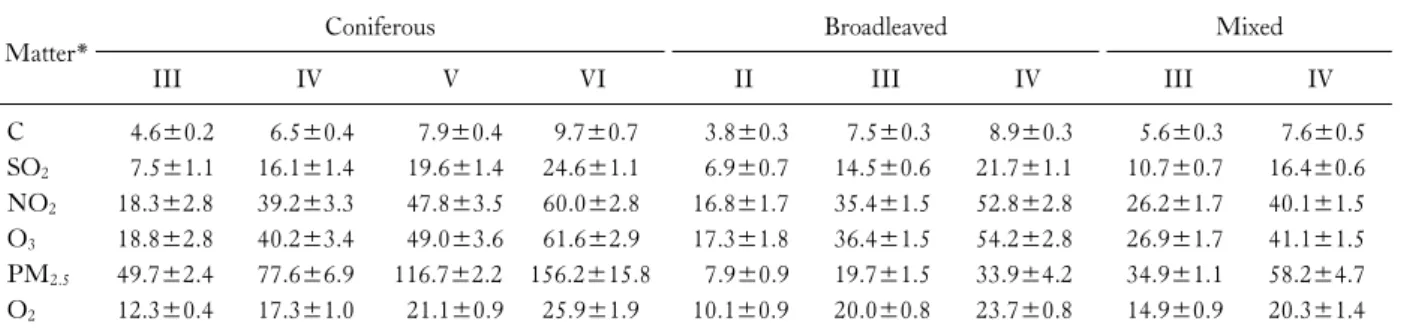
The annual atmospheric purification effect per unit area of the study site increased as the age class rose. For the same age class, the effect was greater in broadleaved forests than in coniferous forests (Table 1). However, annual PM2.5
deposition was larger in coniferous forests than in broad- leaved forests. Age-class VI coniferous forest, the oldest age at the study site showed the greatest atmospheric purifica- tion effect per unit area: 9.7 t carbon/ha/yr, 24.6 kg SO2/ha/yr, 60.0 kg NO2/ha/yr, 61.6 kg O3/ha/yr, 156.2 kg PM2.5/ha/yr, and 25.9 t O2/ha/yr.
Previous studies (Jo 2001; Jo et al. 2002; Jo and Ahn 2013) reported that the annual atmospheric purification effect per unit area of age-class IV broadleaved forest distributed in the central area of Korea, including the Namsan Nature Park in Seoul, was 6.8-7.6 t carbon/ha/yr, 17.1-23.7 kg SO2/ha/yr, and 44.2-48.2 kg NO2/ha/yr. The absorption values of the study site were similar to or up to 1.3 times larger than those in the previous studies. The annual atmospheric purification effect for the total area of the study site was as follows: 478.5 t carbon/yr, 1,048.1 kg SO2/yr, 2,556.4 kg NO2/yr, 2,625.5 kg O3/yr, 3.4 t PM2.5/yr, and 1,276.0 t O2/yr (Table 2).
Piao and Jo
J For Environ Sci 34(2), 165-168 167
Table 2. Capacity and economic value of atmospheric purification by matter
Matter Unit area (ha) Total area
Capacitya Value (ten thousand ₩/ha/yr) Capacityb Value (million ₩/yr)
C 7.6 302 478.5 191
SO2 16.6 6 1,048.1 4
NO2 40.4 61 2,556.4 39
O3 41.5 63 2,625.5 40
PM2.5 53.7 55 3.4 35
O2 20.2 808 1,276.0 511
aUnit: t/ha/yr for C and O2, and kg/ha/yr for the other matter; bUnit: t/yr for C, PM2.5 and O2, and kg/yr for the other matter.
Table 1. Atmospheric purification effects per unit area by forest type and age class
Matter* Coniferous Broadleaved Mixed
III IV V VI II III IV III IV
C 4.6±0.2 6.5±0.4 7.9±0.4 9.7±0.7 3.8±0.3 7.5±0.3 8.9±0.3 5.6±0.3 7.6±0.5 SO2 7.5±1.1 16.1±1.4 19.6±1.4 24.6±1.1 6.9±0.7 14.5±0.6 21.7±1.1 10.7±0.7 16.4±0.6 NO2 18.3±2.8 39.2±3.3 47.8±3.5 60.0±2.8 16.8±1.7 35.4±1.5 52.8±2.8 26.2±1.7 40.1±1.5 O3 18.8±2.8 40.2±3.4 49.0±3.6 61.6±2.9 17.3±1.8 36.4±1.5 54.2±2.8 26.9±1.7 41.1±1.5 PM2.5 49.7±2.4 77.6±6.9 116.7±2.2 156.2±15.8 7.9±0.9 19.7±1.5 33.9±4.2 34.9±1.1 58.2±4.7 O2 12.3±0.4 17.3±1.0 21.1±0.9 25.9±1.9 10.1±0.9 20.0±0.8 23.7±0.8 14.9±0.9 20.3±1.4
*Unit: t/ha/yr for C and O2, and kg/ha/yr for the other matter.
Emission offset and implication
The annual emissions of carbon, SO2, and NO2 per cap- ita from energy consumption in Chuncheon City were 1.6 t/yr, 4.7 kg/yr, and 27.7 kg/yr, respectively. Mt. Bongeui annu- ally offset carbon emissions of about 300 citizens, SO2
emissions of 220 citizens, and NO2 emissions of 92 citizens in Chuncheon. The study site also annually produced 1.5%
of the amount of O2 necessary for Chuncheon’s total pop- ulation (280 thousand), based on the annual O2 require- ment for respiration of 0.3 t per capita (Nowak et al. 2007).
Thus, the study site played an important role in improving the urban air quality.
The economic value per unit area of the annual atmos- pheric purification effect equaled approximately 3 million KRW/ha/yr for carbon, 60,000 KRW/ha/yr for SO2, 610,000 KRW/ha/yr for NO2, 630,000 KRW/ha/yr for O3, 550,000 KRW/ha/yr for PM2.5, and 8 million KRW/ha/yr for O2 (Table 2). The total economic value for the entire study area of the effect was equivalent to about 820 million
KRW/yr. The economic value for O2 and carbon com- prised 62.3% and 23.3% of the total, respectively. These economic values can be useful in securing the budget re- quired for managing the study site.
The economic value of the annual atmospheric purifica- tion effect per unit area by forest type and age class ap- peared in the order of 18 million KRW/ha/yr for age-class VI coniferous forest and 15 million KRW/ha/yr for age-class IV broadleaved forest. High priority of the man- agement should be placed on conservation of these forest types and age classes with greater levels of atmospheric purification. The area of the study site important as the ur- ban forest has been reduced with the expansion of the city (Jo 2003). It is essential to limit the development activities by establishing a buffer zone around the periphery of the study site. The poor growth of trees reduces the atmos- pheric purification effect. The normal growth of trees should be ensured through such means as supplementary planting, thinning, or the control of insects and diseases, such as pine creeper and oak wilt disease. It is important to
Impacts of Mt. Bongeui on Atmospheric Purification in Chuncheon
168 Journal of Forest and Environmental Science http://jofs.or.kr
publicize the atmospheric purification value of the study site and to boost citizens’ participation and interest. This study comprehensively considered various gaseous and par- ticulate materials in quantifying the atmospheric purification.
The results of the study are expected to contribute to the sharing of relevant information with the world as well as the study site.
Acknowledgements
This study was developed from Piao and Jo (2017)’s pre- sentation at International Symposium of KNU Institute of Forest Science.
References
Cheongwadae. 2016. Plan to counteract climate change I. Seoul, Korea.
Cheongwadae. 2017. Strategy to decrease PM2.5. http://www.me.
go.kr/issue/finedust4. Accessed 10 Oct 2017.
Chuncheon. 2017. Annual statistical report 2016.
GCCSI (Global Carbon Capture and Storage Institute). 2017.
Global costs of carbon capture and storage. Global CCS Institute, Melbourne.
GIR (Greenhouse Gas Inventory and Research Center). 2017.
Climate change and green growth. Greenhouse Gas Inventory and Research Center, Seoul.
Jo HK. 2001. Indicator for CO₂ Uptake and Atmospheric Purifi- cation Evaluation of Vegetation. Development of Eco-Indicators for Sustainable Development. Ministry of Environment, Seoul.
Jo HK. 2003. How Can We Foster the Bongeuisan Urban Park.
In: The 3rd Citizen Discussion for Bongeuisan Management.
Chuncheon, Korea; 2003. pp 11-49.
Jo HK, Ahn TW. 2003. Atmospheric CO2 uptake by Pinus densi- flora and Quercus mongolica. J Environ Sci 12: 853-860.
Jo HK, Ahn TW. 2013. Evaluation of CO2 storage and uptake by forest landscapes in the middle region of Korea. J Environ Sci 22: 139-149.
Jo HK, Cho YH, Ahn TW. 2002. Capacity and value of atmos- pheric purification for Namsan nature park in Seoul. Korean J Environ Ecol 16: 172-178.
KEA (Korea Energy Agency). 2016. Energy Use and Greenhouse Gas Emission. Korea Energy Agency, Yongin.
KPRC (Korea Price Research Center). 2017. Control Cost of O2. https://www.kprc.or.kr. Accessed 6 Oct 2017.
Lieth H. 1963. The role of vegetation in the carbon dioxide content of the atmosphere. J Geophysical Res 68: 3887-3898.
MOE (Ministry of Environment). 2014. Strategy to improve air quality. Ministry of Environment, Seoul.
Murray FJ, Marsh L, Bradford PA. 1994. New York state energy plan. Albany, NY.
NIER (National Institute of Environmental Research). 2012. Air Pollutants Emission Factors Sourcebook. National Institute of Environmental Research, Incheon.
Nowak DJ, Hirabayashi S, Bodine A, Hoehn R. 2013. Modeled PM2.5 removal by trees in ten U.S. cities and associated health effects. Environ Pollut 178: 395-402.
Nowak DJ, Hoehn R, Crane DE. 2017. Oxygen production by ur- ban trees in the United States. Arbor Urban For 33: 220-226.
Piao ZH, Jo HK. 2017. Atmospheric purification effects of Mt.
Bongeui in Chuncheon. Annual International Symposium of KNU Institute of Forest Science: LXIV-LXIV.