Journal of Forest and Environmental Science
Journal of Forest and Environmental Science Vol. 32, No. 2, pp. 149-157, May, 2016 http://dx.doi.org/10.7747/JFES.2016.32.2.149
The Analysis on Forest Fire Occurrence Characteristics by Regional Area in Korea from 1990 to 2014 Year
Bo Ram Jeon1 and Hee Mun Chae2,*
1Department of Forest Environment System, Kangwon National University, Chuncheon 24341, Republic of Korea
2Department of Forest Environment Protection, Kangwon National University, Chuncheon 24341, Republic of Korea
Abstract
Understanding regional characteristics in forest fire occurrence is important to establish effective forest fire prevention policy in Korea. This study analyzed the characteristics of forest fires occurred in 16 administrative districts for recent 25 years (1990∼2014) to examine regional characteristics in forest fire occurrence. Forest fire occurrence reflects regional characteristics depending on climatic factors as well as region’s society-cultural factors. Results showed that the first cause of forest fire occurrence was carelessness by human activities throughout all administrative districts, however, the second cause depends on regional characteristics. As the results of forest fire occurrence period analyzed for 10 days, the most forest fires occurred in the southern region during January to March, while forest fires in the northern region occurred mostly during March to April. We classified forest fire occurrence patterns into three types (centralized:
Gyeonggi-do, dispersal: Busan, horizontally distributed: Gyeongsangnam-do) by multi-temporal analysis for forest fire occurrence period.
Key Words: regional characteristics in forest fire occurrence, forest fire frequency, forest fire occurrence cause, forest fire occurrence pattern
Received: April 29, 2016. Revised: May 9, 2016. Accepted: May 13, 2016.
Corresponding author: Hee Mun Chae
Department of Forest Environment System, Kangwon National University, 1 Gangwondaehak-gil, Chuncheon 24341, Republic of Korea Tel: 82-33-250-8367, Fax: 82-33-259-5617, E-mail: [email protected]
Introduction
Forest fires is recognized as an extremely serious issue af- fecting the forest ecosystem and are caused enormous dam- ages in socio-economically. The impacts of forest fire are more important to forests ecosystem of Korea because Korea’s forest ratio is at high level of 65%. According to the forest fire statistic annual report for the recent ten years (2005∼2014), forest fire was occurred in annual average 384 number and burned area was 630.6 ha (Korea Forest Service 2015). Recently, big forest fires frequently occur globally by the climate change and these big forest fires
emerge as a global disaster. Forest fires are decrease of bio- logical diversity and increases in flood damages, and in at- mospheric pollution as CO2 emissions, also make to very serious in the economic and social. Although it is important to control a forest fire quickly, when it occurs, the pre- vention of a forest fire is a more important (Kim et al.
2002).
The causes of forest fires can be divided into human ac- tivity and natural factors. Most forest fires in Korea occur by human activity and they do not seldom occur by the nat- ural phenomenon such as lightening. Many forest fires oc- cur by human activity due to high population density of ko-
rea; however, such forest fire occurrence is related with var- ious weather conditions including temperature, humidity and wind velocity (Van Wagner 1987). Forest fire occur- rence in Korea is differently distributed by month, occur- rence time and day of the week, and forest fire occurrence period and damaged area are different according to region of korea (Lee et al. 2006). In Korea, dry duration is pro- longed and many forest fires tend to occur simultaneously nationwide by strong wind according to region in spring and fall seasons. The high possibilities of many forest fire occurrence and big forest fires are gradually increasing during the forest fire danger seasons (spring and fall) (Chae 2003).
In the recent, Forest fires occur frequently by climate change as continuing drought, drying weather condition.
Since the 1990s, Goseong forest fire in 1996, East Coast forest fire in 2000, Cheongyang and Yesan forest fires in 2002, and Yangyang forest fire in 2005 were very big forest fires which were caused dried weather and strong wind ve- locity by regional characteristics. In the previous studies, regional forest fire causes and characteristics of forest fire occurrence by region were analyzed through the regional patternization of forest fire occurrence factors in Gang- won-do (Lee et al. 2001). In the study of forest fire charac- teristics in Korea using to forest fire statistics (Lee et al.
2012), The number of forest fires were analyzed by season, forest fire occurrence cause and fire occurrence timet, and the forest fire characteristics for the past 50 years. The study on forest fire occurrence situation analysis of Korea (Lee et al. 2006) were investigated to frequency analysis to time for fire control and damaged area based on the stat- istical data of forest fire occurrence during 14 year. The na- tional institute of forest science of the Korea Forest Service has developed a forest fire forecasting system since 2003, and has been doing a daily forest fire forecasting by region during the forest fire danger seasons (Korea Forest Service 2015). Korea’s forest fire forecasting system predicts the degree of forest fire risk by region based on topology, forest stands and weather. The forest fire danger season of Korea is set up by dividing it into spring (February 1-May 15) and fall (November 1-December 15).
Fire forecasting system in national level are not reflected the recent climatological features by climate change. Therefore, forest fire forecast system of local level should be
developed. This study attempts a new approach for devel- opment of the forest fire forecasting system in local level during fire danger seasons by classifying the forest fire oc- currence characteristics by the region during 25 years.
Materials and Methods
Analysis of forest fire occurrence data during 25year in Korea
This study for analysis of forest fire occurrence causes analyzed forest fire occurrence number according to region for 25 years (1990 to 2014 year) using the forest fire stat- istical data of the Korea Forest Service. We investigated to forest fire occurrence time that is month and day based on the region in korea. This study was classified 16 admin- istrative districts for analysis of the forest fire occurrence number based on the region in korea. The classified admin- istrative districts were as follows: six metropolitan areas (Seoul, Incheon, Daejeon, Daegu, Gwangju and Busan) and nine metropolitan municipalities (Gyeonggi–do, Chu- ngcheongbuk-do, Chungcheongnam-do, Gyeongsangbuk-do, Gyeongsangnam-do, Jeollabuk-do, Jeollanam-do, Gangwon-do Yeongseo and Gangwon-do Yeongdong). In particular, Gangwon-do was divided into Yeongdong and Yeongseo, since climate and forest fir occurrence situations are different. This study analyzed regional causes and time to forest fire occurrence through korea forest fire statistical analysis for 25 years (1990-2014). We divide into unit of ten days (1-10 days, 11-20 days, 21-30 and 31 days) on each month for analysis of more detailed forest fire occur- rence characteristics according to region.
Results and Discussion
Forest fire occurrence number during 25 years in Korea
The forest fire occurrence number in Korea from 1990 to 2014 were 10,132 number and burned area by forest fire was 53,386 ha. The year of most the forest fire occurrence number was 785, 729 and 630 in 2001, 2000 and 1995, respectively. The largest burned area took place in 2000, as 25,953 ha. The monthly mean number of forest fire occur- rence was the highest in April with an increase from February to April, and the forest fires showed a decrease af-
Table 1. The number of forest fire occurrence of Korea from 1990 to 2014 year
Year 90 91 92 93 94 95 96 97 98 99 00 01 02 03 04 05 06 07 08 09 10 11 12 13 14 Total Number 71 139 180 278 433 630 527 524 265 315 729 785 599 271 544 516 405 418 389 570 282 277 197 296 492 10,132 Ratio (%) 0.7 1.4 1.8 2.7 4.3 6.2 5.2 5.2 2.6 3.1 7.2 7.7 5.9 2.7 5.4 5.1 4.0 4.1 3.8 5.6 2.8 2.7 1.9 2.9 4.9 100
Table 2. The number of forest fire occurrence month
Month 1 2 3 4 5 6 7 8 9 10 11 12 Total
Number 624 1,392 2,490 3,229 689 276 34 21 117 280 420 460 10,132
Ratio (%) 6.2 13.9 24.8 32.2 6.9 2.8 0.3 0.2 1.2 2.8 4.2 4.6 100
Table 3. The number of forest fire occurrence day of the week
Day Sunday Monday Tuesday Wednesday Thursday Friday Saturday Total
Number 1,860 1,372 1,349 1,425 1,280 1,326 1,420 10,132
Ratio (%) 18.5 13.7 13.4 14.2 12.8 13.2 14.2 100.0
Table 4. The forest fire occurrence number according to forest fire occurrence time from 1990 to 2014 year
Hour 0 1 2 3 4 5 6 7 8 9 10 11 12 13 14 15 16 17 18 19 20 21 22 23 Total
Number 50 61 72 72 77 65 57 40 42 88 327 777 1,204 1,616 1,722 1,495 969 439 216 186 154 130 95 78 10,132 Ratio (%) 0.5 0.6 0.7 0.7 0.8 0.6 0.6 0.4 0.4 0.9 3.2 7.7 11.9 15.9 17.0 14.8 9.6 4.3 2.1 1.8 1.5 1.3 0.9 0.8 100
ter May. The most forest fires occurred from February to May, which is the spring forest fire danger season in Korea.
In this spring forest fire danger season, big forest fires oc- curred including Goseong forest fire in 1996, east coast for- est fire in 2000, west coast fire in 2002 and Yangyang and Naksan Temple forest fire in 2005.
Forest fire occurrence frequency by seasonal and monthly during 25 years in Korea
Forest fire occurrence frequency from 1990 to 2014 average 405 forest fires number occurred in each year, and the year of most forest fires occurrence was in 2001 with 785 number (7.7%), followed by 729 number (7.2%) in 2000 and 630 number in 1995 (6.2%). The total of forest fire occurrence number on 1995, 2000 and 2001 was 21.1%
of the total Korea’s forest fire occurrence number (Table 1).
Concerning monthly forest fire frequency, forest fires in- tensively occurred during March to May, which is the spring forest fire danger season, with 6,408 number, and the most forest fires occurred in April with 3,229 number
(32.2%) (Table 2). The reason why forest fire damages are huge during the spring forest fire danger season is because of strong wind, dry weather, dried forest fuels and small-scale precipitation. Many forest fires by various hu- man activities accessing forests in spring be a main caused.
In contrast with this, just 172 (1.7%) forest fires number occurred in summer (July-September) that forest fire oc- currence frequency was very low during in this period.
Forest fire occurrence by day of the week, 1,860 forest fires occurred the most on Sundays, followed by 1,425 and 1,420 forest fires on Wednesdays and Saturdays, respectively (Table 3). The Forest fires in spring seasons (March-May) occurred 63.9% with 6,408 forest fires, and winter (December-February) 2,476 forest fires (24.7%), fall (September-November) 817 forest fires (8.2%) and summer (June-August) 331 forest fires (3.3%). The forest fires dur- ing the spring fire danger was begin to increase in February, and showed trend to be concentrated in early May. The most forest fire occurrence occurred from 10:00 to 17:00 of day as 8,549 forest number that is 85% of the total forest
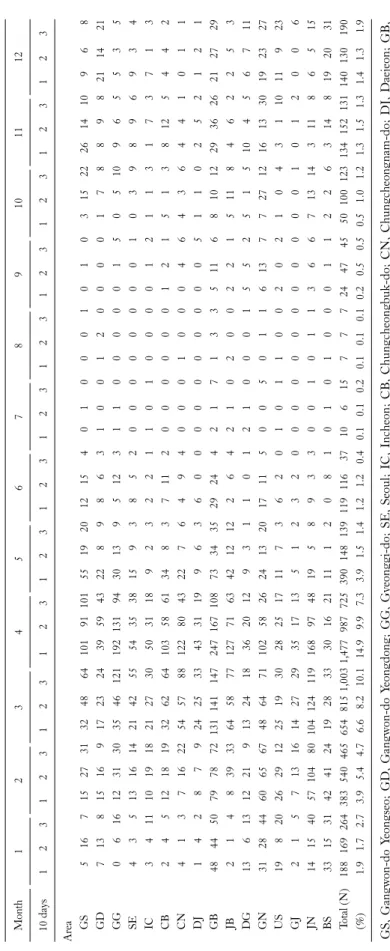
fires. Also, the most forest fires occurred at 14:00 with 1,722 number (17.0%), and 1,616 number (15.9%) at 13:00 and 1,495 number (14.8%) at 15:00 in the order. The number of forest fires occurrence during 13:00 to 15:00 of day was 47.7% of the total forest fire occurrence number (Table 4). As a result of analysis on forest fire occurrence in the ten days with interval during the spring and fall forest fire danger seasons, the most forest fires occurred during April 1∼April 10 with 1,477 number (14.9%) during the spring forest fire danger season.
The number of forest fire occurrence in each region of Korea
Analysis of Forest Fire Occurrence number in each re- gion of Korea
As a result of analyzing forest fire occurrence number in 16 administrative districts nationwide from 1990 to 2014, Gyeongsangbuk-do occurred most forest fire occurrence number as 1,748 number. Jeollanam-do and Gyeongsang- nam-do showed 1,117 and 961 forest fires number, re- spectively, In Gangwon-do occurred 1,622 forest fires in- cluding Gangwon Yeongdong and Yeongseo region oc- curred 842 and 780 number, respectively.
To analyze forest fire occurrence of period in each re- gion, this study analyzed forest fire occurrence number by classifying as ten days with interval during forest fire dan- ger seasons in Korea (Table 5). The forest fires in the south- ern region including Gyeongsangnam-do, Busan Metro- politan city and Jeollanam-do occurred earlier period than the spring forest fire danger seasons, compared to the cen- tral and northern regions. High forest fire occurrence ratio was revealed in all regions during April 1∼April 10 in this spring forest fire danger season. In Gyeongsangbuk-do, where forest fire occurrence was the most, relatively high forest fire occurrence was shown in all seasons, as well as during the forest fire danger seasons, except for summer, and the region did not show centralized distribution in April, compared to other regions. Busan Metropolitan city located in the southern region of korea occurred higher for- est fire, compared to other regions from January to February 20, and Ulsan Metropolitan city and Gyeongsangnam-do also showed a similar trend. That is, the southern region showed forest fire occurrence one month earlier than the spring forest fire danger season’s start date. In April, the
most forest fires occurred in the central region including Gyeonggi-do, Chungcheongbuk-do, Chungcheongnam-do and Daejeon Metropolitan city. Gangwon-do Yeongdong region showed higher forest fire occurrence than other re- gions from April 21 to May 31, which was analyzed to show differences in forest fire occurrence period and distribution, compared to those of the northern, eastern and southern regions.
The reason why the southern region showed higher for- est fire occurrence number in earlier period than the spring forest fire danger season is because of local weather factors and forest fires occurrence due to burning of ridges be- tween rice paddies/fields, deriving from higher farming area ratio than the Seoul Metropolitan Area.
As a result of analysis on forest fire occurrence time on the 10day with interval during the 1990 to 2014, the forest fire occurrence of the southern region including Gyeong- sangnam-do, Busan Metropolitan city and Jeollanam-do was earlier than the spring forest fire danger seasons, com- pared to the central and northern regions. Busan Metropol- itan city showed higher forest fire occurrence ratio from January to February 20, compared to other regions, and Ulsan Metropolitan city and Gyeongsangnam-do also showed a similar trend. Therefore, the southern region re- vealed forest fire occurrence period one month earlier than the spring forest fire danger season’s start date, February 1.
Analysis on the Forest Fire Occurrence Causes by Region in Korea
The forest fire for recent 25 years of korea was occurred 4,253 number by carelessness (Table 6). Forest fire occur- rence cause by carelessness (4,253 fire number) was ana- lyzed as the most in terms of the forest fire occurrence cause by region. In most regions, although the cause by the weed burning was the second highest factor of forest fire occur- rence, forest fires by cigarette littering were the second highest cause in Seoul Metropolitan city, which took up 14.7% of the total forest fires by littering. In the case of the weed burning that is second cause of total Korea forest oc- currence, the ratio of forest fire occurrence was a divided to regions. In Jeollanam-do, the weed burning showed rela- tively higher ratio (18.2%) than the other region, The weed burning was analyzed to occur more in rural areas than ur- ban areas. Forest fire occurrence by shooting in army activ-
Table 5. The analysis on 10 days the forest fire occurrence number in each the month of regional area from 1990 to 2014 year Month123456789101112 10 days123123123123123123123123123123123123 Area GS5167152731324864101911015519201215401000101031522261410968 GD7138151691723243959432289863100120000178898211421 GG06161231303546121192131943013951231100000150510965535 SE4351316142142555435381593852000000001039896934 IC3411101918212730503118923221101000012113173713 CB2451218193262641035861348371120000001215138125442 CN4137162254578812280432276494000100046436441011 DJ142879242533433119963600000000005110252121 GB48445079787213114114724716710873343529244217133511681012293626212729 JB2148393364587712771634212122642102002215118462253 DG136131221913241836201293110121000155251510456711 GN312844606567486471102582624132017115005011613772712161330192327 US198202629122519302825171173620101100202104311011923 GJ21571316142729351713512320000000000001012006 JN1415405710480104124119168974819589330010113667131431186515 BS33153142412419283330162111120810101000112263148192031 Total (N)1881692643835404656548151,0031,477987725390148139119116371061577724474550100123134152131140130190 (%)1.91.72.73.95.44.76.68.210.114.99.97.33.91.51.41.21.20.40.10.10.20.10.10.10.20.50.50.51.01.21.31.51.31.41.31.9 GS, Gangwon-do Yeongseo; GD, Gangwon-do Yeongdong; GG, Gyeonggi-do; SE, Seoul; IC, Incheon; CB, Chungcheongbuk-do; CN, Chungcheongnam-do; DJ, Daejeon; GB, Gyeongsangbuk-do; JB, Jeonllabuk-do; DG, Daegu; GN, Gyeongsangnam-do; US, Ulsan; GJ, Gwangju; JN, Jeonllanam-do; BS, Busan.
Table 6. The analysis on forest fire occurrence cause on each 16 administrative district in Korea from 1990 to 2014 year Number
of fire
Visiting
mountain Farmer Refuse Smoking Tomb
visits Children Army
activity Other
GS 752 (7.6) 335 111 49 44 31 11 29 142
GD 427 (4.3) 187 38 32 32 11 11 6 110
GG 841 (8.5) 387 110 73 43 84 15 17 112
SE 385 (3.9) 151 6 11 101 3 56 0 57
IC 291 (2.9) 122 27 10 48 4 33 2 45
CB 565 (5.7) 197 152 55 46 41 11 1 62
CN 600 (6.1) 197 177 66 25 53 8 5 69
DJ 248 (2.5) 98 54 23 15 15 20 0 23
GB 1,739 (17.6) 764 359 155 88 90 12 12 259
JB 678 (6.9) 286 165 58 26 52 11 2 78
DG 278 (2.8) 179 10 5 8 18 10 0 48
GN 955 (9.7) 427 179 66 54 65 13 3 148
US 352 (3.6) 194 32 21 15 13 8 2 67
GJ 200 (2.0) 92 41 17 18 9 9 0 14
JN 1,111 (11.2) 382 331 100 61 89 16 2 130
BS 462 (4.7) 255 26 28 63 3 19 1 67
Total 9,884 4,253 (43.0) 1,818 (18.4) 769 (7.8) 687 (7.0) 581 (5.9) 263 (2.7) 82 (0.8) 1,431 (14.5)
ity took up relatively higher ratio (35.4%) in Gangwon-do Yeongseo region, compared to other regions. The reason is conjectured that military bases are concentrated in Gang- won-do Yeongseo region. Forest fires by carelessness are identified as the cause nationwide. However, there is a need to identify the characteristics of forest fires by cause through classification of the causes by region, and to estab- lish forest fire prevention measures suitable for regional characteristics in terms of forest fire occurrence and pre- vention policies according to each cause.
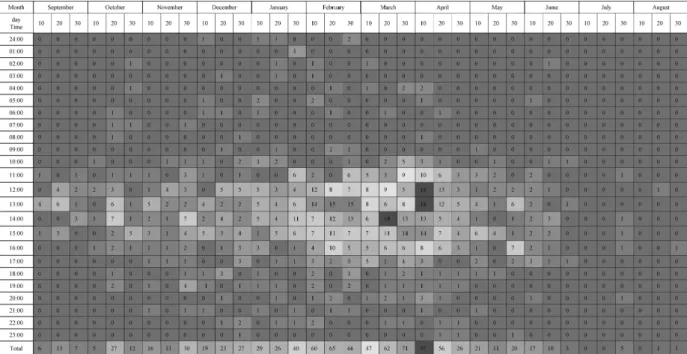
Forest fire occurrence pattern in each region of Korea As a result of analyzing regional forest fire occurrence for recent 25 years by month and time, they show the pat- tern as revealed in Fig. 1. This study comparatively ana- lyzed regional forest fire occurrence patterns by classifying them into three types. Pattern 1 is a centralized type of for- est fire occurrence pattern, which occurs intensively at the period in which forest fire occurrence time is regular. As an example of Gyeonggi-do, the centralized pattern occurring from the end of March to the middle of April by month, and from 13:00 to 15:00. Such a centralized type of forest fire occurrence pattern is shown in Gangwon-do Yeongseo, Gangwon-do Yeongdong, Chungcheongbuk-do, Chung-
cheongnam-do, Seoul Metropolitan city, Incheon Metro- politan city, Daejeon Metropolitan city, Gwangju Metro- politan city, Jeollabuk-do and Jeollanam-do. Pattern 2 is a horizontally-distributed type. Monthly forest fire occur- rence as shown in Gyeongsangnam-do was revealed mainly from early February to middle of April. Most forest fire oc- currence time is from 12:00 to 14:00. Compared to the cen- tralized type, forest fires occur during the relatively longer period. Pattern 3 is a dispersal type. As shown in Busan Metropolitan city, Ulsan Metropolitan city, Daegu Metro- politan city pattern 3 was classified as the region, where monthly forest fire occurrence is relatively dispersed, differ- ent from the centralized type or horizontally-distributed type in terms of forest fire occurrence concentration fre- quency.
As a result of analyzing regional forest fire occurrence patterns by month and time for recent 25 years, Busan and Daegu Metropolitan cities, which are the southern region, showed a dispersal type pattern. Gyeonggi-do and Gang- won-do Yeongseo regions, which are the central region, showed a centralized type pattern. Therefore, the forecast policy of forest fires and prevention policy are judged to be needed in order to cope with forest fire occurrence by re- gion according to forest fire occurrence characteristics.
Fig. 1. The analysis on the forest fire occurrence patterns based on regional forest fire occurrence time from 1990 to 2014 year.
Fig. 1. Continued.
Conclusion
This study has analyzed the forest fire occurrence num- ber in 16 administrative districts of Korea for 25 years (1990-2014). As a result, the region where the most forest fires occur was analyzed to be Gyeongsangbuk-do, fol- lowed by Gangwon-do (Yeongseo and Yeongdong). The years when the most forest fires occurred were 2001, 2000 and 1995 in the order.
Forest fires occur by reflecting regional characteristics according to various factors such as regional social and cul- tural factors and weather factors (Whelan 1995). Korea have a lots of concentrated population in small territory and 64% of forest area in total territory. Therefore, Korea is very sensitively affected by forest fires. The most forest fire oc- currence causes of Korea was carelessness that actually re- flects Korea’s characteristics (dense population density, high forest area and movement of holiday makers during the spring and fall forest fire danger seasons). However, the second factors causing forest fires by region show slightly different trends. The weed burning take up the second most cause of forest fires in Chungcheong, Jeolla and Gyeongsang regions in comparison with urban areas such
as Seoul Metropolitan city. Forest fires by cigarette littering took up the second most cause in Seoul and Busan Metropolitan cities. The cause of shooting in army activity in Gangwon-do Yeongseo and Gyeonggi-do regions took up higher ratio, compared to other regions. According to a study on spatial characteristics by forest fire occurrence cause (Kwak et al. 2010). The most of forest fires of Korea occur by human activity, and therefore the forest fires can be effectively prevented, if the occurrence causes are con- trolled well. Therefore, there is a need to reflect regional characteristics in order to establish effective forest fire pre- vention policy because various external environmental caus- es take up much for forest fire occurrence.
As a result of analyzing forest fire occurrence as ten days with interval by 16 administrative districts in Korea, many forest fires occurred in the southern region (Busan Metropolitan city, Gyeongsangnam-do and Gyeongsang- buk-do) before the spring forest fire danger season. In the case of Busan Metropolitan city, the forest fire occurrence showed more from the end of December to January than the other regions. Gangwon-do Yeongseo and Gyeonggi-do regions, which are the northern region, showed relatively centralized forest fire occurrence in April. Forest fire occur-
rence frequency was analyzed to concentrate on between January and March in the southern region, and between March and April in the northern region. The forest fire oc- currence of Korea during to spring forest fire seasons shows a trend to feature that it increases from south to north along with the plant’s growth periods, due to difference in plant’s growth periods, as temperature rises from south to north (Lee et al. 2006). The forest fire occurrence number was higher in Gyeongsangbuk-do, Jeollanam-do and Gyeong- sangnam-do, which implies the forest fire occurrence was higher in the southern region. As a result of analysis on the forest fire occurrence number during the spring and fall forest fire danger seasons, 1/3 of total fire forests occurred in the end of March and in the middle of April, which im- plies that forest fires are concentrated on the spring forest fire danger season. The forest fire prevention policy for lo- cal-level need to be devised according to the regional forest fire occurrence period and cause. Also, there is a need to consider the development of more detailed local-level forest fire prevention system rather than level of the central gov- ernment in the forest fire prevention policy establishment.
Acknowledgements
This study was supported by 2014 Research Grant from
Kangwon National University (No. 12014031).
References
Chae HM. 2003. The Study on Initial Forest Fire Spread by Fine Forest Fuel.
Kim SY, Lee SY, An SH, Shin YC, Oh JS. 2002. Statistical Analysis on Danger Period of Forest Fire by Regions in Korean.
Journal of the Korean Society of Hazard Mitigation 2: 161-167.
Korea Forest Service. 2015. http://www.forest.go.kr.
Kwak HB, Lee WK, Lee SY, Won MS, Koo KS, Lee BD, Lee MB. 2010. Cause-specific Spatial Point Pattern Analysis of Forest Fire in Korea. J Korean For Soc 99: 259-266.
Lee MW, Lee SY, Lee JH. 2012. Study of the Characteristics of Forest Fire Based on Statistics of Forest Fire in Korea. Journal of Korean Society of Hazard Mitigation 12: 185-192.
Lee SY, Han SY, An SH, Oh JS, Jo MH, Kim MS. 2001.
Regional Analysis of Forest Fire Occurrence Factors in Kangwon Province. Korean Journal of Agricultural and Forest Meteorology 3: 135-142.
Lee SY, Lee HP. 2006. Analysis of Forest fire Occurrence in Korea. T. of Korean Institute of Fire Sci & Eng 20: 54-63.
Van Wagner CE. 1987. Development and Structure of the Canadi- an Forest Fire Weather Index System. Canadian Forest Service, Petawawa National Forestry Institute, Chalk River, Ontario, Forestry Technical Report, pp 35-37.
Whelan RJ. 1995. The Ecology of Fire. Cambridge University Press, New York, pp 1-7.