Vol. 28, No. 1, pp. 19-23, February, 2012
Development of GRAT-Tourism Evaluation
Indicators for Forest Management Revitalization of Rural Areas
Seung-Il Ahn, Sang Hyun Choi, Hee-Sung Woo and Jong-Choon Woo*
Department of Forest Management, Kangwon National University, Chuncheon 200-701, Republic of Korea
Abstract
Recently the Korean government provided forest recreation areas through developing evaluation index of rural areas amenity resources, forest therapy and recreational forest for revitalization of rural areas and national health promotion.
However, what the public wants is just one place which includes all recreational facilities. GRAT tourism means Green, Rest and Therapy-Tourism. It is a new concept of recreational forests. This study defines GRAT-Tourism, the new concept of recreational activity and discusses the development of the GRAT-Tourism Evaluation Index.
Key Words: recreational forest, therapy, rest tourism, green, evaluation index
Received: January 25, 2012. Revised: February 10, 2012. Accepted: February 13, 2012.
Corresponding author: Jong-Choon Woo
Department of Forest Management, Kangwon National University, Chuncheon 200-701, Korea Tel: 82-33-250-8335, Fax: 82-33-243-4484, E-mail: [email protected]
Introduction
In Korea, the exodus of people from rural areas to met- ropolis makes the income disparity worsen between these two areas. In addition, radical reduction of population in rural areas occurs. This reduction of population makes the rural area an elderly society and hollow. Because of this, many alternatives are being developed to solve these problems. The Green Tourism is one of the alternatives.
Green Tourism means that "local communities will pro- mote tourism and recreational activity targeting the urban citizens by using rural resources, for revitalization of rural areas and exchange between urban and rural areas." On the other hand, urbanization brings a variety of problems like concentration of population, traffic congestion, housing shortages, increasing waste and pollution.
Ease of life has been improved, but the quality of life has been constantly becoming worse. One of which the atmos-
pheric environment which is being because of the polluted reduction of forest and chronic traffic congestion. Urban workers work longer times and they suffer from physical and mental stress. Therefore, they go back to nature to re- lieve their stress. Furthermore due to the implementation of five-day work a week and experiential learning systems in schools, their interest in leisure is increasing. Because of these, natural healing and alternative medicine are becom- ing the new trends in forestry. Forest therapy is a best way to reduce stress and increase immunity. The GRAT tourism which stands for Green, Rest and Therapy-Tourism is a new concept of Recreational forest. This study defines GRAT-Tourism as a new concept of Recreational activity and discusses the development of the GRAT-Tourism Evaluation Index. In addition, searching the optimum area for GRAT-Tourism is also provided in this study.
Fig. 1. Delphi method process.
Materials and Methods
The research methods of this paper are described as follows
First, literature study was conducted to prove that forest therapy is related to health and medical improvements.
Second, new terms on GRAT-Tourism were established by using the evaluation indicators of the rural amenity re- sources, the Green Tourism, the recreational forest, and the forest therapy.
The GRAT-Tourism Evaluation Indicator is made up of these Evaluation Indicators and "The Silence indicator"
from Gangwon Province.
Forty nine elements were derived for preliminary evalua- tion of the four items. To prove these above indicators, we
conducted a survey among experts (50 people including Ph.Ds in Gangwon Development Research, Ph.Ds in Gangwon province office and master course and Ph.D stu- dents in Kangwon National University) by using Delphi analysis twice.
The Delphi method is a structured communication tech- nique, originally developed as a systematic, interactive fore- casting method which relies on a panel of experts.
In the standard version, experts answer questionnaires in two or more rounds. After each round, a facilitator provides an anonymous summary of the experts’ forecasts from the previous round as well as the reasons they provided for their judgments. Thus, experts are encouraged to revise their earlier answers in light of the replies of other members of their panel. It is believed that during this process the range of the answers will decrease and the group will converge to- wards the "correct" answer. Finally, the process is stopped after a pre-defined stop criterion (e.g. number of rounds, achievement of consensus, stability of results) and the mean or median scores of the final rounds determine the results (Fig. 1).
The development of the GRAT-Tourism evaluation in- dicator has a broad range of contents. Delphi method con- ducted by experts has been used for being reasonable be- cause a general survey method could be altered by people's subjectivity.
The Delphi method is important to prove the reliability
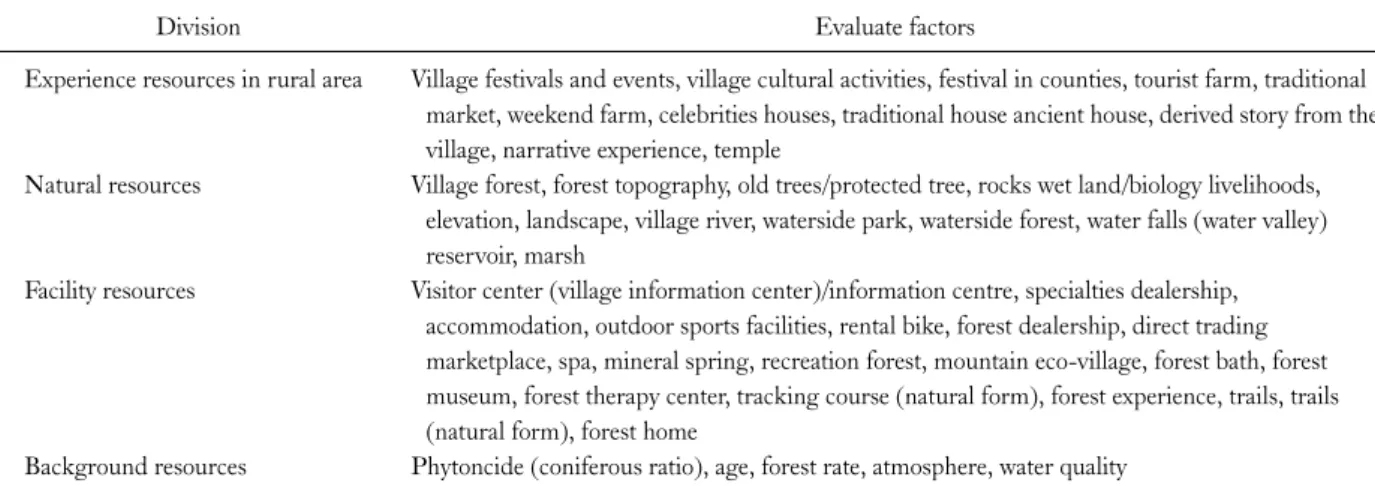
Table 1. Deduction of the GRAT-Tourism evaluate index factor
Division Evaluate factors
Experience resources in rural area
Natural resources
Facility resources
Background resources
Village festivals and events, village cultural activities, festival in counties, tourist farm, traditional market, weekend farm, celebrities houses, traditional house ancient house, derived story from the village, narrative experience, temple
Village forest, forest topography, old trees/protected tree, rocks wet land/biology livelihoods, elevation, landscape, village river, waterside park, waterside forest, water falls (water valley) reservoir, marsh
Visitor center (village information center)/information centre, specialties dealership, accommodation, outdoor sports facilities, rental bike, forest dealership, direct trading marketplace, spa, mineral spring, recreation forest, mountain eco-village, forest bath, forest museum, forest therapy center, tracking course (natural form), forest experience, trails, trails (natural form), forest home
Phytoncide (coniferous ratio), age, forest rate, atmosphere, water quality
and validity of the GRAT-Tourism evaluation indicator.
During the 1st survey, experts evaluated the suitability of GRAT-Tourism resources. According to these results, 20%
of the indicators that are not related to GRAT-Toursim are eliminated. Also, synonyms are modified and reclassified.
The 2nd survey is composed of reclassification of the in- dicators from 1st survey results. The second survey eval- uated the suitability by using the Likert scale.
The 2nd survey paper is checked by experts according to a score scale that ranges from 10 (very suitable) to 1 (very non-suitable). After the second survey, the average and standard deviation of each indicator are calculated and the result of importance of evaluation factors is verified through the Content Validity Ration (CVR). The reliability was analyzed by SPSS19.0 by calculating the Cronbach α value (Fig. 2).
Results and Discussion
Developing GRAT-Tourism evaluation indicator us- ing the Delphi method
Research method using the Delphi method
This study offers the basic standard of the GRAT-Touri- sm evaluation indicator and is applied on the rural areas.
The purpose of this study is to select the optimum place for GRAT-Tourism and the results will be used for developing potential rural areas (Table 1).
Delphi analysis and discussion
The 1st Delphi analysis result: The 1st Delphi anal- ysis was operated during 1st February to 15th February, 2011.
Fifty panels were required to answer the survey, but 4 were exempted for personal reasons.
Some of the indicator factors have the same meaning, be- cause the re-classification is operated by inserting addi- tional data and revising the wording.
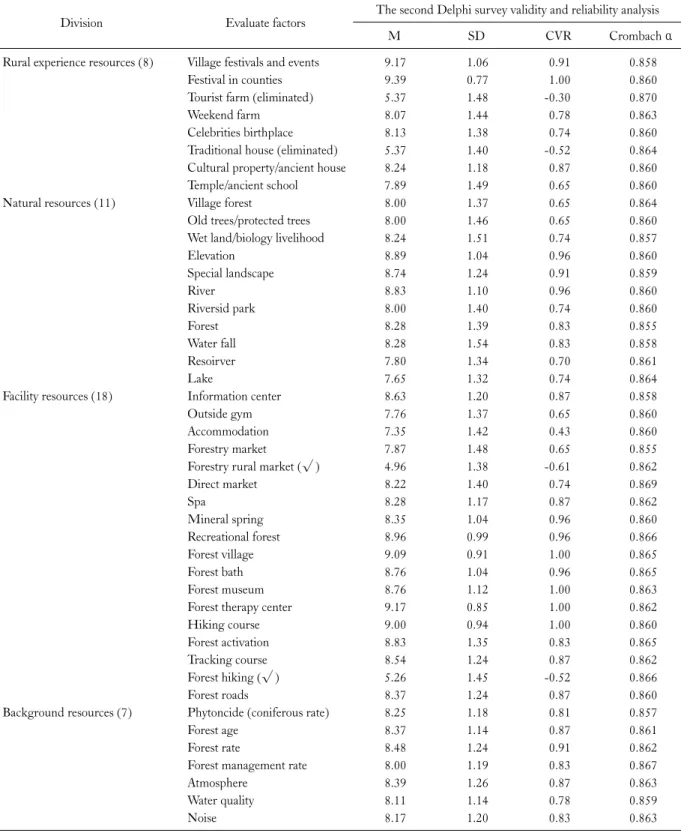
As a result, 8 factors such as village cultural activities, traditional market, history derived from the village, narra- tive experience, rocks, swamps and forest house were eliminated. The survey results showed that these factors are not important to GRAT-Tourism. On the other hand, 6 fac- tors such as Hyang-gyo, lake, forest road, percentage of forest management, noise and cultural experience were in- cluded in the survey results. The second Delphi analysis re- sult be shown Table 2.
GRAT-Tourism factors applied in the villages
Forest is the best way to reduce stress and increase immunity.
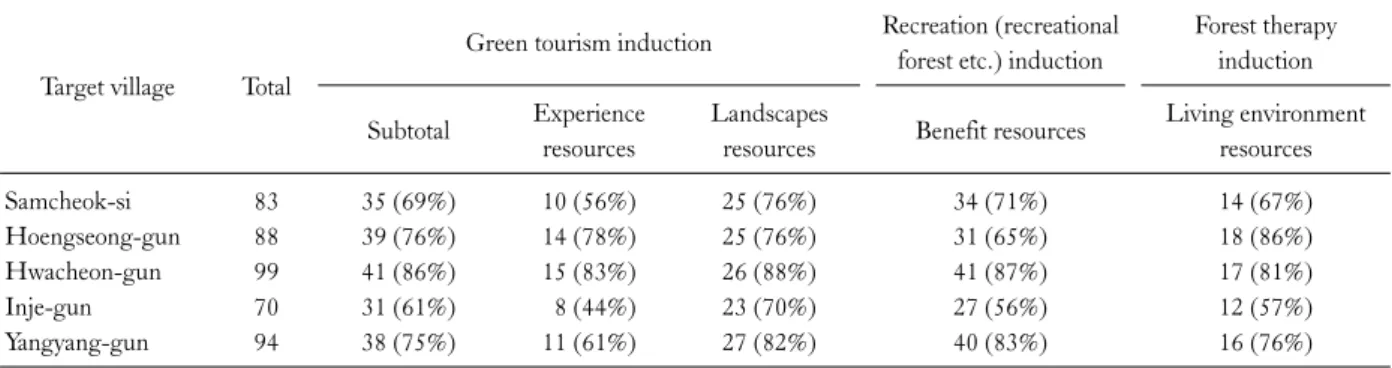
GRAT-tourism is new concept of Recreational forest. In this study define GRAT-Tourism of New concept of Recreational activity and develop about GRAT-Tourism Evaluation Index. It is also offered to search for optimal area for GRAT-Tourism (Table 3).
Table 2. Deduction of the GRAT-Tourism evaluation index factor
Division Evaluate factors The second Delphi survey validity and reliability analysis
M SD CVR Crombach α
Rural experience resources (8)
Natural resources (11)
Facility resources (18)
Background resources (7)
Village festivals and events Festival in counties Tourist farm (eliminated) Weekend farm
Celebrities birthplace Traditional house (eliminated) Cultural property/ancient house Temple/ancient school Village forest
Old trees/protected trees Wet land/biology livelihood Elevation
Special landscape River
Riversid park Forest Water fall Resoirver Lake
Information center Outside gym Accommodation Forestry market
Forestry rural market (√) Direct market
Spa
Mineral spring Recreational forest Forest village Forest bath Forest museum Forest therapy center Hiking course Forest activation Tracking course Forest hiking (√) Forest roads
Phytoncide (coniferous rate) Forest age
Forest rate
Forest management rate Atmosphere
Water quality Noise
9.17 9.39 5.37 8.07 8.13 5.37 8.24 7.89 8.00 8.00 8.24 8.89 8.74 8.83 8.00 8.28 8.28 7.80 7.65 8.63 7.76 7.35 7.87 4.96 8.22 8.28 8.35 8.96 9.09 8.76 8.76 9.17 9.00 8.83 8.54 5.26 8.37 8.25 8.37 8.48 8.00 8.39 8.11 8.17
1.06 0.77 1.48 1.44 1.38 1.40 1.18 1.49 1.37 1.46 1.51 1.04 1.24 1.10 1.40 1.39 1.54 1.34 1.32 1.20 1.37 1.42 1.48 1.38 1.40 1.17 1.04 0.99 0.91 1.04 1.12 0.85 0.94 1.35 1.24 1.45 1.24 1.18 1.14 1.24 1.19 1.26 1.14 1.20
0.91 1.00 -0.30 0.78 0.74 -0.52 0.87 0.65 0.65 0.65 0.74 0.96 0.91 0.96 0.74 0.83 0.83 0.70 0.74 0.87 0.65 0.43 0.65 -0.61 0.74 0.87 0.96 0.96 1.00 0.96 1.00 1.00 1.00 0.83 0.87 -0.52 0.87 0.81 0.87 0.91 0.83 0.87 0.78 0.83
0.858 0.860 0.870 0.863 0.860 0.864 0.860 0.860 0.864 0.860 0.857 0.860 0.859 0.860 0.860 0.855 0.858 0.861 0.864 0.858 0.860 0.860 0.855 0.862 0.869 0.862 0.860 0.866 0.865 0.865 0.863 0.862 0.860 0.865 0.862 0.866 0.860 0.857 0.861 0.862 0.867 0.863 0.859 0.863
Table 3. Applying GRAT-Tourism evaluation index on the villages
Target village Total
Green tourism induction Recreation (recreational forest etc.) induction
Forest therapy induction
Subtotal Experience resources
Landscapes
resources Benefit resources Living environment resources Samcheok-si
Hoengseong-gun Hwacheon-gun Inje-gun Yangyang-gun
83 88 99 70 94
35 (69%) 39 (76%) 41 (86%) 31 (61%) 38 (75%)
10 (56%) 14 (78%) 15 (83%) 8 (44%) 11 (61%)
25 (76%) 25 (76%) 26 (88%) 23 (70%) 27 (82%)
34 (71%) 31 (65%) 41 (87%) 27 (56%) 40 (83%)
14 (67%) 18 (86%) 17 (81%) 12 (57%) 16 (76%)
Conclusions
The Delphi method is a structured communication tech- nique, originally developed as a systematic, interactive fore- casting method which relies on a panel of experts.
In the standard version, the experts answer ques- tionnaires in two or more rounds. After each round, a facili- tator provides an anonymous summary of the experts’ fore- casts from the previous round as well as the reasons they provided for their judgments. Thus, experts are encour- aged to revise their earlier answers in light of the replies of other members of their panel. It is believed that during this process the range of the answers will decrease and the group will converge towards the "correct" answer. Finally, the process is stopped after a pre-defined stop criterion (e.g.
number of rounds, achievement of consensus, stability of results) and the mean or median scores of the final rounds determine the results.
The New concept of GRAT-Tourism indicators are de- veloped using Delphi and AHP method. Green tourism and Rest and Forest therapy, all of these advantages in one area that is selected Optimal GRAT-Tourism places.
Application of GRAT-Tourism theory in the site, this new concept will leads revitalization in rural areas and eco- nomic effects.
References
Ji KB 2007. A Study on Forest Therapy Quarters in Gangwon Province. Research Institute for Gangwon, Gangwon, Chun- cheon, pp 18-23.
Jo YB. 2010. A study on the development of suitable locations eval- uation model and therapy type to therapeutic forests. PhD thesis. Wonkwang University, Iksan, Korea. (in Korean) Jung UC. 2003. A Study on Strategies of Green Tourism Needed
for Rural Area Renovation. Major Course in General Admini- stration. The Graduate School of Public Administration Won- kwang University, Iksan, Korea. pp 1.
Kim BS, Lee JH. 1997. A Survey of Urban and Rural Residents' Opinions about the Development of Green Tourism. J Korean Dev Ass 9: 183-199.
Kim SY. 2006. Department of Landscape Architecture Graduate School of Chonbuk National University. Chonbuk National University, Jeonju, pp 43.
Kim WJ. 2003. Study of Methods for Vitalizing Gangwondo Green Tourism. Hankyong National University. Anseong, pp 8-11.
Park JH. 2006. A Study on Green-Tourism Marketing Strategy.
Major in Business Administration Graduate School of Business Administration Gyeongsang National University, Jinju, pp 2.
Park KY. 2004. A study on the operations and realities of green tourism. Ph.D. Program in Livestock Business Management Graduate School of Konkuk University, Seoul, pp 16-20.
The Province of Gangwon. 2008. Development Silence Indicators and Survey Method. Research Institute for Gangwon, Chun- cheon, pp 25.