Vol. 29, No. 3, pp. 194-199, August, 2013 http://dx.doi.org/10.7747/JFS.2013.29.3.194
Change in Community Composition and Soil Carbon Stock Along Transitional Boundary in a Sub-Tropical Forest of Garhwal Himalaya
Munesh Kumar1,*, Manish Kumar1, Sajid Saleem1, Sunil Prasad1 and GS Rajwar2
1Department of Forestry and Natural Resources, HNB Garhwal University Srinagar Garhwal, Uttarakhand, India
2Department of Botany, Govt. Post Graduate College, Rishikesh 249201, Uttarakhand, India
Abstract
The aim of the present study was to assess the effect of transitional boundary on community composition and soil carbon stock. Five vegetation types were recognized horizontally along the transitional strip based on the dominance of tree species i.e., Pure Anogeissus latifolia forest (P.AL), mixed Pinus roxburghii and Lannea coromandelica forest (M.PR&LC), pure Pinus roxburghii forest (P.PR), mixed Pinus roxburghii and Lannea coromandelica (M.PR&LC) and pure Anogeissus latifolia forest (P.AL). The results revealed that Anogeissus latifolia was reported dominant tree in the outer transitional boundaries of the forest, which reduced dominance of trees towards middle where Pinus roxburghii was found dominant. The soil carbon stock was reported higher in the Anogeissus latifolia dominant forest and reduced with the dominance of Pinus roxburghii in the middle site. Both the species are growing close to one another and competing for survival, but the aggressive nature of Anogeissus latifolia particular in this region may change new growth of Pinus roxburghii and will enhance soil carbon stock. But high anthropogenic pressure on Anogeissus latifolia tree species could be limited chance to further its flourish.
Key Words: Transitional zone, Pure, mixed, competition, survival
Received: November 14, 2012. Revised: July 25, 2013. Accepted: July 25, 2013.
Corresponding author: Munesh Kumar
Department of Forestry and Natural Resources, HNB Garhwal University Srinagar Garhwal, Uttarakhand, India Tel: 911370267529, Fax: 911370267529, E-mail: [email protected]
Introduction
In transition zone more homogenous communities often correspond with sharp environmental and ecological gra- dients and depicted great influence of dominant plants on ecosystem structure, ecosystem properties and animal com- munities (Gosz 1993; Risser 1995).
Terrestrial carbon stocks consist of above and below ground carbon. Above ground carbon stock component in- cludes biomass (stems, twigs, leaves, vines, epiphytes and understory) and necromass (dead trunks, standing dead trees and litter in the form of leaves, stem, twigs, flowers,
fruits and fire residues). Below ground carbon stock com- ponents are roots of live or dead plants, soil organisms and soil organic matter. Carbon stock of a land-use system is in- fluenced by its vegetation. A land use system consisting of tree species with high wood density will have a higher bio- mass carbon compared to that with a low wood density and similar tree diameter.
In the sub-tropical region of Garhwal Himalaya Anogeissus latifolia and Pinus roxburghii are growing in- dependently as pure forest but overlaps in certain areas which forms a transitional boundary/ecotone zone. In the present field study, a unique feature has been noticed in the
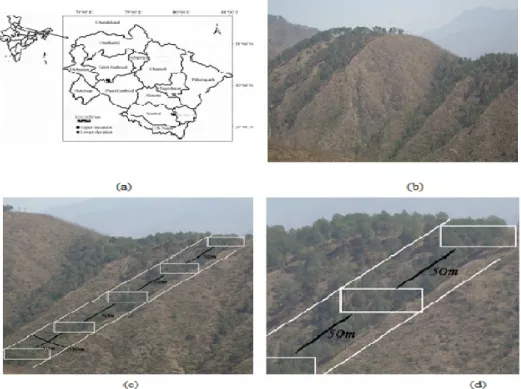
Fig. 1. Location map (a) and other site conditions (b-d) of the study area.
transitional boundaries of the forest, where Anogeissus lat- ifolia (Bakli) and Pinus roxburghii (Chir pine) growing closely and forming the transitional boundary. In the transi- tional boundaries of present study the hypothesis was devel- oped that: (i) Does transitional boundaries affects the com- munity structure and distribution pattern of the species? (ii) Does changing species composition affect soil carbon stock? To test the hypothetical questions, the following ob- jectives were selected; i) Effect of transitional boundaries on community structure and distribution pattern of species and ii) Effect of community structure change on soil carbon stock in transitional boundaries.
Materials and Methods
Study area
The study area was located between 30o 29' N and 78o 24' E at an elevation ranges from 700-1,000 m mean above sea level. Most of the present study area was situated towards south-west facing aspect with steep slope (Fig. 1, & Location map) climatic conditions of the area includes cold winters, very hot summers and enough rainfall in rainy seasons.
Vegetation and soil sampling analysis
A 200 m wide strip of forest was selected from the base to top along altitudinal gradient covering five different alti- tudes and each altitude was taken 50 m apart from each oth- er approximately. The aim of 200 m wide strip was to cover Anogeissus latifolia, Pinus roxburghii and mixed A. latifolia and P. roxburghii forests in the transitional boundary. Five altitudinal strips were choosen along altitudinal gradient on the basis of species dominance i.e., pure Anogeissus latifolia forest (P.AL), mixed Pinus roxburghii and Lannea coro- mandelica forest (M.PR.LC), pure Pinus roxburghii forest (P.PR), mixed Pinus roxburghii and Lannea coromandelica (M.PR.LC) and pure Anogeissus latifolia forest (P.AL).
Five quadrats (each of 10x10 m size) were used horizon- tally, from each forest type and repeated for five different al- titudes therefore; a total of 25 quadrats were used for the vegetation analysis in entire transitional zone. Every quad- rat was placed at 50 m interval horizontally and vertically both to create uniformity in data collection. Vegetation anal- ysis of tree and shrub layers in each forest site was done on vertical transect, laid across the selected area in fixed inter- val to avoid biased sampling. Trees were considered to be an
individuals >30 cm cbh (circumference at breast height).
The quantitative informations of vegetation were collected using methods described by Curtis and McIntosh (1950) and importance value index (IVI) as described by Curtis (1959).
The soil samples of each altitudinal strip were collected from 0-30 cm depth from each quadrat used for vegetation sampling, packed in polythene bags and brought to the lab- oratory for soil organic carbon analysis. Soil organic carbon was analyzed using methods of Walkley and Black (1934) and soil carbon stock was estimated with the method de- scribed by Jha et al. (2003).
Results and Discussion
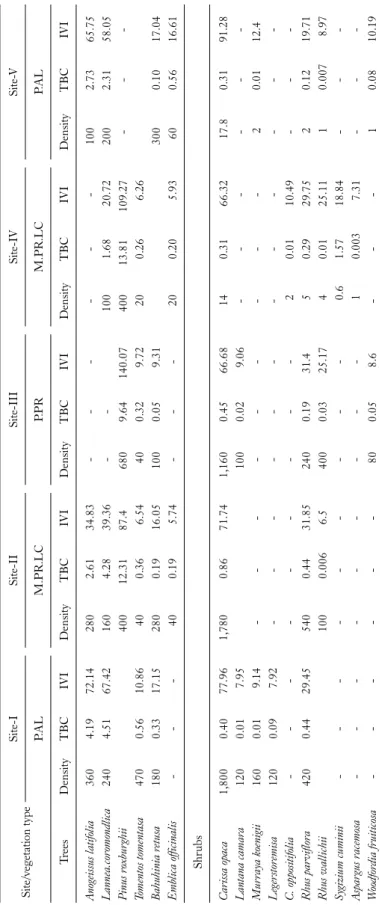
Community composition along transition zone In P.AL (site-I), A. latifolia was the dominant tree spe- cies with highest tree density but highest total basal cover was recorded for Lannea coromandelica. Bauhinia retusa and Terminalia tomentsa were found the associated species on this site. In shrub layer, Carissa opaca was dominant and co-dominanted with Rhus parviflora while associated shrub species in this site were Lantana camara, Murrya koneigii and Legrstroemia parviflora.
In M.PR&LC (site-II) forest, the dominant tree species was Pinus roxburghii and co-dominanted with Lannea coromandelica. Anogeissus latifolia was the third dominant species on this site. Other associated species recorded on the site were Bauhinia retusa, Emblica officinalis and Terminalia tomentosa. In shrub layer, again the aggressive growth was reported in Carissa opaca while Rhus parviflora and Rhus wallichii were associated shrub species.
In P.PR (site-III) forest, the dominant tree species was again Pinus roxburghii with highest values of density and to- tal basal cover and Terminalia tomentosa and Bauhinia retusa were found the associated species. It was interesting to note that Pinus roxburghii increased their dominance towards pure forest and wiped out completely a growth of Anogiesuss laitifola and Lannea coromandelica. Again Carissa opaca was dominant shrub in this forest layer but in the pure forest of Pinus roxburhii has emerged new shrub species of Lanata camara on this site. Other shrubs could not tolerate the can- opy cover of the pure Pinus roxburghii site and no species of shrubs were reported. In M.PR&LC (site IV) forest, the
dominant tree was Pinus roxburghii with co-dominant tree L. coromandelica and least dominant tree reported was Emblica officinalis, again the dominance of Pinus roxburghii existed because of more shady conditions. In shrub layer the dominant species was again Carissa opaca with asso- ciated species Rhus parviflora, Rhus wallichii and new ap- peared species Coolobrokia oppositifola and Asparugus racemosa. The appearance of new species on the site could be because of shady conditions on this site.
In the P.AL (site-V) forest again dominant tree was A.
latifolia with co-dominant species L coromandelica. Other associated trees were Bauhinia retusa and Emblica officinalis.
In shrub layer the dominant shrub was Carissa opaca with other associated species i.e., Rhus parviflora, Murrya koeni- gii, Woodfordia fructicosa and Rhus wallichii.
Soil carbon stock along transitional zone
The soil carbon stock of P.AL was 69.60 t ha-1 which re- duced in M. PR.LC and reported the lowest 49.60 t ha-1 in the middle zone of P.PR, which was dominated by Pinus roxburghii tree. It again increased in M.PR.LC forest which was 55.60 t ha-1 and in the P.AL site again the value was highest compared to middle site (Table 1).
Among the forest types, highest tree density (1,250 trees/ha) was reported in P.AL (site-I), which reduced to- wards M.PR&LC (1,200 trees/ha) and followed by P.PR (Table 2) forest type (820 trees/ha).The reduction in tree density from outer site of transitional zone to middle site might be due to the result of toxic effect produced by Pinus roxburghii which reduced new growth and resulted into low- er density of other species. However the density on M.PR&LC was lowest which represents narrow deep val- ley where the density of lower girth class trees was lower.
But the density again increased in the P.AL forest as com- pared to M. PR&LC (site-II) because of higher density values of Bauhinia retusa and Anogeissus latifolia.
Total basal cover was found lower on both the P.AL for- est (site-I and site-V) and this is because of both the transi- tional boundaries of forests were dominated by Anogeissus latifolia and such forest is under high anthropogenic pres- sure for the daily demand of the villagers for fodder and other needs. M. PR&LC and MP&LC vegetation types have higher total basal cover and it might be due to the mixed type of species composition which could not provide
Table 1. Density (ha-1 ), total basal cover (m2 ha-1 ) and IVI on different forest sites in transitional boundary Site/vegetation typeSite-ISite-IISite-IIISite-IVSite-V P.ALM.PR.LCP.PRM.PR.LCP.AL TreesDensityTBCIVIDensityTBCIVIDensityTBCIVIDensityTBCIVIDensityTBCIVI Anogeissus latifolia Lannea.coromondlica Pinus roxburghii Tomentos tomentasa Bahuhinia retusa Emblica officinalis
360 240 470 180 -
4.19 4.51 0.56 0.33 -
72.14 67.42 10.86 17.15 -
280 160 400 40 280 40
2.61 4.28 12.31 0.36 0.19 0.19
34.83 39.36 87.4 6.54 16.05 5.74
- - 680 40 100 -
- - 9.64 0.32 0.05 -
- 140.07 9.72 9.31 -
- 100 400 20 20
- 1.68 13.81 0.26 0.20
- 20.72 109.27 6.26 5.93
100 200 - 300 60
2.73 2.31 - 0.10 0.56
65.75 58.05 - 17.04 16.61 Shrubs Carissa opaca Lantana camara Murraya koenigii Legerstoremisa C. oppositifolia Rhus parviflora Rhus wallichii Sygizium cuminii Aspargus racemosa Woodfordia fruiticosa
1,800 120 160 120 - 420 - - -
0.40 0.01 0.01 0.09 - 0.44 - - -
77.96 7.95 9.14 7.92 - 29.45 - - -
1,780 - - - 540 100 - - -
0.86 - - - 0.44 0.006 - - -
71.74 - - - 31.85 6.5 - - -
1,160 100 - - - 240 400 - - 80
0.45 0.02 - - - 0.19 0.03 - - 0.05
66.68 9.06 - - - 31.4 25.17 - - 8.6
14 - - - 2 5 4 0.6 1 -
0.31 - - - 0.01 0.29 0.01 1.57 0.003 -
66.32 - - - 10.49 29.75 25.11 18.84 7.31 -
17.8 - 2 - - 2 1 - - 1
0.31 - 0.01 - - 0.12 0.007 - - 0.08
91.28 - 12.4 - - 19.71 8.97 - - 10.19
Table 2. Total density and total basal cover on different forest sites in transitional boundary
Parameter P.AL (Site-I) M. PR LC (Site-II) P.PR (Site-III) M. PR LC (Site-IV) P.AL (Site-V) Total density (tree ha-1)
Total TBC (m2 ha-1) SOC (g kg-1) Carbon stock (t ha-1)
1,250 9.59 17.4 69.60
1,200 19.94 16.7 66.80
820 10.01
12.4 49.60
540 15.95
13.9 55.60
660 5.7 16.6 66.40
easy accessibility to the villager and time consuming due to mixed species composition.
Between the P.AL forests (site-I and site-V), the higher value of carbon stock was reported in P.AL (site-I) which was 69.60 t/ha where the density of Anogeissus latifolia was higher. These results indicate that, Anogeissus latifolia species stocks more soil carbon than other recorded species. Similar trends were observed with other sites as soil carbon stock on site-I (P.AL) than on site-II (M.PR&LC) where density of Anogeissus latifolia was lower than on the site-I and again the carbon stock was lower on site-V, where the density was lower compared to site-I and site-II. The soil carbon stock on site-IV and site-III was lower because of non availability of Anogeissus latifolia and higher density of Pinus roxburghii.
Among the sites, the carbon stock of soil reduced form site-I to site-II and site-V to site-IV and lowest on site-III.
Thus study suggested that carbon stock of soil increased with reducing presence of Pinus roxburghii and therefore highest value of carbon stock was reported where the Pinus roxburghii was almost absent and higher density of Anogeissus latifolia was recorded.
It has been reported that now-a-days Anogeissus latifolia is dominant on northern aspect with combination of Lannea coromandelica, Emblica officinalis however Pinus roxburghii was dominant on southern aspect few years ago and now moving towards northern aspect and in some places Pinus roxburghii is restricted in the narrow gaze and forming tran- sitional boundary with most of the sites which has already occupied by a Anogiesses latifolia in northwest, northern and eastern aspects.
It is unique to notice that wherever Anogiesses latifolia and Pinus roxburghii were growing closer, most of the areas were occupied by Anogeissus latifolia by replacing Pinus roxburghii.
In the present study it has been observed that in the outer boundaries of transition zone, Anogeissus latifolia was domi- nant and no tree of Pinus roxburghii was reported (site-I and
site-V of P. AL forest). As we move for the vegetation analy- sis from the transitional boundaries towards the core sites, the density of Pinus roxburghii increased but here the density of Anogeissus latifolia was reduced. Thus the study revealed that both the forests (Pinus roxburghii and Anogeissus lat- ifolia) are surviving intolerably. However, in the mixed site there is severe competition between the species for co-existence. In an earlier study Kumar et al. (2012) carried out a study of the same forest and reported a wider niche for Anogeissus latifolia (1.98) followed by Pinus roxburghii (1.96). Similarly in the present study soil carbon stock was also reported higher in Anogeissus latifolia dominant forest and reduced with the higher densities of Pinus roxburghii. In an earlier study Kumar et al. (2012) reported that soil or- ganic carbon was higher in Anogeissus latifolia and reduced with the mixed forests of Anogeissus latifolia and Pinus rox- burghii, both of these forests are still competing for the sur- vival and follow the law of competitive exclusion principle which indicates that between the species competing for the resources in same place cannot co-exist for a longer period and one has to eliminate from the competition in due course of time. Thus the wider niche of Anogeissus latifolia may have chance to occupy the whole resources of Pinus roxburghii forests in future. Although the certain factors may retrieve the condition and also finish the Anogeissus latifolia forest from this area. Kumar et al. (2010) have reported that all the associated tree species of A. latifolia forests in this forest are severely lopped by the villagers for various purposes i.e., fuel, fodder, timber etc. However, relative lopping intensity among the species was significantly higher for A. latifolia (45 to 57%). Thus lopped whole branches may stop further regeneration of the species.
Conclusions
The study concluded that if both the species i.e.,
Anogeissus latifolia and Pinus roxburghii follow the law of competitive exclusion principle, one has to eliminate from the transitional boundary and only second will survive. In an earlier study, author revealed a wider niche of Anogeissus latifolia and species might have good chance to occupy the area of Pinus roxburghii in due course of time but it may also retrieve the condition if the high resource pressure remains continued on Anogeissus latifolia and such conditions in- crease the chances of the replacement of Anogeissus latifolia from the study site.
References
Curtis JT. 1959. The vegetation of Winconsin. An Ordination of plant communities, University Winconsin Press, Madision Winconsin, pp 657.
Curtis JT, Cottam G. 1956. Plant ecology work book laboratory field reference manual. Burgers publication co., Minnesota, pp
193.
Curtis JT, McIntosh RP. 1950. The Interrelation of certain analytic and synthetic phytosociological characters. Ecology 31:
434-455.
Gosz JR. 1993. Ecotone hierarchies. Ecological Applications 3:
369-376.
Jha MN, Gupta MK, Saxena A, Kumar R. 2003. Kumar Soil or- ganic carbon store in different forests of India. Indian Forester 129: 714-723.
Kumar Munesh, Joshi Mukesh, Todaria NP. 2010. Regeneration status and plant bio-diversity in a sub-tropical forest of Garhwal Himalaya. Journal of Forestry Research 21: 439-444.
Kumar M, Kumar S, Sheikh MA, Gusain MS. 2012. Community structure, species niche width and soil characteristics in a transi- tional zone of sub-tropical forest. Indian Forester 138: 154-158.
Risser PG. 1995. The status of the science examining ecotones. Bio Science 45: 318-325.
Walkley AE, Black JA. 1934. An examination of the Degtiga Vett.
Method for determining soil organic matter and proposed mod- ification of the chromic acid titration method. Soil Science 37:
29.