183 INTRODUCTION
Angiogenesis is the development of new blood vessels by sprouting from pre-existing endothelium,1,2) and is significant component of a wide variety of physiological process (e. g.
wound healing, embryonic development) and pathological conditions (e. g. diabetic eye disease, tumor growth and spread).3,4) It is strictly regulated phenomenon and is under the control of balance between angiogenic stimulators and inhibi- tors.5) Complex and diverse cellular actions are implicated in angiogenesis, such as extracellular matrix (ECM) degradation, proliferation and migration of endothelial cells, and morpho- logical differentiation of endothelial cells to form tubes.6,7) A new benzopyran derivative, KR-31482, [4-[(4-Chloro- phenyl)-(1H-imidazol-2-lymethyl)-amino]-2-dimethoxymethyl- 6-nitro-chroman-3-ol], is a synthetic anti-ischemic agent.
Benzopyran was known as one of the most frequently used
skeletons in drugs including anti-oxidants, anti-hypertensives, and therapeutic agents for ischemia-related diseases. A variety of amines were introduced at the 4-position of benzopyran for the identification of ATP sensitive potassium channel (KATP) openers targeting ischemic diseases, such as myocardial infarction and stroke. Some of benzopyran derivatives substi- tuted with a secondary amine including imidazole (e. g.
KR-31482) showed the inhibitory effects on endothelial cell tube formation unexpectedly.
Therefore, we investigated whether KR-31482 suppresses the angiogenic action of endothelial cells using in vitro and in vivo angiogenesis assays. In consequence, we found that KR-31482 inhibited in vitro angiogenesis, such as proliferation, migration, invasion, tube formation, and MMP-2 release in bovine aortic endothelial cells, and new vessel formation in chorioallantic membrane and mouse Matrigel plugs in vivo. In summary, our results demonstrate that KR-31482 may act as an anti-cancer agent via the inhibition of angiogenesis.
Antiꠂangiogenic Activity of KRꠂ31482, a New Benzopyran Derivative
Eui-Yeun Yi1, Jung-A Kang1, Hyun Seok Song1, Hkyu-Yang Yi2, Sung-En Yoo2 and Yung-Jin Kim1
1Department of Molecular Biology, Pusan National University, Busan 609-735,
2Korea Research Institute of Chemical Technology, Daejeon 305-600, Korea
Angiogenesis is considered an integral process to the growth and spread of solid tumors.
Anti-angiogenesis therapy has recently been found to be one of the most promising new anti-cancer therapeutic strategies. In this study, we provide several lines of evidence showing that KR-31482, a new benzopyran derivative has anti-angiogenic activity. KR-31482 inhibited the proliferation, migration, invasion and tube formation of bovine aortic endothelial cells (BAECs), and suppressed the release of matrix metalloproteinase-2 (MMP-2) in BAECs. KR-31831 also inhibited angiogenesis in chorioallantic membrane (CAM) assay and in vivo mouse Matrigel plug assay. Taken together, these results suggest that KR-31482 might act as an angiogenic inhibitor. (Cancer Prev Res 11, 183-191, 2006)
ꠏꠏꠏꠏꠏꠏꠏꠏꠏꠏꠏꠏꠏꠏꠏꠏꠏꠏꠏꠏꠏꠏꠏꠏꠏꠏꠏꠏꠏꠏꠏꠏꠏꠏꠏꠏꠏꠏꠏꠏꠏꠏꠏꠏꠏꠏꠏꠏꠏꠏꠏꠏꠏꠏꠏꠏꠏꠏꠏꠏꠏꠏꠏꠏꠏꠏꠏꠏꠏꠏꠏꠏꠏꠏꠏꠏꠏꠏꠏꠏꠏꠏꠏꠏꠏꠏꠏꠏꠏꠏꠏꠏꠏꠏꠏꠏꠏꠏꠏꠏꠏꠏ Key Words: Angiogenesis, Tumor, Invasion, VEGF, bFGF
책임저자:김영진, ꂕ 609-735, 부산시 금정구 장전동 30 부산대학교 분자생물학과
Tel: 051-510-2176, Fax: 051-513-9258 E-mail: [email protected]
접수일:2006년 9월 1일, 게재승인일:2006년 9월 22일
Correspondence to:Yung-Jin Kim
Department of Molecular Biology, Pusan National University, 30, Jangjeon-dong, Geumjeong-gu, Busan 609-735, Korea
Tel: +82-51-510-2176, Fax: +82-51-513-9258 E-mail: [email protected]
MATERIALS AND METHODS 1. Materials
KR-31482 was donated from the Korea Research Institute of Chemical Technology (Daejon, Korea). Matrigel was pur- chased from Collaborative Biomedical Products (Bedford, MA) and used at a concentration of 10 mg/ml for the mouse Matrigel plug assay. bFGF and heparin were from Life Technologies (Gaithersbeg, MD). [3H]-methylthymidine (25 Ci/mmol) was from Amersham Pharmacia Biotechnology (Piscataway, NJ).
2. Animals
Seven-week-old, specific pathogen free (SPF) male C57BL/6 mice were supplied from Hyochang Science (Taegu, Korea).
They were provided with auto-claved tap water and lab chow ad libitum and were housed at 23±0.5oC 10 % humidity in a 12 h light-dark cycle.
3. Cell culture
Bovine aortic endothelial cells (BAECs, ATCC) were grown in DMEM supplemented with heat-inactivated 10% fetal bovine serum (Life Technologies, Grand Island, NY), 100 units/ml of penicillin and 100 g/ml of streptomycin in a 37oC incubator with a humidified atmosphere containing 5% CO2. 4. Chorioallantoic membrane (CAM) assay
Fertilized chick eggs were incubated under constant humidified egg breeder at 37oC. On the third day of incubation, about 2 ml of egg albumin were aspirated by an 18-gauge hypodermic needle through the small hole drilled at the narrow end of the eggs, to detach the developing CAM from the shell.
The shell covering the air sac was punched out and removed by forceps, and the shell membrane on the floor of the air sac was peeled away. After two more days of incubation, sample-loaded thermanox cover slips were air-dried and applied to the CAM surface to test the angiogenic inhibition by the chemicals. Three days later, 1 to 2 ml of 10% fat emulsion (Intralipose) was injected into the chorioallantoic and observed under a dissecting microscope. Retinoic acid (RA) is known as an anti-angiogenic compound, and 1 g/egg RA was used as a positive control for anti-angiogenic responses. When KR- 31482-treated CAM showed vascular zone to a similar degree
of RA-treated CAM that had little vessels compared to empty cover slip, the response was scored as positive, and calculated by the percentage of positive eggs to total numbers of eggs tested. Independent experiment was repeated three times and at least more than 20 eggs in each experiment were used.
5. [3H]-thymidine incorporation assay
BAECs, grown to near confluence in 24-well culture plates, were made quiescent and treated with KR-31482 for 48 h.
Cells were labeled with [3H]-methylthymidine (25 mCi/mmol;
Amersham, Aylesbury, UK) for 4 h before the assay. After labeling, unincorporated [3H]-methylthymidine was removed by washing with 10% trichloroacetic acid, and then incorpo- rated [3H]-methylthymidine was extracted in 0.2 M NaOH and 0.1% SDS at 37oC for 1 h. The cpm values from cultures were counted with a liquid scintillation counter (Beckman Instruments, Fullerton, CA).
6. Wounding migration assay
BAECs, plated on 60 mm culture dishes at 90% confluence, were wounded with a razor blade that 2 mm in width and marked at the injury line. After wounding, the cultures were washed with serum-free medium and further incubated in DMEM with 1% serum, 1 mM thymidine and/or KR-31482.
BAECs were allowed to migrate for 24 h and rinsed with serum- free medium, followed by fixing with absolute methanol and staining with Giemsa. Migration was quantitated with counting the number of cells that moved beyond the reference line.
7. Invasion assay
Invasiveness of BAECs was analyzed using transwell chambers system with 8μm-pore-polycarbonate filter inserts.
The lower side of filter was coated with 10μl of type IV collagen (3 mg/ml), and the upper side was coated with 10μl of Matrigel (0.5 mg/ml). BAECs (3×10⁴ cells/well) and chemicals were placed in upper part of the filters and BSA was treated in down part. After 24 h incubation at 37oC cells on both sides of the membrane were fixed with methanol and stained with hematoxyline/eosin. Cells on the upper surface of the membrane were removed by wiping with cotton swab, and the average number of cells on the lower side of the mem- brane was counted with optical microscopy at ×40 magnifi- cation.
8. Tube formation assay
BAECs (5×10⁵ cells) were seeded on a layer of previously polymerized Matrigel with or without KR-31482. Matrigel cultures were incubated at 37oC After 6 h, changes of cell morphology were observed under a phase contrast microscope and photographed at ×40 magnification.
9. Gelatin-based zymography
The conditioned media cultured BAECs was analyzed by the gelatin-based zymography, using slightly modified procedure from that of Herron et al. (1986). Conditioned media were separated by SDS-PAGE using 10% acryl amide copolymerized with 0.33 mg/ml gelatin (Sigma). After electrophoresis, the gel was rinsed twice with 2.5% Triton X-100 for 15 min and incubated at 37oC for 24 h in incubation buffer (0.05 M Tris- HCl pH 7.5, 0.15 M NaCl, 0.01 M CaCl2, 1 M ZnCl2, 0.02%
NaN3). Gelatinase was identified following staining of the gel with coomassie brilliant blue R250 and destaining with 7%
acetic acid. The digested area appeared clear on a blue back- ground indicating the location of gelatinase.
10. In vivo matrigel plug assay
C57BL/6 mice (7 weeks of age) were injected subcutaneously 500μl of Matrigel at 4oC containing bFGF (100 ng/ml) and heparin (50 units/ml) with or without KR-31482 (5μg). After injection, the Matrigel rapidly formed a plug. After 7 days, the mice were killed and their skins easily pulled back to expose the Matrigel plug, which remained intact. The appearance of each Matrigel plugs after Hematoxylin/eosin staining showed the formation of the active neovessels containing red blood cells. The quantitation of functional vasculature inside the Matrigel plug was confirmed by the measurement of hemo- globin content. Amount of hemoglobin were measured using the Drabkin reagent kit 525 (Sigma, St. Louis, MO) for the quantitation of blood vessel formation.8) The concentration of hemoglobin was calculated from a known amount of hemo- globin assayed in parallel.
11. Data analysis and atatistics
Data are presented as means ±SD or as the percentage of control. Statistical comparisons between groups were performed using the Student’s t test. *p<0.05 was considered statistically significant.
RESULTS
1. KR-31482 is anti-angiogenic in the chicken cam assay
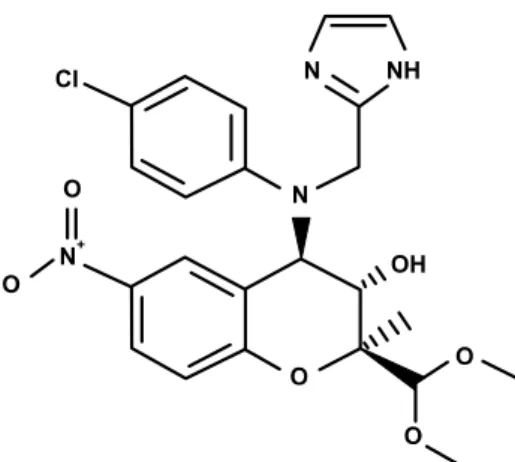
To determine whether KR-31482 has anti-angiogenic acti- vity, we performed in vitro and in vivo angiogenesis assays. The chemical structure of KR-31482 is shown in Fig. 1. The CAM assay is one of the most widely used in vivo angiogenesis assays, which measures the angiogenic activity of compounds during developmental angiogenesis. So the chick embryo CAM assay was first carried out. KR-31482 at the concentration of 0.5 and 1.5μg/egg was analyzed in each chicken embryo.
Untreated normal CAM formed new branches from the existing vessels (Fig. 2A, blank). Treatment with DMSO as solvent of chemical (data not shown) or the blank implanted only thermanox cover slip resulted in normal vascular development similar to that observed with untreated CAM. In CAM treated with retinoic acid (1μg/egg) as positive control during 7 days of development, a profound inhibition of microvessel formation was observed (Fig. 2A), in particular the inhibition of larger vessels formation were apparently observed. A dramatic decrea- se of neovascularization with low vessel density was observed in the surrounding areas of implanted thermanox cover slip with KR-31482 (Fig. 2A), and the inhibitory efficiency was about 84.2% of positive response with application at the concentration of 1.5μg/egg of KR-31482 (Fig. 2B). Thus KR-31482 had anti-angiogenic activity and the inhibitory effect on chicken embryonic angiogenesis as compared with that of blank in a dose-dependent.
Fig. 1. Structure of KR-31482.
2. KR-31482 has a strong growth-inhibitory influence on BAECs
We examined the cytotoxic effect on the BAECs viability by increasing concentration of KR-31482 (from 50 to 400μM).
The cytotoxic effect of KR-31482 on the endothelial cells was determined using the MTT assay. The treatment of KR-31482 did not show any cytotoxic effect on BAECs up to 200μM (data not shown). Then, the dose ranges of KR-31482 (50, 100, 200 μM) were used in all in vitro angiogenesis experi- ments. The effect of KR-31482 on the proliferation of endothe- lial cells was then determined using the [3H]-methylthymidine
incorporation assay. Fig. 3 showed that the treatment of KR-31482 for 48 h significantly decreased the DNA synthesis of BAECs as compared with that of blank in a dose-dependent manner. It is noted that KR-31482 revealed the strong inhibitory effect on the proliferation of endothelial cells.
3. KR-31482 inhibits the migration of BAECs
The migration of endothelial cells is one of the critical features in the formation of new blood vessels and in the repair of injured vessels. To determine whether KR-31482 affects the movement of endothelial cells from a wound edge to the open area, we performed wounding migration assay. After KR- 31482 treatment, endothelial cells migrated more slowly than blank. As shown in Fig. 4, the treatment of KR-31482 for 24 h profoundly decreased the migration of BAECs as compared with that of blank in a dose-dependent manner. Therefore KR-31482 shows an anti-migratory effect on endothelial cells.
4. KR-31482 reduces the invasive ability of BAECs by reducing the production and activation of MMP-2
During angiogenesis, endothelial cells must invade through basement membrane, a major barrier to cell movement. To evaluate whether KR-31482 regulates endothelial cellular invasion, we performed invasion assay with trans-well system.
Fig. 2. Anti-angiogenic effect of KR-31482 on the chick CAM.
Cover-slip alone and retinoic acid (RA, 1μg/egg) were used as a negative and positive control, respectively. Blank showed normal neovascularization in the absence of KR-31482. Angio- genesis was almost blocked by RA. KR-31482 (0.5, 1.5 g/egg) showed the anti-angiogenic effect similar to that observed in RA-treated CAM. (B) Angiogenic responses were scored as positive when the KR-31482-treated CAM showed a vascular zone similar to RA-treated CAM, which had very small vessels compared with blank, and calculated by the percentage of positive eggs.
*p<0.05 compared to blank.
A
Dose ( g/egg)µ
Eggs showing anti- angiogenesis
Total eggs tested
% of inhibition
Blank - 8 32
RA 1 22 24
KR-31482 0.5 13 21
1.5 16 19
25+8.9- 91.7+12.5- * 61.9+8.7- * 84.2+10- * B
Blank
KR 31482 (0.5 g)µ
RA (1 g)µ
KR 31482 (1.5 g)µ
Fig. 3. KR-31482 decreases the BAECs proliferation. The effect of KR-31482 on proliferation of endothelial cells was examined by [3H]-methylthymidine incorporation assay as described in
“Materials and Methods”. Various concentration (50, 100 and 200μM) of KR-31482 was added and incubated for 48 h, respectively. Data represent the mean±SE (n=3) and a per- centage of sample absorbance to control.
*p<0.05 compared to control.
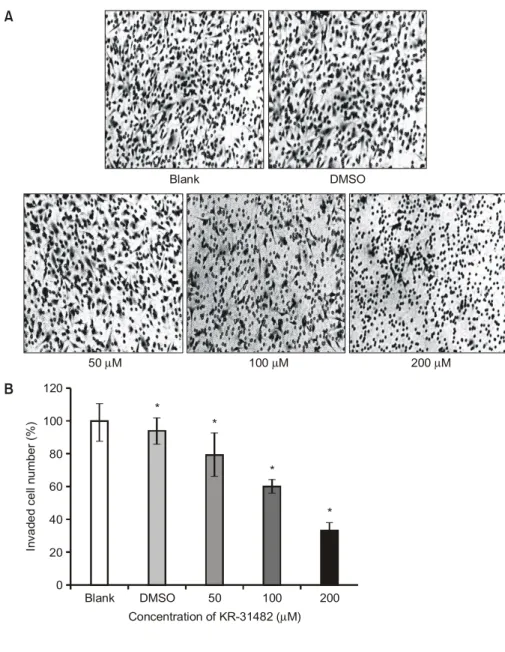
After 24 h incubation, KR-31482 suppressed the invasiveness of BAECs as compared with that of blank in a dose-dependent manner (Fig. 5). Additionally, we examined the regulatory effect of KR-31482 on MMPs production of BAECs using gelatin-based zymography. Because of that regulation of extracellular proteolytic activity is important in a process of endothelial cell migration, invasion through the basement membrane and capillary morphogenesis. MMPs are known to be important for degrading extracellular matrix components and for stimulating both endothelial and tumor cellular invasion.
Thus, In Fig. 6, the treatment of KR-31482 for 24 h reduced the production of active-MMP-2 as compared with those of the blank in a dose-dependent manner. This result indicates that KR-31482 inhibits the activity of invasion in
BAECs by reducing the production and activation of MMP-2.
5. KR-31482 inhibits the tube formation of BAECs
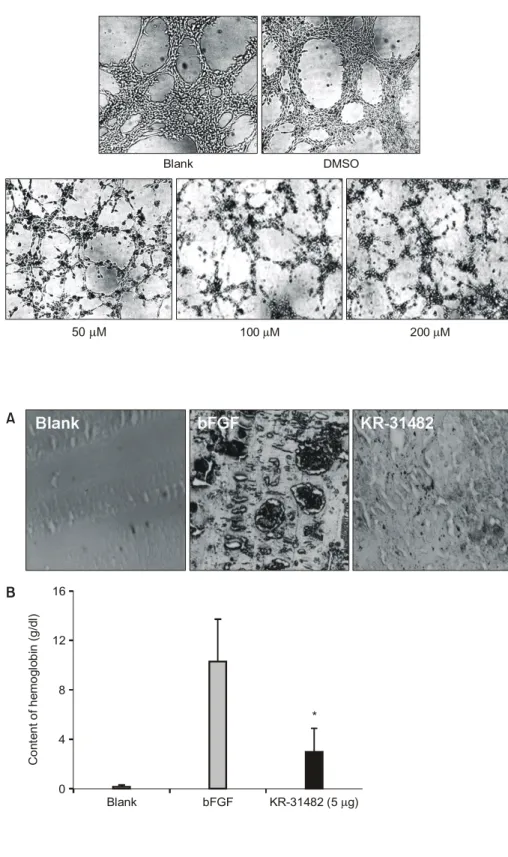
We carried out tube formation assay to estimate the effect of KR-31482 on the morphological differentiation of endo- thelial cells using Matrigel in BAECs. The endothelial cells formed hollow capillaries on Matrigel beds, and these tubes became stronger and more robust with elongated networks as time went on within 0-12 h range. As shown in Fig. 7, BAECs on Matrigel formed blood vessel network in the absence of KR-31482, whereas the treatment of KR-31482 for 6 h strongly inhibited the formation of tube-like structures in a dose-dependent manner. These tubes were broken, shortened, and much narrow in many sites, which were organized less Fig. 4. KR-31482 reduces the migra- tory activity in BACEs. The motility of endothelial cells by different concen- tration of KR-31482 was measured by wounding migration assay as des- cribed in “Material and Methods”. The basal migration in the absence of KR-31482 was blank. All data are expressed as percentage mean±SE from three different experiments with triplicate.
*p<0.05 compared to blank.
Blank
A
DMSO
50 Mµ 100 Mµ 200 Mµ
Blank DMSO 50 100 200
Migrated cell number (%)
Concentration of KR-31482 ( M)µ 0
20 40 60 80 100 120
*
*
* *
B
incomplete compared with that of blank. This finding de- monstrates that KR-31482 inhibits the tube formation of BAECs in vitro.
6. KR-31482 inhibits the angiogenesis in vivo mouse matrigel plug assay
These anti-angiogenic activities in vitro urged us to confirm the anti-angiogenic activity of KR-31482 on the ongoing angiogenesis process in mouse Matrigel implants. Matrigel with or without KR-31482 (5μg) was injected subcutaneously into C57/BL6 mice. The solid gel plug was removed from the mice at 7 days after implantation for histological examination. As shown in Fig. 8A, Matrigel Plugs containing the vessels formed by angiogenesis were abundantly filled with intact red blood cells, which indicate the formation of a functional vasculature inside the Matrigel. The neomicrovessels formation significantly increased in the Matrigel containing bFGF 100 ng/ml, whereas it was not observed in the Matrigel alone (blank). Matrigel Fig. 5. KR-31482 prevents the inva- sion of BAECs. BAECs were incubat- ed on the transwell chamber for 18 h in the absence or presence of KR- 31482. In vitro invasion was measured using transwell coated with Matrigel.
BAECs on lower side of a transwell filter were fixed, stained, mounted on a slide and photographed. The number of cells invading into the transwell was counted. Data are mean±SE of duplicate, and this independent expe- riment was repeated three times.
*p<0.05 compared to blank.
A
Blank DMSO
50 Mµ 100 Mµ 200 Mµ
Blank DMSO 50 100 200
Invaded cell number (%)
Concentration of KR-31482 ( M)µ 0
20 40 60 80 100 120
*
*
*
*
B
Fig. 6. KR-31482 reduces gelatinase activity in BAECs. The gelatinase activity and expression in endothelial cells were stu- died using gelatin-based zymography (For details see Materials and Methods) and were appeared as clear band.
Blank: conditioned medium from non-treated, BAECs: DMSO, conditioned medium BAECs treated with DMSO as solvent;
conditioned medium from BAECs treated with 50, 100 and 200 μM KR- 31482, respectively.
This data was repeated three experiments, independently.
Pro MMP-2 Active MMP-2
Blank DMSO 50 100 200
Dose of KR-31482 ( M)µ
plugs containing KR-31482 had produced fewer vessels as compared with that of plug containing bFGF, indicating that KR-31482 significantly inhibits the formation of bFGF- stimulated neomicrovessels. We also measured the hemoglobin content inside the Matrigel plugs to quantify the anti-angio- genic effect induced by the treatment of KR-31482. bFGF and
heparin increased hemoglobin to 10.25±3.435 g/dl (n=16) and hemoglobin in control was 0.149±0.076 g/dl (n=11) (Fig. 8B). KR-31482 remarkably decreased the bFGF- elevated hemoglobin quantity to about 2.96±1.95 g/dl (n=18) (Fig.
8B). Taken together, these results indicate that KR-31482 has a profound anti-angiogenic activity in vivo.
Fig. 7. KR-31482 blocks the vascular tube formation in BAECs. The chan- ges of cell morphology were captured through a phase contrast microscope (×40) and photographed. Repre- sentative photographs of the tube formation of endothelial cells cultured on polymerized Matrigel layers reveal the inhibitory effect of KR-31482 on the formation of capillary-like struc- ture. This assay was repeated three times, independently.
Blank DMSO
100 Mµ 200 Mµ
50 Mµ
Fig. 8. Anti-angiogenic effect of KR- 31482 on the mouse Matrigel plug.
Matrigel alone and bFGF were used as a negative and positive control, respectively. (A) The Matrigel without KR-31482 did not show any migration and invasion of endothelial cells. With Matrigel containing bFGF, many blood vessels appeared in the gel. KR- 31482 strongly inhibited bFGF-induced angiogenesis. (B) Quantitation of he- moglobin content. Each value repre- sents the mean of SD of at least five animals, and performed in three diffe- rent experiments.
Blank: matrigel alone.
*p<0.05 versus hemoglobin content of bFGF-induced implants.
A
Blank bFGF KR-31482 (5 g)µ
Content of hemoglobin (g/dl)
0 4 8 12 16
*
B
DISCUSSION
The growth of the tumor cell is dependent on the angiogenic growth of new blood vessels. Trials of anti-angiogenic therapy are based on strategies that interfere with angiogenic ligands, their receptors or downstream signaling. Angiogenesis is a complex process involving several cascades; a) enzymatic degra- dation of vascular basement membrane and interstitial matrices by endothelial cells, b) directed migration and proliferation of endothelial cells to provide cells for the new vessels, c) invasion of endothelial cells and d) formation of capillary-like networks by endothelial cells.9~13)
In this study, the chick embryo CAM assay was first carried out. Because the CAM assay is one of the most widely used in vivo angiogenesis assays, which measures the angiogenic activity of compounds during developmental angiogenesis.
KR-31482 has anti-angiogenic activity (Fig. 2).
And then, to elucidate KR-31482’s utilization as an anti- angiogenesis agent, we tested the effects of KR-31482 on angiogenesis in each step by using in vitro angiogenesis assays.
We observed the inhibition of DNA synthesis by KR-31482 (Fig. 3). The cells incubated in the presence of KR-31482, lost their proliferative activity in a dose-dependent manner. The mobility of endothelial cells, such as migration and invasion, is one of the initiation steps in angiogenesis. The migration and invasive activity of BAECs were performed by wounding migration and invasion assays (Fig. 4, 5). KR-31482 signifi- cantly reduced both activities of BAECs in a dose-dependent manner. Matrix Metalloproteinases (MMPs) are secreted as proenzymes and key regulators of extracellular matrix turnover through degradation a wide variety of extracellular matrix proteins.14) Also, regulation of extracellular proteolytic activity is important in the process of endothelial cell migration, invasion through the basement membrane and capillary mor- phogenesis, which occur during angiogenesis, and is essential step in tumor invasion and metastasis.15) On the basis of the fact that the motility of BAECs was profoundly suppressed by KR-31482, we therefore tested the effect of KR-31482on the production and activation of MMP-2 by using gelatin-based zymography. Expectedly, KR-31482 reduced the production and activation of pro- MMP-2 (Fig. 6). Thus, the inhibitory effects of KR-31482 on the angiogenesis may be at least partially dependent on the reduction of MMP-2. One of the
aspects of the biological relevance of endothelial cell chemotaxis in vitro that is important to the process of angiogenesis is an ability to promote morphological differentiation into capil- lary-like structure.16,17) In the absence of KR-31482, BAECs, placed on the Matrigel, formed short and thick capillary-like networks that seemed to be indicative of angiogenic develop- ment, whereas BAECs in the presence of KR-31482 showed reduced tube-like structure (Fig. 7). By performing these in vitro angiogenesis assays, we concluded that KR-31482 has strong inhibitory effects on a series of angiogenic processes, including endothelial cell proliferation, migration, invasion, and tube formation.
We also confirmed the anti-angiogenic activity of KR-31482 by performing in vivo mouse Matrigel plug assay. KR-31482 highly inhibited the formation of neovessels in Matrigel, and we noted that these newly synthesized vessels with bFGF under KR-31482-presence conditions participated poorly in the circu- lating of blood vessels in mice (Fig. 8).
In summary, the major findings reported here are that a new benzopyran derivative KR-31482 inhibited the in vitro angio- genesis in BAECs and in vivo bFGF-induced neovascularization in mice Matrigel plugs in association with the decreased releases of pro-MMP-2. Therefore, we suggest that KR-31482 exhibits strong anti-angiogenic actions and also may have potential to be a useful inhibitor of the large number of serious diseases characterized by upregulated angiogenesis. Further study is required to define more precisely the molecular mechanisms by which KR-31482 modulates endothelial cell function as well as gene expression, and especially, the effects of KR-31482-reduced expressions of as VEGF, bFGF and their receptors on their downstream signaling pathways.18,19)
ACKNOWDGEMENT
This study was supported in part by a grant of the 2003 Korean National Cancer Control Program, Ministry of Health
& Welfare, R.O.K.
REFERENCES
1) Folkman J, Shing Y. Angiogenesis. J Biol Chem 267, 10931- 10934, 1992.
2) Siddiqui FA, Desai H, Siddiqui TF, Francis JL. Hemoglobin induces the expression and secretion of vascular endothelial growth factor from human malignant cells. Hematol J 3,
264-270, 2002.
3) Folkman J, Klagsbrun M. Angiogenic growth factors. Science 235, 442-447, 1987.
4) Savani RC, Cao G, Pooler PM, Zaman A, Zhou Z. Diffential involvement of the hyaluronan (HA) receptors CD44 and receptor for HA-mediated motility in endothelial cell function and angiogenesis. J Biol Chem 276, 36770-36778, 2001.
5) Miao RQ, Agata J, Chao L, Chao J. Kallistatin is a new inhibitor of angiogenesis and tumor growth. Blood 100, 3245- 3252, 2002.
6) Lee MS, Moon EJ, Lee SW, Kim MS, Kim KW, Kim YJ.
Angiogenic activity of pyruvic acid in in vivo and in vitro angiogenesis models. Cancer Res 61, 3290 -3293, 2001.
7) Folkman J. What is the evidence that tumors are angiogenesis dependent? J Natl Cancer Inst 82, 4-6, 1990.
8) Drabkin DS, Ausin JH. Spectrophotomeric constans for com- mon hemoglobin derivaties in human, dog, and rabbit blood.
J Biol Chem 98, 719, 1932.
9) Bussolino F, Mantovani A, Persico G. Molecular mechanisms of blood vessel formation. Trends Biochem Sci 22, 251- 256, 1997.
10) Carmeliet P, Jain RK. Angiogenesis in cancer and other dis- eases. Nature 407, 249-257, 2000.
11) Kohn, EC, Alessandro R, Spoonster J, Wersto RP, Liotta LA.
Angiogenesis: role of calcium-mediated signal transduction.
Proc Natl Acad Sci USA 92, 1307-1311, 1995.
12) Hanahan D, Folkman J. Patterns and emerging mechanisms of the angiogenic switch during tumorigenesis. Cell 86, 353- 364, 1996.
13) Zhang Y, Griffith EC, Sage J, Jacks T, Liu JO. Cell cycle inhibition by the antiangiogenic agent TNP-470 is mediated by p53 and p21. Proc Natl Acad Sci USA 97, 6427-6432, 2000.
14) Giavazzi R, Taraboletti G. Preclinical development of metallo- proteasis inhibitors in cancer therapy. Ciritical Rev Oncol/
Hematol 37, 53-60, 2001.
15) Liekens S, Clercq ED, Neyts J. Angiogenesis: regulators and clinical applications. Biochem Pharm 61, 253-270, 2001.
16) Cao Y. Endogenous angiogenesis inhibitors and their thera- peutic implications. IJBCB 33, 357-369, 2001.
17) Folkman J. Angiogenesis in cancer, vascular, rheumatoid and other disease. Nat Med 1, 27-31, 1995.
18) Fidler IJ, Ellis LM. The implications of angiogenesis for the biology and therapy of cancer metastasis. Cell 79, 185-188, 1994.
19) Wynendaele W, Oosteram AT, Pawinski A, Bruijn EA and Maes RA. Angiogenesis. possibilities for therapeutic interven- tions. Pharmacy World & Science 20, 225-235, 1998.
![Fig. 3. KR-31482 decreases the BAECs proliferation. The effect of KR-31482 on proliferation of endothelial cells was examined by [ 3 H]-methylthymidine incorporation assay as described in](https://thumb-ap.123doks.com/thumbv2/123dokinfo/5455262.240180/4.892.83.425.163.607/decreases-proliferation-proliferation-endothelial-examined-methylthymidine-incorporation-described.webp)