Ⅰ. 서 론
심미적 보철에 대한 요구가 증가함에 따라 전부도 재관은 이제 일반적인 보철 처치의 하나가 되었다.
그러나 그 적용은 아직까지 제한적이며, 여러 가지 전부도재 시스템이 개발되었지만 많은 것은 일시적 으로 사용되다가 현재 쓰이지 않고 있다. 금속도재 관과 비교하여 우수한 심미성을 가지고 있는데도 불 구하고 많은 전부도재 시스템이 사용되지 못한 것은 전부도재관 제작에 잠재적인 문제점이 있기 때문이 다. 전부도재관 시스템이 극복해야 할 문제는 변연 적합도, 강도, 기공과정의 편리성 등으로 볼 수 있 다.
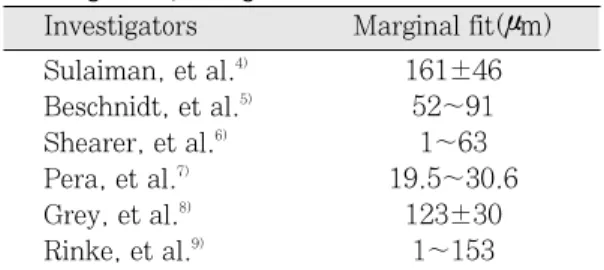
변연적합도는 금관가공의치학에서 매우 중요한 개 념 중 하나다. 변연적합도가 좋지 못할 경우, 치은열 구액, 치태침착, 골소실의 증가1,2)를 보인다. 따라서 치주염과 이차우식의 빈도가 증가하게 되고, 결국 치아상실의 가능성이 높아진다. 전부도재관의 변연 적합도에 대한 많은 연구가 있었다. 그러나 어떤 논 문에서는 결과에 대한 통계처리가 쉽지 않음3,4)을 보 여 주고 있다. Table I에서 보는 것처럼 In-Ceram crown의 변연적합도에 대한 여러 논문의 결과를 살 펴보면 그 수치가 큰 차이가 있음을 알 수 있다. 다 양한 실험 조건들에 대한 고려가 필요하다 하더라도 이러한 일관성을 찾기 어려운 결과의 원인에는 각 조사자간의 서로 다른 통계학적 관점과 추론이 작용
대한 요구로 현재 널리 사용되는 전부도재 시스템으 로는 In-Ceram(Vita Zahnfabrik, Bad Sa¨ckin- gen, Germany), IPS-Empress 2(Ivoclar, Schaan, Germany), CAD/CAM(Procera Allceram, Celay) 등이 있다. In-Ceram 시스템은 slip casting법을 사 용한다. In-Ceram core alumina powder slip을 내화모형에 바른 후 10시간 동안 furnace에서 소결 하고, liquid glass를 바르고 4시간 동안 furnace에서 infiltration하면 강한 alumina core가 완성되고 그 위 에 장석도재를 올려 치관을 제작한다. IPS Empress 2 시스템은 heat-press 기술을 이용한다. 모형에 core를 wax-up하여 매몰한 후 injection방법으로 lithium-disilicate glass core를 만든 후 장석도재를 축조하여 치관을 제작한다. CAD/CAM 시스템은 기 존의 도재관 제작과는 다른 과정인 copy-milling법을 사용한다. Procera Allceram (Nobel Biocare, Go¨ teborg, Sweden)은 형성된 치아모형을 Procera reader로 읽은 단면자료를 Sweden으로 모뎀전송하 면, 전송된 자료를 모아 CAD/CAM 작업으로 milling 하여 high purity alumina core를 제작한다. 이렇게 제작, 관리함으로써 균일한 품질의 수복물을 제공할 수 있으나, 시스템 구축의 번거로움 등이 있어 국내 에서는 아직 일반화되지 않고 있다. Celay(Mikrona AG, Spreitenbach, Switzerland) 시스템도 copy- milling법으로 치관제작을 하는데, 특히 Celay/In- Ceram 제작은 시간을 많이 절약할 수 있는 장점이 대한치과보철학회지:Vol. 40, No. 2, 2002
Celay/In-Ceram, Conventional In-Ceram, Empress 2 전부도재관의 변연적합도에 관한 비교 연구
서울대학교 치과대학 치과보철학교실
양재호∙여인성∙이선형∙한중석∙이재봉
A B
Fig. 1. The prepared tooth which (the maxillary central incisor) was cleaned and embedded in an self-curing resin block.
The long axis of the tooth was perpen- dicular to the block. A, Labial view. B, Incisal view. C, Schematic diagram of tooth preparation.
C
tration 과정을 거쳐 core를 완성한다. 그 후 장석도재 를 축조하여 치관을 완성하기 때문에, 기존의 slip casting에서 요구하는 14시간(소결: 10시간, glass infiltration: 4시간)을 약 90분(milling: 약 50분, glass infitration: 40분)으로 줄일 수 있다. 그리고 mass product인 alumina blank를 사용하기 때문에 균일한 강도의 core를 얻을 수 있다. Hwang 등10)은 mass product의 alumina blank를 사용할 경우 약 12% 정 도 더 강한 강도를 얻을 수 있다고 했다. 여러 임상
가들이 copy-milling에 대해 technique-sensitive 하고 변연적합도가 떨어진다고 생각한다. 그러나 Groten 등11)에 의하면 Celay/In-Ceram 치관의 변연 적합도는 매우 우수한 것으로 평가되었다. 현재 Celay는 국내에 비교적 널리 보급되어 있는 copy- milling 시스템이다.
본 연구의 목적은 국내에서 사용되고 있는 전부도 재관 시스템(In-Ceram, IPS Empress 2, Celay/In- Ceram)의 변연적합도를 비교하고, 실험 방법과 통 계적 처리 등에 대해 고찰하는 것이다.
Ⅱ. 연구재료 및 방법
발치한 한 개의 상악중절치를 아크릴릭 레진에 포 매한다. High speed handpiece를 사용하여 개략적인 치아 형성을 하였다. Milling machine(F2, Degussa Korea, Seoul, Korea)으로 치아 형성을 마무리하여 최종적으로 6�taper, 1mm shoulder 변연을 갖는 치 아 형태가 되도록 하였다(Fig. 1).
Table Ⅰ. Investigators and experimental results in marginal opening of In-Ceram crowns
Sulaiman, et al.4) 161±46 Beschnidt, et al.5) 52�91 Shearer, et al.6) 1�63 Pera, et al.7) 19.5�30.6
Grey, et al.8) 123±30
Rinke, et al.9) 1�153
Investigators Marginal fit(
μ
m)About 7mm
6。taper
1mm shoulder
A B C
Fig. 2. A. The plaster model for individual trays. B. The plaster model that was relieved by 2 sheets of base- plate wax. C. The custom-made tray for final impression.
개인용 tray 제작을 위해 예비인상을 알지네이트 (Aroma fine, GC Inc, Tokyo, Japan)로 채득하고 plaster model을 제작하였다(Fig. 2, A). Baseplate wax 두 장 두께로 plaster model을 relief 한 후 (Fig. 2, B), tray resin(Quicky, Nissin Dental Products Inc, Kyoto, Japan)으로 40개의 개인용 tray 를 만들었다(Fig. 2, C). Addition type의 silicon 인 상재(Examix, GC Inc, Tokyo, Japan)로 최종인상 (Fig. 3, A)을 채득하여 40개의 주모형(Rhombrock, Mitsubishi, Tokyo, Japan)을 제작하였다(Fig. 3, B).
각 군당 10개씩, 총 40개의 치관을 제작—대조군 으로 metal 변연의 PFM(Rexillium III, JENER-
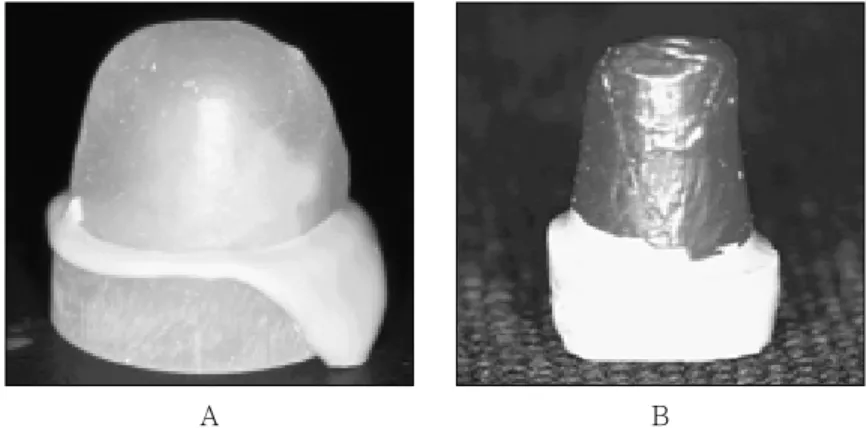
IC/PENTRON Inc, Wallingford, USA) 치관 10개, 실험군으로 Celay/In-Ceram alumina 치관 10개, slip casting In-Ceram alumina 치관 10개, layering tech- nique을 적용한 IPS Empress 2 치관 10개를 제작하 였다. 각 군의 치관은 숙련된 기공사에 의해 제조사 의 지시에 따라 제작하였다(Fig. 4).
변연적합도는 형성된 치아의 변연 한계점과 수복 물 변연 사이의 간격으로 정의하였다. 측정은 Optical dimensional metrology center(Accura 2000, INTEK PLUS, Daejeon, Korea)로 하였다(Fig.
5). 본 측정장치로 변연적합도를 240배 확대된 상에 서 0.1
μ
m의 감도로 측정하였다. Computer 출력 화A B
Fig. 3. A. The final impression by polyvinyl siloxane using the individual
Fig. 5. The optical dimensional metrology center. Fig. 6. The schematic diagram showing the mea- surement method of marginal gap.
A B
C D
Fig. 4. Forty crowns were fabricated; A, PFM crowns (n=10) with metal margin. B, Copy-milled In-Ceram crowns (n=10) by Celay technology. C, In-Ceram alumina crowns (n=10) by slip casting technique. D, IPS Empress 2 crowns (n=10) by layering technique.
면에 잡힌 확대상에서, 변연 간격은 치아 변연에서 얻은 최소자승선과 치관 변연의 한 점 사이의 최소 거리로 측정되었다(Fig. 6). 한 치관의 임의로 선택 된 50곳에서 변연 간격을 측정하여 구한 평균값을 그 치관의 변연적합도로 표시하였다.
통계처리는 비모수적 방법을 사용하였다. 평균값 과 표준편차를 구하고, Kruskall-Wallis 검정을 사용 하여 각 군의 평균값을 비교, 평가하였다.
Ⅲ. 결 과
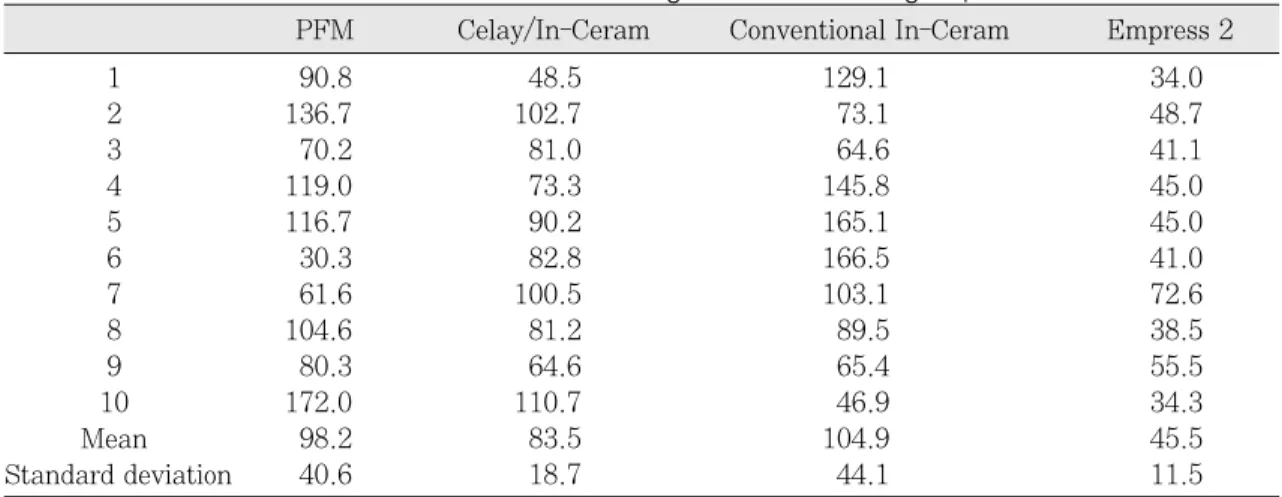
각 군의 변연 오차의 평균값 및 표준편차는 Table
Ⅱ와 같다. Table Ⅲ는 Kruskal-Wallis 검정 결과를 보여주고 있다. P<0.05 수준에서 근사 유의 확률이 P=0.001이므로 각 군간의 평균값이 같지 않다고 할 수 있다. 비모수통계는 사후검정법이 따로 없기
Empress 2는 통계적으로 유의성 있게 우수한 변연 적합도를 보였으나, 다른 세 군의 변연적합도의 차 이는 통계적 유의성이 없었다.
Ⅳ. 총괄 및 고안
수종 전부도재관의 변연적합도를 정확히 비교하려 면, 각 전부도재관 제작 시스템을 제외한 다른 모든 조건이 동일해야 한다. 따라서 비교할 모든 수복물 시편은 한 개의 형성된 치아로부터 제작되는 것이 바람직하다. 그러나, 이러한 실험 설계 하에서는 수 복물과 치아를 접착한 상태에서 변연적합도를 측정 할 수 없다. 동일한 조건으로 영구접착 후, 변연 오 차를 측정하기 위해서는 제작된 치관 시편 수와 같 은 수의 치아가 필요하다. 영구접착 하기 전과 후의 수복물의 변연적합도는 통계적으로 유의성이 있는 Table Ⅱ. The means and standard deviations of marginal fits in each 4 groups (μm)
PFM Celay/In-Ceram Conventional In-Ceram Empress 2
1 90.8 48.5 129.1 34.0
2 136.7 102.7 73.1 48.7
3 70.2 81.0 64.6 41.1
4 119.0 73.3 145.8 45.0
5 116.7 90.2 165.1 45.0
6 30.3 82.8 166.5 41.0
7 61.6 100.5 103.1 72.6
8 104.6 81.2 89.5 38.5
9 80.3 64.6 65.4 55.5
10 172.0 110.7 46.9 34.3
Mean 98.2 83.5 104.9 45.5
Standard deviation 40.6 18.7 44.1 11.5
Table Ⅳ. Mann-Whitney test statistics
PFM-Celay/In-Ceram 0.364 PFM-Conventional In-Ceram 0.880
PFM-Empress 2 0.004*
Celay/In-Ceram-Conventional In-Ceram 0.406 Celay/In-Ceram-Empress 2 0.001*
Conventional In-Ceram-Empress 2 0.001*
(* shows statistically different marginal accuracy) Sig.
Table Ⅲ. Kruskal-Wallis test statistics
PFM 10 25.30
Celay/In-Ceram 10 22.80
Conventional In-Ceram 10 26.30
Empress 2 10 7.60
Total 40
Asymp. Sig. 0.001
N Mean Rank
Table Ⅴ. 50 measurements of marginal opening in one crown sample(μm)
123.4 123.8 124.2 90.2 92.1 123.8 125.4 127.7 56.2 67.2
65.6 124.3 118.9 113.3 121.7 126.5 79.1 90.1 96.1 74.9
101.9 77.2 100.3 99.3 94.6 59.1 62.2 66.5 67.7 67.5
65.7 63.1 65.3 62.9 128.9 129.0 131.1 57.8 58.7 60.3
79.3 79.0 78.7 101.9 79.7 76.1 125.1 100.9 65.1 69.3
서, 영구접착 후 변연적합도 비교 측정에 있어 같은 조건을 부여하려면, cementing medium이 같아야 하 지만, 여기서도 고려할 점은 각 수복물 제작 시스템 차이 외에 cement 자체의 점주도, film thickness 등 이 변수로 개재된다는 것이다. 이런 면들을 고려하 여, 본 실험에서는 cementation을 하지 않은 상태에 서 변연적합도를 측정하도록 하였다.
본 실험 설계에서 변연적합도에 영향을 주는 인자 는 두 가지이다. 하나는 제작 시스템이고 다른 하나 는 제작하는 기공사의 기술적 차이다. 기공사의 테 크닉은 많은 주관적인 요소가 복합되어 있는 것으로 이를 고려하게 되면 일관성 있는 통계적 추론을 하 기 매우 어려워진다. 따라서 그 시스템을 사용하여 치관을 제작하는 기공사 간에 기술적인 차이가 없다 는 가정이 필요하다. 본 실험에서는 이 가정을 적용 하기 위해, 그 시스템에 대해 충분한 경험이 있는 기 공사를 각 시스템 당 일인씩 선정하여 제작을 의뢰 하였다. 기공사 간의 테크닉의 차이가 없을 때, 제작 된 치관의 변연적합도를 측정하여 얻은 평균과 표준 편차는 각기 특정한 의미를 갖게 된다. 평균값은 시 스템 자체가 내재적으로 가지고 있는 정확도를 의미 하고, 표준편차는 technique sensitivity로 해석할 수 있다. 본 실험 결과에 의하면, copy-milling method 인 Celay/In-Ceram 시스템은 다른 군과 비교하였을 때, technique sensitive하지 않았다. 즉 적절히 훈련 될 경우 copy-milling 방법은 비교적 균일한 변연적합 도의 치관 수복물을 제작할 수 있었다. 이러한 결과 의 신뢰도를 높이려면, 시편 수의 크기를 어느 정도 로 설정하는가가 중요한 문제가 된다.
통계적 추론의 신뢰도는 일반적으로 모수 통계 분 석이 비모수 분석보다 높다. 모수 통계 분석이 가능 하다면, 비모수 통계는 사용하지 말아야 한다.14)모 수적 방법을 사용하려면, 추출한 표본의 모집단이 정규분포를 이루어야 한다는 가정이 필요하다. 이
가정을 성립시키기 위해 적절한 시편 수의 크기가 요구된다. 비교군의 수가 3개 이상이 될 때 평균값 비교를 위한 모수 통계로 일원배치분산분석(one- way ANOVA)을 사용한다. 치관 수복물의 변연적합 도 측정 연구 논문의 다수는 통계 처리로 일원배치 분산분석을 적용하였다. 모수적 방법을 적용한 논문 에서 각 군당 추출한 시편 수의 크기는 대개 10개 정
도였다.15-18) 본 연구의 결과처럼 변연적합도의 평균
값과 표준편차를 비교해 보면 산포도가 큰 것이 일 반적이다. 이런 경우 10개 정도의 시편 수로 모집단 의 정규성을 가정할 수는 없다. 정규성의 가정이 성 립하지 않으면 모수적 통계 방법을 사용해서는 안된 다. 비록 모수 통계 분석이 비모수적 방법보다 높은 신뢰도를 보이나, 이 때에는 비모수 통계 추론 (Kruskal-Wallis)이 보다 정확한 분석이 된다. 비모 수 통계 처리는 신뢰도가 좀 떨어지는 단점은 있으 나, 적은 시편 수로 손쉽게 분석할 수 있는 장점이 있다. 다만 위에서 언급한 것처럼 비모수 처리는 모 수적 방법에서 사용하는 사후분석이 없기 때문에 각 각 두 군씩 짝지어 비교해야 한다는 불편함이 있다.
치관 수복물의 변연적합도 연구에 있어서, 모수적 통계 분석을 사용하려면, 각 군당 추출한 표본 시편 수의 크기는 30 이상이 되어야 한다. 표본 수를 30으 로 조절하면, 모집단의 정규성을 가정할 수 있다. 또 한 이 경우 표준 편차(technique-sensitivity)에 대한 해석의 신뢰도도 높아진다.
한 시편의 변연적합도를 구할 때, 본 실험에서 제 작된 한 치관의 50 곳에서 측정한 변연 오차는 Table Ⅴ와 같다. 임의로 선택된 50 points의 평균값 은 90.8
μ
m이다. Table Ⅴ에서 네 점을 선택 ─ 여러 논문에서 사용한 방법3,4,19) ─ 하여 평균값을 구하면 90.8μ
m과 상당한 차이를 보이는 결과를 발견할 수 있었다. 예를 들어 Table Ⅴ의 처음 네 수치의 평균 을 구하면 115.4μ
m이다. 따라서, 한 시편의 변연적합도를 나타내는 대표값을 구하려면, 적절한 측정회 수가 필요하다는 것을 알 수 있다. Groten 등20)은 50 회 이상 측정하게 되면, 측정 위치를 임의로 선택하 나, 전략적으로 선정하는가에 관계없이 유사한 값을 갖게 된다고 하였다. 즉 한 치관 시편의 변연적합도 를 계산하기 위해서는 최소 50points 이상에서 변연 측정이 필요하다. 그러므로, 본 연구에서는 한 시편 에서 변연적합도를 측정하기 위해 50개의 위치를 임 의로 선정하여 측정하였다.
임상적으로 전부도재관이 성공적으로 수복되기 위 해 요구되는 변연적합도의 한계는 명확히 규명되어 있지 않다. Sorensen 등1)은 변연 오차로 인해 발생하 는 골소실 등을 억제하기 위해서는 변연적합도가 50
μ
m 이하이어야 한다고 하였다. 그러나, 대부분의 학 자들은 전부도재관의 변연적합도에 관한 연구에서 그 이상의 변연오차를 보고 하고 있고 그러면서도 훌륭히 임상에서 성공한 증례를 발표하고 있다. 수 복 인공 치관의 적절한 변연적합도에 관해 고찰한 내용들을 살펴보면, 아직까지 명확한 근거를 찾지 못하고 있으나, 다수는 100�150μ
m 정도면 임상적으로 받아들일만한 것으로 보고 있는 것 같다.21-23)이 를 토대로 본 연구 결과를 검토하면, 대조군을 포함 한 모든 전부도재관 시스템은 단일 치관 수복물에서 임상적으로 적절한 변연적합도를 보인다고 하겠다.
그러나 보다 명확한 변연적합도 규격에 관한 계속적 연구가 필요할 것으로 사료된다.
Ⅴ. 결 론
본 연구 결과 다음과 같은 결론을 얻을 수 있었다.
1. 각 시스템으로 제작된 단일 수복 치관의 변연적 합도는 PFM 치관이 98.2±40.6
μ
m, Celay/In- Ceram 치관이 83.5±18.7μ
m, conventional In-Ceram 치관이 104.9±44.1μ
m, IPS Empress 2 layering 치관이 45.5±11.5μ
m이었다. 비모수통계 분석 결과 IPS Empress 2 시스템이 다른 시 스템 보다 유의성 있게 우수한 변연적합도를 보 였고, 다른 세 군의 변연적합도는 통계적으로 유 의성이 없었다(P<0.05).
2. 임상적으로 받아들일 수 있는 적절한 변연적합도
한 변연 오차를 보였다.
3. 본 연구와 같이, 변수를‘수복 치관 제작 시스템’
만으로 조절한 경우, 평균값은 각 시스템으로 제 작한 수복 치관의 변연적합도, 표준 편차는 각 시 스템이 가지고 있는 technique-sensitivity로 해석 할 수 있다.
4. 각 군의 표준 편차를 비교한 결과, copy-milling 방 법은 다른 제작법보다 technique-sensitivity가 높지 않았다.
5. 평균값과 표준 편차에 대한 해석의 신뢰도를 높 이려면 비모수적 방법보다 모수 통계 추론을 사 용하는 것이 바람직한데, 모수적 방법을 사용하 기 위해서는 각 군당 표본수의 크기를 30 이상으 로 조절하여야 한다.
임상적으로 받아들일 수 있는 변연 간격에 대한 명 확한 결과와 근거는 아직 마련되어 있지 않으며 이 에 대한 보다 많은 연구가 필요하다.
REFERENCES
1. Sorensen SE, Larsen IB, Jo/rgensen KD.
Gingival and alveolar bone reaction to marginal fit of subgingival crown margins.
Scand J Dent Res 1986;94:109-14.
2. Sorensen JA. A rationale for comparison of plaque-retaining properties of crown sys- tems. J Prosthet Dent 1989;62:264-9.
3. Leong D, Chai J, Lautenschlager E, Gilbert J. Marginal fit of machine-milled titanium and cast titanium single crowns.
Int J Prosthodont 1994;7:440-7.
4. Sulaiman F, Chai J, Jameson LM, Wozniak WT. A comparison of the marginal fit of In- Ceram, IPS Empress, and Procera Crowns.
Int J Prosthodont 1997;10:478-84.
5. Beschnidt SM, Strub JR. Evaluation of the marginal accuracy of different all-ceram- ic crown systems after simulation in the ar- tificial mouth. J Oral Rehabil 1999;26:582-
Influence of marginal configuration and porcelain addition on the fit of In-Ceram crowns. Biomaterials 1996;17:1891-5.
7. Pera P, Gilodi S, Bassi F, Carossa S. In vit- ro marginal adaptation of alumina porce- lain ceramic crowns. J Prosthet Dent 1994;72:585-90.
8. Grey NJ, Piddock V, Wilson MA. In vitro comparison of conventional crowns and a new all-ceramic system. J Dent 1993;21:47- 51.
9. Rinke S, Huls A, Jahn L. Marginal accu- racy and fracture strength of convention- al and copy-milled all-ceramic crowns.
Int J Prosthodont 1995;8:303-10.
10. Hwang JW, Yang JH. Fracture strength of copy-milled and conventional In-Ceram crowns. J Oral Rehabil 2001;28:678-83 11. Groten M, Girthofer S, Probster L. Marginal
fit consistency of copy-milled all-ceramic crowns during fabrication by light and scanning electron microscopic analysis in vitro. J Oral Rehabil 1997;24:871-81.
12. Hung SH, Hung KS, Eick JD, Chappell RP.
Marginal fit of porcelain-fused-to-metal and two types of ceramic crown. J Prosthet Dent 1990;63:26-31.
13. Kern M, Schaller HG, Strub JR. Marginal fit of restorations before and after ce- mentation in vivo. Int J Prosthodont 1993;6:585-91.
14. Chao LL. Statistics: methods and analy- ses. Tokyo:McGraw-Hill Inc. 1974.
15. Richter-Snapp K, Aquilino SA, Svare
CW, Turner KA. Change in marginal fit as related to marginal design, alloy type and porcelain proximity in porcelain- fused-to-metal restorations. J Prosthet Dent 1988;60:435-9.
16. May KB, Russell MM, Razzoog ME, Lang BR. Precision of fit: The Procera AllCeram crown. J Prosthet Dent 1998;80:394- 404.
17. Cooney JP, Richter WA, MacEntee MI.
Evaluation of ceramic margins for metal- ceramic restorations. J Prosthet Dent 1985;54:1-5.
18. Blackman R, Baez R, Barghi N. Marginal accuracy and geometry of cast titanium cop- ings. J Prosthet Dent 1992;67:435-40.
19. Schaerer P, Tomohiko S, Wohlwend A. A comparison of the marginal fit of three cast ceramic crown systems. J Prosthet Dent 1988;59:534-42.
20. Groten M, Axmann D, Pro¨bster L, Weber H. Determination of the minimum number of marginal gap measurements required for practical in vitro testing. J Prosthet Dent 2000;83:40-9.
21. Bjo¨rn AL, Bjo¨rn H, Grkovic B. Marginal fit of restorations and its relation to periodontal bone level. II. Crowns. Odontol Revy 1970;21:337-46.
22. Christensen GJ. Marginal fit of gold inlay castings. J Prosthet Dent 1966;16:297-305.
23. McLean JW, von Fraunhofer JA. The es- timation of cement film thickness by an in vivo technique. Br Dent J 1971;131:107-11.
Reprint request to:
Jae-Ho Yang, D.D.S., M.S.D., Ph.D.
Department of Prosthodontics, College of Dentistry, Seoul National University 28-1, Yeongun-Dong, Chongno-Gu, Seoul, 110-749, Korea
Tel. 82-2-760-2661 E-mail. [email protected]
There have been many studies about marginal discrepancy of single restorations made by var- ious systems and materials. But many of statistical inferences are not definite because of sam- ple size, measurement number, measuring instruments, etc.
The purpose of this study was to compare the marginal adaptations of the anterior single restora- tions made by different systems and to consider more desirable statistical methods in analysing the marginal fit. Thein vitromarginal discrepancies of three different all-ceramic crown systems (Celay In-Ceram, Conventional In-Ceram, IPS Empress 2 layering technique) and one control group (PFM) were evaluated and compared. The crowns were made from one extracted maxillary cen- tral incisor prepared with a 1mm shoulder margin and 6�taper walls by milling machine. 10 crowns per each system were fabricated. Measurements of a crown were recorded at 50 points that were randomly selected for marginal gap evaluation. Non-parametric statistical analysis was performed for the results.
Within the limits of this study, the following conclusions were drawn:
1. Mean gap dimensions and standard deviations at the marginal opening for the maxillary incisor crowns were 98.2±40.6
μ
m for PFM, 83.5±18.7μ
m for Celay In-Ceram, 104.9±44.1μ
m forconventional In-Ceram, and 45.5±11.5
μ
m for IPS Empress 2 layering technique. The IPS Empress 2 system showed the smallest marginal gap (P<0.05). The marginal openings of the other three groups were not significantly different (P<0.05).2. The marginal discrepancies found in this study were all within clinically acceptable standards (100�150
μ
m).3. When the variable is so controlled that the system may be the only one, mean value is inter- preted to be the marginal discrepancy of a restoration which is made by each system and stan- dard deviation is to be technique-sensitivity of each one.
4. From the standard deviations, the copy-milling technique (Celay/In-Ceram) was not considered to be technique-sensitive in comparison with other methods.
5. Parametric analysis is more reliable than non-parametric one in interpretation of the mean and standard deviation. The sample size of each group has to be more than 30 to use parametric statistics.
The level of clinically acceptable marginal fit has not been established. Further studies are need- ed.
MARGINAL FIT OF CELAY/IN-CERAM, CONVENTIONAL IN-CERAM AND EMPRESS 2 ALL-CERAMIC SINGLE CROWNS
Jae-Ho Yang, D.D.S., M.S.D., Ph.D., In-Sung Yeo, D.D.S., M.S.D., Sun-Hyung Lee, D.D.S., M.S.D., Ph.D., Jung-Suk Han, D.D.S., M.S., Ph.D.,
Jai-Bong Lee, D.D.S., M.S.D., Ph.D.
Department of Prosthodontics, College of Dentistry, Seoul National University.
ABSTRACT