INTRODUCTION
The family Muraenidae, which belongs to the order An- guilliformes, has 16 genera with about 199 species world- wide (Froese and Pauly, 2019). It is characterized by the elongate body, posterior nostril high on the head, above or before the eye, a simple pore or in a tube, gill opening a small round hole or slit, pectoral and pelvic fins absent, and lateral-line pores absent on the body except for one or two above and before gill opening (Bõhlke et al., 1999;
Nelson et al., 2016). In Korea, seven species with two genera in the family Muraenidae have been reported so far (Kang et al., 2018).
Three species in the genus Strophidon have been report- ed worldwide (Hibino et al., 2017; Fricke et al., 2020).
Recently, a single specimen of unrecorded morays species was collected by a danish seine off the southern coast of Jejudo Island (sea block no. 252), Korea. It was morpho- logically identified as Strophidon sathete according to Ha- tooka (2013) and Loh et al. (2015). Here, we described its
morphology based on the specimen and added the species to the list of the Korean fish fauna.
Measurements followed the method of Bõhlke and Ran- dall (2000), and Hubbs et al. (2004). Vertebral counts were made from soft X-ray photo; mean vertebral formula was expressed as predorsal-preanal-total vertebrae (Bõhlke, 1982). Teeth counts follow the method of Bõhlke (1989), and were counted using a magnifying glass and stereo microscope. The examined specimen are deposited at the Fish Genetics and Breeding Laboratory of Jeju National University (JNU), Korea.
Strophidon McClelland, 1844
(New Korean genus name: Ga-neun-gom-chi-sok) Strophidon McClelland, 1844: 187 (type species: Lyco-
dontis longicaudata McClelland, 1845).
Description. Body elongate, its depth 40 times or more in total length (TL); tail about equal to preanal length;
dorsal fin elevated, well developed; anterior nostrils sim- ple tubes; teeth not noticeably molariform; usually some canine teeth present; dorsal fin origin before anus; 1~4 branchial pores (Bõhlke and Randall, 2000).
—21 — http://www.fishkorea.or.kr
* Corresponding author: Choon Bok Song Tel: 82-64-754-3471, Fax: 82-64-756-3493, E-mail: [email protected]
ISSN: 1225-8598(Print), 2288-3371(Online). DOI: https://doi.org/10.35399/ISK.32.1.4
Accepted: March 16, 2020
First Record of the Slender Giant Moray, Strophidon sathete (Muraenidae, Anguilliformes) from Korea
By Byung Yeob Kim, Soo Jin Koh
1, Maeng Jin Kim
1and Choon Bok Song*
College of Ocean Sciences, Jeju National University, Jeju 63243, Republic of Korea
1West Fisheries Research Institute, National Institute of Fisheries Sciences, Incheon 22383, Republic of Korea
ABSTRACT
A single specimen of Strophidon sathete (1,302 mm in total length), belonging to the family Muraenidae, was collected in a danish seine off the southern coast of Jejudo Island in April, 2019 for the first time. It was characterized by having unpatterned coloration and thin body, snout slightly rounded, three superorbital pores, four infraobital pores, and six mandibular pores. This species is distinguishable from morphologically similar Gymnothorax albimarginatus inhabiting Korean waters by having all fins dark (vs. fins dark posteriorly with white margin for latter), body depth 1.8~3.1% in total length (vs. 3.2~5.7%), and no dark band on head in less than 50~70 cm (vs. exist). We add Strophidon
sathete to the Korean fish fauna and propose a new Korean name, “Ga-neun-gom-chi” for the speciesbecause the body is relatively thinner than other similar moray species (G. albimarginatus) in Korea.
Key words: Strophidon sathete, Muraenidae, first record, Jejudo Island, Korea
Strophidon sathete (Hamilton, 1822) (New Korean name: Ga-neun-gom-chi)
(Figs. 1, 2; Table 1)
Muraenophis sathete Hamilton, 1822: 17, 363 (type lo- cality: near Calcutta, India).
Strophidon sathete: Chen et al., 1994: 54 (Taiwan); Bõhl- ke, 1997: 106 (Indo-Pacific); Bõhlke et al., 1999: 1647 (Western Central Pacific); Myers, 1999: 51 (Microne- sia); Randall and Lim, 2000: 585 (South China Sea);
Hatooka in Nakabo, 2013: 249 (Japan).
Material. JNU1504, one specimen, 1,302 mm in TL, off the southern coast of Jejudo Island (sea block no. 252) with a danish seine, 1 April, 2019.
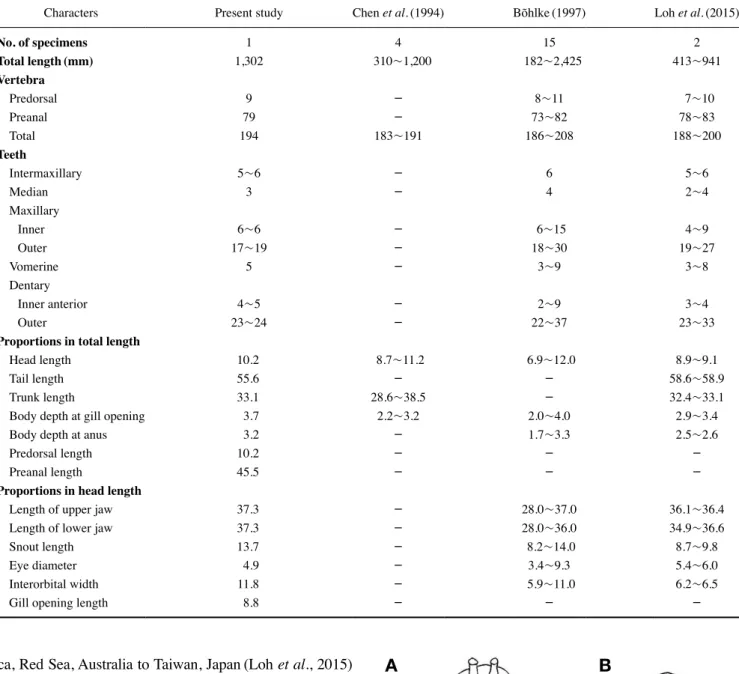
Description. Counts and measurements are shown in Ta- ble 1.
Body very elongated, cylindrical, slightly compressed behind anus; head long with pores typical, three superor-
bital pores, four infraobital pores (Fig. 2A), six mandibular pores; mouth moderately; snout blunt and short (two times of eye diameter); anterior nostril with a short tube; poste- rior nostril above eye; lower jaw projecting slightly than upper jaw; in upper jaw, 5~6 intermaxillary teeth on each side, 5 median teeth (Fig. 3A); maxillary teeth biserial, an outer row of 14 short triangular teeth and an inner row of 5 tall depressible teeth; vomerine teeth uniserial 5 in number in lower jaw (Fig. 3B); dentary teeth biserial, an anterior inner row of 4~5 large teeth and an outer row of 23 small- er teeth; the origin of dorsal fin far at behind the pectoral pore; dorsal and anal fins confluent with caudal fin; pec- toral and pelvic fins absent; anus located before midbody;
tail much longer than preanal length.
Coloration. when fresh, body uniformly brown head, body and fins with unpatterned coloration; dorsal, anal and caudal fin dark brown.
Distribution. Known from Indo-West Pacific: South Afri-
Fig. 1. Strophidon sathete, JNU1504, 1,302.0mm TL, Jejudo Island, Korea.
Fig. 2. Position of infraorbital sensory pores of Strophidon sathete(A) and S. ui in Hatooka(2013)(B).
A B
Infraorbital sensory pores
Infraorbital sensory pores
ca, Red Sea, Australia to Taiwan, Japan (Loh et al., 2015) and Korea (Present study).
Remarks. The present specimen, belonging to the family Muraenidae, is characterized by having body very elon- gated, cylindrical, slightly compressed behind anus, dorsal and anal fins confluent with caudal fin, pectoral and pelvic fins absent, anus located before midbody, tail much longer than preanal length and infraorbital sensory pore located below posterior part of eye. The morphological character- istics of present specimen were compared with those in the previous reports of Strophidon sathete (Hatooka, 2013;
Loh et al., 2015), which revealed that all morphological traits examined were well matched with those of Strophi- don sathete (Table 1).
Bõhlke (1997) regarded that Straphidon ui Tanaka, 1918
Table 1. Comparison of morphological characters between present and previous studies on Strophidon sathete
Characters Present study Chen et al.(1994) Bõhlke(1997) Loh et al.(2015)
No. of specimens 1 4 15 2
Total length(mm) 1,302 310~1,200 182~2,425 413~941
Vertebra
Predorsal 9 - 8~11 7~10
Preanal 79 - 73~82 78~83
Total 194 183~191 186~208 188~200
Teeth
Intermaxillary 5~6 - 6 5~6
Median 3 - 4 2~4
Maxillary
Inner 6~6 - 6~15 4~9
Outer 17~19 - 18~30 19~27
Vomerine 5 - 3~9 3~8
Dentary
Inner anterior 4~5 - 2~9 3~4
Outer 23~24 - 22~37 23~33
Proportions in total length
Head length 10.2 8.7~11.2 6.9~12.0 8.9~9.1
Tail length 55.6 - - 58.6~58.9
Trunk length 33.1 28.6~38.5 - 32.4~33.1
Body depth at gill opening 3.7 2.2~3.2 2.0~4.0 2.9~3.4
Body depth at anus 3.2 - 1.7~3.3 2.5~2.6
Predorsal length 10.2 - - -
Preanal length 45.5 - - -
Proportions in head length
Length of upper jaw 37.3 - 28.0~37.0 36.1~36.4
Length of lower jaw 37.3 - 28.0~36.0 34.9~36.6
Snout length 13.7 - 8.2~14.0 8.7~9.8
Eye diameter 4.9 - 3.4~9.3 5.4~6.0
Interorbital width 11.8 - 5.9~11.0 6.2~6.5
Gill opening length 8.8 - - -
Fig. 3. Shape of teeth of Strophidon sathete. A: upper jaw, B: lower jaw.
A B
was as a junior synonymy of S. sathete based on descrip- tion, counts and measurements. However, Hatooka (2013) did not follow Bõhlke’s classification and regarded S. ui as a different species based on the position of infraorbital sensory pore. That is, S. sathete has a sensory pore below posterior part of eye, while S. ui does not (Fig. 2). Also, Loh et al. (2015) suggested that Gymnothorax dorsalis should be placed in Strophidon rather than in Gymnotho- rax based on morphological and molecular characteristics.
Further review studies are needed to clarify the taxonomic position of these species.
S. sathete morphologically resembles G. albimarginatus Temminck and Schlegel, 1846 inhabiting Korean waters.
However, it is distinguishable from the latter by the dorsal and anal fin color (all fins dark vs. fins dark posteriorly with white margin for latter), body depth (1.8~3.1% in to- tal length vs. 3.2~5.7%), and presence or absence of dark band on head in less than 50~70 cm (no vs. exist) (Bõhlke, 1997; Hatooka, 2013). We suggest its new Korean name,
“Ga-neun-gom-chi” for the species because the body is relatively thinner than other similar moray species (G. al- bimarginatus) in Korea.
ACKNOWLEDGEMENTS
This research was supported by the 2019 scientific pro- motion program funded by Jeju National University.
REFERENCES
Bõhlke, E.B. 1982. Vertebral formulae for type specimens of eels(Pi- sces: Auguilliformes). Acad. Nat. Sci. Phila., 134: 31-49.
Bõhlke, E.B., J.E. McCoskere and J.E. Bõhlke. 1989. Methods and Terminology. In: Bõhlke, E.B.(ed.), Fishes of the Western North Atlantic. pp. 1-7. Orders Anguilliformes and Sacco- pharyngiformes. Mem. Sears Found. Mar. Res., part 9, vol. 1, Yale Univ. Press, New Haven, U.S.A., xvii+655.
Bõhlke, E.B. 1997. Notes on the identity of elongate unpatterned Indo-Pacific morays, with description of a new species(Mu- raenidae, subfamily Muraninae). Proc. Acad. Natl. Sci. Phi- la., 147: 89-109.
Bõhlke, E.B. and J.E. Randall. 1996. Siderea flavocula, a new species of moray eel(Anguilliformes: Muraenidae) from Oman. J.
South Asian Natl. Hist., 2: 95-101.
Bõhlke, E.B. and J.E. Randall. 2000. A review of the moray eels (Anguilliformes: Muraenidae) of the Hawaiian Islands, with descriptions of two new species. Proc. Acad. Nat. Sci. Phila., 150: 203-278.
Chen, H.M., K.T. Shao and C.T. Chen. 1994. A review of the mu- raenid eels(Family Muraenidae) from Taiwan with descrip- tions of twelve new records. Zool. Stud., 33: 44-64.
Fricke, R., W.N. Eschmeyer and R. Van der Laan. 2020. Eschmeyer’s catalog of fishes: Genera, species, references. Online version, 2 March 2020.
Froese, R. and D. Pauly. Editors. 2019. FishBase. World Wide Web electronic publication. www.fishbase.org,version(12/2019).
Hamilton, F. 1822. An account of the fishes found in the river Ganges and its branches. Edinburgh & London. i-vii+1-405.
Hatooka, K. 2013. Muraenidae. In: Nakabo, T.(ed.), Fishes of Japan with pictorial keys to the species, 3rd edition. Tokai Univ.
Press, Kanazawa, pp. 244-261.(in Japanese)
Hibino, Y., U. Satapoomin and S. Kimura. 2017. A new species of the genus Diaphenchely(Anguilliformes: Muraenidae) from Thailand. Ichthyol. Res., 64: 458-463.
Hubbs, C.L., K.F. Lagler and G.R. Smith. 2004. Fishes of the Great Lakes Region. Revised ed. Univ. Michigan Press, Ann Arbor, Miami, 276pp.
Kang, C.B., Y.S. Song, J.W. Park, J.K. Kim and H.G. Jeong. 2018.
New Korean record of highfin moray Gymnothorax pseudo- thyrsoideus(Anguilliformes: Muraenidae) from Jeju Island, Korean J. Fish. Aquat. Sci., 51: 298-304.(in Korean) Loh, K.H., A.S.H. Muhammad, V.C. Chong and A. Sasekumar. 2015.
Notes on the Moray Eels(Anguilliformes: Muraenidae) of Malaysia with Two New Records. Sains Malaysiana, 44: 41- McClelland, J. 1844. Apodal fishes of Bengal. Calcutta J. Nat. Hist., 5: 47.
151-226, Pls. 5-14.
Myers, R.F. 1999. Micronesian reef fishes. A comprehensive guide to the coral reef fishes of Micronesia. 3rd revised ed. Coral Graphics, Guam. i-vi+1-330, 192 pls.
Nelson, J.S., T.C. Grande and M.V.H. Wilson. 2016. Fishes of the world. 5th ed. John Wiley & Sons Inc, Hoboken, New Jersey, 705pp.
Randall, J.E. and K.K.P. Lim. 2000. A checklist of the fishes of the South China Sea. Raffles Bull. of Zool. Natl., Suppl. 8: 569- 667.
Tanaka, S. 1918. Two new species of Japanese fishes. Zool. Mag., 30:
51-52.(in Japanese)
Temminck, C.J. and H. Schlegel. 1846. Pisces. In: Siebold, P.F. de (ed.), Fauna Japonica. Parts 10-14: 173-269.
한국산 곰치과 어류 1 미기록종, Strophidon sathete
김병엽
·
고수진1·
김맹진1·
송춘복제주대학교 해양과학대학, 1국립수산과학원 서해수산연구소
요 약 :
곰치과에 속하는 Strophidon sathete 1개체(전장 1,302mm)가 2019년 4월 제주도 남방 해역에서 외끌이기선저인망으로 처음 채집되었다. 이 종의 특징은 무늬가 없고, 몸이 가늘며, 주둥이 약간 둥근 형태를 띠며, 3개의
안상골공(superorbital pores), 4개의 안하골공(infraobital pores), 그리고 6개의 하악골공(mandibular pores)을 갖는
다. 형태적으로 가지굴(Gymnothorax albimarginatus)과 유사하지만 등지느러미와 뒷지느러미가 전체적으로 어둡
고(vs. 말단에 하얀색을 띰), 전장에 대해 체고비율이 1.8~3.1%(vs. 3.2~5.7%), 그리고 전장이 50~70cm보다 작을
때 반문이 없는 것(vs. 반문이 있음)으로 구분할 수 있다. 따라서 몸의 굵기가 유사종에 비해 상대적으로 가는 형태
적 특징에 근거해서 이 미기록종의 국명을 “가는곰치”로 제안한다.