INTRODUCTION
The genus Strophidon McClelland, 1844, belonging to the family Muraenidae, has been reported three spe-cies, worldwide[S. sathete(Hamilton, 1822); S. ui Tana-ka, 1918; and S. dorsalis(Seale, 1917)](Hibino et al., 2017; Fricke et al., 2020). This genus is characterized by the following morphological characters: body elongate, its depth 40 times or more in total length(TL), tail about equal to preanal length, dorsal fin well developed, anteri-or nostrils simple tubes, teeth not noticeably molarifanteri-orm, usually some canine teeth present; dorsal fin origin before the anus, one to four branchial pores(Böhlke and Randall, 2000). Two species, S. sathete and S. ui in this genus have been reported in Japan(Hatooka, 2013) and one species, S. sathete in Korea up to the date(Kim et al., 2020).
Recently, a single specimen of unrecorded moray spe-cies was collected by a fish trap off Jindo Island(Sea block
no. 212), Korea. The specimen was identified as S. dor-salis based on the number of vertebrae and sensory pores on the head, and body coloration. In addition, nucleotide sequencing of the mitochondrial cytochrome c oxidase subunit I(COI) gene was carried out to confirm the cor-rectness of species identification of the specimen. Here, we described the detail morphological characters based on the specimen and added the species to the list of the Kore-an fish fauna.
MATERIALS AND METHODS
Measurements followed the method of Böhlke and Randall(2000). Vertebral counts were made from soft X-ray photo(M-150W, Japan); the vertebral formula was expressed as predorsal-preanal-total vertebrae(Böhlke, 1982). Teeth counts followed the method of Böhlke et al. (1989) by using a magnifying glass and stereomicroscope. The examined specimen was deposited at the MABIK (Marine Biodiversity Institute of Korea), Korea.
Molecular identification of the specimen was
conduct-—191 — http://www.fishkorea.or.kr
저자 직위: 강충배(연구원), 김맹진(해양수산연구사), 김진구(교수),
송춘복(교수)
* Corresponding author: Choon Bok Song Tel: 82-64-754-3471, Fax: 82-64-756-3493, E-mail: [email protected]
New Record of a Moray Eel, Strophidon dorsalis
(Muraenidae,
Anguilliformes) from Korea
By Chung Bae Kang, Maeng Jin Kim
1, Jin-Koo Kim
2and Choon Bok Song
3,*
Department of Exhibition and Education, Marine Biodiversity Institute of Korea, Seochen 33662, Republic of Korea
1West Fisheries Research Institute, National Institute of Fisheries Sciences, Incheon 22383, Republic of Korea 2Department of Marine Biology, Pukyong National University, Busan 48513, Republic of Korea
3College of Ocean Sciences, Jeju National University, Jeju 63243, Republic of Korea
ABSTRACT A single specimen of Strophidon dorsalis(1,254mm in total length), belonging to
the family Muraenidae, was firstly collected in a fish trap off the coastal waters of Jindo Island in July 2018. It was characterized by having unpatterned body coloration, thin body, slightly rounded snout, two superorbital pores, three infraorbital pores, and six mandibular pores. This species is distinguishable from a morphologically similar species, S. sathete inhabiting the Korean waters by having three infraorbital pores(vs. four in S. sathete), last infraorbital pore below an anterior part of the eye(vs. below a posterior part of the eye), body depth 3.2~4.1% in total length(vs. 1.8~3.1%), and total vertebrae 154~167(vs. 188~200). We add S. dorsalis to the Korean fish fauna and propose a new Korean name, “Seo-mang-gom-chi” for the species.
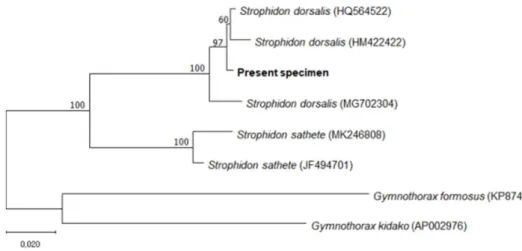
ed by using the DNA sequences(597bp) of mitochondri-al cytochrome c oxydase subunit I(COI) gene. Genomic DNA extraction and PCR were performed according to Loh et al.(2015). The DNA sequence of COI gene (Ac-cession No.: MT679541) obtained from the present spec-imen was compared with those of S. dorsalis(HQ564522, MG7202304, HM422422), S. sathete(MK246808, JF494701), Gymnothorax formosus(KP874184, outgroup) and G. kidako(AP002976, outgroup) deposited at the Na-tional Center for Biological Information(NCBI) databases. The phylogenetic tree(Fig. 4) was constructed and genetic distances were estimated by using the program MEGA 7.0 (Kumar et al., 2016) to confirm the relationships between the DNA sequence from the specimen and those deposit-ing in NCBI.
Strophidon dorsalis(Seale, 1917)
(New Korean name: Seo-mang-gom-chi) (Figs. 1, 2; Table 1)
Gymnothorax dorsalis Seale, 1917: 92(type locality: Hong
Kong); Böhlke, 1997: 96(Indo-Pacific); Randall and Lim, 2000: 585(South China Sea); Loh et al. 2011: 51 (Taiwan); Böhlke and Smith, 2002: 106(Indo-Pacific); Yoshida et al., 2013: 19(Thailand); Psomadakis et al., 2015: 14(Pakistan).
Strophidon dorsalis: Loh et al., 2015: 33(Taiwan); Ho et al., 2015: 162(Taiwan).
Material examined. one specimen, MABIK PI00049569, 1,254mm in TL, Jindo Island(sea block no. 212) with a fish trap, 25 July 2018.
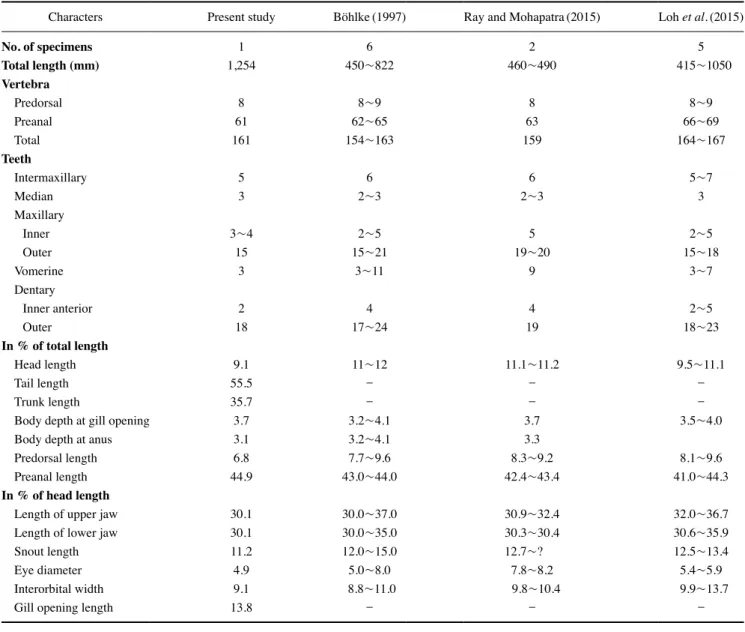
Description. Counts and measurements are shown in Table 1. Body elongated and cylindrical, slightly compressed be-hind anus and compressed tail; head long(Fig. 2A) with two superorbital pores, three infraorbital pores and six mandibular pores(Fig. 2B); mouth moderately large; snout blunt and short(two times of eye diameter); ante-rior nostril with a short tube; posteante-rior nostril above eye; eyes closer to snout than posterior tip of jaw; upper jaw projecting slightly than lower jaw; in upper jaw, five
in-Fig. 1. Strophidon dorsalis, MABIK PI00049569, 1,254 mm TL, Jindo Island, Korea.
Fig. 2. Head(A) and sensory pores(B) of S. dorsalis(MABIK PI00049569).
A B
Supraorbital poresInfraorbital pores
termaxillary teeth on each side, three median teeth(Fig. 3); maxillary teeth biserial, an outer row of 15 short trian-gular teeth and an inner row of three to four tall
depress-ible teeth; vomerine teeth uniserial three in number; in lower jaw(Fig. 3), dentary teeth biserial, an anterior in-ner row of two large teeth and an outer row of 18 smaller
Table 1. Comparison of morphological characters between present and previous studies on Strophidon dorsalis
Characters Present study Böhlke(1997) Ray and Mohapatra(2015) Loh et al.(2015)
No. of specimens 1 6 2 5 Total length (mm) 1,254 450~822 460~490 415~1050 Vertebra Predorsal 8 8~9 8 8~9 Preanal 61 62~65 63 66~69 Total 161 154~163 159 164~167 Teeth Intermaxillary 5 6 6 5~7 Median 3 2~3 2~3 3 Maxillary Inner 3~4 2~5 5 2~5 Outer 15 15~21 19~20 15~18 Vomerine 3 3~11 9 3~7 Dentary Inner anterior 2 4 4 2~5 Outer 18 17~24 19 18~23 In % of total length Head length 9.1 11~12 11.1~11.2 9.5~11.1 Tail length 55.5 - - -Trunk length 35.7 - -
-Body depth at gill opening 3.7 3.2~4.1 3.7 3.5~4.0
Body depth at anus 3.1 3.2~4.1 3.3
Predorsal length 6.8 7.7~9.6 8.3~9.2 8.1~9.6
Preanal length 44.9 43.0~44.0 42.4~43.4 41.0~44.3
In % of head length
Length of upper jaw 30.1 30.0~37.0 30.9~32.4 32.0~36.7
Length of lower jaw 30.1 30.0~35.0 30.3~30.4 30.6~35.9
Snout length 11.2 12.0~15.0 12.7~? 12.5~13.4
Eye diameter 4.9 5.0~8.0 7.8~8.2 5.4~5.9
Interorbital width 9.1 8.8~11.0 9.8~10.4 9.9~13.7
Gill opening length 13.8 - -
teeth; the origin of dorsal fin above before the pectoral pore; dorsal and anal fins confluent with caudal fins; pec-toral and pelvic fins absent; anus located almost middle part of body, tail much longer than preanal length. Coloration. When fresh, body greyish, dorsal part of body more dark and ventral part pale with unpatterned color-ation; dorsal, anal and caudal fin dark brown. Body and all fins uniform deep brown after fixation.
Distribution. Known from Indo-West Pacific: Pakistan, India, Malaysia, Indonesia, Taiwan(Böhlke, 1997) and Korea(present study).
Remarks. The present specimen, belonging to the family Muraenidae, is characterized by having body very elon-gated, cylindrical, slightly compressed behind anus, dorsal and anal fins confluent with caudal fin, pectoral and pelvic fins absent, anus located before mid-body, tail much lon-ger than preanal length, unpatterned coloration, infraorbit-al pore located below anterior part of eye and body depth at gill opening 3.7%. These morphological characteristics of the present specimen were well matched with those of S. dorsalis described by Seale(1917). However, as there were no detailed measurements in the original paper by Seale (1917), our measurements were compared with those in other previous reports of S. dorsalis(Böhlke, 1997; Loh et al., 2015; Ray and Mohapatra, 2015). The results revealed that most of the morphological traits examined were con-sistent with each other. However, there were some differ-ences in head length, predorsal fin length, snout length and eye diameter(Table 1). These differences tended to de-crease(head length, predorsal fin length, snout length and eye diameter) in proportion as the size increases. Thus it may be regarded as an intraspecific variation. In addition, we adopted a molecular identification method based on COI DNA sequences to make sure of the accurate species
identification. The result indicated that COI sequence of the present specimen was almost identical(97.8~99.3%) to those of S. dorsalis obtained from NCBI, but was differ-ent from S. sathete(Fig. 4). Thus, we identified our spec-imen to be S. dorsalis based on both morphological and molecular characters.
Strophidon dorsalis morphologically resembles S. sath-ete inhabiting the coastal waters of Jejudo Island, Korea. The former is distinguishable from the latter by having the body depth at gill opening(3.2~4.0% in total length vs. 1.8~2.9% for S. sathete), vertebral count(preanal verte-brae 61~69, total verteverte-brae 154~167 vs. preanal verteverte-brae 78~83, total vertebrae 188~200), and the number of in-fraorbital pores(four vs. three)(Böhlke, 1997; Loh et al., 2015). We suggest a new Korean name, “Seo-mang-gom-chi” for the species, because it was collected at the coastal waters near Seomang in Jindo Island.
ACKNOWLEDGEMENTS
We would like to express my gratitude to Park, Su-Young, a TAC investigator at the Korea Fisheries Re-sources Agency, and the officials of Jindo County Nation-al Federation of Fisheries Cooperative for providing the sample. This work was supported by the Efficient Secure-ment of Marine Bioresources and Taxonomic Research (2020M00100) funded by the National Marine Biodiversi-ty Institute of Korea(MABIK).
REFERENCES
Böhlke, E.B. 1982. Vertebral formulae for type specimens of eels
sces: Anguilliformes). Acad. Natl. Sci. Phila., 134: 31-49. Böhlke, E.B. 1989. Methods and Terminology. In: Böhlke, E.B.
(ed.), Fishes of the Western North Atlantic, Part 9, Vol. 1, Orders Anguilliformes and Saccopharyngiformes. Sears Found. Mar. Res., Yale Univ. Press, New Haven, U.S.A., pp. 1-7.
Böhlke, E.B. 1997. Notes on the identity of elongate unpatterned Indo-Pacific morays, with description of a new species (Mu-raenidae, subfamily Muraeninae). Proc. Acad. Natl. Sci. Phi-la., 147: 89-109.
Böhlke, E.B. and J.E. Randall. 2000. A review of the moray eels (Anguilliformes: Muraenidae) of the Hawaiian Islands, with descriptions of two new species. Proc. Acad. Natl. Sci. Phila., 150: 203-278.
Böhlke, E.B. and D.G. Smith. 2002. Type catalogue of Indo-Pacific Muraenidae. Proc. Acad. Natl. Sci. Phila., 152: 89-172. Fricke, R., W.N. Eschmeyer and R. Van der Laan(eds.). 2020.
Eschmeyer’s catalog of fishes: genera, species, referenc-es. Available at: http://researcharchive.calacademy.org/ research/ichthyology/catalog/fishcatmain.asp., (accessed 2 Mar. 2020).
Hamilton, F. 1822. An account of the fishes found in the river Ganges and its branches. Edinburgh & London. vii+405pp.
Hatooka, K. 2013. Muraenidae. In: Nakabo, T.(ed.), Fishes of Japan with pictorial keys to the species, 3rd ed. Tokai Univ. Press, Kanagawa, Japan, pp. 244-261.
Hibino, Y., U. Satapoomin and S. Kimura. 2017. A new species of the genus Diaphenchely(Anguilliformes: Muraenidae) from Thailand. Ichthyol. Res., 64: 458-463. https://doi. org/10.1007/s10228-017-0578-3.
Ho, H.C., D.G. Smith, J.E. McCosker, Y. Hibino, K.H. Loh, K.A. Tighe and K.-T. Shao. 2015. Annotated checklist of eels (orders Anguilliformes and Saccopharyngiformes) from Taiwan. Zootaxa, 4060: 140-189. https://doi.org/10.11646/ zootaxa.4060.1.16.
Kim B.Y., S.J. Koh, M.J. Kim and C.B. Song. 2020. First record of
the slender giang moray, Strophidon sathete(Muraenidae, Anguilliformes) from Korea. Korean J. Ichthyol., 32: 21-25. https://doi.org/10.35399/isk.32.1.4.
Kumar, S., G. Stecher and K. Tamura. 2016. MEGA7: Molecular evolutionary genetics analysis version 7.0 for bigger datasets. Mol. Biol. Evol., 33: 1870-1874.
Loh, K.H., K.T. Shao, H.C. Ho, P.E. Lim and H.M. Chen. 2015. A new species of moray eel(Anguilliformes: Muraenidae) from Taiwan, with comments on related elongate unpatterned species. Zootaxa, 4060: 030-040. https://doi.org/10.11646/ zootaxa.4060.1.5.
Loh, K.H., K.T. Shao and H.M. Chen. 2011. Gymnothorax melano-somatus, a new moray eel(Teleostei: Anguilliformes: Mu-raenidae) from southeastern Taiwan. Zootaxa, 3134: 43-52. https://doi.org/10.11646/zootaxa.3134.1.2.
McClelland, J. 1844. Apodal fishes of Bengal. Calcutta J. Nat. Hist., 5: 151-226, Pls. 5-14.
Psomadakis, P.N., H.B. Osmany and M. Moazzam. 2015. Field iden-tification guide to the living marine resources of Pakistan. FAO species identification guide for fishery purposes. Food and Agriculture Organization of the United Nations, Rome, x+386pp.
Randall, J.E. and K.K.P. Lim. 2000. A checklist of the fishes of the South China Sea. Raffles Bull. of Zool. Natl., Suppl. 8: 569-667.
Ray, D. and A. Mohapatra. 2015. First record of the moray eel Gym-nothorax dorsalis Seale, 1917(Anguilliformes: Muraenidae) from Indian waters. Indian J. Fish., 62: 132-134.
Seale, A. 1917. New species of apodal fishes. Bull. Mus. Comp. Zool., 61: 79-94.
Tanaka, S. 1918. Two new species of Japanese fishes. Zool. Mag., 30: 51-52.
Yoshida, T., H. Motomura, P. Musikasinthorn and K. Matsuura. 2013. Fishes of northern Gulf of Thailand. Natl. Mus. Nat. Sci., i-viii+1-239.
한국산 곰치과 어류 첫기록종
, Strophidon dorsalis
강충배
·
김맹진
1·
김진구
2·
송춘복
3국립해양생물자원관, 1국립수산과학원 서해수산연구소, 2부경대학교 자원생물학과, 3제주대학교 해양과학대학
요 약 : 곰치과에 속하는 Strophidon dorsalis 1개체(전장 1,254mm)가 2018년 7월 우리나라 남해안의 진도연
안에서 연안통발로 처음 채집되었다. 이 종의 특징은 몸에 무늬가 없고, 주둥이가 약간 둥근 형태를 띠며, 2개의 안
상골공(superorbital pores), 3개의 안하골공(infraorbital pores), 그리고 6개의 하악골공(mandibular pores)을 갖는 다. 이 종은 형태적으로 가는곰치(Strophidon sathete)와 유사하지만 안하골공이 3개이며(vs. 가는곰치는 4개), 마지
막의 안하골공은 눈의 앞부분에 위치하며(vs. 안하골공이 눈의 뒷부분에 위치), 전장에 대해 체고비율이 3.2~4.1%
(vs. 1.8~3.1%), 그리고 척추골수가 154~167개(vs. 188~200)로 구분할 수 있다. 이 어종의 국명은 ‘서망곰치’로 제안한다.