—139—
INTRODUCTION
Recently a single halfbeak specimen which was col- lected from the northern coastal waters of Jeju Island by a local fisherman and was donated to the fish collection of the National Institute of Biological Resources (NIBR), Korea. The specimen was readily identified as a member of the family Hemiramphidae (Beloniformes) by its elon- gated body with a prolonged lower jaw as well as forked caudal fin, and finally identified as Hemiramphus far in having prominent five blackish bars on lateral body. Alth- ough the species has been widely known from the Indo- West Pacific and the Mediterranean Sea (Collette, 1974;
Collette and Su, 1986), no formal report has been made from the Korean waters to date.
In this study, we described Hemiramphus far as the first record from Korea based on the specimen collected from the coastal waters of Jeju Island. Counts and mea- surements follow those of Collette and Su (1986) and the specimen examined is deposited in NIBR as vou- cher.
Genus Hemiramphus Cuvier, 1816
(New Korean name: Geom-mu-neui-hag-gong-chi-sog) Hemiramphus Cuvier, 1816: 186 (type species: Esox bra-
siliensis Linnaeus, 1758, designated by Gill, 1863).
Dorsal fin rays 12~18; anal fin rays 10~19; pectoral fin relatively short, its ray 9~13, Scales absent on snout;
preorbital ridge absent (Collette, 1984).
Hemiramphus far (Forsskål, 1775) (New Korean name: Geom-mu-neui-hag-gong-chi)
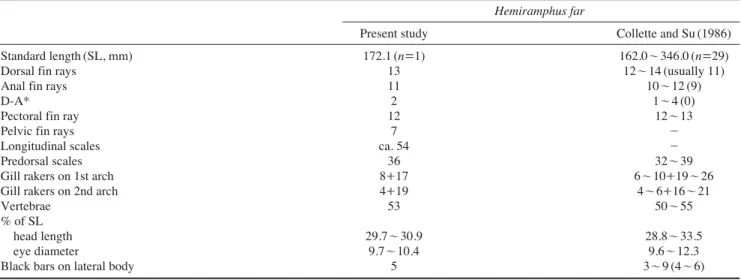
(Fig. 1; Table 1)
Esox far Forsskål, 1775: 67 (type locality: Al-Luhayya, Yemen, Red Sea).
Hemiramphus far: Collette, 1974: 38 (Queensland, Nor- thern Territory, Western Australia); Collette and Su, 1986: 254 (South China Sea, Taiwan, Hongkong, Japan).
Materials examined. NIBR-P21655, 172.1 mm in stan- dard length (SL), Gonae Port, Gonae-ri, Aewol-eup, Jeju- si, Jeju-do, Korea, July 2013, collected by J. I. Lee.
Description. Dorsal fin rays 13; anal fin rays 11; pec- toral fin rays 12, upper- and lowermost rays unbranched;
pelvic fin rays 7; branched caudal fin rays 6++7; longitu- dinal scale rows ca. 54; predorsal scale rows 36; gill ra- kers 8++17 on first arch, 4++19 on second arch; vertebrae 37++16==53.
First Record of the Black-barred Halfbeak, Hemiramphus far (Beloniformes: Hemiramphidae) from Jeju Island, Korea
By Byung-Jik Kim*, Jung-Hyun An
1and Seung-Hyun Lee
2Wildlife Genetic Resources Center, National Institute of Biological Resources, Environmental Research Complex, Incheon 404-708, Korea
1National Biodiversity Center, National Institute of Biological Resources, Environmental Research Complex, Incheon 404-708, Korea
2Fishbone Jeju, Business Support Center, Cheju National University, Jeju 690-756, Korea
ABSTRACT Based on a single specimen collected from the northern coastal waters of Jeju Island, we described Hemiramphus far as the first record from Korea. The specimen shows a elongated body with a prolonged lower jaw, 13 dorsal fin rays, 11 anal fin rays, 36 predorsal scales, and silvery white body with five black bars laterally and yellowish color on posterior part of lower jaw, tips of dorsal fin and upper caudal lobe. “Geom-mu-neui-hag-gong-chi” is proposed as a new Korean name for the species.
Key words : Hemiramphus far, Hemiramphidae, new Korean record, Jeju Island, description
*Corresponding author: Byung-Jik Kim Tel: 82-32-590-7127 Fax: 82-32-590-7223, E-mail: [email protected]
KOREAN JOURNAL OF ICHTHYOLOGY, Vol. 26, No. 2, 139-142, June 2014 ISSN: 1225-8598 (Print), 2288-3371 (Online)
Received: March 27, 2014 Revised: June 12, 2014 Accepted: June 21, 2014
http://www.fishkorea.or.kr
Proportion of percentage in SL: body depth at pectoral fin origin 14.6, depth at pelvic fin origin 15.5; body width 9.1; head length 21.6; head width 7.8; snout length 8.1;
eye diameter 5.4; interorbital width 6.2; upper jaw length 6.7; lower jaw length 31.6; snout to origin of dorsal fin 76.9; snout to origin of pectoral fin 22.9; snout to origin of pelvic fin 67.8; snout to origin of anal fin 83.9; dorsal fin base 14.7; anal fin base 7.1; pectoral fin length 17.1;
pelvic fin length 11.2; caudal fin length 22.0, tip of lower lobe broken; caudal peduncle depth 6.6; caudal peduncle length 10.3; length of longest dorsal ray (3rd ray), 10.9;
length of longest anal ray (2nd ray) 6.3.
Body elongate and rather compressed with a short cau- dal peduncle. Upper jaw short, triangular and roughly convex with a median shallow ridge, scaleless dorsally;
lower jaw prolonged, much longer than upper jaw; both jaws with small tricuspid teeth in five to six rows irreg- ularly; lower jaw with thin membrane on both sides. Eye rather large, interorbital space wide and flat with two shallow grooves. Gill membranes free from isthmus. No spine in fins. Dorsal and anal fins nearly opposite, base of dorsal fin nearly twice longer than that of anal fin. Pec- toral fin rather small and triangular. Insertion of pelvic fin two thirds between tip of upper jaw and base of cau-
dal fin. Caudal fin deeply forked, lower lobe produced.
Head with cycloid scales near to anterior margin of nos- tril dorsally. Body fully scaled with deciduous cycloids.
Color when fresh. Head and body dark blackish dor- sally, silvery white laterally, and whitish ventrally, with a median whitish bar from posterior tip of opercle to base of caudal fin. Five blackish vertical bars on lateral body, median two prominent. Dorsal sides of upper and lower jaws blackish. Posterior portion of lower jaw yellowish dark. Dorsal fin dark greenish or greenish yellow anteri- orly and whitish posteriorly. Pectoral and pelvic fins trans- parent with minute dark dots on each ray. Pelvic fin with a dark spot on its origin. Anal fin nearly whitish. Upper lobe of caudal fins yellowish with dark dorsal and lower margins, lower lobe dark.
Color after preservation. Nearly same when fresh, except for fading yellowish color on lower jaw, dorsal and caudal fin, especially dorsal aspects of upper and lower jaws, head, and body blackish. A gray and whitish bar on mid-lateral body prominent.
Distribution. Known from the Indo-West Pacific (Col- lette and Su, 1986): East Africa and Red Sea to Samoa, north to the Ryukyu Islands, Japan and Korea (northern coastal waters of Jeju Island, present study), south to
140 Byung-Jik Kim, Jung-Hyun An and Seung-Hyun Lee
Fig. 1.Hemiramphus far, NIBR-P21655, 172.1 mm SL, collected from Aewol, Jeju Island, Korea.
Table 1.Comparison of diagnostic characters of Hemiramphus far between the Korean specimen and the previous work Hemiramphus far
Present study Collette and Su (1986)
Standard length (SL, mm) 172.1 (n==1) 162.0~346.0 (n==29)
Dorsal fin rays 13 12~14 (usually 11)
Anal fin rays 11 10~12 (9)
D-A* 2 1~4 (0)
Pectoral fin ray 12 12~13
Pelvic fin rays 7 -
Longitudinal scales ca. 54 -
Predorsal scales 36 32~39
Gill rakers on 1st arch 8++17 6~10++19~26
Gill rakers on 2nd arch 4++19 4~6++16~21
Vertebrae 53 50~55
% of SL
head length 29.7~30.9 28.8~33.5
eye diameter 9.7~10.4 9.6~12.3
Black bars on lateral body 5 3~9 (4~6)
*, number of dorsal rays minus number of anal rays
northern Australia and New Caledonia. Migrated to the eastern part of the Mediterranean Sea via the Suez Canal (Kara et al., 2012).
Remarks. The present specimen having five black bars on lateral body is easily distinguished from the congeners of the halfbeak genus Hemiramphus and subsequently identified as He. far representing a new Korean record.
Because the type specimens of He. far does not exist any more (Klausewitz and Nielsen, 1965), we could not direct- ly compare the present specimen with the type specimen.
However, the prominent lateral coloration of the present specimen is well accordance with the original description (i.e., fupra lineam argenteam maculis nigris notatus) of He. far by Forsskål (1775). Additionally, major morpho- metric and meristic characters of the present specimen are well agreed to those of Collette and Su (1986), except for the number of gill rakers on the first arch (Table 1).
The difference in the number of gill rakers on the first arch seems to be infraspecific variation of the species, although it is needed to examine many specimens. From the Korean waters, three species of halfbeaks only in the genus Hyporamphus have been reported as follows: Hy.
intermedius Cantor, Hy. quoyi (Valenciennei), and Hy.
sayori (Temminck and Schlegel). He. far can be easily distinguished by its four to six prominent vertical bar on lateral body from most congeners lack bars as adults, ex- cept for He. robustus Günther, 1866 with one bar under anterior part of dorsal fin (Collette, 1974) as well as above three species of Hyporamphus from Korea. We proposed a new Korean name, “Geom-mu-neui-hag-gong-chi”, for the species referring to its blackish bars on lateral body.
ACKNOWLEDGMENTS
We deeply appreciate Mr. Jong-Il Lee (Jeju Province, Korea) for his donation of the present halfbeak specimen.
We also thank to Mr. Hyun-Geun Cho and Ye-Seul Lee (NIBR) for their treatments of specimen as well as taking radiographs. This work was supported by a grant from the National Institute of Biological Resources, funded by the Ministry of Environment of the Republic of Korea (NIBR No. 2013-01-50).
REFERENCES
Collette, B.B. 1974. The garfishes (Hemiramphidae) of Aus- tralia and New Zealand. Records of the Australian Museum, 29: 11-105.
Collette, B.B. 1984. Hemiramphidae. In: Froese, R. and D.
Pauly (eds.), FAO species identification sheets for fishery purposes. Western Indian Ocean (Fishing Area 51), Vol. 2, FAO, Rome, 7 unnumbered pages.
Collette, B.B. and J.-X. Su. 1986. The halfbeaks (Pisces, Bel- oniformes, Hemiramphidae) of the Far East. Procee- dings of the Academy of Natural Sciences of Phila- delphia, 138: 250-302.
Cuvier, G. 1816. Le Règne Animal distribué d’après son organisation pour servir de base à l’histoire naturelle des animaux et d’introduction à l’anatomie comparée.
Les reptiles, les poissons, les mollusques et les anné- lides. Edition 1. Vol. 2: xviii++532pp.
Forsskål, P.S. 1775. Descriptiones animalium avium, amphi- biorum, piscium, insectorum, vermium; quae in itinere orientali observavit... Post mortem auctoris edidit Car- sten Niebuhr. Hauniae. 20++xxxiv++164pp, map.
Gill, T.N. 1863-64. Note on the genera of Hemirhamphinae.
Proceedings of the Academy of Natural Sciences of Philadelphia, 15: 272-273.
Günther, A. 1866. Catalogue of fishes in the British Museum.
Catalogue of the Physostomi, containing the families Salmonidae, Percopsidae, Galaxidae, Mormyridae, Gymnarchidae, Esocidae, Umbridae, Scombresoci- dae, Cyprinodontidae, in the collection of the British Museum, 6: xv++368pp.
Kara, M.H., F. Rouag and L. Laouira. 2012. Westward range expansion of the lessepsian spotted halfbeak Hemir- amphus far (Hemiramphidae) in the Mediterranean Sea. Marine Biodiversity Records: 1-4.
Klausewitz, W. and J.G. Nielsen. 1965. On Forsskål’s collec- tion of fishes in the Zoological Museum of Copenha- gen. Spolia Zoologica Musei Hauniensis, 22: 1-29.
Linnaeus, C. 1758. Systema Naturae, Ed. X. (Systema natu- rae per regna tria naturae, secundum classes, ordines, genera, species, cum characteribus, differentiis, syn- onymis, locis. Tomus I. Editio decima, reformata.) Holmiae. Vol. 1: ii++824pp.
First Record of Hemiramphus far from Korea 141
제주도 북부 연안에서 출현한 학공치과 한국미기록종, Hemiramphus far
김병직∙안정현1∙이승현2
국립생물자원관 야생생물유전자원센터, 1국립생물자원관 국가생물다양성센터
2제주대학교 창업보육센터 피쉬본제주
요 약 :제주도 북부 연안에서 채집된 학공치과 어류 1개체 (표준체장 172.1 mm)를 근거로 Hemiramphus far 를 한국미기록종으로 기재∙보고한다. 본 종은 몸이 가늘고 긴 신장형으로 꼬리지느러미가 이차하고, 하악이 매 우 길게 돌출되어 있는 점, 등지느러미와 뒷지느러미가 각각 13연조와 11연조로 이루어진 점, 등지느러미전방 비늘수가 36개인 점, 체색이 은백색이며 체측에 5개의 흑색 세로무늬가 있는 점, 하악 후단 봉합부, 등지느러미 선단 및 꼬리지느러미 상엽 후단이 황색인 점이 특징적이다. 본 종의 신한국명으로, “검무늬학공치”를 제안한다.
찾아보기 낱말 :Hemiramphus far, 학공치과, 한국미기록종, 기재, 제주도 142 Byung-Jik Kim, Jung-Hyun An and Seung-Hyun Lee