150
Symposia
S19-2
Hypoxic Stress Adaptation in Aspergillus nidulans
Chinbayar Bat-Ochir1, Sun-Ki Koh1, Jun-Yong Kwak1, Yeong-Man Yu2, Mee-Hyang Jeon1,
Pil-Jae Maeng2, Hee-Moon Park2, Dong-Min Han3, and Suhn-Kee Chae1 *
1 Department of Biochemistry and Fungal Pathogenesis Center, Paichai university, Daejeon 302-735
2 School of Bioscience and Biotechnology, Chungnam National University, Daejeon 305-764, Korea,
and Division of Life Science, Wonkwang University, Iksan, 570-749
Pathogenic microorganisms must overcome numerous obstacles to successfully colonize in a host after their infection. One of these barriers is low oxygen concentration in host cells. Oxygen concentration in body tissue is considerably lower than the atmosphere. Fungal pathogens are classified as strict aerobes. Thus most pathogenic fungus have to sense this reduced oxygen concentration and adapt their metabolism to the host hypoxic environment. Studies determined that in Schizosaccharomyces pombe and Cryptococcus neoformans, oxygen sensing and hypoxic adaptation is regulated by a mammalian Sterol Regulatory Element Binding Protein (SREBP) pathway. Mammalian SREBP is a membrane-tethered transcription factor located in endoplasmic reticulum (ER) membrane. The N-terminus of the SREBP has a basic helix-loop-helix leucine zipper (bZIP) motif and the C-terminus interacts to SREBP-Cleavage Activating Protein (SCAP). SCAP is an ER resident membrane bound protein, which has 8 transmembrane segments. By its C-terminus, SCAP binds to SREBP whereas N-terminus binds to INSIG protein of this pathway. INSIG is also an ER resident protein, has 6 transmembrane segments. When sterol is repleted, SCAP changes its conformation by interacting sterol molecules to form a SREBP-SCAP-INSIG tight complex. As a result, SCAP-SREBP movement to Golgi is prevented. In contrast, when sterol is depleted, the SCAP-SREBP complex moves to Golgi by forming COPII vesicle. In Golgi, SREBP is sequentially cleaved by two proteases, site 1 (S1P) and site 2 (S2P), releasing an active N-terminal transcription factor to the nucleus to up-regulate genes involved in sterol and fatty acid synthesis (Fig. 1). Fungal ergosterol synthesis from squalene is a highly oxygen-consumptive process. Synthesis of a single ergosterol molecule requires 12 molecules of O2, and ergosterol synthesis has been
estimated to account for 25% of nonrespiratory oxygen consumption in S. pombe. Thus reduced oxygen concentration lowers ergosterol synthesis, then mammalian SREBP homolog, S. pombe Sre1p activated just same as in mammals and induces expressions of the genes, necessary in ergosterol synthesis and also hypoxic growth.
We are interested in hypoxic adaptation mechanisms of Aspergillus species which can cause wide variety of human diseases named Aspergillosis, including allergic bronchopulmonary aspergillosis, pulmonary aspergilloma, and invasive aspergillosis and so on. In this study, we characterized genes in the SREBP pathway:
hitA, a homolog of mammalian SREBP-1, hitB which exhibited amino acid similarity to the N-terminus of HitA,
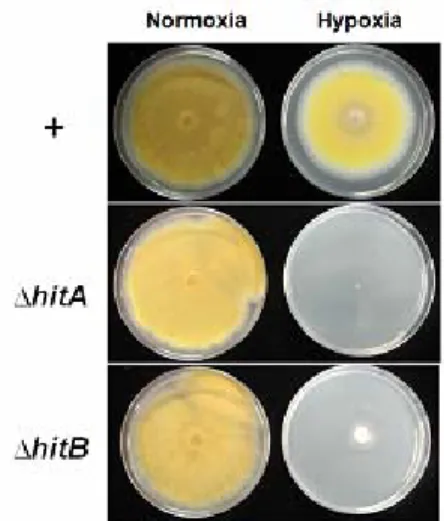
and insA, a homolog of INSIG. No SCAP homolog was found in Aspergillus species. Null mutants of hitA exhibited no growth in hypoxia (Fig. 2) and was highly sensitive to itraconazole, an inhibitor of lanosterol 14-alpha demethylase in ergosterol synthesis. Forced over-expression of the N-terminus of HitA rescued the defect in hypoxic growth and the sensitivity to itraconazole in hitA null mutants, indicating that the N-terminus of HitA should be released from ER. Cleavage of the N-terminus of HitA was approved in the protein level by
151 www.msk.or.kr Western analysis. However, such cleavages also occurred in normoxic condition in a similar level in hypoxia which was different from the results shown in S. pombe and C. neoformance. It was uncertain whether absent of SCAP caused the result in A. nidulans. Considerable induction of hitA was seen in hypoxia and in the presence of itraconazole which caused sterol depletion in the cell. In addition, HitA significantly affected gene expressions of the ergosterol synthesis pathway judged by northern and DNA microarray analysis. Expressions of erg11A but not erg11B both encoding lanosterol 14-alpha-demethylases, erg3A and erg3B both encoding C-5 sterol desaturases, erg1A encoding squalene expoxidase, and erg25A and erg25B both encoding C-4 methyl sterol oxidases were highly reduced or absence in hitA null mutants. However, we failed to see the enhanced cleavage of HitA in the protein level when ergosterol concentration was lowered by challenging to itraconazole.
Interestingly, we found another SREBP homolog, HitB in A. nidulans. HitB showed amino acid similarity to the N-terminus of HitA and did not contain transmembrane regions suggesting a non-membrane tethered transcription factor. HitB homologs were found only in Aspergillus species and a few filamentous fungi including Penicillium species. hitB null mutants exhibited highly retarded growth in hypoxia (Fig. 2), although
hitB null mutants did not show itraconazole sensitivity. The N-terminus of HitA complemented the growth
defect of hitB null mutants in hypoxia, while HitB failed to complement hitA null mutants in hypoxia. Homo- and hetero-dimerizations in the N-terminus of HitA and HitB were detected in vitro.
A protein demonstrating high amino acid similarity to INSIG was existed in A. nidulans and named insA. Null mutant of insA showed no phenotypic difference compared to the wild-type, while over-expression of InsA exhibited high sensitivity to itraconazole. Forced over-expression of insA resulted in no hitA induction with itraconazole and in hypoxia, where significant induction of hitA was apparent in these conditions. Co- overexpression of HitA with InsA rescued the itraconazole sensitivity of the InsA over-expression strains. These implied that InsA played a regulatory role on the activation of HitA, although no SCAP was found in A. nidulans.
Overall, genes in the SREBP pathway for hypoxic adaptation in Aspergillus nidulans showed some similarities and differences found in S. pombe and C. neoformance. Considering the different metabolic process of ammonium fermentation in hypoxia found unique to A. nidulans and a few filamentous fungi from those organisms, distinct and complex mechanisms to adapt hypoxic environment were possibly exist in Aspergillus.
Fig. 1. Activation of SREBPs by sterol
depletion. [Biochem. Soc. Trans. (2002) 30:1091-1095]
Fig. 2. Growth phenotypes of wild type (+), ΔhitA
and ΔhitB in hypoxia (1% O2).
Point inoculated cultures were incubated at 37oC either at normoxia for 5 days or at hypoxic chamber for 7 days after 14 h incubation at normoxia.