INTRODUCTION
The Gempylidae comprises 24 species belonging to six genera worldwide(Nelson et al., 2016; Froese and Pauly, 2019), and three species from three genera have been recognized in Korea to date[Rexea prometheoides (Bleeker, 1856); Thyrsitoides marleyi(Fowler, 1929); and Gempylus serpens Cuvier, 1829](Myoung et al., 2013).
They have slightly compressed fusiform bodies, exposed maxilla, strong teeth, very small or no pelvic fins(Smith, 1997) and are distributed in tropical and subtropical wa- ters worldwide(Nakamura and Parin, 1993). The gempy- lid genus Lepidocybium Gill, 1862 includes a single spe- cies, Lepidocybium flavobrunneum(Smith, 1843)(Froese and Pauly, 2019). It has a lateral line with an irregular wave pattern and a caudal peduncle with a large keel flanked by two small supplementary keels(Gill, 1862;
Nakamura and Parin, 2001). In this study, a single spec- imen of L. flavobrunneum was collected off the north- western coast of Jeju Island on April 28, 2016. Here, we describe its morphology in detail as the first record from Korea.
MATERIALS AND METHODS
We caught a single specimen[910.0mm standard length (SL)] of L. flavobrunneum using a longline off the north- western coast of Jeju Island, Korea on April 28, 2016(Fig.
1). We then performed morphological analyses that includ-
—26 — http://www.fishkorea.or.kr
* Corresponding author: Jin-Koo Kim Tel: 82-51-629-5927, Fax: 82-51-629-5931, E-mail: [email protected]
First Record of the Escolar Lepidocybium flavobrunneum (Perciformes: Gempylidae) from Jeju Island, Korea
By Young Sun Song, Se Hun Myoung
1and Jin-Koo Kim*
Department of Marine Biology, Pukyong National University, Busan 48513, Republic of Korea
1Department of Biological Sciences, Macquarie University, North Ryde, Australia, 2109
ABSTRACT A single specimen of Lepidocybium flavobrunneum(910.0mm standard length) in the family Gempylidae, was collected off northwestern Jeju Island, Korea on April 28, 2016. The species is characterized by a blackish body, very low first dorsal fin spines, second dorsal fin rays followed by six finlets, anal fins followed by five finlets, caudal peduncle with a large keel flanked by two small supplementary keels, and a lateral line with an irregular wave pattern. Here, we propose the new Korean names “Heuk-gal-chi-ggo-chi-sok” for the genus Lepidocybium and “Heuk-gal-chi-ggo-chi”
for the species L. flavobrunneum.
Key words: Lepidocybium flavobrunneum, Escolar, Gempylidae, Jeju Island, Korea
Fig. 1. Sampling location of Lepidocybium flavobrunneum, 910.0 mm SL, Jeju Island, Korea.
ed five counts and 24 measurements. Counting, measur- ing, and identification procedures followed those in Na- kamura and Parin(2001) and Nakabo and Doiuchi(2013).
Each body part was measured to the nearest 0.1mm using digital Vernier calipers. The data were converted to per- centages of total and standard lengths. The specimen was deposited in the Marine Fish Resource Bank of Korea at Pukyong National University(PKU), Busan, Korea.
RESULTS AND DISCUSSION Genus Lepidocybium Gill, 1862 (New Korean name: Heuk-gal-chi-ggo-chi-sok)
Lepidocybium Gill, 1862: 125(type species: Cybium fla- vobrunneum Smith, 1843).
Body slightly compressed, fusiform; both jaws with strong fang-like teeth, much larger teeth in lower jaw; first dorsal fin with short spine, second dorsal and anal fins followed by four to five finlets; lateral line with irregular wave pattern, caudal peduncle with large keel flanked by two small supplementary keels(Gill, 1862; Nakamura and Parin, 2001).
Lepidocybium flavobrunneum (Smith, 1843) (New Korean name: Heuk-gal-chi-ggo-chi)
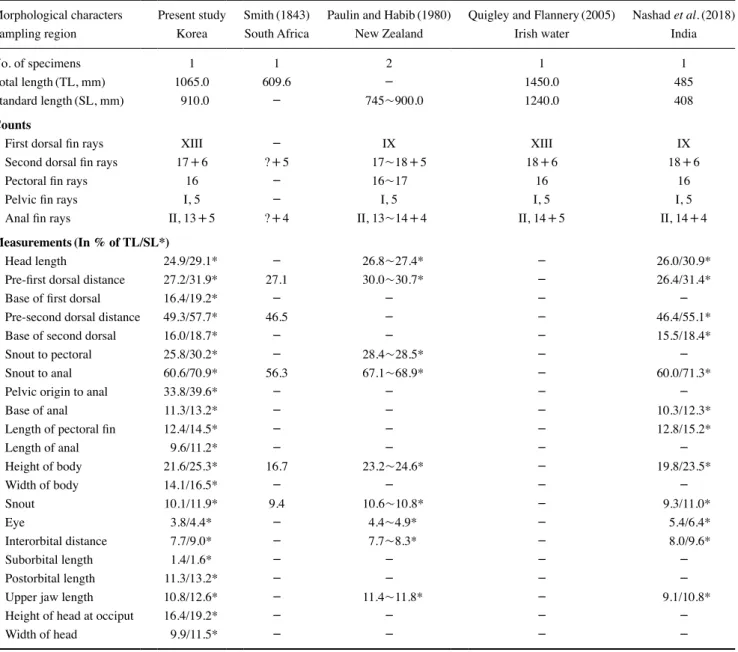
(Figs. 2, 3; Table 1)
Table 1. Comparison of counts and measurements of Lepidocybium flavobrunneum
Morphological characters Present study Smith(1843) Paulin and Habib(1980) Quigley and Flannery(2005) Nashad et al.(2018)
Sampling region Korea South Africa New Zealand Irish water India
No. of specimens 1 1 2 1 1
Total length(TL, mm) 1065.0 609.6 - 1450.0 485
Standard length(SL, mm) 910.0 - 745~900.0 1240.0 408
Counts
First dorsal fin rays XIII - IX XIII IX
Second dorsal fin rays 17+6 ?+5 17~18+5 18+6 18+6
Pectoral fin rays 16 - 16~17 16 16
Pelvic fin rays I, 5 - I, 5 I, 5 I, 5
Anal fin rays II, 13+5 ?+4 II, 13~14+4 II, 14+5 II, 14+4
Measurements(In % of TL/SL*)
Head length 24.9/29.1* - 26.8~27.4* - 26.0/30.9*
Pre-first dorsal distance 27.2/31.9* 27.1 30.0~30.7* - 26.4/31.4*
Base of first dorsal 16.4/19.2* - - - -
Pre-second dorsal distance 49.3/57.7* 46.5 - - 46.4/55.1*
Base of second dorsal 16.0/18.7* - - - 15.5/18.4*
Snout to pectoral 25.8/30.2* - 28.4~28.5* - -
Snout to anal 60.6/70.9* 56.3 67.1~68.9* - 60.0/71.3*
Pelvic origin to anal 33.8/39.6* - - - -
Base of anal 11.3/13.2* - - - 10.3/12.3*
Length of pectoral fin 12.4/14.5* - - - 12.8/15.2*
Length of anal 9.6/11.2* - - - -
Height of body 21.6/25.3* 16.7 23.2~24.6* - 19.8/23.5*
Width of body 14.1/16.5* - - - -
Snout 10.1/11.9* 9.4 10.6~10.8* - 9.3/11.0*
Eye 3.8/4.4* - 4.4~4.9* - 5.4/6.4*
Interorbital distance 7.7/9.0* - 7.7~8.3* - 8.0/9.6*
Suborbital length 1.4/1.6* - - - -
Postorbital length 11.3/13.2* - - - -
Upper jaw length 10.8/12.6* - 11.4~11.8* - 9.1/10.8*
Height of head at occiput 16.4/19.2* - - - -
Width of head 9.9/11.5* - - - -
Asterisk(*) indicates the body proportion of standard length(SL).
Cybium flavobrunneum Smith, 1843: no pagination(type locality: Cape of Good Hope, South Africa, southeast- ern Atlantic).
Lepidocybium flavobrunneum: Paulin and Habib, 1980:
405(New Zealand); Azevedo and Heemstra, 1995: 3 (Azores); Quigley and Flannery, 2005: 128(Ireland);
Nakabo and Doiuchi, 2013: 1640(Japan); Nashad et al., 2018: 1409(India).
Material examined. PKU 62091, 910.0mm SL, caught by a longline, off northwestern coast of Jeju Island(33°33′
35.8″N 125°57′22.7″E), 28 April, 2016, collected by W.J.
Lee.Description. Counts and measurements are shown in Ta- ble 1. Body slightly compressed and fusiform, body depth high; head and eyes large; snout relatively small(Fig. 2A);
two pairs of nostril openings, anterior nostril small and ovoid, and posterior nostril slender and elongated, anterior nostril smaller than posterior. Mouth large and terminal, upper jaw extends toward anterior margin of eye; posteri- or of maxilla rounded, its tip curved downward(Fig. 2B);
lower jaw protrudes slightly compared with upper jaw;
both jaws with strong canine teeth in a single row, much larger lower jaw, tip forward to oral cavity(Fig. 2C); vom- er and palatines with a single row of strong canine teeth (Fig. 2D). Operculum large, margins rounded, without
spines; gill rakers rudimentary, very short and rounded(Fig.
2E), upper part covered with small spines. First dorsal fin very low, well-separated from second dorsal fin, its origin located in the upper middle of pectoral fin; pelvic fins rel- atively short, their origin slightly behind origin of pectoral fin; caudal fin deeply forked. Caudal peduncle with prom- inent large keel flanked by two small supplementary keels, lateral line with irregular wave pattern(Fig. 3); body and head covered with small cycloid scales, but scales absent on snout, upper jaw, and mandible.
Coloration. Body uniformly blackish when fresh(Fig.
2A) and a light blackish color after fixation.
Distribution. Jeju Island, Korea(present study) and known from tropical and temporal waters worldwide, ex- cept for the northern coast of the Indian Ocean(Scott and Scott, 1988; Parin, 1990; Nakamura and Parin, 1993).
Remarks. The specimen collected in this study belongs to the genus Lepidocybium as both jaws contain strong fang- like teeth, with much larger teeth in the lower jaw(Gill, 1862). Additionally, the specimen matches the original description of L. flavobrunneum(Smith, 1843) well; nota- bly, it has a caudal peduncle with a prominent large keel that is flanked by two small supplementary keels, a later- al line with an irregular wave pattern, and blackish body color. Most of the morphological characters are consistent with previous descriptions of L. flavobrunneum(Paulin
(A)
(B) (C) (D) (E)
Fig. 2. Lepidocybium flavobrunneum(Smith, 1843), PKU 62091, 910mm SL, Jeju Island, Korea. (A) Overall view of body; (B) Head shape; (C) Jaws and teeth; (D) Oral cavities; (E) Gill rakers.
and Habib, 1980; Quigley and Flannery, 2005; Nashad et al., 2018; Table 1). As body size increases, the proportions of some body parts tend to increase(snout, upper jaw, pre-second dorsal fin, and anal fin base length) or decrease (interorbital, head, and pectoral fin length). However, when meristic characters are compared, Irish specimens and the specimen in this study have an anal fin followed by five finlets, whereas South African, New Zealand, and Indian specimens each have four finlets(Table 1). There are also some measurement differences; i.e., our specimen has a longer preanal length[60.6% of total length(TL)]
and a lower body depth(21.6% of TL) compared to the South African specimen(56.3% and 16.7% of TL, respec- tively)(Table 1). The Indian specimen has bigger eyes (6.4% of SL) compared to the other specimens(less than 5.0% of SL), and some body parts of the New Zealand specimens - the interorbital, head, pre-pectoral, and pre- anal lengths - are smaller than in other specimens(Table 1).
The Atlantic and Indo-Pacific populations of L. flavobrun- neum differ anatomically(e.g., the location of the first dor- sal pterygiophore) and genetically(4.85% in mtDNA con- trol region)(Collette et al., 1984; Brendtro et al., 2008).
Further studies of the geographic variation in the species are required, using more specimens as well as anatomical and molecular data. This species is readily distinguished from the escolar species G. serpens, R. prometheoides, and T. marleyi in having three caudal peduncle keels(vs.
no caudal peduncle keel), and a lateral line with an irreg- ular wave pattern(vs. curved, straight, or separated lines) (Myoung et al., 2013). We propose the new Korean names
‘Heuk-gal-chi-ggo-chi-sok’ for the genus Lepidocybium and ‘Heuk-gal-chi-ggo-chi’ for L. flavobrunneum because it has uniformly blackish body color, following guidelines of the National Fisheries Research and Development In- stitute(2010).
ACKNOWLEDGEMENTS
This research was supported by the Marine Biotechnol- ogy Program of the Korea Institute of Marine Science and Technology Promotion(KIMST) funded by the Ministry of Oceans and Fisheries(MOF)(No. 20170431).
REFERENCES
Azevedo, J.M.N. and P.C. Heemstra. 1995. New records of marine fishes from the Azores. Arq. Cienc. Mar., 13: 1-10.
Bleeker, P. 1856. Beschrijvingen van nieuwe en weinig bekende vischsoorten van Amboina, verzameld op eenereis door den Molukschen Archipel gedaan in hetgevolg van den Gouver- neur Generaal Duymaer van Twist, in September en Okto- ber 1855. Acta Soc. Sci. Indo-Neerl., 1: 1-76.
Brendtro, K.S., J.R. McDowell and J.E. Graves. 2008. Population genetic structure of escolar(Lepidocybium flavobrunneum).
Mar. Biol., 155: 11-22.
Collette, B.B., T. Potthoff, W.J. Richards, S. Ueyanagi, J.L. Pusso, Y.
Nishikawa and H.G. Moser. 1984. Scombroidei: develop- ment and relationships. In: Moser, H.G. et al.(eds.), Ontog- eny and systematics of fishes. Allen Press, Lawrence, KS, U.S.A., pp. 591-602.
Cuvier, G. 1829. Le Règne Animal, distribué d’après son organisa- tion, pour servir de base à l’histoire naturelle des animaux et d’introduction à l’anatomie comparée. Le Règne Animal, 2: 200.
Fowler, H.W. 1929. New and little known fishes from the Natal coast. Ann. Natal. Mus., 6: 245-264.
Froese, R. and D. Pauly(eds.). 2019. FishBase. World Wide Web electronic publication. www.fishbase.org, version(08/2019).
Gill, T.N. 1862. On the limits and arrangements of the family of scombroids. Proc. Acad. Nat. Sci. Philad., 14: 124-127.
Myoung, S.H., J.H. Ryu and J.K. Kim. 2013. New Record of the Snake Mackerel, Gempylus serpens(Perciformes: Gempy- Fig. 3. Illustration of Lepidocybium flavobrunneum(PKU 62091, 910mm SL) showing the irregular wave pattern of lateral line.
lidae) from Jeju Island, Korea. Korean J. Ichthyol., 3: 178- Nakabo, T. and R. Doiuchi. 2013. Gempylidae. In: Nakabo, T.181. (ed.),
Fishes of Japan with pictorial keys to the species. 3rd edi- tion. Tokai Univ. Press, Tokyo, Japan, pp. 1640-1644.(in Japanese)
Nakamura, I. and N.V. Parin. 1993. Snake mackerels and cutlass fishes of the world(families Gempylidae and Trichiuridae).
FAO Fisheries Synopsis, Rome, Italia, 125(5), 136pp.
Nakamura, I. and N.V. Parin. 2001. Families Gempylidae, Trichiuri- dae. In: Carpenter, K.E. and V. Niem.(eds.), The living ma- rine resources of the western central Pacific(FAO species identification guide for fishery purposes). Bony fishes part 4 (Labridae to Latimeriidae), estuarine crocodiles, sea turtles, sea snakes and marine mammals, pp. 3698-3720.
Nashard, M., S.S. Shirke, H.D. Pradeep and M.S. Devi. 2018. First record of escolar, Lepidocybium flavobrunneum(Smith, 1843) from the Indian EEZ of Andaman Sea. Indian J. Mar.
Sci., 47: 1409-1412.
Nelson, J.S., T.C. Grande and V.H. Wilson. 2016. Fishes of the World, 5th edition. John Wiley and Sons Inc., New Jersey, NJ, U.S.A., 386pp.
NFRDI(National Fisheries Research and Development Institute).
2010. Fishes of the ocean. Hanguel Graphics, Busan, 487
pp.
Parin, N.V. 1990. Gempylidae. In: Quéro, J.C., J.C. Hureau, C. Kar- rer, A. Post and L. Saldanha.(eds.), Check-list of the fishes of the eastern tropical Atlantic(CLOFETA). JNICT, Lisbon;
SEI, Paris; and UNESCO, Paris, France, pp. 965-972.
Paulin, C.D. and G. Habib. 1980. First record of Lepidocybium fla- vobrunneum(Pisces: Gempylidae) from New Zealand. New Zeal. J. Mar. Fresh., 14: 405-407.
Quigley, D.T.G. and K. Flannery. 2005. First record of escolar Lepidocybium flavobrunneum(Smith, 1843)(Pisces: Gem- pylidae) from Irish Waters, together with a review of NE Atlantic records. Ir. Nat. J., 28: 128-130.
Scott, W.B. and M.G. Scott. 1988. Atlantic fishes of Canada. Can.
Bull. Fish. Aquat. Sci., 219: 731.
Smith, A. 1843. Pisces. In: Illustrations of the zoology of South Af- rica, consisting chiefly of figures and descriptions of the ob- jects of natural history collected during an expedition into the interior of South Africa in 1834-1836. London, U.K., 4:
Smith, C.L. 1997. National Audubon Society field guide to tropical 77.
marine fishes of the Caribbean, the Gulf of Mexico, Flori- da, the Bahamas, and Bermuda. Alfred A. Knopf Inc., New York, U.S.A., 720pp.
한국 제주도 근해에서 채집된 갈치꼬치과 (Gempylidae) 어류 1 미기록종, Lepidocybium flavobrunneum
송영선
·
명세훈1·
김진구부경대학교 자원생물학과, 1맥쿼리대학교 생명과학과
요 약 : 농어목(Perciformes) 갈치꼬치과(Gempylidae)에 속하는 Lepidocybium flavobrunneum 1개체(체장 910 mm)가 2016년 4월 28일 한국 제주도 해역에서 처음 채집되었다. 본 종은 등지느러미 극조가 매우 짧으며 등지느
러미와 뒷지느러미 뒤쪽에 각각 6개와 5개의 토막지느러미를 가진다. 또한 꼬리자루에 강한 측융기선 1개와 그 뒤
쪽에 2개의 작은 돌기가 있고, 체측에는 불규칙한 파상무늬의 측선이 구불구불하게 뻗어 있다. 이 종의 새로운 속
명과 국명으로 ‘흑갈치꼬치속’ 및 ‘흑갈치꼬치’를 제안한다.
찾아보기 낱말 : Lepidocybium flavobrunneum, 흑갈치꼬치, 흑갈치꼬치과, 제주도, 한국