INTRODUCTION
The family Chaenopsidae (Perciformes) comprises 96 species and 14 genera worldwide, while eight species and one genus occur in Japan, and only one species, Neoclinus bryope was recorded in Korean waters (Kim and Kang, 1991; Aizawa and Doiuchi, 2013; Nelson et al., 2016).
The chaenopsid fishes are tropical and mainly distributed in warm North and South American waters (Nelson et al., 2016). Generally, they have a big mouth, supraorbital, na- sal cirri variously present or absent, and relatively small- sized (Murase et al., 2015).
Neoclinus chihiroe was firstly reported as a new spe- cies in southern Japanese waters (Fukao, 1987) and also recorded in some Japanese documents thereafter (Fukao and Okazaki, 1987, 1990; Hongjamrassilp et al., 2020), but there still has been a lack of data on their occurrence elsewhere. This species is distributed in northwest Pacific, especially along the coast of Japan (Fukao and Okazaki, 1987) and is in the category of least concern (LC) in the
list of IUCN (Williams and Craig, 2014). This species is expected to live all over Japan waters constituting a popu- lation. However, there are mentions that local protection is required depending on the area in which they live (Williams and Craig, 2014).
The genus Neoclinus usually inhabit between rock ma- trix (Fukao, 1990), but also uses distinctive materials as shelters, including the vacant of gastropods (Fukao and Okazaki, 1987) and empty worm tubes (Stephens and Springer, 1971), occasionally artificial shelters like discard- ed cans and bottles (McCleneghan and Ames, 1976). Such a hiding behavior is a life history strategy to protect their bodies from potential predators and make it easier to care of their spawned eggs (Murase and Sunobe, 2011; Fro- ese and Pauly, 2019). They attached spawned egg masses around their shelters and protected for serval days (Murase and Sunobe, 2011). Because of this spawning behavior, they expected limited egg dispersal ability (Hongjamrass- ilp et al., 2020). Nonetheless, there still have been a lack of available data on their biology and ecology. Therefore, additional information is required for the establishment of strategy protecting and managing their habitats.
Historically, only one species of chaenopsid fishes (i.e., N. bryope) has been reported in Korean waters (Kim and
—142 — http://www.fishkorea.or.kr
저자 직위: 명세훈(연수연구원), 민원기(선임연구원), 우민수(무기계약직기술 원), 김윤배(책임기술원), 신진용(무기계약직기술원), 박주면(선임연구원)
* Corresponding author: Joo Myun Park Tel: 82-54-780-5344, Fax: 82-54-780-5319, E-mail: [email protected]
New Record of Neoclinus chihiroe (Perciformes: Chaenopsidae) from Dokdo, East Sea, Korea
By Se Hun Myoung, Won-Gi Min
1, Min-Su Woo
1, Yun-Bae Kim
1, Jin Yong Shin
1and Joo Myun Park*
Dokdo Research Center, Korea Institute of Ocean Science and Technology, Uljin 36315, Republic of Korea
1Ulleungdo-Dokdo Ocean Science Station, Korea Institute of Ocean Science and Technology, Ulleung 40205, Republic of Korea
ABSTRACT
A single specimen (52.5 mm SL) of Neoclinus chihiroe, belonging to the family Chaen
opsidae, was firstly collected from Dokdo, East Sea of Korea on 9 December 2020. This species was characterized by a black spot between the first and the second dorsal spines, and a black spot on upper part of opercular membrane. The species was morphologically similar to N. okazakii, but distinctly distinguished by pectoral fin base without a black dot. This study documents the first record of N.
chihiroe in Korean waters and suggests the new Korean name ‘Donghaebineulbedolachi’ for the
species.
Key words: Neoclinus chihiroe, Chaenopsidae, new record, Dokdo, East Sea
Kang, 1991; MABIK, 2020). In the present study, a sin- gle specimens of N. chihiroe was collected from Dokdo, Korea. Therefore, we described its morphological charac- teristics and reported the first record based on a specimen from Korean waters.
MATERIALS AND METHODS
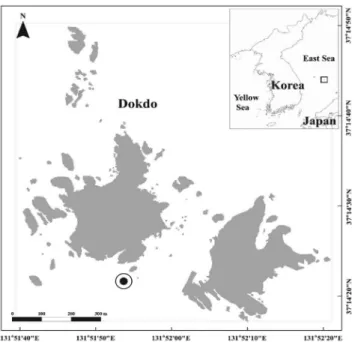
One specimen of N. chihiroe was collected from the Dokdo (37°14ʹ23.29ʺN 131°51ʹ52.92ʺE), Ulleung-gun, Gyeongsangbuk-do, Korea, via SCUBA diving on 9 De- cember 2020 (Fig. 1). In the laboratory, meristic counts and measurements were followed by Hubbs and Lagler’s (1958) methods. Prior to alcohol fixation, the specimen was anes- thetized with ice and then each body part was measured to the nearest 0.1 mm using digital Vernier calipers. The specimen was preserved in 99% ethanol and deposited at Marine Biodiversity Institute of Korea (MABIK).
RESULTS AND DISCUSSION Taxonomic accounts
Neoclinus chihiroe Fukao, 1987
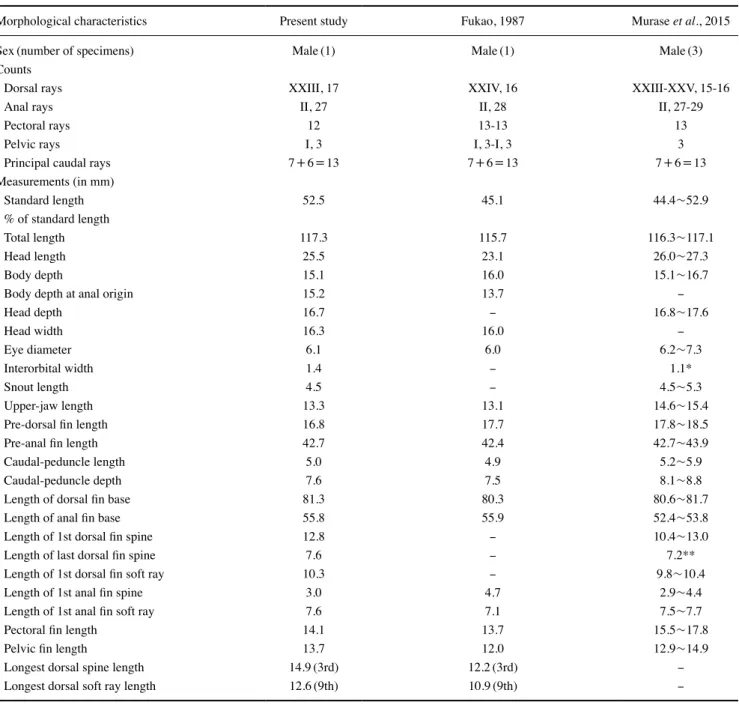
(New Korean name: Dong-hae-bi-neul-be-do-la-chi) (Fig. 2; Table 1)
Neoclinus chihiroe Fukao, 1987: 301 (type locality: Shi- rahama, Wakayama Prefecture, Japan); Fukao and Okazaki, 1990: 243 (Japan); Murase et al., 2010: 66 (Japan); Aizawa and Doiuchi, 2013: 1294 (Japan).
Material examined. MABIK PI00049711, one specimen, 52.5 mm SL, collected by hand net in SCUBA, Dokdo, Ulleung-gun, Gyeongsangbuk-do, Korea (37°14ʹ23.29ʺN 131°51ʹ52.92ʺE), 15~20 m depth, 9 December 2020 (Fig.
1). Description. Body measurements of the specimen shown in Table 1. Overall body elongated and compressed. Eyes protruded and posterior tip of upper jaw beyond the eyes.
Dorsal fin single, its membrane slightly notched and soft ray part of dorsal fin higher than spinous dorsal fin. Ori- gin of dorsal fin located forward from origin of pectoral fin. Origin of soft ray part of dorsal fin located behind middle of body. Caudal fin separated from dorsal and/or anal fins. Caudal fin rounded. Anal fin serrated, and its origin located to behind anus. Pelvic fins located before
pectoral fins. Pectoral fin rounded. Three pairs of supra- orbital cirri arranged in single row and much branched;
first cirri longer and branched the most than second and/
or third cirri. The specimen has one pair of nasal cirri.
Coloration. Body color uniformly orange (Fig. 2). Dark orange color presented on the dorsal part of the body, but a bright orange color on the belly. A number of small black dots scattered in the central body. Dorsal fin yel- lowish, and black spot showed between first and second dorsal spines. Upper half of body darker than lower half.
White dots scattered on the whole-head and upper body part. Red dots scattered around the gill cover. Upper part of opercular membrane has a black spot. Two black stripes appeared lightly on the spinous ray part of dorsal fin. Overall pectoral fin orange. There was no black dot at the base of pectoral fin. Pelvic fins covered in black on an orange background. Anal fin has a one vertical black line on an orange background, and the black line became lighter as it goes toward the caudal fin. Overall caudal fin bright orange.
Distribution. Dokdo, Korea (present study), Japan (Fu- kao, 1987; Aizawa, 2002; Murase et al., 2010; Aizawa and Doiuchi, 2013).
Remarks. In this study, a single specimen of chaenopsid fishes was collected from Dokdo with body elongate and compressed, scales absent, no lateral line and supraorbital, and nasal cirri variously present, and classified as Neoc- linus species by its overall body morphology (Willwams,
Fig. 1. Map showing the sampling area of Neoclinus chihiroe from Dokdo, Korea(●).
2002; Nelson et al., 2016). The body morphometrics of the specimen was well matched the original description of N.
chihiroe (Fukao, 1987) as follows; there was a black spot between first and second dorsal spines, and also was on the upper part of opercular membrane, pectoral fin base without black dot (Aizawa and Doiuchi, 2013). Accord- ing to the original description (Fukao, 1987; Murase et al., 2015), the species has 13 pectoral rays, whereas the pres- ent specimen showed slightly discordance in the number
of pectoral rays (12, Table 1). The body depth at anal ori- gin of the specimen in this study was slightly longer (15.2%
SL) than previous record (13.7% SL in Fukao, 1987), but the predorsal fin length slightly shorter (16.8% SL vs.
17.8~18.5% SL in Murase et al., 2015). However, these differences are regarded within ranges of intra-specific variations. Nonetheless, it was consistent with N. chihi- roe in that the main features of black spot on upper part of opercular membrane, no black dot on the base of pectoral
Table 1. Morphometric measurements of Neoclinus chihiroe in comparison with previous records
Morphological characteristics Present study Fukao, 1987 Murase et al., 2015
Sex(number of specimens) Male(1) Male(1) Male(3)
Counts
Dorsal rays XXIII, 17 XXIV, 16 XXIII-XXV, 15-16
Anal rays II, 27 II, 28 II, 27-29
Pectoral rays 12 13-13 13
Pelvic rays I, 3 I, 3-I, 3 3
Principal caudal rays 7+6=13 7+6=13 7+6=13
Measurements (in mm)
Standard length 52.5 45.1 44.4~52.9
% of standard length
Total length 117.3 115.7 116.3~117.1
Head length 25.5 23.1 26.0~27.3
Body depth 15.1 16.0 15.1~16.7
Body depth at anal origin 15.2 13.7 -
Head depth 16.7 - 16.8~17.6
Head width 16.3 16.0 -
Eye diameter 6.1 6.0 6.2~7.3
Interorbital width 1.4 - 1.1*
Snout length 4.5 - 4.5~5.3
Upper-jaw length 13.3 13.1 14.6~15.4
Pre-dorsal fin length 16.8 17.7 17.8~18.5
Pre-anal fin length 42.7 42.4 42.7~43.9
Caudal-peduncle length 5.0 4.9 5.2~5.9
Caudal-peduncle depth 7.6 7.5 8.1~8.8
Length of dorsal fin base 81.3 80.3 80.6~81.7
Length of anal fin base 55.8 55.9 52.4~53.8
Length of 1st dorsal fin spine 12.8 - 10.4~13.0
Length of last dorsal fin spine 7.6 - 7.2**
Length of 1st dorsal fin soft ray 10.3 - 9.8~10.4
Length of 1st anal fin spine 3.0 4.7 2.9~4.4
Length of 1st anal fin soft ray 7.6 7.1 7.5~7.7
Pectoral fin length 14.1 13.7 15.5~17.8
Pelvic fin length 13.7 12.0 12.9~14.9
Longest dorsal spine length 14.9(3rd) 12.2(3rd) -
Longest dorsal soft ray length 12.6(9th) 10.9(9th) -
*All three individuals showed same percentage of interorbital width.
**Only a single individual has been measured among the three.
fin (Aizawa and Doiuchi, 2013). The body morphology of N. chihiroe is almost similar to N. okazakii Fukao, 1987, but distinctly different from the basal color of pectoral fin (without black dot for N. chihiroe vs. with black dot for N.
okazakii) (Aizawa, 2002; Aizawa and Doiuchi, 2013). Al- though a single species of N. bryope (Jordan and Snyder, 1902) in the genus Neoclinus has been recorded distribut- ing in Korean waters (Kim and Kang, 1991), N. chihiroe is easily distinguished from the N. bryope by the presence of black spot on the upper part of opercular membrane (with black spot for N. chihiroe vs. without black spot for N. bryope) (Aizawa, 2002; Aizawa and Doiuchi, 2013).
Therefore, this study documents the first record of N. chi- hiroe in Korean waters and suggests the new Korean name of ‘Dong-hae-bi-neul-be-do-la-chi’ for the species.
ACKNOWLEDGEMENTS
This research was supported by the Korea Institute of Ocean Science & Technology project [grant numbers PE99913], and “A project on sustainable research and de-
velopment of Dokdo” [PG52260] funded by the Ministry of Oceans and Fisheries, Korea.
REFERENCES
Aizawa, M. 2002. Chaenopsidae. In: Nakabo, T.(ed.), Fishes of Japan with Pictorial Keys to the species, English ed. Tokai Univ.
Press, Japan, pp. 1088-1089.
Aizawa, M. and R. Doiuchi. 2013. Chaenopsidae. In: Nakabo, T.(ed.), Fishes of Japan with Pictorial Keys to the Species, 3rd ed.
Tokai Univ. Press, Hadano, Japan, pp. 1292-1294.
Froese, R. and D. Pauly. 2019. FishBase. World Wide Web electronic publication. version(12/2020). Available at: www.fishbase.
Fukao, R. 1987. Fishes of Neoclinus bryope species complex from org.
Shirahama, Japan, with description of two new species. Jpn.
J. Ichthyol., 34: 291-308.
Fukao, R. 1990. Fishes of Neoclinus from Okinawa with notes on the traits of their habitats. Jpn. J. Ichthyol., 37: 116-126.
Fukao, R. and T. Okazaki. 1987. A study on the divergence of Japan- ese fishes of the genus Neoclinus. Jpn. J. Ichthyol., 34: 309- 323.
Fig. 2. Neoclinus chihiroe, fresh, MABIK PI00049711, 52.5 mm SL, Dokdo. A, an underwater photo; B and C, images taken in the laboratory.
A B
C
Fukao, R. and T. Okazaki. 1990. A supplementary study on the di- vergence of Japanese fishes of the genus Neoclinus. Jpn. J.
Ichthyol., 37: 239-245.
Hongjamrassilp, W., A. Murase, R. Miki and P.A. Hastings. 2020.
Journey to the West: Trans-Pacific Historical Biogeogra- phy of Fringehead Blennies in the genus Neoclinus(Tele- ostei: Blenniiformes). Zool. Stud., 59: 1-12. https://doi.org/
10.6620/ZS.2020.59-09.
Hubbs, C.L. and K.F. Lagler. 1958. Fishes of the Great Lakes Region. Bull. Cranbrook Inst. Sci., 26: 1-213.
Jordan, D.S. and J.O. Snyder. 1902. A review of the Blennoid fishes of Japan. Proc. U. S. Natl. Mus., 25: 441-504.
Kim, I.S. and E.J. Kang. 1991. Taxonomic revision of the sub orders Blennioidei and Zoarcoidei(Pisces, Perciformes) from Korea.
Korean J. Zool., 34: 500-525.
MABIK(Marine Biodiversity Institute of Korea). 2020. National List of Marine Species. Namu Press, Seocheon, Korea.
McCleneghan, K. and J.A. Ames. 1976. A unique method of prey capture by a sea otter, Enhydra lutris. J. Mammal., 57: 410- 412.
Murase, A., M. Aizawa and T. Sunobe. 2010. Two new chaenopsid fishes, Neoclinus monogrammus and Neoclinus nudiceps (Teleostei: Perciformes: Blennioidei), from Japan. Species
Divers., 15: 57-70. https://doi.org/10.12782/specdiv.15.57.
Murase, A. and T. Sunobe. 2011. Interspecific territoriality in males of the tubeblenny Neoclinus bryope(Actinopterygii: Chaenopsi- dae). J. Ethol., 29: 467-472. https://doi.org/10.1007/s10164- 011-0276-y.
Murase, A., F. Tashiro and S. Awata. 2015. The northernmost records of two Neoclinus blennies(Teleostei: Chaenopsidae) from the Sea of Japan. Mar. Biodivers. Rec., 8: e124. https://doi.
org/10.1017/S1755267215001037.
Nelson, J.S., T.C. Grande and M.V.H. Wilson. 2016. Fishes of the World, 5th ed. John Wiley & Sons Inc., Hoboken, New Jersey, U.S.A., p. 386.
Stephens Jr, J.S. and V.G. Springer. 1971. Neoclinus nudus, new scale- less clinid fish from Taiwan with a key to Neoclinus. Proc.
Biol. Soc. Wash., 84: 65-72.
Williams, J.T. 2002. Chaenopsidae. Tubeblennies. In: Carpenter, K.E.
(ed.), FAO species identification guide for fishery purposes.
The living marine resources of the Western Central Atlantic, Vol. 3: Bony fishes part 2(Opistognathidae to Molidae), sea turtles and marine mammals. FAO, Rome, Italy, pp. 1761- 1767.
Williams, J.T. and M.T. Craig. 2014. Neoclinus chihiroe. IUCN Red List of Threatened Species. 2014: e.T185130A1769631.
한국 동해 독도에서 채집된 비늘베도라치과 (Chaenopsidae) 어류 첫기록종 , Neoclinus chihiroe
명세훈
·
민원기1·
우민수1·
김윤배1·
신진용1·
박주면한국해양과학기술원 독도전문연구센터, 1울릉도·독도해양연구기지
요 약 :
농어목 비늘베도라치과에 속하는 Neoclinus chihiroe 1개체(52.5mm SL)가 2020년 12월 9일 독도에 서 잠수조사를 통해 처음 채집되었다. 이 종의 특징은 등지느러미 첫 번째 극조와 두 번째 극조 사이에 검은색 점을 가지고 있으며, 아가미 덮개 뒤편 위쪽에 검은색 점을 가지고 있었다. 이 종은 비늘베도라치과에 속하는 N.
okazakii와 형태적으로 유사하였지만, 가슴지느러미 기부에 검은 점을 가지지 않는 점에서 구별된다. 이번 연구는 N. chihiroe의 국내 첫 출현을 보고하며 이 종의 새로운 국명은 ‘동해비늘베도라치’로 제안한다.