—302—
INTRODUCTION
The cutlass fishes (Family Trichiuridae), comprising 3 subfamlies, 10 genera and 39 species worldwide, are widely distributed in tropical and temperate seas of the world (Nelson, 2006). These fishes are characterized by having very elongate and strongly compressed body, lower jaw protruding than upper jaw, fang-like teeth on both jaws and dorsal fin extremely long based, with spines and soft rays (Nelson, 2006). Many of these spe- cies are economically important for aquaculture. In Korea, 4 species in 4 genera have been reported so far (Kim et al., 2005).
During a survey of the fisheries resources in Korean waters, two specimens of Benthodesmus tenuis, were firstly collected from off Heuksan-do and Yeosu, Jeolla- nam-do, Korea by the bottom trawl. This species named as “Se-jang-gal-chi” in Korean, which was proposed by Yamada et al. (2009) without real specimens collected from Korea waters. In this study, we describe the mor- phological characters of B. tenuis on the basis of two specimens collected in Korea. Counts and measure- ments followed the method of Hubbs and Lagler (1964).
The present specimens were deposited at Marine Bio- diversity Institute of Korea (MABIK) of Korea.
Genus Benthodesmus Goode and Bean, 1882 (New Korean name: Se-jang-gal-chi-sok) Benthodesmus Goode and Bean, 1882: 380 (type species:
Benthodesmus elongatus, Clarke, 1879).
Head profile is gently rising from tip of snout to origin of dorsal fin. Top of head flat and frontal ridges not ele- vated. Lower jaw extends anterior to upper jaw. Spinous part (XXXI to XLVI spine) and soft part (68 to 112 soft rays) of dorsal fin (total 102 to 155 fin elements) divid- ed by a shallow notch, and base of dorsal spinous part about half as long as base of soft part. Pelvic fins com- posed of a scale-like spine and a rudimentary soft ray, inserted before, below or behind base of pectoral fins.
Caudal fin forked (See Nakamura and Parin, 1993).
Benthodesmus tenuis (Günther, 1877) (New Korean name: Se-jang-gal-chi)
(Fig. 1; Table 1)
Lepidopus tenuis Günther, 1877: 437 (Type locality:
Sagami Bay, Japan).
Benthodesmus tenuis tenuis: Peden and Hughes, 1986: 4 (Canada); Paulin et al., 1989: 229 (New Zealand); Bos- chung, 1992: 167 (Alabama); Nakamura, 1984: 227 (Japan); Adam et al., 1998: 14 (Maldive Island); Ran- dall and Lim, 2000: 643 (South China sea); Shao et al., 2008: 263 (Taiwan).
Material examined. MABIK PI00012372, one speci-
First Record of the Cutlass Fishes, Benthodesmus tenuis (Perciformes: Trichiuridae) from Korea
By Maeng Jin Kim*, Jung Hwa Choi, Tag Yun Oh, Jung Yun Kim and Dong Woo Lee
Fisheries Resources Management Division, National Fisheries Research and Development Institute, Busan 619-705, Korea
ABSTRACT Two specimens (332.0~~377.6 mm in standard length) of Benthodesmus tenuis (Günther), belonging to the family Trichiuridae, firstly collected in off Heuksan-do and Yeosu, Jeollanam-do by the bottom trawl. This species was characterized by the following morphological traits: 125~~126 dor- sal fin rays (vs. 144~~155 for B. pacificus), I, 73 anal fin rays (vs. 91~~101), interorbital region flat (vs. inter- orbital region with prominent crest for A. anzac), opercular black and caudal fin forked. We propose a new Korean name, “Se-jang-gal-chi-sok” and “Se-jang-gal-chi” for the genus and species, respec- tively.
Key words : Trichiuridae, Benthodesmus tenuis, first record
*Corresponding author: Maeng Jin Kim Tel: 82-51-720-2292, Fax: 82-51-720-2337, E-mail: [email protected]
KOREAN JOURNAL OF ICHTHYOLOGY, Vol. 24, No. 4, 302-305, December 2012 ISSN: 1225-8598
Received: November 22, 2012 Revised: December 20, 2012 Accepted: December 27, 2012
http://www.fishkorea.or.kr
men, 377.6 mm in SL, 34�38′75′′N, 124�52′60′′E, bottom trawl, off Heuksan-do, Korea, 6 October, 2011.
MABIK PI00012373, one specimen, 332 SL, 34�138′
12′′N, 127�42′73′′E, bottom trawl, off Yeosu, 14 April, 2012.
Description. Counts and measurements for the pre- sent specimen are shown in Table 1. Body much elon- gate, tapering, compressed. Body and head scaleless;
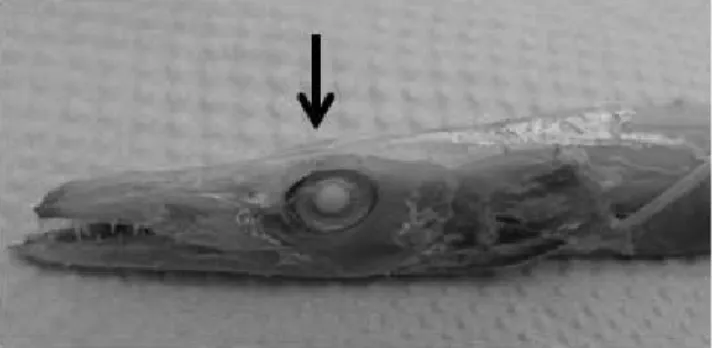
dorsal profile of head nearly flat (Fig. 2); head small;
ineterorbital space flat; eye size moderate, circular;
mouth large, slightly oblique, maxillary gently curved downward; lower jaw more projecting than upper jaw, posterior end of upper jaw not extending to below an- terior part of eye; 2 pairs of fangs at tip of upper jaw, 6 small canines on lateral side of upper jaw; no large fang front of lower jaw, 7 small teeth on lateral side; vomer toothless; dorsal fin extending from opercle to end of body; pectoral fin small, pointed; pelvic fin inserted be-
low pectoral fin base with a small scale-like spine; ori- gin of anal fin located in front of the middle of body;
anus located in front of anal fin; caudal fin small and forked.
Color when fresh. Body uniformly silver; tip of both jaws, top of head and opercular regions black; all fins pale or white.
Color after preservation. Body uniformly pale brown;
tip of both jaws and top of head grey-white; opercular regions black; all fins pale.
Distribution. Known Western Atlantic and Indo- Pacific ocean : Cape Hatteras, Gulf of Mexico, Surinam and southern Brazil, Gulf of Guinea to Angola, Emperor Seamounts, Hawaii, Tahiti, Vietnam, Java, Japan (Na- kamura and Parin, 1993) and Korea (present study).
Remarks. The present specimens collected from the coastal waters of Korea, agree well with the morpholo- gical characters of the genus Benthodesmus by having
First Record of Benthodesmus tenuis 303
Fig. 1. Benthodesmus tenuis, MABIK PI00012372, 377.6 mm in SL, bottom trawl, off Heuksan-do, Korea.
Table 1. Counts and proportional measurements of Benthodesmus tenuis
Counts and Measurements Present study Günther (1877) Nakamura and Parin (1993) Okamura et al. (1985)
Standard length (mm) 332.0, 377.6 (n==2) none none 436~723 (n==5)
Counts
Dorsal fin rays (spines+soft rays) 125~126 126 118~128
Pectoral fin rays 12 - - 12
Anal fin rays I, 73 71 II, 69~76
Vertebrae 132 - 122~132 -
In % of standard length
Body depth at the anus 3.8 - - -
Head length 12.7~13.1 - - 11.0~13.7
Snout length 4.6~5.2 - - -
Eye diameters 2.0~2.4 - - -
Upper jaw 5.7~5.8 - - -
Interorbital length 1.2~1.4 - - -
Predorsal fin length 9.8~12.2 - - 10.2~11.7
Prepectoral fin length 12.5~13.3 - - -
Preanus length 44.2~45.0 - - -
Preanal fin length 44.3~45.9 - - 43.2~47.9
Pectoral fin length 4.9~5.2 - - -
In % of head length
Snout length 39.9~46.2 - - 38.9~44.3
Eye diameter 15.5~19.3 - - 21.1~23.0
Interorbital length 9.8~10.7 - - 7.1~10.7
Upper jaw 43.4~46.2 - - 36.8~41.4
Pectoral fin length 38.8 (damaged)~39.5 - - 40.9~46.8
the interorbital space flat, elongated and slender body, and small forked caudal fin (Nakamura and Parin, 1993;
Nakabo, 2002). In far East Asia, only two species, B.
tenuis and B. pacificus (or, regarded as B. elongatus by Nakabo, 2002) (Nakamura and Parin, 1993) have been recognized up to date (Nakamura and Parin, 1993; Nakabo, 2002). The morphological characters of present speci- mens collected in Korea agree with these of Benthodes- mus tenuis such as dorsal, anal fin rays and body form, but there is no detailed description in the original paper (Günther, 1877). Therefore, we compared it with previous studies of B. tenuis (Table 1) and it was matched with their results. Then, we identified finally the present spe- cimens collected in Korea as B. tenuis. Although, some measurements, such as pectoral fin length, eye diameter and upper jaw, differ from those of the Okamura et al.
(1985). We think that these differences seems to be re- sulted of measuring only two specimens or geographi- cal variation.
On the other hand, B. pacificus was regarded as sub- species of B. elonatus (Nakamura, 1984), and then this species upgraded to the level of species (Nakamura and Parin, 1993), but Nakabo (2002) regarded as B. elonatus instead of B. pacificus from Japan for the species. There- fore, a taxonomic review on solving some remaining problems between B. elongatus and B. pacificus will be necessary.
B. tenuis is similar to B. pacificus in morphological characters such as body form from East Asia. However, the former can be distinguished from the latter by hav- ing dorsal fin rays 120~130 (vs. 144~155 for B. paci- ficus) and anal fin rays 70~76 (vs. 91~101) (Naka- mura and Parin, 1993; Nakabo, 2002). B. tenuis is also similar to Assurger anzac inhabiting the coastal waters of South sea, Korea, but the former is easily distinguish- able from the latter by having interobital region flat (vs.
interorbital region with prominent crest for A. anzac) and anal fin rays 70~76 (vs. 78~87). The Korean name of B. tenuis was firstly proposed by Yamada et al.
(2009) as “Se-jang-gal-chi”, we followed the name for the species.
ACKNOWLEDGEMENTS
This work was founded by a grant from the National Fisheries Research and Development Institute (RP-2012- FR-056).
REFERENCES
Adam, M.S., N.R. Merrett and R.C. Anderson. 1998. Addi- tions to the fish fauna of the Maldive Islands. Part 1:
An annotated checklist of the deep demersal fishes of the Maldive Islands. Ichthyological Bulletin of the J. L. B. Smith Institute of Ichthyology, 67: 1-19.
Boschung, H.T. 1992. Catalogue of freshwater and marine fishes of Alabama. Bulletin of the Alabama Museum of Natural History, 14: i-xvi+1-266.
Goode, G.B. and T.H. Bean. 1882. Benthodesmus, a new genus of deep-sea fishes, allied to Lepidopus. Procee- dings of the United States National Museum, V. 4:
379-383.
Günther, A. 1877. Preliminary notes on new fishes collected in Japan during the expedition of H.M.S. ‘Challen- ger’. Annals and Magazine of Natural History (Series 4), 4: 433-446.
Hubbs, C.L. and K.F. Lagler. 1964. Fishes of the Great Lake Region. Bull. Granbrook Inst. Sci., 26: 19-27.
Kim, I.S., Y. Choi, C.L. Lee, Y.J. Lee, B.J. Kim and J.H.
Kim. 2005. Illustrated book of Korean fishes. KyoHak Publishing Co Ltd Seoul, 615pp.
Nakabo, T. 2002. Trichiuridae. In: Nakabo, T. (ed.), Fishes of Japan with pictorial keys to the species, English edition. Tokai Univ. Press, Tokyo, pp. 1342-1345.
Nakamura, I and N.V. Parin. 1993. FAO species catalog.
Snake mackerels and cutlassfishes of the world (fam- ilies Gempylidae and Trichiuridae). Rome, 125: 136.
Nakamura, I. 1984. Family Trichiuridae. In: Masuda, H., K.
Amaoka, C. Araga, T. Uyeno and T. Yoshino (eds.), The fishes of the Japanese Archipelago. Tokai Univ.
Press, Tokyo, p. 109.
Nelson, J.S. 2006. Fishes of the world. 4th ed, John Wiley and Sons, Inc., Hoboken, New Jersey, 601pp.
Okamura, O., Y. Machida, T. Yamakawa, K. Matsuura and T. Yatou. 1985. Fishes of the Okinawa trough and the adjacent waters II, Japan Fisheries Resource Conser- vation Association, Tokyo, 781pp.
Paulin, C.D., A. Stewart, C.D. Roberts and P.J. McMillan.
1989. New Zealand fish a complete guide. National Museum of New Zealand Miscellaneous Series, 19:
i-xiv+1-279, 8 pls.
Peden, A.E. and G.W. Hughes. 1986. First records, confirma- tory records, and range extensions of marine fishes 304 Maeng Jin Kim, Jung Hwa Choi, Tag Yun Oh, Jung Yun Kim and Dong Woo Lee
Fig. 2. The arrow indicated the interorbital space.
off Canada’s west coast. Canadian Field-Naturalist, 100: 1-9.
Randall, J.E. and K.K.P. Lim. 2000. A checklist of the fishes of the South China Sea. Raffles Bull. Zool. Suppl., 8: 569-667.
Shao, K.T., H.C. Ho, P.L. Lin, P.F. Lee, M.Y. Lee, C.Y.
Tsai, Y.C. Liao and Y.C. Lin. 2008. A checklist of the fishes of southern Taiwan, Northern South China Sea.
The Raffles Bulletin of Zoology Suppl., 19: 233-271.
Yamada, U., M. Tokimura, K. Hoshino, S. Deng, Y. Zheng, S. Li, Y.S. Kim and J.K. Kim. 2009. Names and illustrations of fishes from the East China sea and the Yellow Sea. - Japan∙Chinese∙Korean -. Over- seas Fishery Cooperation Foundation of Japan, Tokyo, 784pp.
First Record of Benthodesmus tenuis 305
한국산 갈치과 어류 1 미기록종, Benthodesmus tenuis
김맹진∙최정화∙오택윤∙김정윤∙이동우
국립수산과학원 자원관리과
요 약 :갈치과에 속하는 Benthodesmus tenuis 2개체(표준 체장 332.0~377.6 mm)가 흑산도와 여수 연안에서 처음으로 채집되었다. 이 종은 등지느러미 기조수 125~126개(B. pacificus는 144~155개), 뒷지느러미 기조수 I, 73 (B. pacificus는 91~101개), 양안 지역에 평평하며 (붕동갈치는 볼록함), 아가미 뚜껑에 검은 반점이 있고, 꼬 리지느러미는 양엽형이다. 이 미기록종의 속명과 국명은 “세장갈치속”, “세장갈치”로 각각 제안하였다.
찾아보기 낱말 :갈치과, 세장갈치, 미기록종