서 론
주의력결핍 과잉행동장애(attention-deficit hyperacti- vity disorder, ADHD)는 유전성이 높은 질환으로 7세 이전 에 발병하는 것으로 알려져 있다.1) 7세에서 10세 사이에 가 장 흔하게 진단되지만 ADHD 증상과 기능 손상은 학령전 기, 즉 3세에서 5세 사이에서도 종종 나타난다.2) 지역사회를 대상으로 한 역학 연구를 보면 학령전기 아동의 2~6%에서 ADHD 진단 기준을 만족하는 것으로 보고되어 있다.2)
학령전기 ADHD 아동은 학습, 또래 관계, 가정 내의 문제 를 일으키며3) 사고에 대한 위험성이 높고 쉽게 다치는 경향이 있다.4) 또한 학습 문제로 인하여 특수 교육 프로그램을 받게 되는 경우가 종종 있고5) 공격적인 행동과 산만함으로 유치원 을 다니는데 어려움을 겪는 경우도 있다.4)
장기 연구에 의하면 학령전기 ADHD 증상은 시간이 경과
하여도 지속되는 것으로 보고되고 있다.4) 3세에 진단된 AD- HD 증상이 6세 아동의 50%에서, 9세 아동의 48%에서 지 속되었다는 보고가 있다.6) 학령전기 ADHD 증상은 방치되 는 경우에 학령기의 낮은 학업 성취도와 청소년기의 읽기 능 력 저하로 이어지는 등, 장기적으로 나쁜 예후를 보이는 것 으로 되어 있다.7)
따라서 학령전기 ADHD 증상을 조기에 발견하고 치료하 는 것이 아동에게 도움이 될 수 있다. 미국 소아정신과학회에 서는 학령전기 ADHD 아동의 치료는 일차적으로 부모 교육 과 행동 치료 프로그램을 시행하도록 권유하고 있으며, 약물 치료는 부모 교육이나 행동 치료 프로그램이 효과적이지 않 거나 시행할 수 없는 경우, 혹은 심각한 ADHD 증상을 보이 는 경우에 시작하도록 권장하고 있다.8)
정신약물 역학 연구에 의하면 ADHD 소아에서 정신자극 제의 사용은 1980년대 말부터 1990년대 중반에 이르기까지 가파르게 증가하여 미국의 경우를 보면, 1987년도에는 정신 자극제의 처방이 0.6% 수준이었는데 1996년도에는 2.4%로 10년의 기간 동안 4배가량 증가하였다.9) 학령전기 아동에서 도 미국에서 정신자극제의 처방은 1991년에 비하여 1995년 에 1.7~3배가량 증가하였으며, methylphenidate(MPH) 제
접수완료:2011년 5월 25일 / 심사완료:2011년 6월 17일
Address for correspondence:Eui-Jung Kim, M.D., PhD., Department of Psychiatry, Ewha Womans University School of Medicine, 911-1 Mok-dong, Yangcheon-gu, Seoul 158-710, Korea
Tel : +82.2-2650-2649, Fax : +82.2-2650-5164 E-mail : [email protected]
주의력결핍 과잉행동장애에서 허가 초과 약물 처방 : 학령전기 아동 중심으로
김 의 정
이화여자대학교 의학전문대학원 정신과학교실
Off-label use of Psychotropic Medications in Preschool Children with Attention-deficit Hyperactivity Disorder
Eui-Jung Kim M.D.,PhD.
Department of Psychiatry, Ewha Womans University School of Medicine, Seoul, Korea
Attention-deficit hyperactivity disorder (ADHD) is a neurobehavioral disorder with an onset of symptoms before 7 years of age, often starting as early as the preschool years. The off-label use of methylphenidate (MPH) for 3- to 6-year-old preschool chil- dren with ADHD is being more common, although MPH is not licensed for use in children younger than age 6 years, in most countries. Despite the limited data, the review of the literature suggests that MPH meets evidence based criteria as beneficial and safe for carefully diagnosed ADHD preschool children. Carefully monitored administration of evidence-based psychotro- pic medication in preschool children with ADHD may be indicated if psychosocial treatments are ineffective.
KEY WORDS:ADHDㆍPreschoolㆍOff-labelㆍPharmacotherapy.
재가 가장 흔하게 처방되었다.10) 이후의 통계를 보면 미국의 학령전기 ADHD 아동에서 정신자극제의 처방율이 1997년도 에는 0.4%, 2002년도에는 0.3%로 보고되고 있어 학령전기 아동에서 정신자극제가 꾸준히 처방되고 있음을 알 수 있다.11)
미국 식약청(FDA)에서는 ADHD 치료제로서 ampheta- mine 제재는 3세 이후부터, MPH 제재, atomoxetine, gu- anfacine, clonidine은 6세 이후부터 사용을 허가하고 있 다.12) 우리나라 식약청에서는 ADHD에서 MPH 제재와 ato- moxetine 처방을 6세 이후부터 허가하고 있다.13) 따라서 6 세 미만의 학령전기 ADHD 아동에서의 약물 치료는 우리나 라에서 소위 off-label 처방으로만 가능한 실정이다.
따라서 저자는 학령전기 ADHD 아동의 off-label 약물 처방이 꾸준히 이루어지고 있는 추세에서 학령전기 ADHD 아동에 대한 약물 치료의 효과와 안전성에 대하여 검토해보 고자 하였다.
정신자극제 치료
1. 정신자극제 치료 : 2000년도 이전의 연구
ADHD 아동에서 약물 치료의 1차 선택은 정신자극제로 알 려져 있으며 이중에서 가장 흔히 처방되는 것은 MPH 제재 이다.14) 학령전기 ADHD 아동에서도 정신자극제의 처방 중 90% 이상은 MPH 제재이며10) amphetamine 제재는 3세 이후의 아동에서 ADHD 치료제로서 유일하게 미국 FDA에 서 승인을 받았으나 처방율이 10% 미만에 불과하며 학령전 기 아동에서 체계적인 연구가 거의 진행되지 않았으므로 본 고에서는 정신자극제를 대표하여 MPH 제재에 대해 언급하 기로 하겠다.
학령기 ADHD 아동에서의 MPH 치료 효과에 대한 체계적 인 연구는 많이 시행되었으나 학령전기 ADHD 아동을 대상 으로 한 위약 대조 연구는 2001년도에 비교적 대규모로 시
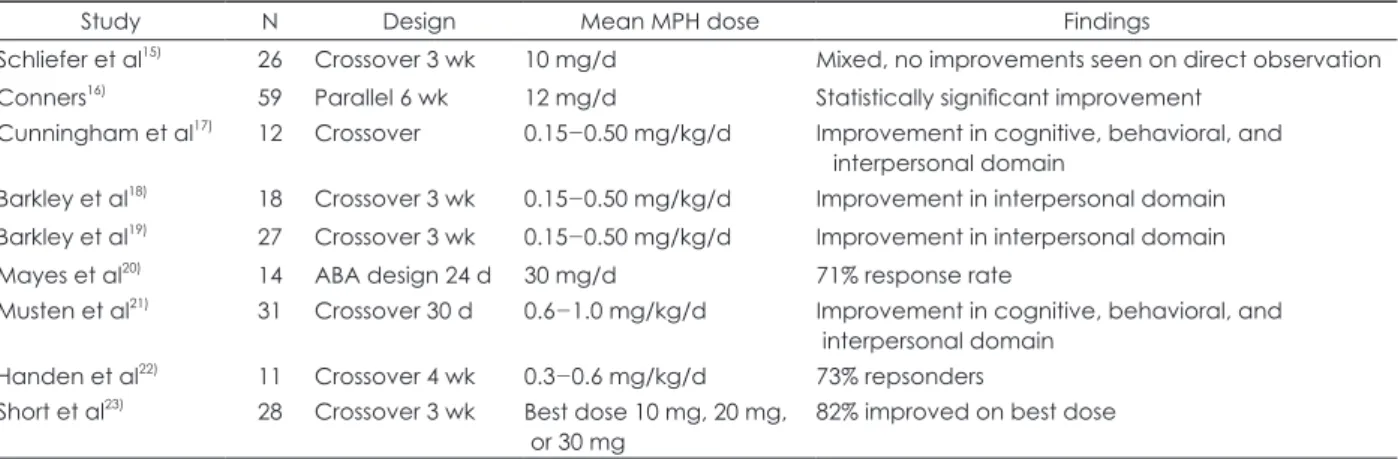
행된 Preschool ADHD Treatment Study(PATS) 이전에 는 불과 10개 미만 정도가 시행되었다(Table 1). 1975년부터 2000년 까지 총 9개의 이중 맹검 위약 대조 연구가 시행되었 고, 모두 MPH 초기 속방형 제재(immediate release, IR) 를 사용하였으며 총 200여명 이상의 학령전기 아동이 연구 에 포함되었다. 9개중 8개의 연구에서(89%) 치료 효과가 보 고되었다. 학령기 아동에 비해 임상 반응의 다양성이 관찰되 었고 인지, 또래 관계, 과잉행동-충동성의 측면에서 위약에 비하여 효과가 있는 것으로 보고되었다. MPH-IR의 평균 사 용 용량은 0.15~1.0 mg/kg/d였고, 하루에 3회 복용 보다는 1회 내지 2회 복용이 더 많았다. 부작용은 대체로 가벼운 수 준으로 보고되었으나 학령기 아동에 비하여 부작용의 빈도수 가 더 많았고 심각한 부작용을 보고하는 아동의 비율이 10%
정도로, 학령기 아동의 3.6%에 비하여 높았다. 또한 특징적 으로 자극과민성, 불안, 슬픔과 사회적 위축 등의 정서에 관 련된 부작용을 호소하는 경향이 두드러졌다.24)
2. Preschool ADHD Treatment Study(PATS)
상기 연구들은 진단 기준, 방법, 기간 등이 다양하였고 대 부분의 연구가 1개의 기관에서 소규모로 시행되었으며 교사 평가가 누락된 경우가 많아 제한점이 많았다. 이를 보완하기 위해 2001년도에 미국 국립 정신보건원(The National Insti- tute of Mental Health, NIMH)이 대규모 임상 연구(PATS) 를 후원하게 되어 학령전기 ADHD 아동에서 위약과 MPH- IR 치료의 효과와 안전성을 비교하는 연구가 시행되었고 2006년부터 연구 결과가 보고되고 있으며25-27) 현재도 장기 임상 연구가 진행 중에 있다.
PATS는 3세에서 5.5세 사이의 아동 303명을 대상으로 하 였고 총 70주간 8개의 phase로 시행되었다 : 1) 모집, 초기 평가 및 등록 ; 2) 10주, 집단 부모 훈련 ; 3) 부모 교육으로 호전을 보이지 않는 아동에 대한 기초 평가 ; 4) 1주, open-
Table 1. Placebo controlled methylphenidate trials in preschoolers
Study N Design Mean MPH dose Findings
Schliefer et al15) 26 Crossover 3 wk 10 mg/d Mixed, no improvements seen on direct observation Conners16) 59 Parallel 6 wk 12 mg/d Statistically significant improvement
Cunningham et al17) 12 Crossover 0.15-0.50 mg/kg/d Improvement in cognitive, behavioral, and interpersonal domain
Barkley et al18) 18 Crossover 3 wk 0.15-0.50 mg/kg/d Improvement in interpersonal domain Barkley et al19) 27 Crossover 3 wk 0.15-0.50 mg/kg/d Improvement in interpersonal domain Mayes et al20) 14 ABA design 24 d 30 mg/d 71% response rate
Musten et al21) 31 Crossover 30 d 0.6-1.0 mg/kg/d Improvement in cognitive, behavioral, and interpersonal domain
Handen et al22) 11 Crossover 4 wk 0.3-0.6 mg/kg/d 73% repsonders Short et al23) 28 Crossover 3 wk Best dose 10 mg, 20 mg,
or 30 mg 82% improved on best dose MPH : methylphenidate
label phase로 모든 MPH-IR 용량에 노출이 되는 안전성 검사 시기 ; 5) 5주, 무작위 이중 맹검 crossover titration 시기로 MPH-IR의 4가지 용량(1.25 mg, 2.5 mg, 5.0 mg, 7.5 mg)과 위약을 하루에 3회 투여함 ; 6) 4주, parallel de- sign으로 MPH-IR과 위약의 무작위 이중 맹검 대조 연구 ; 7) 40주, open-label phase로 약물 유지기 ; 8) 6주, 이중 맹검 약물 치료 종결기.
5주간의 crossover titration 시기에서는 MPH가 ADHD 의 증상을 유의하게 감소시킴으로써 단기 치료 효과가 있음 이 입증되었고 증상이 경감되는 정도는 약물의 용량에 비례 하였다.23) MPH의 평균 적정 용량은 14.2±8.1 mg/d(0.7±
0.4 mg/kg/d)로 Multimodal Treatment Study of Chil- dren with ADHD(MTA)에서 보고된 1.0 mg/kg/d보다 낮 았으며,25) 하루 적정 용량은 7.5 mg에서 30 mg의 범주로 나 타났다.
MPH 치료에 대한 effect size(Cohen’s d 계수)를 살펴보 면, 부모 평가에서는 0.35, 교사 평가에서는 0.43으로, small to medium effect를 나타내었다. 이는 MTA에서 보고된 0.52 (부모 평가), 0.75(교사 평가)보다 낮은 수준에 해당한다. 10 개월간의 유지 치료 기간 동안에도 약물 치료 효과는 유의하 게 유지 되었으며 이 기간에는 MPH 용량이 19.9 mg/d(0.92 mg/kg/d)로 증가되었다.27) 따라서 학령전기 ADHD 아동에 서 MPH-IR 치료는 단기 뿐 아니라 1년간의 치료에서도 효 과적이라고 할 수 있겠다.
부작용은 총 1년 간 부모의 보고에 의하여 평가되었다. 초 기 5주간의 약물 증량 기간에는 감정의 폭발(emotional out- burst)(10~15%), 식욕 감소(7~14%), 체중 감소(4~7%)가 나 타났으며28) 10개월간의 약물 유지 치료 기간에는 자극과민 성 등의 정서적인 부작용은 감소되었고 불면과 식욕 감소는 그대로 유지되었다.27) 전체 아동의 30%에서 중등도 이상의 부작용이 보고되었는데, 주로 감정의 폭발(emotional out- burst), 자극과민성, 상동 행동 및 사고, 식욕 감소의 양상을 나타냈다. 또한 11%에서는 약물 부작용으로 추정되는 사유 로 치료 과정을 중단하게 되었는데, 이는 1% 미만의 아동에 서 치료를 중단하였던 MTA보다 높은 수치이다. 혈압이나 맥박 상승에 대한 영향은 대조군과 유의한 차이를 보이지 않았으며 기타 다른 심혈관계 부작용의 빈도도 위약과 차이 가 없었다.26) PATS에서의 부작용 양상은 전반적으로는 안전 한 정도의 수준이었지만 30%정도에서 중등도 이상의 부작 용이 나타난 점으로 볼 때, 학령전기 ADHD 아동에서 MPH 로 약물 치료하는 경우에 부작용 발현에 대한 면밀한 주의 가 필요하겠다. 또한 부작용에 있어서 불안정한 정서(emo- tional lability)의 보고율이 초기에 10~15% 정도로 높게 나
타났다는 점이 주목할 만하다.
PATS에서는 1년간 140명을 대상으로 체중 및 신장에 대 한 성장 속도를 측정하였다. 치료 시작 전에는 체중과 신장이 기대치에 비하여 높은 수치를 나타내어, 체중의 경우에는 1.78 kg, 신장의 경우에는 2.04 cm 정도가 더 큰 것으로 나타났 다. 1년의 치료 과정 후에 연간 성장률을 측정하였는데, 체중 은 1.32 kg 정도, 신장은 1.38 cm 정도가 기대치보다 더 낮 게 측정되었다. 이러한 연구 결과는 학령기 아동에서 MPH 치 료후 성장 속도의 지연을 보고한 MTA 결과와 일치하는 소 견이다.28) 학령전기 ADHD 아동에서 MPH-IR 치료는 1년 간의 추적 연구에서 아동의 성장 속도를 지연시키는 것으로 나타났으며, 앞으로는 보다 더 장기적인 추적 연구가 시행되 어야 할 것이다.
PATS의 약동학적 연구 결과를 보면 학령전기 아동은 학 령기 아동에 비하여 MPH의 대사 속도가 지연되어 있으며 따 라서 체중을 계산하여 조정된 동일한 용량을 투여하여도 학 령기 아동에 비해 학령전기 아동에서는 더 오랜 시간동안 약 물에 노출될 수 있다. 그러므로 학령전기 아동에서 MPH로 치료하는 경우에는 소량으로 치료를 시작하고 천천히 증량 해야 하며 학령기 아동에 비해 최종 용량이 다소 낮을 가능 성을 염두에 두어야 한다.29)
3. 정신자극제 치료 : 확장형 제재
현재까지 학령전기 ADHD 아동에서의 정신자극제 치료 연 구는 MPH-IR 제재에 관한 연구가 거의 대부분이었다. 아직 까지는 OROS(osmotic release oral system)제재에 관한 연구는 이루어지지 않았고 확장형 제재(extended release) 에 관한 연구는 beaded MPH를 사용한 개방형 연구가 최 근에 1개 정도 보고되었을 정도로 매우 제한적이다.
2009년도에 Maayan 등30)은 11명의 학령전기 ADHD 아 동에서 8시간 지속되는 확장형 MPH 제재인 Ritalin LA를 4주간 투여하는 개방형 연구를 보고하였다. 약물은 자유롭 게 증량하여 하루에 최대 30 mg까지 사용하도록 하였는데, 평균 용량은 17.73 mg/d였고, 가장 흔히 처방되는 용량은 10 mg/d로 나타났다. 4주간의 치료 후에 Swanson, Nolan, and Pelham-IV(SNAP-IV) 척도 점수는 1.09점이 감소하 였고, Clinical Global Impression Scale-Severity(CGI- S) 척도 점수는 5점에서 3.36점으로 유의하게 감소하였다.
가장 흔한 부작용은 식욕 저하로 11명 중 7명에서 나타났으 며, 3명은 복통과 불면을 호소하였고 2명은 불안정한 정서 를 나타내었다. 혈압이나 맥박에 대한 수치는 변동이 없었다.
상기 연구는 소규모의 개방형 연구로, 결과를 일반화하기 는 어려우나, 학령전기 ADHD 아동에서 확장형 제재의 치료
가 효과적이고 비교적 안전하다는 결과를 보여주는 첫 예비 연구라는 점에서 의의를 찾을 수 있을 것이다. 향후에는 학 령전기 ADHD 아동에서 확장형 제재 및 OROS 제재에 관 한 체계적인 연구가 시행되어야 할 것이다.
비정신자극제 치료
1. Atomoxetine
학령전기 ADHD 아동에서 atomoxetine 치료에 관한 위 약 대조군 연구는 현재까지 보고된 바가 없으며 2개의 개방 형 연구가 보고되었다.
2007년에 Kratochvil 등은 3곳의 센터에서 5세와 6세 아 동, 총 22명을 대상으로 atomoxetine을 8주간 투여하는 개 방형 연구를 보고하였다.31) atomoxetine은 최대 1.8 mg/
kg/d까지 증량하도록 하였는데, 평균 용량은 1.25 mg/kg/d 였다. 8주간의 치료 후에 ADHD Rating Scale-IV(ADHD- IV-RS) 척도 점수는 평균 20.68점이 감소하였고 CGI-S 척 도 점수는 아동의 82%에서 개선되었다. 부작용으로는 불안 정한 정서가 22명중 12명(54.5%)에서 보고되어 가장 흔하게 나타났고, 식욕 저하가 11명(50%)에서 있었으며, 체중 저하가 1.04 kg 정도로 보고되었다.
2009년도에는 Ghuman 등이 3세에서 5세 사이의 ADHD 아동 12명을 대상으로 시행한 atomoxetine 개방형 연구를 보고하였다.32) 6주간 약물 증량을 시행하고 4주간 유지 치료 기를 갖는 전향적인 개방형 연구로서 atomoxetine 평균 용 량은 1.59 mg/kg/d이었고, 10주간의 치료 후에 SNAP-IV- HI 점수는 10.2점이 감소하였다. 부작용은 전체 아동의 67%
에서 나타났고 반항적인 행동, 공격성, 자극과민성, 분노 발 작(tantrums), 소화기계 증상 등이 관찰되었다.
학령전기 ADHD 아동에서 atomoxetine 치료에 관한 연 구는 현재까지 매우 제한적이나, 2개의 개방형 연구 결과에 서 보면 학령전기 아동에서 atomoxetine 치료는 ADHD의 핵심 증상을 개선하는데 효과적이라는 예비 연구 결과를 시 사한다. 앞으로는 학령전기 ADHD 아동을 대상으로 atomo- xetine 치료의 효과와 안전성에 대한 대규모의 정교하고 체 계적인 연구가 시행되어야 하겠다.
2. 기타 비정신자극제 치료
학령전기 ADHD 아동에서 atomoxetine을 제외한 기타 비정신자극제 치료에 관한 연구는 매우 제한적이다.
α-agonist는 학령전기 ADHD 아동에서 종종 처방되고 있 음에도 불구하고, 학령전기 아동만을 대상으로 시행된 연구 는 없으며 몇 개의 증례 보고가 있는 정도이다.
Cesena 등은 학령전기 아동에서 clonidine 치료에 관한 증례 보고를 하였는데 후천성 면역 결핍증을 앓고 있는 4세 아동에서 clonidine을 3여했을 때 과잉 행동과 충동성에서 유의한 개선이 나타났다고 보고하였다.31) 용량은 0.025 mg 을 하루에 3회 처방하였고 56개월 간 유지하였으며 초기에 진정 작용으로 인한 부작용을 호소하였으나 치료 후반기에 호전되었음을 보고하였다.
Lee34)는 총 4명의 학령전기 아동에서 guanfacine을 2개 월에서 6개월간 투여하였는데 용량은 하루에 0.25 mg 내지 0.5 mg을 2회 사용하였다. Child Behavior Checklist(CB- CL)와 부모용 Connors’ rating Scale(CRS)을 사용하여 치 료 전후의 점수를 비교한 결과, 충동성과 과잉 행동 점수가 감소하였고, 모자 관계가 개선되었다. 부작용으로는 진정 작 용과 흉통이 보고되었다.
α-agonist는 진정 작용, 자극과민성, 서맥과 저혈압 등을 유발할 수 있으므로,33,34) 혈압과 맥박을 정기적으로 검사하 는 것이 필요하다.37)
Campbell 등은 3세 ADHD 아동에서 fluoxetine 치료에 관한 증례 보고를 하였다.38) fluoxetine 10 mg을 하루에 1 회 투여하였고 6주간 관찰하였는데 임상 면담에 의한 평가 에서, 집중력이 개선되었고 공격성이 감소하였으며 부작용은 나타나지 않았다.
학령전기 ADHD 아동 치료 : Current Evidence and Practice
최근 소아 정신약물학 분야에서도 근거 중심 치료(evid- ence-based treatment)에 대한 관심이 증가하고 있다. 근 거 중심 치료(evidence-based treatment)란 clinical sam- ple을 대상으로, clinical significance에 대한 평가를 포함 하고, 신뢰할만한 결과가 반복적으로 입증되는 무작위 대조 연구가 존재하는 것으로 정의37)할 때, 학령전기 ADHD 아동 에서 MPH 치료는 근거 중심 치료(evidence-based treat- ment)의 기준을 만족시키는 것으로 나타났다.40)
2007년도에 The Preschool Psychopharmacology Working Group(PPWG)은 학령전기 약물 치료에 관한 전 체 문헌 고찰, 임상 경험, 전문가의 의견을 종합하여 소아 정 신 질환 별로 알고리듬을 개발하였으며 학령전기 ADHD 아 동의 치료에 관한 알고리듬도 제시하였다(Table 2).41,43) 앞서 기술한 바와 같이 학령전기 ADHD 아동의 치료는 부모 교육 이나 행동 치료를 우선적으로 시행하도록 되어 있고 이에 대 한 효과가 부족하거나 정신사회적 치료의 시행이 어려운 경 우에 약물 치료를 시작하도록 되어 있다. MPH가 학령전기
ADHD 아동의 약물 치료에서 1차 치료 약제로 되어 있다.
PPWG는 ‘Level of evidence’를 함께 제시하였는데(Ta- ble 2), MPH는 Level A, α-agonist는 Level B, atomox- etine은 Level C로 명기되어 있다.
미국 소아정신과 학회에서는 진료지침서에서 학령전기 A- DHD 아동의 치료에 대해 간단히 언급하고 있다. 일반 치료 지침은 PPWG 알고리듬과 마찬가지로 정신사회적 치료를 우 선 시행하도록 되어 있으며 약물 치료시에는 소량에서 시작 하고 주의 깊게 모니터링을 하면서 천천히 증량하도록 권장하 고 있으며 1주에 7일 모두 투약해야 한다고 제시되어 있다.10) Ghuman 등43)은 학령전기 ADHD 아동의 약물 치료에서
‘start low, go slow’의 원칙을 따르면서, 동시에 저용량 투 여로 인한 치료 효과의 부족함을 피하도록 해야 한다고 하였 다. 또한 치료 효과와 부작용에 대한 면밀한 모니터링을 위 해 처음 1~2개월 동안에는 1주 혹은 2주마다 외래를 방문 하도록 하고 이후에는 매월마다 방문하도록 권장하고 있다.
CRS, ADHD-IV-RS, CBCL과 같은 부모 혹은 교사용 평 가 척도를 치료 시작 전과 외래 방문시에 정기적으로 평가하 도록 제시하고 있다.
MPH의 치료 용량은 초기에 2.5 mg을 하루에 2회 투여 하는 것으로 시작하여 치료 반응과 부작용에 따라 2~4주간 에 걸쳐서 7.5 mg을 2회 혹은 3회 투여하도록 제시하였다.
결 론
학령전기 ADHD 아동은 적절히 치료를 받지 못하는 경우, 다양한 방면에서 기능 손상을 일으킬 수 있으며 이러한 증 상은 학령기 이후까지 지속되는 경향이 있다. 따라서 학령전
기 ADHD 아동에서 적절한 치료를 받는 것은 매우 중요하 다. 심각한 증상을 보이거나 정신사회적 치료에 효과를 보이 지 않는 ADHD 아동의 경우 약물 치료가 도움이 되는데 현 재로서는 학령전기 ADHD 아동에서의 약물 치료는 off-la- bel 치료에 머물러 있다.
학령전기 ADHD 아동에서의 MPH 치료에 관한 연구는 학령기 아동에 비하면 제한적인 수준이지만 Level A에 해당 하는 근거를 갖고 있으며 근거중심치료의 기준을 만족시킨 다. MPH는 학령전기 ADHD 아동에서 ADHD의 증상 조절 에 효과적이며 대체로 안전한 것으로 사료된다.
따라서 학령전기 ADHD 아동의 약물 치료를 일괄적으로 off-label 치료로 규정하여 제한하기보다는, 약물 치료가 반드시 필요한 아동에서는 효과와 안전성에 대한 근거를 갖 고 있는 약물을 선택하여 면밀한 모니터링을 병행하면서 주 의 깊게 치료를 시행하는 것이 도움이 될 수 있음을 제안하 고자 한다.
향후에는 MPH의 다양한 제재들과 비정신자극제 치료에 대한 대조군 연구가 폭 넓게 시행되어 치료에 대한 근거의 축 적이 필요할 것이며, 약물 치료와 정신사회적 치료의 효과에 대한 비교 연구도 시행되어야 할 것이다. 아울러 학령전기 아 동에서 약물 치료의 효과와 안전성에 대한 장기적인 연구가 필요할 것으로 생각된다.
중심 단어:주의력결핍 과잉행동장애 ·학령 전기 ·허가 초과 ·
약물치료 .
References
1) American Psychiatric Association. Diagnostic and Statistical Man- ual of Mental Disorders. 4th ed. text revision (DSM-IV-TR). Wash- Table 2. Treatment algorithm for preschool children with ADHD
Principles
• Assessment and diagnosis should be comprehensive, developmentally appropriate and contextually sensitive.
• An adequate trial of psychotherapy should precede pharmacotherapy, and should continue even if medication is used.
• Pharmacotherapy should be considered in the context of the clinical diagnosis and degree of functional impairment.
• Referral of the parent for treatment may optimize family mental health.
• Medication discontinuation trials are recommended following 6 months of treatment.
• The use of additional medication to manage side effects of medication is discouraged.
• Level of evidence for recommendation is based upon :
A : Trials, large meta-analyses, or overwhelming clinical consensus Well controlled, randomized B : Empirical evidence (open trials, case series) or strong clinical consensus
C : Single case report or no published reports : recommendation developed by PPWG based on clinical and research experiences.
Stage 0 : Diagnostic assessment and psychotherapeutic intervention Stage 1 : Methylphenidate trial (Level A)
Stage 2 : Amphetamine trial (Level C)
Stage 3 : a-adrenergic (Level B) or atomoxetine trial (Level C)
ington DC: American Psychiatric Press;2000.
2) Lavine JV, Gibbons RD, Christoffel KK, Arend R, Rosenbaum D, Binns H, et al. Prevalence rates and correlates of psychiatric disor- ders among preschool children. J Am Acad Child Adolesc Psychi- atry 1996;35:204-214.
3) Dupaul GJ, McGoey KE, Eckert TL, Van Brakle J. Preschool chil- dren with attention-deficit/hyperactivity disorder. J Am Acad Child Adolesc Psychiatry 2001;40:508-515.
4) Lahey BB, Pelham WE, Loney J, Kipp H, Ehrhardt A, Lee SS et al.
Three-year predictive validity of DSM-IV attention deficit hyper- activity disorder in children diagnosed at 4-6 years of age. Am J Psy- chiatry 2004;161:2014-2020.
5) Lahey BB, Pelham WE, Stein MA, Loney J, Trapani C, Nugent K et al. validity of DSM-IV attention deficit hyperactivity disorder for younger children. J Am Acad Child Adolesc Psychiatry 1998;37:
695-702.
6) Pierce EW, Ewing LJ, Campbell SB. Diagnostic status and symp- tomatic behavior of hard-to-manage preschool children in middle childhood and early adolescence. J Clin Child Psychol 1998;28:44- 7) McGee R, Prior M, Williams S. The long-term significance of tea-57.
cher-rated hyperactivity and reading ability in childhood: findings from two longitudinal stidies. J Child Psychol Psychiatry 2002;43:
1004-1017.
8) Dulcan M. Practice parameters for the assessment and treatment of children, adolescents, and adults with attention deficit hyperactivi- ty disorder. J Am Acad Child Adolesc Psychiatry 1997;36(10 Sup- pl):85S-121S.
9) Offson M, Marcus SC, Weissman MM, Jensen PS. NAtional ternds in the use of psychotropic medications by children. J Am Acad Child Adolesc Psychiatry 2002;41:514-521.
10) Zito JM, Safer DJ, dosReis S, Gardner JF, Boles M, Lynch F. Trends in the prescribing of psychotropic medications to preschoolers.
JAMA 2000;283:1025-1030.
11) Zuveska SH, Vitiello B, Norquist GS. Recent treds in stimulant me- dication use among U.S. children. Am J Psychiatry 2006;163:579- 12) US Food and Drug Administration. Medication guide: Ritalin. [ac-585.
cessed on 15 Feb 2011]. Available from http://www.fda.gov/down- loads/Drugs/DrugSafety/ucm089090.pdf.
13) Korean Food and Drug Administration. Medications that are pro- hibited in children and adolescents. [accessed on 15 Feb 2011]. Avai- lable from http://ezdrug.kfda.go.kr/kfda2.
14) Greenhill LL, Posner K, Vaughan BS, Kratochvil CJ. attention defi- cit hyperactivity disorder in preschool children. Child Adolesc Psy- chiatr Clin N Am 2008;17:347-366.
15) Schliefer M, Weiss G, Cohen N, Elman M, Cvejic H, Kruger E. Hy- peractivity in preschoolers and the effect of methylphenidate. Am J Orthopsychiatry 1975;45:38-50.
16) Conners CK. Controlled trial of methylphenidate in preschool chil- dren with minimal brain dysfunction. Int J Ment Health 1975;4:61- 17) Cunningham CE, Siegel LS, Offord DR. A developmental dose-re-74.
sponse analysis of the effects of methylphenidate on the peer inter- actions of attention deficit disordered boys. J Child Psychol Psychi- atry 1985;26:955-971.
18) Barkley RA, Karlsson J, Strzelecki E, Murphy JV. Effects of age and Ritalin dosage on the mother-child interactions of hyperactive children. J Consult Clin Psychol 1984;52:750-758.
19) Barkley RA. The effects of methylphenidate on the interactions of preschool ADHD children with their mothers. J Am Acad Child Adolesc Psychiatry 1988;27:336-341.
20) Mayes SD, Crites DL, Bixler EO, Humphrey FJ 2nd, Mattison RE.
Methylphenidate and ADHD: influence of age, IQ and neurodevel- opmental status. Dev Med Child Neurol 1994;36:1099-1107.
21) Musten LM, Firestone P, Pisterman S, Bennett S, Mercer JJ. Effects
of methylphenidate on preschool children with ADHD: cognitive and behavioral functions. Am Acad Child Adolesc Psychiatry 1997;
36:1407-1415.
22) Handen BL, Feldman HM, Lurier A, Murray PJ. Efficacy of meth- ylphenidate among preschool children with developmental disabil- ities and ADHD. J Am Acad Child Adolesc Psychiatry 1999;38:805- 23) Short EJ, Manos MJ, Findling RL, Schubel EA. A prospective study 812.
of stimulant response in preschool children: insights from ROC analyses. J Am Acad Child Adolesc Psychiatry 2004;43:251-259.
24) Firestone P, Musten LM, Pisterman S, Mercer J, Bennett S. Short- term side effects of stimulant medication are increased in preschool children with attention-deficit/hyperactivity disorder: a double- blind placebo-controlled study. J Child Adolesc Psychopharmacol 1998;8:13-25.
25) Greenhill LL, Kollins S, Abikoff H, McCracken JT, Riddle MA, Swanson J, et al. Efficacy and Safety of immediate-release methyl- phenidate for preschoolers with ADHD. J Am Acad Child Adolesc Psychiatry 2006;45:1284-1293.
26) Wigal T, Greenhill L, Chuang S, McGough J, Vitiello B, Skrobala A, et al. Safety and tolerability of methylpheniate in preschool chil- dren with ADHD. J Am Acad Child Adolesc Psychiatry 2006;45:
1294-1313.
27) Vitiello B, Abikoff H, Chuang SZ, Kollins SH, McCracken JT, Rid- dle MA, et al. Effectiveness of methylphenidate in the 10 month continuation phase of the preschoolers with attention deficit/hy- peractivity disorder treatment study (PATS). J Child Adolesc Psy- chopharmacol 2007;17:593-604.
28) National Institute of Mental Health Multimodal Treatment Study of ADHD follow-up: changes in effectiveness and growth after the end of treatment. Pediatrics 2004;113:762-769.
29) Wigal SB, Gupta S, Greenhill L, Posner K, Lerner M, Steinhoff K, et al. Pharmacokinetics of methylphenidate in preschoolers with at- tention-deficit hyperactivity disorder. J Child Adolesc Psychophar- macol 2007;17:153-164.
30) Maayan L, Paykina N, Fried J, Strauss T, Gugga SS, Greenhill L.
The open-label treatment of attention-deficit/hyperactivity disor- der in 4- and 5-year-old children with beaded methylphenidate. J Child Adolesc Psychopharmacol 2009;19:147-153.
31) Kratochvil CJ, Vaughan BS, Mayfield-Jorgensen ML, March JS, Kol- lins SH, Murray DW, et al. A pilot study of atomoxetine in young children with attention-deficit/hyperactivity disorder. J Child Ado- lesc Psychopharmacol 2007;17:175-185.
32) Ghuman JK, Aman MG, Ghuman HS, Reichenbacher T, Gelenberg A, Wright R, et al. Prospective, naturalistic, pilot study of open-la- bel atomoxetine treatment in preschool children with attention-defi- cit hyperactivity disorder. J Child Adolesc Psychopharmacol 2009;
19:155-166.
33) Ceseña M, Lee DO, Cebollero AM, Steingard RJ. Case study: be- havioral symptoms of pediatric HIV-1 encephalopathy successful- ly treated with clonidine. J Am Acad Child Adolesc Psychiatry 1995;
34:302-306.
34) Lee BJ. Clinical experience with guanfacine in 2-and 3-year-old children with attention-deficit hyperactivity disorder. Infant Men- tal Health 1997;18:300-305.
35) Connor DF, Fletcher KE, Swanson JM. A meta-analysis of cloni- dine for symptoms of attention-deficit hyperactivity disorder. J Am Acad Child Adolesc Psychiatry 1999;38:1551-1559.
36) Scahill L, Barloon L, Farkas L. Alpha-2 agonists in the treatment of attention deficit hyperactivity disorder. Child Adolesc Psychiatr Nurs 1999;12:168-173.
37) Pliszka SR, Crismon ML, Hughes CW, Corners CK, Emslie GJ, Jen- sen PS, et al. The Texas Children’s Medication Algorithm Project : revision of the algorithm for pharmacotherapy of attention-defi- cit/hyperactivity disorder. J Am Acad Child Adolesc Psychiatry 2006;45:642-657.
38) Campbell NB, Tamburrino MB, Evans CL, Franco KN. Fluoxetine for ADHD in a young child. J Am Acad Child Adolesc Psychiatry 1995;34:1259-1260.
39) Riddle MA, Kastelic EA, Frosch E. Pediatric psychopharmacology.
J Child Psychol Psychiatry 2001;42:73-90.
40) Connor DF. Preschool attention deficit hyperactivity disorder: a review of prevalence, diagnosis, neurobiology, and stimulant treat- ment. J Dev Behav Pediatr 2002;23(1 Suppl):S1-S9.
41) Gleason MM, Egger HL, Emslie GJ, Greenhill LL, Kowatch RA, Lie- berman AF, et al. Psychopharmacological treatment for very young
children: contexts and guidelines. J Am Acad Child Adolesc Psy- chiatry 2007;46:1532-1572.
42) Vaughan BS, March JS, Kratochvil CJ. The evidence-based phar- macological treatment of paediatric ADHD. Int J Neuropsycho- pharmacol;2011. p.1-13.
43) Ghuman JK, Arnold LE, Anthony BJ. Psychopharmacological and other treatments in preschool children with attention-deficit/hyper- activity disorder: current evidence and practice. J Child Adolesc Psy- chopharmacol 2008;18:413-447.