253
PCR을 이용한 품종동정 및 시유와 낙농제품의 진위판별 방법에 관한 연구: 총설
최 석 호․이 승 배* 상지대학교 동물생명자원학부
Detection of Adulteration and Species Identification of Milk and Dairy Products using PCR: A Review
Suk-Ho Choi and Seung-Bae Lee*
Division of Animal Resources and Life Science, Sangji University, Wonju 220-702, Korea
Abstract
The authentication and implications of misleading labeling in milk and dairy products is important to protect against cheating consumers from adulteration and to alert sensitive consumers to any undeclared potential allergens. This need to support milk and dairy products labeling has led to the development of specific analytical techniques for the analysis of milk and dairy products ingredients. Recently, several methods based on polymerase chain reaction (PCR), including restriction fragment length polymorphism (PCR-RFLP), multiplex PCR, species-specific PCR, and real-time PCR, have been proposed as useful means for identifying species of origin in milk and dairy products, as well as quantifying and detecting any adulteration. These methods have particular advantages owing to their high specificity and sensitivity, as well as rapid processing time. In this review, we provide an updated and extensive overview of the PCR-based methods used for milk and dairy products authentication with a particular focus on the application of PCR methods to detect adulteration.
Keywords: adulteration, PCR method, species identification, milk, dairy products
* Corresponding author: Seung-Bae Lee, Division of Animal Re- sources and Life Science, Sangji University, Wonju 220-702, Korea. Tel: +82-33-730-0542, Fax: +82-33-730-0503, E-mail:
서 론
최근 값싼 식품원료를 사용하거나, 표시사항을 허위로 기 재하여 소비자를 기만하는 가짜식품의 제조유통으로 인하여 식품에 대한 막연한 불안감이 높아지고 있다. 가짜식품 (EMA, economically Motivated Adulteration)이란 경제적 이득을 취하 기 위하여 제조된 식품을 일반적으로 말한다. 가짜식품은 우 리의 건강을 위협할 뿐 아니라, 건전한 식품 유통 질서를 어 지럽히는 주범으로 우리나라에서도 외국처럼 이들 식품에 대한 관리, 감독을 강화해 나가야 할 시점이다. 미국 식품의
약품청(FDA), 영국 식품기준청(FAS)에서도 최근에 늘어나는 가짜식품, 가짜 의약품, 가짜 화장품 등에 대한 관리를 강화 하고 있으며, 유럽에서는 가짜원료가 혼입되어 있는 식품으 로부터 소비자를 보호하기 위하여 식품안전과 이력추적제도 에 관련된 European Union regulation을 설정하였다(Park et al., 2012).
식품 제조 시 가격이 비싼 품종의 젖 대신에 가격이 낮은 품종의 젖으로 일부 또는 전부가 혼입되지 않게 관리하는 것 은 매우 중요하다. 품종이 잘못 표시된 제품은 알러지 가능성 이 있는 민감한 소비자의 경우 건강에 부정적인 영향을 미칠 수 있다. 선진국에서는 식품알러지 문제가 공공건강문제로 대 두되고 있다. 최근 국제식품규격위원회(Codex alimentarius),
FAO 및 세계보건기구가 잠제적인 알러지를 일으키는 성분
으로 우유, 계란, 어류, 갑각류, 땅콩, 콩, 호두, 유청 및 글루
텐을 함유한 곡류들을 제시하고 있다(Mafra et al., 2008). 식 품에 표시된 라벨은 소비자들이 어떤 식품을 선택하느냐에 대한 중요한 정보이며, 식품 선택은 채식주의 또는 종교적 습 관과 같은 생활스타일이 반영된다. 최근 식품 사고의 발생으 로 부터 소비자의 건강을 보호하고, 식품의 안전을 위해 식품 라벨표시의 입법화를 강조하고 있다(Cheftel, 2005). 따라서 식품에 대한 정확한 라벨표시는 소비자, 식품 산업 및 국가의 식품관리를 위해 매우 중요하다. 식품에 대한 라벨 표시와 진 위 판별에 대한 검사는 국가마다 차이는 있지만, 엄격한 품질 관리 차원에서 적합한 분석방법이 필요하다(Dennis, 1998). 비 록 한국에서는 우유와 유제품의 변조에 대한 보고는 비록 없 을지라도, 다른 나라에서는 변조유제품에 대한 보고를 보면 Di-Pinto 등(2004)은 30개의 버펄로유 모짜렐라 치즈 중에 22 개 시료에서 우유가 탐지되었고, Mafra 등(2007)은 17개 상업 용 산양유 치즈제품 시료 중에 15개에 우유가 혼입되었다고 보고하였으며, 루마니아에서는 양젖과 산양유로 만든 치즈 중 에 67.3%에서 우유가 검출되고(Stanciuc and Rapeanu, 2010), Zelenakova 등(2009)에 의하면 슬로바키아에서는 20개 양젖 시료 중 8개 시료에서 우유가 검출되었으며, 30개 양젖 치즈 시료 중 12개 시료에서 우유가 혼입된 것이 발견하였다고 보 고하고 있다.
식품의 진위를 보증하기 위해서, 정부와 생산업자가 제품 이 정확하게 라벨이 표시되어 있는지를 조사할 수 있는 분석 기술의 개발이 매우 필요하다(Santos et al., 2003). 낙농제품 시장에 있어서 계절번식에 의한 생산량의 차질, 낮은 양젖의 수율 및 상대적으로 낮은 우유 가격으로 인해 양젖 또는 산 양젖 대신에 우유로 대치하는 것은 속이는 행위가 된다(Mafra
et al., 2004). 비록 우유가 낙농제품시장에서 많은 비중을 차
지할지라도 알러지(Halken, 2003; Sampson, 2003) 또는 유당불 내증, 종교적, 문화적인 차이로 우유를 기피하게 된다(Shatenstein and Ghadirian, 1998). 식품에 사용된 원료의 진위 판별이나 젖의 품종을 동정하는 분석방법으로 면역적인방법(Xue et al., 2010; Zelenakova et al., 2008; Hurley et al., 2004), 전기영동 방법(Mayer, 2005), 면역크로마토그라피방법(Colak et al., 2006), 크로마토그라피방법(Enne et al., 2005) 및 특정 단백질이나 펩 타이드를 정량하는 방법인 Matrix-assisted laser desorption/
ionisation time-of-flight mass spectrometry(Nicolaou et al., 2011) 방법 등이 다양하게 사용되고 있다.
최근에는 Polymerase Chain Reaction(PCR)을 이용한 분자생 물학적 방법을 사용하여 양젖 또는 산양젖에 우유를 혼합하 여 만든 생치즈 및 숙성치즈에서도 첨가된 우유의 양을 민감 하고 정확하게 측정할(Plath et al., 1997; Lockley and Bardsley, 2000; Woolfe and Primrose, 2004) 뿐만 아니라, 육제품, 생선 및 시유와 낙농제품에 있는 품종을 동정하는데 가장 많이 사
용되고 있다(Herrero-Martínez et al., 2000; Branciari et al., 2000;
Bania et al., 2001; Maudet and Taberlet, 2001; Veloso et al., 2002; Darwish et al., 2009).
본 총설논문은 시유 및 낙농제품의 진위 판별 및 품종 동 정에 사용된 PCR 방법을 알아보고자 이미 발표된 다양한 문 헌 등을 정리하여 서술하였다.
본 론
1. 품종동정을 위한 PCR 방법
최근 대부분의 생물학적 조직에 존재하는 DNA 분자는 식 품제조 공정 중 처리되는 압력, 고열 등에 대하여 단백질보다 안정성이 우수하며, 품종을 동정하는 목표물질로 사용할 수 있고, 식품 내에 있는 성분의 동정 및 구별을 위해 DNA 분자 를 선택할 수 있어 단백질분석을 대체할 수 있는 장점이 있 다(Gachet et al., 1999; Lockey and Bardsley, 2000). 식품에 사 용된 성분의 품종을 동정하기 위한 DNA를 기초로 하는 방법 은 PCR 방법을 이용하여 하나 또는 그 이상의 DNA 단편을 높은 특이성으로 증폭시킬 수 있고, 이 방법은 신속성, 간편 성, 민감도 및 특이성 등이 우수하여 최근에는 식품원료 동정 을 위하여 많은 연구가 진행되고 있다(Fabrice et al., 2005;
Folmer et al., 1994; Wang et al., 2000; Kocher et al., 1989;
Paul et al., 2003; Tomoaki et al., 2009).
품종 판별을 위한 유전자 증폭에는 크게 두 가지로 구분 할 수 있다. 첫째, 일반 프라이머(universal primer)를 이용하여 증폭 후 염기서열을 결정하고, 유전자은행(www.ncbi.nlm.nih.
gov/blast.cgi 등)에 등록되어 있는 염기서열과 비교하여 종을 판별하는 방법(Fabrice et al., 2005; Folmer et al., 1994; Paul et al., 2003; Michael et al., 2005), 두 번째, 종 특이 프라이머 (species-specific primer)를 개발하여 유전자 증폭 유무로 종을 판 별하는 방법(Kocher et al., 1989; Tomoaki et al., 2009)이 있다.
특히, 품종을 구분하기 위한 PCR 방법에 mitochondria DNA (mt DNA) 유전자는 여러 가지 장점을 지니고 있어 프라이머 제작에 널리 사용되고 있다(Bottero and Dalmasso, 2011). mt
DNA 유전자는 첫 번째로 모계 유전방식으로 다음 세대로 전
달되어 핵 내 DNA보다 세포당 수천 개의 copy number가 있 어 열변성에 의해 야기된 DNA 단편으로부터 적절한 크기로 증폭될 수 있다. 두번째로 다양한 축종에서 보고된 염기서열 의 유용성뿐만 아니라, 동물 mt DNA 유전자 구성에 관한 방 대한 정보를 이용하여 PCR 증폭을 위한 축종별 특이 프라이 머를 쉽게 설계할 수 있다. 세번째로 mt DNA의 큰 변이성 때 문에 혼합물에서 신뢰성 있는 축종감별이 가능하다. DNA에 기반을 둔 PCR 방법에 널리 이용된 유전자는 12S rRNA, 16S rRNA 및 cytochrome b(cyt b)와 같은 mt DNA 유전자로 반추
류(소, 면양, 산양 및 사슴), 가금류(닭, 칠면조, 오리 및 거위), 개, 고양이, 그리고 돼지와 같은 축종을 구별하는데 사용되었 다(Ha et al., 2006; Martín et al., 2007a; Martín et al., 2007b;
Tanabe et al., 2007).
mt DNA 내에 두 개의 다른 12S rRNA와 16S rRNA는 변화 하는 지역과 변하하지 않는 지역을 갖는 특징이 있으므로 이 점을 프라이머를 설계하는데 이용할 수 있고, 다른 크기의 특 이성 있는 증폭된 DNA 절편을 만들기 위해 각 품종에 맞는 프라이머 결합 위치를 잘 선택해야 한다(Bottero et al., 2003).
PCR 증폭 방법은 특이성이 있는 올리고뉴클레오타이드를
하이브리다이져이션에 근거로 하며, in vitro 상에서 프라이머 에 의해 수 백만 개로 DNA 단편을 증폭시키는 것이다(Saiki
et al., 1985). 단편 크기를 확인하기 위해 아가로즈 전기영동
에 의해 한 개의 단편의 특이적 증폭하는 것은 품종의 판별 을 평가하기 위한 가장 간단한 PCR 전략이다.
PCR 방법을 살펴보면 mt DNA 유전자에서 일정한 보존부 위의 염기서열에 존재하는 돌연변이를 분석하는 PCR-restriction fragment length polymorphism(RFLP) 방법은 여러 개의 품종 을 구별하는데 사용되었다(Girish et al., 2007; Lanzilao et al., 2005; Montiel-Sosa et al., 2000; Pfeiffer et al., 2004; Wolf et
al., 1999). 근연종 구별이나 다양한 동물 품종을 동시에 감별
하는데 여러 개의 제한효소가 종종 필요하므로, RFLP 방법은 경제적인 측면에서 식품의 품종을 구별하는데 적합하지 않 다(Bottero and Dalmasso, 2011). Random amplified polymorphic DNA (RAPD) 방법은 일련의 PCR 증폭산물을 만들 수 있는 genomic DNA의 여러 부위와 상보적인 짧은 임의의 프라이 머를 사용한다(Calvo et al., 2001; Rastogi et al., 2007). RAPD 는 DNA 염기서열 정보가 거의 없어도 표준물질과 비교를 할 수 있다면 매우 효과적인 기술로 이 방법은 DNA 서열 정보 가 사전에 필요하지 않기 때문에, 가축과 희귀 동물 품종 구 별에는 적합하다(Ballin, 2010). 하지만 이 기술은 재현성이 떨 어지고 광범위하게 핵산이 붕괴한 가열 처리된 가공식품에 적용하기는 어려움이 있다(Fajardo et al., 2010), 염기서열 분 석법은 정확하고 신뢰성이 있는 방법이지만, 두 가지 이상의 축종이 혼합된 시료에는 적용할 수 없어서 일상적인 진단실 험에는 적절하지 않다(Bottero and Dalmasso, 2011).
2개 또는 그 이상의 프라이머를 가지고 DNA 단편을 동시
에 신속 간편하게 증폭하는 방법인 multiplex PCR의 경우, 단 일 step으로 혼합물에 들어 있는 각 품종의 특이성 프라이머 에 의해 증폭된 DNA 단편을 아가로즈 겔 전기영동으로 쉽게 분리하여 각 DNA 절편길이 차이를 탐지할 수 있는 장점이 있으나, 이 방법은 잘 알려지지 않는 품종이 제품 내에 들어 있는 경우는 매우 어려운 점이 있다(Dalmasso et al., 2004;
Matsunaga et al., 1999; Tobe and Linacre, 2008). 하지만 낙농
제품의 경우, 일반적으로 잘 알려진 소, 산양, 양 및 버펄로 젖 으로 제품을 만들므로 multiplex PCR을 이용하면 이들 젖을 동정하는데 매우 유용하게 사용할 수 있다(Bottero et al., 2002;
Bottero et al., 2003). 한편, single strand conformation polymor- phisms(PCR-SSCP) 방법은 증폭된 단일가닥 형태로 다양성 분석을 할 수 있고(Lockey and Bardsley, 2000), 또한 품종을 동정하는데 마이크로 세털라이트로 알려진 single sequence repeats(SSR)를 분석하는 방법도 있다(Taylor et al., 1998).
알러젠의 경우와 같이 식품분석에서 어려운 면은 법적으 로 요구하는 식품 성분의 양을 정확히 정량화하는 것이다.
증폭 사이클에 따라 불규칙성으로 인하여 PCR이 끝날 때마 다 얻어진 정량적 정보가 부족함을 극복하기 위해 식품 내에 2가지 성분의 양을 정량하는 탐지방법인 quantitative competitive PCR(QC-PCR)과 real-time PCR이 개발되었다. 특히, real-time PCR은 특이성 probe 또는 표시된 프라이머의 사용은 DNA 단편을 동시에 탐지하고 확인할 수 있으며, 반응 후 증폭 산 물을 전기영동으로 확인할 필요가 없고, 간편하고 신속하게 결과를 얻을 수 있으며, 교차오염의 위험도 낮다. 또한, mtDNA 유전자가 아닌 핵 내 DNA를 이용하므로 소, 돼지 및 닭 등의 가축을 감별하고 정량할 수 있어 식품 분석 시 이 기술의 신 뢰성을 증가시키므로 많이 응용될 수 있으나, 단점은 고가의 시약과 장비 그리고 특이성 높은 probe를 설계하기 위해서는 염 기서열 부위를 선정하는데 여러 가지 제약조건이 따른다(Laube et al., 2003; Levin, 2004; García-Cañas et al., 2004). 하지만 낙농식품에서는 Lopparelli 등(2007)은 모짜렐라 치즈, Mininni 등(2009)은 이탈리안 치즈에 들어 있는 우유를 정량하거나 탐 지하였고, Lopez-Calleja 등(2007b)은 양젖에서 산양젖을 검 출 및 정량하였으며, Lopez-Calleja 등(2007a)은 양젖에서 혼 입된 우유를 검출하는데 Real-time PCR 방법이 적용될 수 있 다고 보고하고 있다.
식품내의 품종을 동정하는데 정확하고 신뢰하는 방법의 필 요성은 과거 수년 동안 꾸준히 증가하고 있다(Teletchea et al., 2005). 그런 가운데 PCR 기술은 식품 중에 동물에서 유래한 구성 성분을 검출하는 데 있어서 편리성, 신속성 그리고 높은 민감도와 특이성을 지닌 분석 방법으로(Fajardo et al., 2010), 식 육제품(Pascoal et al., 2004), 낙농제품(De La Fuente and Juárez, 2005) 및 어류제품(Comi et al., 2005)에 사용된 동물 성분의 품종기원을 탐지하는데 성공적으로 응용되어 왔으며, 식물의 경우, GMO 탐지를 비롯하여 농산식품에 PCR 기술이 폭넓게 사용되고 있다(Gachet et al., 1999; Lockey et al., 2000;
Miraglia et al., 2004; Wiseman 2002; García-Cañas et al., 2004;
Anklam et al., 2002).
2. PCR 방법에 의한 시유와 낙농제품의 정량 및 진위판별
낙농제품의 진위평가는 경제적인 면뿐만 아니라, 식품 알 러지 또는 종교적인 측면에 있어서 소비자의 이익을 위해 매 우 중요한 이슈가 된다. 일반적으로 고부가가치의 낙농제품 에 혼입된 젖을 보면 상표로 등록된 품종의 젖을 넣지 않거 나 또는 등록하지 않은 젖소 젖을 이용해서 제품을 만든다.
따라서 젖의 품종을 조사하는 것은 치즈를 만드는데 매우 중 요하며, 특히, 순수한 하나의 양젖이나 순수한 하나의 산양젖 으로 만든 치즈만이 치즈의 순수성을 보장 받을 수가 있으나, 일부 치즈는 다른 품종의 젖을 혼합하여 제조한다(Maudet and Taberlet, 2001; Bottero et al., 2002; Bottero et al., 2003; Ulberth, 2003).
단백질 분석을 기초로 하는 방법이 젖 품종을 동정하는데 사용되는데, 이 분석방법은 어떤 점에서는 상당히 가치가 있 으나, 품종을 동정하기 위해 단백질을 측정하는 방법은 단백 질을 분해하는 효소 또는 열처리에 따라 단백질이 변성되거 나, 숙성된 치즈의 경우 단백질 측정이 방해를 받을 수가 있 다(Plath et al., 1997). 또한, 이 단백질 측정방법의 다른 단점은 노 동 집약적이고, 시간이 많이 소요될 뿐만 아니라, 분석에 영양을 미치는 전처리 과정이 복잡한 것이다(Karoui and Baerdemaeker, 2007). 식품의 진위 판별에 대한 최근 분석 경향은 DNA를 기 초로 하는 방법으로 전반적으로 전환하고 있는 추세다. 특히 우유나 치즈제품에 내에 존재하는 동물품종을 탐지하는데 PCR 방법의 사용이 증가하며, 특히, 백혈구는 우유에 존재하는 대 표적인 체세포로 치즈를 제조하는 동안에도 여전히 존재하 므로 백혈구 내의 DNA를 추출하여 증폭시킬 수 있는 장점이 있다(Diaz et al., 2007). 체세포에 있는 염색체 DNA는 우유 또는 숙성된 치즈 안에 존재하므로 체세포로부터 DNA를 추 출하여 정확히 종 특이성에 차이가 나는 프라이머를 이용하 여 PCR을 실시하면 낙농제품내의 혼입된 젖의 품종을 검출 할 수 있다(Plath et al., 1997; Bania et al., 2001; Klotz and Einspanier, 2001; Maudet and Taberlet, 2001; Rea et al., 2001;
Bottero et al., 2002, 2003). 품종을 구별하는데 목표로 하는 유전자를 보면 미토콘드리아 내에 포유동물에서 매우 특이 성이 있는 cytochrome b 유전자를 비롯하여 12S rRNA 및 16S rRNA가 폭 넓게 사용되고 있다(Maskova and Paulickova, 2006;
Mafra et al., 2007; Bottero et al., 2003). 특히, cytochrome b 유전자를 이용하면 뉴클레오타이드 차이를 통해 매우 가까 운 종의 품종을 구별할 수 있다(Herman, 2001; Bottero et al., 2003).
Lipkin 등(1993)은 젖에 들어 있는 체세포는 DNA를 측정 하는 시료로 사용할 수 있으며, 생물학적 계통의 차이(젖소, 산양, 양 및 버펄로)를 근거로 품종마다 생산되는 젖의 차이 를 이용하여 몇 가지 PCR에 근거한 방법들이 낙농제품의 진 위 판별을 위해 개발되어 왔다(Bania et al., 2001; Branciari et
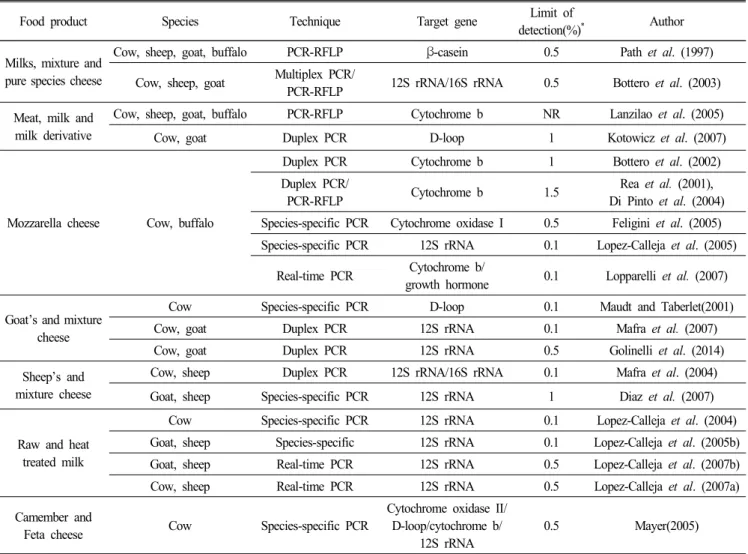
al., 2000; Mayer, 2005; Plath et al., 1997). DNA 증폭하는 방 법은 저온살균, 초고온살균, 분유 및 우유 카제인 등과 같은 열처리한 젖에서도 이용되며, 상표로 표시되지 않은 젖의 일 부 또는 전부가 혼입된 치즈는 PCR 방법에 의해 쉽게 탐색 될 수 있고, PCR에 근거한 낙농제품의 진위 판별에 적용된 방법을 Table 1에 나타냈다.
라벨에 원료표시가 확인된 전형적인 이탈리안 모짜렐라 치즈의 경우, 버펄로 젖으로만 만들어지는데, 이 모짜렐라 치 즈에 우유의 혼입은 위조치즈가 되므로 몇 가지 PCR 방법들 이 위조치즈를 검출하는 방법으로 개발되었다. Plath 등(1997) 은 소, 버펄로, 산양 및 양의 β-카제인 gene의 차이를 이용하 여 PCR-SSCP보다 높은 민감도를 가진 PCR-RFLP 방법을 개 발하여 양젖과 산양젖으로 만든 치즈 안에 혼입된 우유를 0.5%
(w/w)까지 탐지하였다. Lanzilo 등(2005)은 낙농산업에서 제 일 관심이 있는 소, 양, 산양 및 버펄로의 cytochrome b 유전 자 중에 92염기 DNA 순서를 비교 분석하여 만든 프라이머를 이용하여 275 bp의 공통 밴드를 찾은 후 3종류의 제한 효소 를 사용하여 각 종마다 차이가 나는 DNA 단편 패턴으로 소, 양, 산양 및 버펄로를 동시에 동정하는 PCR-RFLP 방법을 개 발하였다.
산양유 치즈에 우유를 넣어 만든 위조치즈를 검출하기 위 해 Maudet와 Taberlet(2001)은 미토콘드리아에 위치하는 12S rRNA유전자를 이용하여 species-specific PCR을 개발하여 모 델로 만든 산양유 치즈 속에 우유가 0.1%까지 들어 있는 것 을 탐지하였다. Di Pinto 등(2004)은 cytochrome b를 이용한 species- specific PCR 방법을 사용하면 1.5%까지 우유의 혼입 을 측정할 수 있으며, 이 방법을 이용하여 30개 모짜렐라 치 즈 제품 중 우유가 혼입된 22개 제품을 탐지할 수 있다고 보 고하였다. Feligini 등(2005)과 López-Calleja 등(2005)에 의하 면 더 민감도가 좋은 species-specific PCR 분석법으로 버펄로 젖으로 만든 치즈에 혼입된 우유를 각각 0.5%(W/W)와 0.1%(w/w) 까지 탐지할 수 있다고 보고하였다. 미토콘드리아의 12S rRNA 유전자를 이용한 species-specific PCR(López-Calleja et al., 2005) 방법으로 Días 등(2007)은 양젖 치즈에 산양유 젖이 혼입된 것을 0.1%(w/w)까지 측정할 수 있었다. Mayer(2005)는 species- specific PCR 방법은 우유를 탐지하는 매우 민감한 방법으로 심지어 우유가 혼합되어 만든 오래 숙성된 치즈에서도 우유를 탐지할 수 있고, 더욱이 가열된 우유와 가짜 치즈에 사용된 카 제인도 검출할 수 있다고 보고하였다. Maskova와 Paulickova (2006)은 산양젖과 양젖으로 만든 치즈 안에 들어 있는 우유 를 검출하기 위해 사용한 PCR 방법은 Invitek 회사에서 만든 Invisorb Spin Food I Kit을 이용하여 치즈에서 DNA를 분리 하고, 포유동물 특이성을 갖는 미토콘드리아에 있는 cytochrome b 유전자 염기서열을 이용하여 만든 species-specific 프라이머
로 PCR을 실시한 결과, 소는 274 bp 크기의 단편, 산양은 157 bp 크기의 단편 및 양은 331 bp 크기의 단편을 갖는 것으로 나타났다. 그리고 이 방법으로 순수한 산양젖에 우유를 넣어 만든 모델 시료에서 우유의 측정 한계는 1%(w/w)로 측정되었 다. 이 방법의 유효성을 검증하기 위해 체코, 슬로바키아, 프랑 스, 독일 및 이태리의 소매점에서 구입된 17개 종류 산양치즈 제품과 7개 종류의 양치즈 제품을 조사한 결과, 산양치즈 중 에서는 3종류 제품, 양치즈 중에서는 1개의 제품에서 우유가 검출되었다.
Duplex PCR 방법은 모짜렐라 치즈 안에 우유와 버펄로 젖 을 동시에 탐지하는 방법으로 cytochrome b 유전자를 이용하 여 버펄로 젖으로 만든 치즈에 우유의 혼입을 1%(w/w) 수준 까지 검출이 가능하며(Bottero et al., 2002; Rea et al., 2001), 또한 이 방법은 RFLP 방법으로 확인된 상업적으로 위조된 치 즈를 검출하는데도 적용되었다(Rea et al., 2001). Bottero 등 (2003)은 미토콘드리아의 12S와 16S rRNA 유전자를 이용하 여 개발된 mutiplex PCR 방법으로 치즈 속에 들어 있는 소, 산양 및 양의 젖은 동시에 탐지할 수 있었고, 참고 방법인 PCR-RFLP 방법을 통해 19개의 상업용 치즈제품 중 3개만이 양젖으로 만들어졌고, 이 중 1개의 시료에는 양젖이 없는 것을 확인할 수 있다고 보고하였다. Duplex PCR을 이용하는 경우 양젖 (Mafra et al., 2004)과 산양젖(Mafra et al., 2007)으로 만든 치 즈에서 우유의 혼입을 0.1%(w/w)까지 검출할 수 있었다. Mafra 등(2004)에 의하면 순수한 산양젖으로 만든 상표가 붙은 상 업용 치즈 9개 중에 3개가 우유가 혼입되고, 혼입된 우유의 양은 9~13%(w/w)로 검출되었다고 보고하였다. 또한 Mafra 등 (2007)은 미토콘드리아의 12S rRNA 유전자를 이용하여 만든 프라이머을 사용하여 양젖과 산양젖으로 만든 치즈에서 우유 을 검출하는 duplex PCR을 사용하였다. 이 방법으로 30-cycle duplex PCR을 하면 1~60% 사이의 우유를 정량할 수 있으며, 35-cycle duplex PCR을 하면 우유를 0.1%(w/w)까지 성공적으 로 검출할 수 있었다고 보고하고 있다. Bobkova 등(2009)은 양젖에 우유가 혼입되는 것을 탐지하기 위해 PCR 방법을 사 용하여 우유가 혼입된 양젖 시료 8개를 분석한 결과, 우유의 검출 한계는 0.01%로 나타났다. Zelenakova 등(2009)은 70개 시유와 치즈제품을 PCR 방법으로 분석한 결과, 20개 양젖 시 료 중 8개 시료에서 우유가 검출되었고, 30개의 양젖 치즈 중 에서는 12개 시료에서 우유가 검출되었다.
혼입된 우유의 양을 정량하기 위해 real-time PCR 방법을 이용하여 상업적으로 만든 모짜렐라 치즈에서 혼입된 우유 양을 검출할 수 있었다(Lopparelli et al., 2007). 또한 López-Calleja 등(2007)은 real-time PCR 방법을 이용하여 양젖에 혼입된 산 양젖을 0.6~1%(w/w)까지 정량할 수 있다고 보고하였으며, Lopez- Calleja 등(2007b)은 TapMan probe가 적용된 real-time PCR을
개발하여 양젖 속에 우유가 혼입된 경우, 우유를 0.5~10%(w/w) 까지 정량 할 수 있었다.
최근 Rodrigues 등(2012)에 의하면 브라질의 경우, duplex
PCR을 이용하여 산양유 내에 우유를 검출한계는 0.5%까지
이며, 66개의 산양유를 측정한 결과, 41.2%에서 우유가 검출 되었다고 보고하고 있고, Golinelli 등(2014)에 의하면 미토콘 드리아 12S rRNA 유전자를 목표로 만든 duplex PCR을 이용 하여 산양유 치즈에 들어있는 우유를 0.5%(vol/vol)까지 측정 이 가능하며, 지방에서 생산된 산양유 치즈 4종류 상표 20개 시료를 검사한 결과, 모두 우유가 혼입되어 있었고 심지어 라 벨에는 우유가 혼입되었다고 표시되지 않은 실정이나, 브라 질에서는 산양유 제품에 혼입된 우유를 검출하는 공식적인 방법이 없다고 보고하였다.
국내에서는 Lee와 Choi(2009)는 시유와 유제품에 들어 있 는 우유와 산양유를 측정하기 위해 미토콘드리아의 12S rRNA 유전자를 이용하여 만든 프라이머을 사용하여 duplex PCR을 실시한 결과, 4개 시유, 3개 요구르트는 표시된 라벨과 제품 성분이 일치하였으나, 산양유 조제분유제품 3개 중 1개, 우유 조제전지분유 4개중 1개가 라벨에 표시된 것과 일치하지 않 았으며, duplex PCR 방법으로 산양유에 들어 있는 우유의 검 출 한계는 0.1%까지로 나타내었다고 보고하였다. 한편, Jung 등(2011)은 Real Time-PCR을 이용하여 우유와 산양유 혼합 물과 산양유 제품에서 우유의 양을 정량한 결과, 1개의 산양 유 시유에서는 1.8% 우유가 검출되었고, 3개의 산양유 분유 에서 2개의 제품에서 각각 9.6%와 11.6%의 우유가 검출되었 다. 이 RT-PCR 방법의 우유의 검출 한계는 0.1%로 나타났다.
유럽의 경우, 낙농제품 특히, 양젖과 산양젖 치즈에 우유 가 혼입되거나, 우유로 만들어진 가짜 치즈가 많이 유통하므 로 이들 식품에서 우유의 검출 및 정량을 측정하는 데 PCR 방 법을 적용하는 연구가 많이 되고 있는 반면, 국내에서는 duplex PCR과 real-time PCR을 이용해서 산양 제품에 우유의 혼입을 검출하는 연구가 되어 있는 실정이다. 우리나라에서도 수입 되는 외국 낙농제품과 국내 제품에 대한 관리, 감독을 강화해 나가야 할 시점에서 민감도와 반복성이 좋은 PCR 방법을 낙 농제품의 진위 판별에 적용하는 것은 매우 유용할 것으로 생 각된다.
결 론
시유와 유제품에 표시된 라벨이 아닌 다른 젖으로 제조하 거나, 혼입된 가짜 제품은 소비자를 속이거나 알러지에 민감 한 소비자의 경우 더 큰 피해를 보게 되므로 제품의 진위를 판별하는 것은 매우 중요하다. 품종을 구별하는데 목표로 하 는 프라이머 유전자를 보면 미토콘드리아 내에 포유동물에서
Table 1. Summary of PCR-based methods applied in the authentication of dairy products
Food product Species Technique Target gene Limit of
detection(%)* Author Milks, mixture and
pure species cheese
Cow, sheep, goat, buffalo PCR-RFLP β-casein 0.5 Path et al. (1997)
Cow, sheep, goat Multiplex PCR/
PCR-RFLP 12S rRNA/16S rRNA 0.5 Bottero et al. (2003) Meat, milk and
milk derivative
Cow, sheep, goat, buffalo PCR-RFLP Cytochrome b NR Lanzilao et al. (2005)
Cow, goat Duplex PCR D-loop 1 Kotowicz et al. (2007)
Mozzarella cheese Cow, buffalo
Duplex PCR Cytochrome b 1 Bottero et al. (2002)
Duplex PCR/
PCR-RFLP Cytochrome b 1.5 Rea et al. (2001),
Di Pinto et al. (2004) Species-specific PCR Cytochrome oxidase I 0.5 Feligini et al. (2005) Species-specific PCR 12S rRNA 0.1 Lopez-Calleja et al. (2005)
Real-time PCR Cytochrome b/
growth hormone 0.1 Lopparelli et al. (2007) Goat’s and mixture
cheese
Cow Species-specific PCR D-loop 0.1 Maudt and Taberlet(2001)
Cow, goat Duplex PCR 12S rRNA 0.1 Mafra et al. (2007)
Cow, goat Duplex PCR 12S rRNA 0.5 Golinelli et al. (2014)
Sheep’s and mixture cheese
Cow, sheep Duplex PCR 12S rRNA/16S rRNA 0.1 Mafra et al. (2004)
Goat, sheep Species-specific PCR 12S rRNA 1 Diaz et al. (2007)
Raw and heat treated milk
Cow Species-specific PCR 12S rRNA 0.1 Lopez-Calleja et al. (2004)
Goat, sheep Species-specific 12S rRNA 0.1 Lopez-Calleja et al. (2005b)
Goat, sheep Real-time PCR 12S rRNA 0.5 Lopez-Calleja et al. (2007b)
Cow, sheep Real-time PCR 12S rRNA 0.5 Lopez-Calleja et al. (2007a)
Camember and
Feta cheese Cow Species-specific PCR
Cytochrome oxidase II/
D-loop/cytochrome b/
12S rRNA
0.5 Mayer(2005)
NR: not reported
* Values in percentage are expressed on a weight by weight basis.
Source: Mafra et al. (2008)
매우 특이성이 있는 cytochrome b 유전자를 비롯하여 12S rRNA 및 16S rRNA가 폭 넓게 사용되고 있다. 시유와 낙농제품의 진위 판별과 정량뿐만 아니라, 품종의 기원을 동정하는데 많 이 사용되는 PCR 방법(ristriction fragment length polymorphisms (PCR-RFLP), multiplex PCR, species-specific PCR 및 real-time
PCR)은 높은 특이성과 민감도를 갖고 신속히 측정할 수 있
는 장점이 있어 시유 및 낙농제품에 많은 활용이 기대된다.
참고문헌
1. Anklam, E., Gadani, F., Heinze, P., Pijnenburg, H. and Vanden Eede, G. 2002. Analytical methods for detection and deter- mination of genetically modified organisms in agricultural crops and plant-derived food products. Eur. Food Res. Technol.
214:3-26.
2. Ballin, N. Z. 2010. Authentication of meat and meat products.
Meat Sci. 86:577-587.
3. Bania, J., Ugorski, M., Polanowski, A. and Adamczyk, E.
2001. Application of polymerase chain reaction for detection of goats milk adulteration by milk of cow. J. Dairy Res.
68:333-336.
4. Bobková, A., Židek, R., Flimelová, E., Bobko, M. and Fiková, M. 2009. Application of PCR method for milk adulteration and milk products identification. Potravinárstvo 3:1-3.
5. Bottero, M. T., Civera, T., Anastasio, A., Turi, R. M. and Rosati, S. 2002. Identification of cows’ milk in Buffalo cheese by duplex polymerase chain reaction. J. Food Prot.
65:362-366.
6. Bottero, M. T., Civera, T., Nucera, D., Rosati, S., Sacchi, P. and Turi, R. M. 2003a. A multiplex polymerase chain reaction for the identification of cows, goats and sheep’s milk in dairy products. Int. Dairy J. 13:277-282.
7. Bottero, M. T. and Dalmasso, A. 2011. Animal species identification in food products: Evolution of biomolecular methods. Vet. J. 190:34-38.
8. Branciari, R., Nijman, I. J., Plas, M. E., Di Antonio, E. and Lenstra, J. A. 2000. Species origin of milk in Italian Mozarella and Greek Feta cheese. J. Food Prot. 63:408-411.
9. Calvo, J. H., Zaragoza, P. and Osta, R. 2001. Random am- plified polymorphic DNA fingerprints for identification of species in poultry pâté. Poult. Sci. 80:522-524.
10. Cheftel, J. C. 2005. Food and nutrition labelling in the European Union. Food Chemistry 93:531-550.
11. Colak, H., Aydin, A., Nazli, B. and Ergun, O. 2006. Detec- tion of presence of cow's milk in sheep's cheeses by immuno- chromatography. Food Control 17:905-908.
12. Comi, G., Iacumin L., Rantsiou, K., Cantoni, C. and Cocolin, L. 2005. Molecular methods for the differentiation of species used in production of cod-fish can detect commercial frauds.
Food Control 16:37-42.
13. Dalmasso, A., Fontanella, E., Piatti, P., Civera, T., Rosati, S. and Bottero, M. T. 2004. A multiplex PCR assay for the identification of animal species in feedstuffs. Mol. Cell Probes.
18:81-87.
14. Darwish, S. F., Allam, H. A. and Amin, A. S. 2009. Evaluation of PCR assay for detection of cow's milk in water Buffalo's milk. World Appl. Sci. J. 7:461-467.
15. Dennis, M. J. 1998. Recent developments in food authenti- cation. Analyst. 123:151R-156R.
16. Díaz, I. L. C., Alonso, I. G., Fajardo, V., Martin, I., Hernandez, P., Lacarra, T. G. and de Santos, R. M. 2007. Application of a polymerase chain reaction to detect adulteration of ovine cheeses with caprine milk. Eur. Food Res. Technol.
225:345-349.
17. Di Pinto, A., Conversano, M. C., Forte, V. T., Novello, L.
and Tantillo, G. M. 2004. Detection of cow milk in buffalo ''Mozzarella'' by polymerase chain reaction (PCR) assay. J Food Qual. 27:428-435.
18. De La Fuente, M. A. and Juárez, M. 2005. Authenticity assessment of dairy products. Crit. Rev. Food Sci. Nutr.
45:563-585.
19. Enne, G., Elez, D., Fondrini, F., Bonizzi, I., Feligini, M.
and Aleandri, R. 2005. High-performance liquid chroma- tography of governing liquid to detect illegal bovine milk addition in water buffalo Mozzarella: Comparison with results from raw milk and cheese matrix. J. Chromatogr. A 1094(1-2):169-178.
20. Fabrice, T., Celia, M. and Catherine, H. 2005. Food and forensic molecular identification: Update and challenges, TRENDS in Biotech. 23:359-366.
21. Fajardo, V., González, I., Rojas, M., García, T. and Martín, R. 2010. A review of current PCR-based methodologies for the authentication of meats from game animal species.
Trends in Food Sci. Technol. 21:408-421.
22. Feligini, M., Bonizzi, I., Curik, V. C., Parma, P., Greppi, G. F. and Enne, G. 2005. Detection of adulteration in Italian Mozzarella cheese using mitochondrial DNA templates as biomarkers. Food Technol. Biotech. 43:91-95.
23. Folmer, O., Black, M., Hoeh, W., Lutz, R. and Vrijenhoek, R. 1994. DNA primers for amplification of mitochondrial cytochrome C oxidase subunit I from diverse metazoan invertebrates, Mol. Mar. Bio. and Biotech. 3:294-299.
24. Gachet, E., Martin, G. G., Vigneau, F. and Meyer, G. 1999.
Detection of genetically modified organisms (GMOs) by PCR: a brief review of methodologies available. Trends Food Sci. Technol. 9:380-388.
25. García-Cañas, V., Cifuentes A. and González, R. 2004. Detec- tion of genetically modified organisms in foods by DNA amplification techniques. Crit. Rev. Food Sci. Nut. 44:425- 436.
26. Girish, P. S, Anjaneyulu, A. S., Viswas, K. N., Santhosh, F. H., Bhilegaonkar, K. N., Agarwal, R. K., Kondaiah, N.
and Nagappa, K. 2007. Polymerase chain reaction-restriction fragment length polymorphism of mitochondrial 12S rRNA gene: a simple method for identification of poultry meat species. Vet. Res. Commun. 31:447-455.
27. Golinelli, L. P., Carvalho, A. C., Casaes, R. S., Lopes, C.
S., Deliza, R., Paschoalin, V. M. and Silva, J. T. 2014.
Sensory analysis and species-specific PCR detect bovine milk adulteration of frescal (fresh) goat cheese. J. Dairy Sci. 97:6693-6699.
28. Ha, J. C., Jung, W. T., Nam, Y. S. and Moon, T. W. 2006.
PCR identification of ruminant tissue in raw and heat-treated meat meals. J. Food Prot. 69:2241-2247.
29. Halken, S. 2003. Early sensitization and development of allergic airway disease risk factors and predictors. Paediatr
Respir Rev. 4:128-134.
20. Hebert, P. D., Cywinska A., Ball S. L. and deWaard, J. R.
2003. Biological identifications through DNA Barcodes.
Proc. Biol. Sci. 270:313-321.
21. Herman, L. 2001. Determination of the animal origin of raw food by species-specific PCR. J. Dairy Res. 68:429-436.
22. Herrero-Martinez, J. M., Simo-Afonso, E. F., Ramis-Ramos, G., Gelfi, C. and Righetti, P. G. 2000. Determination of cow´s milk in non-bovine and mixed cheeses by capillary electrophoresis of whey proteins in acidic isoelectric buffers.
J. Chromatogr. A. 878:261-271.
23. Hurley, I. P., Coleman, R. C., Ireland, H. E. and Williams, J. H. H. 2004. Measurement of bovine IgG by indirect competitive ELISA as a means of detecting milk adulteration.
J. Dairy Sci. 87:215-221.
24. Jung, Y. K., Jhon, D. Y., Kim, K. H. and Hong, Y. H. 2011.
Quantitative detection of cow milk in goat milk mixtures by real-time PCR. Korean J. Food Sci. Ani. Resour. 31:
827-833.
25. Karoui, R. and Baerdemaeker, J. D. 2007. A review of the analytical methods coupled with chemometric tools for the determination of the quality and identity of dairy products.
Food Chem. 102:621-640.
26. Klotz, A. and Einspanier, R. 2001. Development of a DNA based screening method to detect cow milk in ewe, goat and buffalo milk and dairy products using PCR-LCR-EIA- technique. Milchwissenschaft-Milk Sci. Int. 56:67-70.
27. Kocher, T. D., Thomas, W. K., Meyer, A., Edwards, S. V., Paabo, S. and Vellablanca, F. X. 1989. Dynamics of mito- chondrial DNA evolution in animals: Amplification and sequencing with conserved primers, Proc. Natl. Acad. Sci.
86:6196-6200.
28. Kotowicz, M., Adamczyk, E. and Bania, J. 2007. Application of a duplex-PCR for detection of cows’ milk in goats’ milk.
Ann. Agric. Environ. Med. 14:215-218.
29. Lanzilao, I., Burgalassi, F., Fancelli, S., Settimelli, M. and Fani, R. 2005. Polymerase chain reaction-restriction fragment length polymorphism analysis of mitochondrial cyt b gene from species of dairy interest. J. AOAC Int. 88:128-135.
30. Laube, I., Spiegelberg, A., Butschke, A., Zagon, J., Schauzu, M., Kroh, L. and Broll, H. 2003. Methods for the detection of beef and pork in foods using real-time polymerase chain reaction. Food Sci. Technol. Int. 38:111-118.
31. Lee, S. B. and Choi, S. H. 2009. Rapid identification of cow
and goat milk in milk products using a duplex PCR Tech- nique. Korean J. Food Sci. Ani. Resour. 29:647-652.
32. Levin, R. E. 2004. The application of real-time PCR to food and agricultural systems. A review. Food Biotechnology 18:97-133.
33. Lipkin, E., Shalom, A., Khatib, H., Soller, M. and Friedmann, A. 1993. Milk as a source of deoxyribonucleic acid and substrate for the polymerase chain reaction. J. Dairy Sci.
76:2025-2032.
34. Lockey, A. K. and Bardsley, R. G. 2000. DNA based-methods for food authentication. Trends Food Sci. Technol. 11:67-77.
35. López-Calleja, I., González, I., Fajardo, V., Rodríguezn M.
A., Hernández, P. E., García, T. and Martín, R. 2007b.
Quantitative detection of goats' milk in sheep's milk by realtime PCR. Food Control 18:1466-1473.
36. López-Callejaa, I., González, I., Fajardoa, V., Martína, I., Hernándeza, P. E., García, T. and Martín, R. 2007a. Realtime TaqMan PCR for quantitative detection of cows’ milk in ewes’ milk mixtures. Int. Dairy J. 17:729-736.
37. López-Calleja, I., González, A. I., Fajardo, V., Rodríguez, M. A., Hernández, P. E. and García, T. 2005a. Application of polymerase chain reaction to detect adulteration of sheep’s milk with goats’ milk. J. Dairy Sci. 88:3115-3120.
38. López-Calleja, I., González, A. I., Fajardo, V., Rodríguez, M. A., Hernández, P. E. and García, T. 2005b. PCR detection of cows’ milk in water buffalo milk and Mozzarella cheese.
Int. Dairy J. 15:1122-1129.
39. López-Calleja, I., González I., Fajardo V., Rodríguez, M.
A., Hernández P. E., García, T. and Martín, R. 2004. Rapid detection of cows’ milk in sheeps’ and goats’ milk by a species-specific polymerase chain reaction technique. J.
Dairy Sci. 87:2839-2845.
40. Lopparelli, R. M., Cardazzo, B., Balzan, S., Giaccone, V.
and Novelli, E. 2007. Real-time TaqMan polymerase chain reaction detection and quantification of cow DNA in pure water buffalo Mozzarella cheese: method validation and its application on commercial samples. J. Agric. Food Chem.
55:3429-3434.
41. Mafra, I., Ferreira, M. P. L. V. O. I., Faria, M. A. and Oliveira, B. P. P. 2004. A novel approach to the quanti- fication of bovine milk in ovine cheeses using a duplex polymerase chain reaction method. J. Agric. Food Chem.
52:4943-4947.
42. Mafra, I., Ferreira, I. M. P. L. V. O. and Oliveira, M. B.
P. P. 2008. Food authentication by PCR-based methods, Eur Food Res. Technol. 227:649-665.
43. Mafra, I., Roxo, A., Ferreira, I. M. P. L. V. O. and Oliveira, M. B. P. P. 2007. A duplex polymerase chain reaction for the quantitative detection of cows’ milk in goats’ milk cheese. Int. Dairy J. 17:1132-1138.
44. Martín, I., García, T., Fajardo, V., López-Calleja, I., Rojas, M., Pavón, M. A., Hernández, P. E., González, I. and Martín, R. 2007a. Technical note: detection of chicken, turkey, duck, and goose tissues in feedstuffs using species-specific polymerase chain reaction. J. Anim. Sci. 85:452-458.
45. Martín, I., García, T., Fajardo, V., Rojas, M., Hernández, P. E., González, I. and Martín, R. 2007b. Technical note:
Detection of cat, dog, and rat or mouse tissues in food and animal feed using species- specific polymerase chain reaction.
J. Anim. Sci. 85:2734-2739.
46. Maskova, E. and Paulickova, I. 2006. PCR-based detection of cow's milk in goat and sheep cheeses marketed in the Czech Republic. Czech J. Food Sci. 24:127-132.
47. Matsunaga, T., Chikuni, K., Tanabe, R., Muroya, S., Shibata, K., Yamada, Y. and Shinmura, Y. 1999. A quick and simple method for the identication of meat species and meat pro- ducts by PCR assay. Meat Science 51:143-148.
48. Maudet, C. and Taberlet, P. 2001. Detection of cows' milk in goats' cheeses inferred from mitochondrial DNA poly- morphism. J. Dairy Res. 68:229-235.
49. Maudet, C. and Taberlet, P. 2002. Holstein’s milk detection in cheeses inferred from Melanocortin Receptor 1 (MC1R).
gene polymorphism. J. Dairy Sci. 85:707-715.
50. Mayer, H. K. 2005. Milk species identification in cheese varieties using electrophoretic, chromatographic and PCR techniques. Int. Dairy J. 15:595-604.
51. Mininni, A. N., Pellizzari, C., Cardazzo, B., Carraro, L., Balzan, S. and Novelli, E. 2009. Evaluation of real-time PCR assays for detection and quantification of fraudulent addition of bovine milk to caprine and ovine milk for cheese manufacture. Int. Dairy J. 19:617-623.
52. Miraglia, M., Berdal, K. G., Brera, C., Corbisier, P., Holst- Jensen, A., Kok, E., Marvin, H. J. P., Schimmel, H., Rentsch, J., van Rie, J. P. and Zagon, J. 2004. Detection and traceability of genetically modified organisms in the food production chain. Food Chem. Toxicol. 42:1157-1180.
53. Mitani, T., Akane A., Tokiyasu, T., Yoshimura, S., Okii Y.
and Yoshida, M. 2009. Identification of animal species
using the partial sequences in the mitochondrial 16S rRNA Gene, Legal Med.(Tokyo) 11:S449-450.
54. Monaghan, M. T., Balke, M., Gregory, T. R. and Vogler, A. P. 2005. DNA-based species delineation in tropical beetles using mitochondrial and nuclear markers, Philos.
Trans. R. Soc. Biol. Sci. 360:1925-1933.
55. Montiel-Sosa, J. F., Ruiz-Pesini, E., Montoya, J., Roncalés, P., López-Pérez, M. J. and Pérez-Martos, A. 2000. Direct and highly species-specific detection of pork meat and fat in meat products by PCR amplification of mitochondrial DNA. J. Agric. Food Chem. 48: 2829-2832.
56. Nicolaou, N., Xu, Y. and Goodacre, R. 2011. MALDI-MS and multivariate analysis for the detection and quantification of different milk species. Anal. Bioanal. Chem. 399:3491- 3502.
57. Park, K. S. and Yoon, H. S. 2012. Identification of raw materials in processed meat products by PCR using species- specific primer. J. Food Hyg. Safety 27:68-73.
58. Pascoal, A., Prado, M., Castro, J., Cepeda, A. and Barros- Velázquez, J. 2004. Survey of authenticity of meat species in food products subjected to different technological pro- cesses, by means of PCR-RFLP analysis. Eur. Food Res.
Technol. 218:306-312.
59. Pfeiffer, I., Burger, J. and Brenig, B. 2004. Diagnostic polymorphisms in the mitochondrial cytochrome b gene allow discrimination between cattle, sheep, goat, roe buck and deer by PCR-RFLP. BMC Genet. 5:30-35.
60. Rastogi, G., Dharne, M. S., Walujkar, S., Kumar, A., Patole, M. S., Shouche, Y. S. 2007. Species identification and authentication of tissues of animal origin using mitochondrial and nuclear markers. Meat Sci. 76:666-674.
61. Rea, S., Chikuni, K., Branciari, R., Sangamayya, R. S., Ranucci, D. and Avellini, P. 2001. Use of duplex polymerase chain reaction (duplex-PCR) technique to identify bovine and water buffalo milk used in making Mozzarella cheese. J.
Dairy Res. 68:689-698.
62. Plath, A., Krause, I. and Einspanier, R. 1997. Species iden- tification in dairy products by three different DNA based techniques. Zeitschrift Fur Lebensmittel-Untersuchung Und- Forschung. 205:437-441.
63. Rodrigues, N. P., Givisiez, P. E., Queiroga, R. C., Azevedo, P. S., Gebreyes, W. A. and Oliveira, C. J. 2012. Milk adulteration: Detection of bovine milk in bulk goat milk produced by small holders in northeastern Brazil by a
duplex PCR assay. J. Dairy Sci. 95:2749-2752.
64. Saiki, R. K., Scharf, S. J., Faloona, F., Mullis, K. B., Horn, G. T., Erlich, H. A. and Arnhcim, N. 1985. Enzymatic ampli- fication of beta-globulin genomic sequences and restriction site analysis for diagnosis of sickle cell anemia. Sci. 230:
1350-1354.
65. Sampson, H. A. 2003. Food allergy. J. Allergy Clin. Immunol.
111:S540-S547.
66. Santos, J., Fernandes, P. and Bardsley, E. R. 2003. Portuguese
"PDO" cheese and species origin of milk. Electron. J. Environ.
Agric. Food Chem. 2:476-479.
67. Shatenstein, B. and Ghadirian, P. 1998. Influences on diet, health behaviors and their outcome in select ethnocultural and religious groups. Nutrition 14:223-230.
68. Stanciuc, N. and Rapeanu G. 2010. Identification of adulterated sheep and goat cheeses marketed in Romania by immuno- cromatographic assay. Food Agr. Immunol. 21:157-164.
69. Tanabe, S., Miyauchi, E., Muneshige, A., Mio K., Sato, C.
and Sato, M. 2007. PCR method of detecting pork in foods for verifying allergen labeling and for identifying hidden pork ingredients in processed foods. Biosci. Biotechnol. Biochem.
71:1663-1667.
70. Taylor, J. F., Eggen, A., Aleyasin A., Armitage, S. M., Barendse, W., Beever, J. E., Bishop, M. D., Brenneman, R. A., Burns, B. M., Davis, S. K., Elo, K., Harizius, B., Kappes, S. M., Keele, J. W., Kemp, S. J., Kirkpatrick B. W., Lewin, H. A., Ma, R. Z., McGrwa, R. A., Pomp, D., Stone, R. T., Sugimoto, Y., Teale, A. J., Vaiman, D., Vilkki, J., Williams, J. L., Yeh, C-C. and Zanotti, M. C. 1998. Report of the first workshop on the genetic map of bovine chromosome 1. Animal Genet.
29:228-235.
71. Teletchea, F., Maudet, C. and Hanni, C. 2005. Food and forensic molecular identification: Update and challenges.
Trends Biotechnol. 23:359-366.
72. Tobe, S. S. and Linacre, A. M. 2008. A multiplex assay to
identify 18 European mammal species from mixtures using the mitochondrial cytochrome b gene. Electrophoresis 29:
340-347.
73. Ulberth, F. 2003. In: Lees M (ed) Food authenticity and traceability, chap. 16. Woodhead Publishing Limited, Cam- bridge.
74. Veloso, A., Teixeira, N. and Ferreira, I. 2002. Separation and quantification of the major casein fractions by reverse- phase high-performance liquid chromatography and urea poly- acrylamide gel electrophoresis. Detection of milk adulterations.
J. Chromatogr. A. 967:209-218.
75. Wang, H. Y., Tsai M. P., Tu, M. C. and Lee, S. C. 2000.
Universal primers for amplification of the complete mito- chondrial 12S rRNA gene in vertebrates. Zool. Studies. 39:
61-66.
76. Wiseman, G. 2002. State of the art and limitations of quan- titative polymerase chain reaction. J. AOAC Int. 85:792-796.
77. Wolf, C., Rentsch, J. and Hübner, P. 1999. PCR-RFLP analysis of mitochondrial DNA: A reliable method for species identification. J. Agric. Food Chem. 47:1350-1355.
78. Woolfe, M. and Primrose, S. 2004. Food forensics: using DNA technology to combat misdescription and fraud. Trends Biotechnol. 22:222-226.
79. Xue, H., Hu, W., Son, H., Han, Y. and Yang, Z. 2010.
Indirect ELISA for detection and quantification of bovine milk in goat milk. J. Food Sci. Technol. 31:370-373.
80. Zelenakova, L., Golian, J. and Zajac, P. 2008. Application of ELISA tests for the detection of goat milk in sheep milk.
Milchwissenschaft. 63:137-141.
81. Zeleňáková, L., Šesták, M. and Židek, R. 2009. Monitoring of sheep milk and milk products adulteration on common european food market. Potravinárstvo 3:69-73.
Received October 17, 2015 Revised November 27, 2015 Accepted December 2, 2015