• 검색 결과가 없습니다.

PCR-RFLP for the Identification of Mammalian Livestock Animal Species

N/A
N/A
Protected

Academic year: 2021

Share "PCR-RFLP for the Identification of Mammalian Livestock Animal Species"

Copied!
6
0
0

로드 중.... (전체 텍스트 보기)

전체 글

(1)

http://dx.doi.org/10.12750/JET.2013.28.4.355

PCR-RFLP for the Identification of Mammalian Livestock Animal Species

Sang-Hyun Han

1,2

, Seon-mi Park

2

, Hong-Shik Oh

2

, Geunho Kang

3

, Beom-Young Park

3

, Moon-Suck Ko

4

, Sang-Rae Cho

4

, Yong-Jun Kang

4

, Sang-Geum Kim

4

and In-Cheol Cho

4,†

1

Educational Science Research Institute, Jeju National University, Jeju 690-756, Korea

2

Department of Science Education, Jeju National University, Jeju 690-756, Korea

3

Animal Products Research and Development Division, National Institute of Animal Science, Suwon 441-706, Korea

4

Subtropical Animal Experiment Station, National Institute of Animal Science, Jeju 690-150, Korea

ABSTRACT

Precise, rapid and simple methods for species identification in animals are among the most important techniques in the livestock industry and research fields including meat classification. In this study, polymerase chain reaction (PCR) based molecular identification using inter species polymorphisms were examined by PCR-restriction fragment length polymorphism (RFLP) analysis for mitochondrial DNA (mtDNA) cytochrome b (CYTB) gene sequences among four mammalian livestock animals (cattle, horse, goat and pig). The results from PCR-RFLP analysis using the AluI restriction enzyme were also provided for the species-specific band patterns among CYTB gene sequences in these four species. The AluI-digestion for CYTB genes provided interesting migration patterns differentially displayed according to each species. Cattle and horse had one AluI-recognition site at different nucleotide positions and their AluI-digested fragments showed different band patterns on the gels. Pig had two AluI-recognition sites within the amplified CYTB sequences and produced three bands on the gels. Goat had no AluI-recognition site and was located at the same position as the uncut PCR product. The results showed the species-specific band patterns on a single gel among the four livestock animal species by AluI-RFLP. In addition, the results from blind tests for the meat samples collected from providers without any records showed the identical information on the species recorded by observing their phenotypes before slaughter. The application of this PCR-RFLP method can be useful and provide rapid, simple, and clear information regarding species identification for various tissue samples originating from tested livestock species.

(Key words : species identification, PCR-RFLP, restriction digestion, CYTB, livestock animals)

This work was supported by a grant (Project no. PJ009231) from Rural Development Administration, Republic of Korea.

Correspondence : E-mail : [email protected]

INTRODUCTION

Species identification in meat and processed foods is impor- tant to verify the source animal for consumers. Recently, the use of horse meat instead of beef for fast foods has led to social problems worldwide. In addition, the authentication of the animal’s country of origin is a topic in international trade.

Species identification is very important in providing the clear evidence for food safety and insurance purposes and ensures compliance with food labeling laws. Molecular methods for species identification using DNA samples extracted from various sample sources are usually deemed credible for economic, pu- blic health, forensic, scientific, or other industrial purposes (Zehner et al., 1998; Bataille et al., 1999; Kusama et al., 2004; Khairalla et al., 2007; Jonker et al., 2008; El-Sayed et al., 2010; Ali et al., 2012; Santos et al., 2012).

Recent reports have described new methods developed for species identification based on genetic differences between species using PCR techniques. The proteins in meat, dairy, and processed products have been analyzed for species identifica- tion using electrophoresis, immunological methods, and so on.

But, the protein methods are not suitable because the proteins can be easily lost or degraded by heating, high pressure, and other operations during food processing (Bottero et al., 2003;

Rodríguez et al., 2004; Rao and Hsieh, 2007; Yarmand and

Homayouni, 2010; Şakalar et al., 2012). Some reports tried to

identify the species using the differences of fatty acid composi-

tion between species, but scientists have concluded that the

differences in composition of various fats may result from

differential rates of growth of fatty tissues and other animal

conditions (Shorland, 1953; Marchello and Cramer, 1963; Payne,

1971). DNA is more stable than proteins during heat proce-

(2)

Table 1. Primers used for PCR amplification of mtDNA CYTB gene sequences

Gene Primer name Nucleotide sequence (5’ → 3’) Standard sequence

Acc. No. Reference

CYTB BESH_F CTGTTACTCACATCTGCCGAGACG DQ186238 Cai et al. (2007)

BESH_F AATCGGGTAAGGGTTGCTTTGTC AJ002189 Ursing and Arnason (1998)

AY522328 Han et al. (2004) DQ089475 Chen et al. (2005) ssing and recent DNA techniques based on PCR allow the

identification of DNA from different species present in a sample. To date, PCR-based molecular identification has been used for tissues from living animals, carcasses, embryo-derived cells, carcass remains and meat-derived products (Zehner et al., 1998; Marfa et al., 2004; López-Andreo et al., 2005; Zhang et al., 2007; Jung et al., 2011; Koh et al., 2011, 2012).

In order to develop a precise, rapid, and simple method of species identification among mammalian livestock animals, a molecular method was examined by PCR-RFLP for mtDNA CYTB gene sequences among cattle, horse, goat, and pig.

MATERIALS AND METHODS

1. Animal Samples and DNA Extraction

A total of 502 DNA samples from four livestock animal species (cattle, horse, pig and goat) were used in this study.

Among those, meat samples (n=276) with species information were randomly collected from retail markets in the Seoul, Gyeonggi-do, and the Jeju-do provinces in South Korea. DNA samples (n=80), species certified, were kindly provided by researchers with the Subtropical Animal Experiment Station, National Institute of Animal Science. For the blind test, the meat pieces (n=146) isolated from carcasses and species infor- mation were separately provided from professional meat-quality graders at the Animal Products Grading Service in a slaughter- house in the Jeju-do province, South Korea. DNA was extracted from the meat using standard techniques (Sambrook et al., 1989) with slight modification. Isolated DNA was diluted to approximately 100 ng/ul in TE buffer and used for PCR analy- sis as a template.

2. Universal Primer Designation

Universal primers were designed to amplify the mtDNA CYTB gene sequences of the animals used in this study. Stan- dard CYTB sequences used for primer designation were obtained

from the National Center for Biotechnology Information (NCBI, http://www.ncbi.nlm.nih.gov/) database. After multiple alignmen- ts using the CLUSTAL W program (Thompson et al., 1994), highly conserved sequence regions were selected to design the primers from the sequences. The information for the primers and standard sequences is shown in Table 1.

3. PCR Amplification and DNA Sequencing

PCR was performed using 25 ul of reaction mixture inclu- ding 100 ng of DNA, 1.0 nmole of each primer, and 2.0 units of i-Taq DNA polymerase (Intron Biotechnology, Korea). PCR conditions included initial heating at 95 ℃ for 3 min, 40 cycles of 45 s for denaturation at 94 ℃, 45 s for annealing at 55℃, and 60 s for extension at 72 ℃, followed by a 5 min extension at 72 ℃. PCR reaction was carried out in a PTC-200 thermal cycler (Bio-Rad, USA). The PCR products were separated on agarose gels containing ethidium bromide (EtBr) and visuali- zed by UV-illumination. The PCR products were purified with a QIAEX II Gel Extraction Kit (Qiagen, USA), and directly sequenced with a MegaBase1,000 automated sequencer (Amer- sham-Pharmacia, USA). Using a BLAST search, we compared the sequences with those previously reported in the NCBI data- base.

4. PCR-RFLP Analysis

The amplified CYTB fragments were digested in indepen- dent reactions using the different restriction enzymes AluI, Hae- III, MspI, RsaI and Tsp509I. RFLP was performed using 20 ul of reaction mixture including 5 ul of PCR product, and 5.0 units of each restriction enzyme (New England BioLabs, USA).

The reaction solution were incubated at 37 ℃ (AluI, HaeIII, MspI and RsaI) or 65 ℃ (Tsp509I) for two hours. These enzymes were chosen from the results of preliminary recognition site analysis using the Webcutter 2.0 (http://users.unimi.it/~camelot /tools/cut2.html) and the NEBcutter v.2.0 (http://tools.neb.com/

NEBcutter2/index.php). Two-replicate PCR-RFLP tests for all

(3)

Fig. 2. Multiple alignments for CYTB gene sequences in the four livestock animals (cattle, horse, pig, and goat) tested in this study.

Underlined and bold sequences indicate the primer-binding sites and the recognition sites against AluI restriction enzyme, respec- tively. Asterisks are the consensus sequences found among the four animal species.

samples were separated on agarose gels and visualized. The di- gests were separated on 2.5% agarose gels containing EtBr and visualized by UV-illumination.

RESULTS

1. PCR-RFLP Polymorphisms of CYTB Gene

The PCR products were amplified as a single band from DNA samples of the meats from four animal species using a pair of universal primers designed for the study. Among the five restriction enzymes, all except the AluI produced polymor- phic patterns within populations of the species (data not shown).

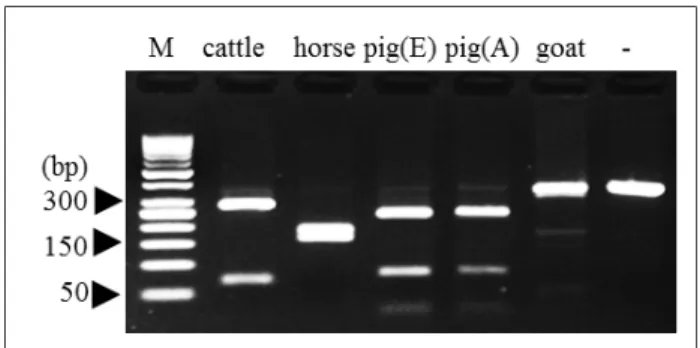
The other four enzymes (HaeIII, MspI, RsaI, and Tsp509I) were excluded for the final test. CYTB fragments digested by AluI have not shown polymorphism within intra-species levels and, furthermore, provided distinguishable band patterns among the four animal species. In addition, pigs originated from the two maternal lineages, Asian origin and European origin pre- viously documented by Han et al. (2011), were also tested, but the AluI-digested fragments from both lineages did not show different band pattern (Fig. 1).

2. Comparison of CYTB Sequences

Fig. 2 shows the results of multiple alignments among the CYTB sequences obtained from DNA sequencing. The sequen- ces had different numbers or different nucleotide positions of AluI-recognition sequence according to the species. The CYTB

Fig. 1. AluI-RFLP patterns detected in four livestock animal spe- cies (cattle, horse, pig, and goat). Pig(E) and Pig(A) repre- sent the pigs from European origin and Asian origin pos- tulated by Han et al. (2011), respectively. The dash on the top of last column indicates the negative control uncut PCR product. M is the DNA size marker (50-bp DNA Ladder).

sequences from cattle and horse had one AluI-recognition site at different nucleotide positions, and AluI-digested fragments separated into two bands showing different lengths on the gels.

The AluI-digested fragments showed 66-bp and 274-bp bands

in cattle, and 160-bp and 180-bp bands in horse. The goat

CYTB sequence, which showed no AluI recognition site, did

not produce a digested band, and the CYTB fragment located

at the same position (340-bp) as the negative control uncut

PCR product. The pig CYTB sequence had two AluI-recogni-

tion sites within 340-bp products and the AluI-digested frag-

ments showed three bands (27-bp, 79-bp, and 234-bp) on the

(4)

Table 3. Blind test results by AluI-RFLP for unidentified carcass samples

Sample No. of animals identified

Cattle Horse Pig Goat

Carcass samples unidentified (n=132) 23 14 105 4

gels. The results from AluI-RFLP for CYTB sequences were identical to those from sequence comparison in multiple align- ments among the sequences. The number of AluI-recognition sites and fragment length digested by the enzyme are shown in Table 2.

3. Blind Test for Unidentified Carcass Samples

To evaluate the confidence of this molecular method, the species information was compared with two different species records obtained separately from the phenotype observation and the blind test for the unrecorded carcass samples. The carcass samples were collected with only the carcass number during the slaughtering period and the species information was provi- ded only after the molecular tests. The results from AluI-RFLP showed that a total of 146 unidentified samples were identified as pig (105), cattle (23), horse (14), and goat (4) (Table 3).

The species information obtained from this molecular approach was identical to that provided by professional meat-quality graders.

DISCUSSION

A molecular method was developed and tested to identify the species of mammalian livestock animals including cattle, horse, goat, and pig. A total of five restriction enzymes were selected from the preliminary sequence analysis, but only the results from AluI digestion fragments were valid in species identification. AluI-RFLP allows the fragments to divide into

Table 2. AluI-recognition sites and fragment sizes for CYTB gene sequences in four species

Species AluI-recognition site (nt) Fragment size (bp)

Cattle 66 66, 274

Horse 180 160, 180

Goat n.d. 340

Pig 234, 261 27, 79, 234

n.d., not detected and had no AluI-recognition site.

four distinguishable band patterns on a single gel without any polymorphisms within intra-species levels. The results from AluI-RFLP for the species-certified DNA samples showed iden- tical species information to that from phenotypic observation.

Interestingly, our previous report (Han et al., 2011) described the AluI-RFLP polymorphisms within the complete sequences of CYTB gene in the pig population. That result suggested that pigs may be divided into two different maternal lineages, Asian origin and European origin. Here, however, we have used only 340-bp partial region of CYTB gene for species identification, and there were no polymorphisms within the amplified PCR products between both lineages in the pig population (Fig. 1).

Consequently, AluI-RFLP for 340-bp fragments of mtDNA CYTB gene is a valid molecular method for identifying the species among cattle, horse, goat, and pig.

Species identification in animal products and related indus-

tries is important to verify the source animals and to provide

evidence for food safety and insurance. Many molecular me-

thods have been developed for species identification using pro-

tein, lipid and DNA samples extracted from various sample

sources (Shorland, 1953; Marchello and Cramer, 1963; Payne,

1971; Zehner et al., 1998; Montiel-Soa et al., 2000; Girish et

al., 2005; Martín et al., 2007). Due to stability during heat

treatment, DNA samples are the most powerful marker for

species verification and various DNA techniques have been

developed for most animal-derived tissues including meat, food,

blood, ancient remains, processed meat products and even an

embryo-derived single cell (Zehner et al., 1998; Kusama et al.,

2004; Jonker et al., 2008; El-Sayed et al., 2010; Farjado et al.,

2010; Koh et al., 2011, 2012; Santos et al., 2012). Among the

methods regarded as useful tools are species-specific PCR (SS-

PCR), multiplex PCR, real-time PCR and PCR-RFLP. SS-PCR

analysis is powerful and valid in identification of two or three

species, but requires specific primer set for each of the species

tested. Multiplex PCR and real-time PCR are also powerful and

sensitive techniques for species identification. However, for mul-

tiple species, some reports have described the unexpected cross

reactions and non-specific PCR products which might result in

false positive information (Klein, 2002; Jung et al., 2011). Se-

(5)

veral molecular techniques using fluorescent dye labeled primers or probes, such as real-time PCR and multiplex PCR, reco- mmended for special instructions and professional analysts for the analyses. PCR-RFLP supplies rapid, simple and precise in- formation for the species using PCR subsequent restriction digestion. Compared to the molecular techniques, PCR-RFLP also has the benefit of being an economical experiment.

A highly distinguishable PCR-RFLP system for the species identification in meats of animal origins has been presented.

The use of a pair of universal primers makes 340-bp PCR pro- ducts of CYTB gene sequences, and AluI-digestion yields diffe- rentially-displayed band patterns on a single gel among the four species tested. Moreover, the results of blind testing using AluI- RFLP provides clear proof of the accuracy of the information compared to phenotype observation. Because it is simple, distin- guishable, precise and rapid (less than one working day), the species-differential PCR-RFLP method developed in this work could potentially be used as a routine monitoring assay to screen the identification of the mammalian livestock animal species. This DNA analysis represents a powerful tool for spe- cies discrimination and identification of raw materials, foods and processed meat products.

REFERENCES

Ali ME, Hashim U, Kashif M, Mustafa S, Che Man YB and Abd Hamid SB. 2012. Development of swine-specific DNA markers for biosensor-based halal authentication. Genet. Mol.

Res. 11: 1762-1772.

Bataille M, Crainie K, Leterreux M, Durigon M and de Ma- zancourt P. 1999. Multiplex amplification of mitochondrial DNA for human and species identification in forensic eva- luation. Forensic Sci. Int. 99: 165-170.

Bottero MT, Dalmasso IA, Nucera D, Turi RM, Rosati S, Squadrone S, Goria M and Civera T. 2003. Development of a PCR assay for the detection of animal tissues in rumi- nant feeds. J. Food. Prot. 66: 2307-2312.

Cai X, Chen H, Lei C, Wang S, Xue K and Zhang B. 2007.

mtDNA diversity and genetic lineages of eighteen cattle breeds from Bos taurus and Bos indicus in China. Genetica 131: 175-183.

Chen SY, Su YH, Wu SF, Sha T and Zhang YP. 2005. Mito- chondrial diversity and phylogeographic structure of Chinese domestic goats. Mol. Phylogenet. Evol. 37: 804-814.

El-Sayed YS, Mohamed OI, Ashry KM and Abd El-Rahman SM. 2010. Using species-specific repeat and PCR-RFLP in typing of DNA derived from blood of human and animal species. Forensic Sci. Med. Pathol. 6: 158-164.

Fajardo V, González I, López-Calleja I, Martin I, Rojas M, Pavón MA, Hernández PE, García T and Martín R. 2007.

Analysis of mitochondrial DNA for authentication of meats from chamois (Rupicapra rupicapra), pyrenean ibex (Capra pyrenaica) and mouflon (Ovis ammon) by polymerase chain reaction-restriction fragment length polymorphism. J. AOAC Int. 290: 179-186.

Girish PS, Anjaneyulu AS, Viswas KN, Shivakumar BM, Anand M, Patel M and Sharma B. 2005. Meat species identification by polymerase chain reaction-restriction frag- ment length polymorphism (PCR-RFLP) of mitochondrial 12S rRNA gene. Meat Sci. 70: 107-112.

Han SH, Kim JH, Song JH, Oh YS, Jung YH, Kayano H and Oh MY. 2004. Polymorphism of the mtDNA cytochrome B and NADH dehydrogenase 6 genes in Tsushima and Jeju Native horses. Korean J. Genetics 26: 1-7.

Han SH, Ko MS, Jeong HY, Lee SS, Oh HS and Cho IC.

2011. Maternal origins of the Jeju Native pig inferred from PCR-RFLP haplotypes and molecular phylogeny for mito- chondrial DNA CYTB gene sequences. J. Life Sci. 21: 341- 348.

Jonker KM, Tilburg JJ, Hagele GH and de Boer E. 2008.

Species identification in meat products using real-time PCR.

Food Addit. Contam. Part A Chem. Anal. Control Expo.

Risk Assess. 25: 527-533.

Jung YK, Jhon DY, Kim K and Hong YH. 2011. Quantitative detection of cow milk in goat milk mixtures by real-time PCR. Korean J. Food Sci. Ani. Resour. 31: 827-833.

Khairalla KM, Aradaib IE, Bakhiet AO, Hassan T, Hago BE and Saeed AR. 2007. A simple and rapid assay for specific identification of bovine derived products in biocomplex ma- terials. Pak. J. Biol. Sci. 10: 1170-1174.

Klein D. 2002. Quantification using real-time PCR technology:

applications and limitations. Trends. Mol. Med. 8: 257-260.

Koh BRD, Kim JY, Na HM, Park SD and Kim YH. 2011.

Development of species-specific multiplex PCR assays of mitochondrial 12S rRNA and 16S rRNA for the identifica- tion of animal species. Korean J. Vet. Sci. 34: 417-428.

Koh BRD, Kim JY, Na HM, Park SD and Kim YH. 2012.

Development of TaqMan probe-based real-time PCR for ra-

(6)

pid identification of beef, pork and poultry meat. Korean J.

Vet. Sci. 35: 215-222.

Kusama T, Nomura T and Kadowaki K. 2004. Development of primers for detection of meat and bone meal in ruminant feed and identification of the animal of origin. J. Food Prot.

67: 1289-1292.

López-Andreo M, Lugo L, Garrido-Pertierra A, Prieto MI and Puyet A. 2005. Identification and quantitation of species in complex DNA mixtures by real-time polymerase chain reac- tion. Anal. Biochem. 339: 73-82.

Mafra I, Ferreira IM, Faria MA and Oliveira BP. 2004. A novel approach to the quantification of bovine milk in ovine cheeses using a duplex polymerase chain reaction method.

J. Agric. Food Chem. 52: 4943-4947.

Marchello JA and Cramer DA. 1963. Variation of ovine fat composition within the carcass. J. Anim. Sci. 22: 380-383.

Martín I, García T, Fajardo V, López-Calleja I, Hernández PE, González I and Martín R. 2007. Species-specific PCR for the identification of ruminant species in feedstuffs. Meat Sci. 75: 120-127.

Montiel-Sosa JF, Ruiz-Pesini E, Montoya J, Roncalés P, López-Pérez MJ, Pérez-Martos A. 2000. Direct and highly species-specific detection of pork meat and fat in meat pro- ducts by PCR amplification of mitochondrial DNA. J. Agric.

Food Chem. 48: 2829-2832.

Payne E. 1971. The use of fatty acid of lipid composition in identification of horse and kangaroo meat. J. Sci. Food Agric. 22: 520-522.

Rao Q and Hsieh YH. 2007. Evaluation of a commercial lateral flow feed test for rapid detection of beef and sheep content in raw and cooked meats. Meat Sci. 76: 489-494.

Rodríguez MA, García T, González I, Asensio L, Hernández PE and Martín R. 2004. PCR identification of beef, sheep, goat and pork in raw and heat-treated meat mixtures. J.

Food Prot. 67: 172-177.

Şakalar E, Abasiyanik MF, Bektik E and Tayyrov A. 2012.

Effect of heat processing on DNA quantification of meat species. J. Food Sci. 77: N40-44.

Sambrook J, Fritsch EF and Manniatis T. 1989. Molecular Cloning: A Laboratory Mannual. 2nd Ed. Cold Spring Har- bor Laboratory.

Santos CG, Melo VS, Amaral JS, Estevinho L, Oliveira MB and Mafra I. 2012. Identification of hare meat by a species- specific marker of mitochondrial origin. Meat Sci. 90: 836- 841.

Shorland FB 1953. Animal fats: Recent researches in fats resear- ch lab. D.S.I.R. New Zealand J. Sci. Food Agr. 4: 497.

Thompson JD, Higgins DG and Gibson TJ, Clustal W. 1994.

Improving the sensitivity of progressive multiple sequen- ce alignment through sequence weighting position specific gap penalties and weight matrix choice. Nucl. Acids Res. 22:

4673-4680.

Ursing BM and Arnason U. 1998. The complete mitochondrial DNA sequence of the pig (Sus scrofa). J. Mol. Evol. 47:

302-306.

Yarmand MS and Homayouni A. 2010. Quality and microstruc- tural changes in goat meat during heat treatment. Meat Sci.

86: 451-455.

Zehner R, Zimmermann S and Mebs D. 1998. RFLP and se- quence analysis of the cytochrome b gene of selected ani- mals and man: methodology and forensic application. Int.

J. Legal. Med. 111: 323-327.

Zhang C, Fowler MR, Scott NW, Lawson G and Slater A.

2007. A TaqMan real-time PCR system for the identifica- tion and quantification of bovine DNA in meals, milks and cheeses. Food Control 18: 1149-1158.

( 접수: 2013. 11. 02/ 심사: 2013. 11. 03/ 채택: 2013. 11. 18)

수치

Table  1.  Primers  used  for  PCR  amplification  of  mtDNA  CYTB  gene  sequences
Fig.  2.  Multiple  alignments  for  CYTB  gene  sequences  in  the  four  livestock  animals  (cattle,  horse,  pig,  and  goat)  tested  in  this  study
Table  2.  AluI-recognition  sites  and  fragment  sizes  for  CYTB  gene  sequences  in  four  species

참조

관련 문서

A FISH probe was simultaneously synthesized and labeled with digoxigenin by polymerase chain reaction (PCR) targeting a 416 bp segment of the 717 bp XhoI family fragment

Polymerase chain reaction (PCR)-based molecular analysis approaches have been applied to study the genetic characters of various fish and crustacean species (Partis & Wells, 1996;

배경 : 본 연구에서는 기관지 검체에서 액체 배지 배양 자동화 장비 BacT/ALERT 3D liquid culture system (bioMérieux,

Several molecular typing methods were used for species identification of NTM strains, including PCR-restriction fragment length polymorphism (PCR-RFLP) and the sequencing

Key Words : Public bath house, Waterborne pathogens Polymerase Chain Reaction-Reverse Blot Hybridization (PCR-REBA).. * 교신저자 :

Molecular methods using polymerase chain reaction (PCR) have become a good alternative for obtaining rapid and highly specific bacterial diagnoses [8,11,27]. There are relatively

In this study, PCR-restriction fragment length polymorphism analysis(PCR-RFLP) based on the region of the rpoB gene was used to verify the identification of

In this study, we combined species-specific polymerase chain reaction (PCR) assays (for red pepper, garlic, onion, spring onion, and ginger) with whole-genome