• 검색 결과가 없습니다.

Diagnosis of viral fish diseases by polymerase chain reaction - restriction fragment length polymorphism

N/A
N/A
Protected

Academic year: 2021

Share "Diagnosis of viral fish diseases by polymerase chain reaction - restriction fragment length polymorphism"

Copied!
8
0
0

로드 중.... (전체 텍스트 보기)

전체 글

(1)

181

Corresponding Author :

해산 어류에 질병을 일으키는 병원성 인자인 바이러스는 어류 iridovirus, viral hemorrhagic septicaemia virus (VHSV), viral nervous necrosis virus (VNNV), hirame rhabdovirus (HRV) 등이 보 고되고 있다.

VHSV는 서유럽 무지개송어에 심각한 질병을 유발하여 상업적 피해를 미치는 것으로 잘 알려 져 있었으나 최근 유럽 근해, 북미뿐만 아니라 일본 등의 다양한 어류에서 그 피해 사례가 보 고되었다 (Takano et al., 2000; Hedrick et al., 2003; Skall et al., 2004). 어류 iridovirus에 속하는 Megalocytivirus가 담수 및 해수어류에 심각한 질병을 일으켜 높은 폐사를 나타내는데, 일본의 참돔에서 분리된 red sea bream iridovirus (RSIV),

농어에서 분리된 sea bass iridovirus (SBIV), grouper sleep disease iridovirus, infectious spleen and kidney necrosis virus (ISKNV), dwarf gourami iridovirus, 한국의 돌돔에서 분리된 rock bream iridovirus (RBIV), orange-spotted grouper iri- dovirus 등이 이에 해당 한다 (Inouye et al., 1992;

Nakajima and Sorimachi, 1995; He et al., 2001;

Sudthongkong et al., 2002; Do et al., 2004; Lu et al., 2005). 이외에도 larvae와 juvenile 시기의 몇 몇 경골어류에 심각한 폐사를 일으키기도 하는 VNNV와 일본의 넙치에서 분리된 후 (Gorie et al., 1985) 은어, black seabream 에서도 분리된 (Yoshimizu et al., 1987) HRV도 전 세계적으로 광범위한 숙주 특이성을 갖는 바이러스로 알려

Polymerase chain reaction - restriction fragment length polymorphism을 이용한 바이러스성 어류 질병 진단

김명석

∙박신후∙조미영∙김진우∙박명애 국립수산과학원 병리연구과

Diagnosis of viral fish diseases by polymerase chain reaction - restriction fragment length polymorphism

Myoung Sug Kim

, Shin Hoo Park, Mi Young Cho, Jin Woo Kim and Myoung Ae Park Pathology Team, National Fisheries Research & Development Institute, 408-1 Shirang Gijang,

Busan 619-900, Korea

Polymerase chain reaction - restriction fragment length polymorphism (PCR-RFLP) assay was used to detect and identify four fish viruses, fish iridovirus, viral hemorrhagic septicaemia virus (VHSV), viral ner- vous necrosis virus (VNNV), hirame rhabdovirus (HRV). Four viruses were detected by PCR with each specific primers. Identification of iridovirus was achieved by digesting the PCR amplified fragment with a restriction enzyme Apa Ⅰ. It was possible to distinguish positive from false positive PCR amplicons of VHSV by RFLP of Pst Ⅰ or HindⅢ restriction enzymes. VNNV was identified using RFLP of BamHⅠ restriction enzyme and HRV was identified by Xba Ⅰ restriction enzyme. This approach can be used for more rapid, simple and specific diagnosis of fish viral diseases.

Key words: PCR, RFLP, Diagnosis, Iridovirus, VHSV, VNNV, HRV

Corresponding Author : Myoung Sug Kim, Tel : 051-720-2476

Fax : 051-720-2498, E-mail : [email protected]

(2)

져 있다. 이런 바이러스성 질병은 양식 산업에 경제적 손실을 입히기 때문에 보다 신속하고 정 확한 진단법 개발의 필요성이 높아지고 있다.

심각한 바이러스 질병에 의한 양식 산업의 피 해를 줄이고 질병의 초기에 신속히 진단하기 위 해 면역항체법, 항혈청법, 분자생물학적 방법 등 많은 진단법을 개발하기 위한 노력과 기술적 진 보가 있어 왔다. 최근 바이러스성 질병 진단에 많이 사용되고 있는 polymerase chain reaction (PCR) 법 또한 이러한 방법들 중 하나로 극소량 의 바이러스 감염에도 확정 진단 확인이 가능한 장점을 가지고 있다. 하지만 비특이적 PCR 산물 에 의해 잘못된 양성 판정의 위험이 있어 추가 로 sequence 분석과 같은 세부 확인 절차가 필요 할 수 있고 이러한 실험적 절차로 확정 진단에 오랜 시간이 소요되기 때문에 바이러스성 질병 발생 시 초기 대응이 어려워질 수 있다는 단점 이 있다.

제한효소 절단 절편의 길이 다양성에 기초한 restriction fragment length polymorphism (RFLP) 법은 제한효소가 항상 DNA의 특정한 부분만을 자르는 재현성이 있기 때문에 바이러스의 geno- type 구분과 병원체의 동정에도 활용되고 있으 며 (Jensen et al., 2005) 짧은 분석시간과 저비용

의 장점이 있다.

본 연구에서는 바이러스성 어류 질병의 진단 효율을 높이기 위하여 바이러스의 유전적 정보 분석을 기초로 PCR-RFLP 법을 조사하고자 하 였다.

재료 및 방법

Primer

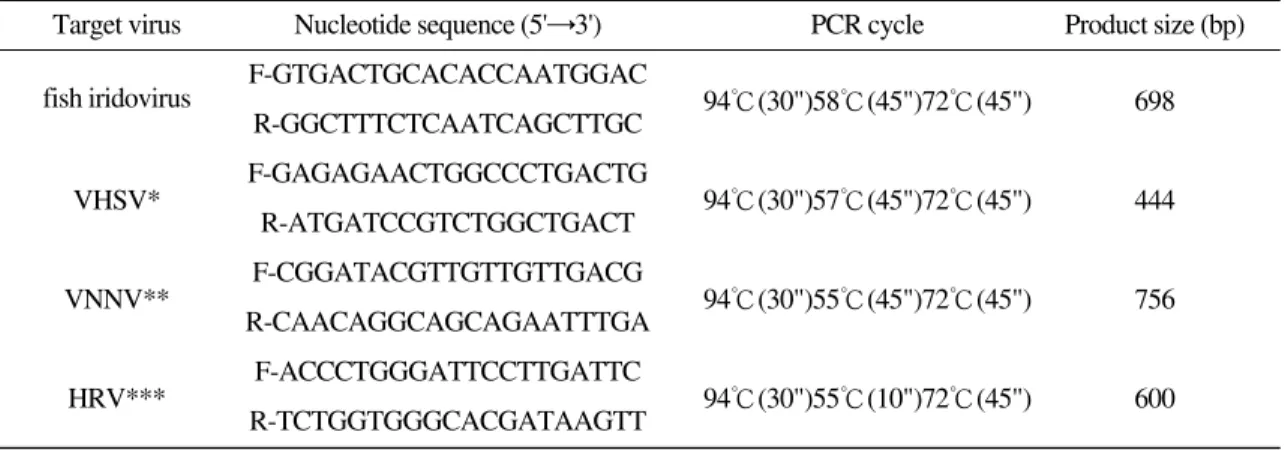
PCR과 reverse transcriptase (RT) - PCR에 사용 된 primer는 4 종류의 어류 바이러스, 즉, 어류 iri- dovirus, VHSV, VNNV, HRV를 특이적으로 증폭 시킬 수 있도록 제작된 (조 등, 2007) 것을 사용 하였다 (Table 1). cDNA의 합성은 9-mer random primer (Takara, Japan)를 사용하여 실시하였다.

RNA 또는 DNA 분리

각각의 바이러스에 감염된 넙치를 우리나라의 해산어 양식장에서 수집하였다. 전체 RNA는 50~100 mg의 감염된 넙치의 균질화된 신장과 비장에서 TRIZOL (Invitrogen, U.S.A.)을 사용하 여 분리하였고 DNA는 High Pure PCR Template preparation Kit (Roche, Germany)를 사용하여 분 리하였다. 분리된 RNA와 DNA는 사용할 때까

Table 1. Specific primers used in PCR to detect four viruses genes

Target virus Nucleotide sequence (5'→3') PCR cycle Product size (bp)

fish iridovirus F-GTGACTGCACACCAATGGAC

94℃(30")58℃(45")72℃(45") 698 R-GGCTTTCTCAATCAGCTTGC

VHSV*

F-GAGAGAACTGGCCCTGACTG

94℃(30")57℃(45")72℃(45") 444 R-ATGATCCGTCTGGCTGACT

VNNV** F-CGGATACGTTGTTGTTGACG

94℃(30")55℃(45")72℃(45") 756 R-CAACAGGCAGCAGAATTTGA

HRV***

F-ACCCTGGGATTCCTTGATTC

94℃(30")55℃(10")72℃(45") 600 R-TCTGGTGGGCACGATAAGTT

* : viral hemorrhagic septicaemia virus

** : viral nervous necrosis virus

*** : hirame rhabdovirus

(3)

지 -80℃에 보관하였다.

cDNA 합성과 PCR

cDNA는 SuperScript One-Step RT-PCR System kit (Invitrogen, U.S.A.)를 사용하여 42℃에서 합 성하였다. PCR은 Table 1의 조건에 따라 DNA Engine Dyad

Peltier Thermal cycler (Bio-RAD)를 사용하여 실시하였고 PCR mixture는 Accupower

PCR premix (Bioneer, Korea)를 사용하여 각각 0.1 μ M의 primer와 2 ㎕의 DNA 또는 cDNA와 DEPC-D.W.를 넣어 전체 20 ㎕가 되도록 하였다.

바이러스 유전자의 cloning 및 sequencing

4 종류의 바이러스를 PCR로 증폭시킨 후 형 성된 PCR product는 전기영동 후 Gel extraction kit (GENEALL, Korea)로 회수하고 TOPO TA cloning

kit (Invitrogen, U.S.A.)로 cloning 한 후 염기서열을 확인하였고 실제 제한효소를 처리 하기 전까지 -20 ℃에 보관하였다. Cloning 된 바 이러스의 유전자는 양성 대조구로 사용하였다.

제한효소 선정

Sequencing으로 얻어진 바이러스의 PCR prod- uct에 대한 염기서열 정보에서 제한효소 부위를

탐색하기 위해 BioEdit 프로그램 (ver.7.0)을 사 용하였으며 제한효소에 의해 적당한 크기의 re- striction fragment로 잘라질 수 있도록 제한효소 를 선택하였다.

제한효소 처리

RFLP 분석을 위해 sequence 분석 결과를 기초 로 하여 어류 iridovirus의 PCR product는 ApaⅠ, BsiwⅠ, NdeⅠ 제한 효소를 사용하여 절단하였 고, VHSV의 PCR product는 HindⅢ와 PstⅠ, VNNV의 PCR product는 BamHⅠ, HRV의 PCR product는 XbaⅠ (이상 Roche, Germany)의 제한 효소를 사용하였다. Agarose gel 전기영동 후 Gel extraction kit (GENEALL, Korea)를 사용하여 회 수된 1 ㎕의 PCR product, 1 ㎕의 제한효소, 1 ㎕ 의 buffer와 nuclease-free water (Amresco, U.S.A.) 를 첨가하여 10 ㎕의 전체 볼륨이 되도록 한 후, 각각의 바이러스에 특이적인 제한효소를 처리 하여 37 ℃에서 3시간 동안 반응시켰다.

Agarose gel 전기영동

PCR 후 바이러스 유전자의 증폭 여부는 1%

agarose gel에서 전기영동하여 확인하였고 제한 효소 처리된 DNA fragment는 6× loading buffer

Table 2. Identification of four viruses by PCR-RFLP

Virus Restriction enzyme Size (bp)

PCR amplicon Restriction fragment

Apa Ⅰ 698 510, 188

fish iridovirus BsiwⅠ 698 513, 185

NdeⅠ 698 508, 190

VHSV* PstⅠ 444 278, 166

Hind Ⅲ 444 321, 123

VNNV** BamHⅠ 756 507, 249

HRV*** XbaⅠ 600 412, 188

* : viral hemorrhagic septicaemia virus

** : viral nervous necrosis virus

*** : hirame rhabdovirus

(4)

(Bioneer, Korea)와 혼합하고 ethidium bromide (0.5 mg/ml)가 포함된 2% agarose gel (Invitrogen, U.S.A.)에서 전기영동하였다. 전기영동은 TAE electrophoresis buffer (40 mM Tris, 20 mM acetate, 2 mM EDTA)를 사용하여 100 V로 실시하였고 전기영동 후 gel은 UV transilluminator에서 사진 을 촬영하였다.

결과 및 고찰

본 연구에서는 다양한 미생물 분류 및 특정 유전자 분석에 이미 광범위하게 사용되고 있는 PCR-RFLP 법을 어류 바이러스성 질병 진단에 있어 그 활용 가능성을 알아보고자 하였다.

넙치에 감염된 4종류의 어류 병원성 바이러 스, 어류 iridovirus, VHSV, VNNV, HRV는 각각 의 특이적 primer를 사용하여 PCR로 증폭시킨 후 제한효소를 처리하여 2개의 fragment로 절단

하였다. 어류 iridovirus에 감염된 넙치에서 증폭 된 PCR 산물은 698 bp 크기의 products를 형성하 였고 sequencing 후 GenBank의 blast 검색에서 rock bream iridovirus (AY532606.1), red sea bream iridovirus (AB007366.1) 등과 100% 일치하였다.

이것을 BsiwⅠ에 의해 513 bp와 185 bp, Nde Ⅰ 의 경우에는 508 bp와 190 bp의 fragment로 나누 어 졌으나 Apa Ⅰ으로 처리한 후 형성된 510 bp 와 188 bp의 restriction fragment가 전기영동에서 가장 명확히 확인되었다 (Fig. 1A). 444 bp 크기 를 갖는 VHSV의 PCR product는 GenBank의 blast 검색에서 viral hemorrhagic septicemia virus (AB179621.1)와 100% 일치하였고 Pst Ⅰ의 처 리로 278 bp와 166 bp 의 fragment로 구분되었으 며 Hind Ⅲ에서는 321 bp와 123 bp의 restriction fragment의 크기로 각각 나누어졌다 (Fig. 1B).

VNNV의 756bp product는 GeneBank의 blast 검 색에서 red spotted grouper nervous necrosis virus

Fig. 1. PCR-RFLP patterns of fish iridovirus (A), VHSV (B), VNNV (C) and HRV (D). Electrophoresis of PCR products

from iridovirus (a1), VHSV (b1), VNNV (c1) and HRV (d2). Separation after restriction enzyme BsiwⅠ(a2), ApaⅠ(a3),

Nde Ⅰ (a4), HindⅢ (b2), PstⅠ (b3), BamHⅠ (c2), XbaⅠ(d1). M = 100 bp DNA ladder

(5)

(DQ116036.1) 등과 100% 일치하였고 BamH Ⅰ 에 의해 507 bp와 249 bp 크기로 나누어졌으며 (Fig. 1C) HRV의 600 bp의 product는 hirame rhabdovirus strain (AF104985.2) 등과 100% 일치 하였고 Xba Ⅰ에 의해 412 bp와 188 bp의 restric- tion fragment로 잘려졌다 (Fig. 1D). PCR-RFLP 법은 재현성을 갖지만 (Dubach et al., 2001) 제한 효소의 절단부위에 mutation이 있으면 기대한 DNA 단편이 생기지 않게 되므로 제한효소는 재현성 있는 실험을 위해 sequencing으로 얻어 진 바이러스의 염기서열 정보와 GenBank에 등 록된 바이러스 유전자 정보를 비교하여 제한효 소의 절단부위가 virus의 genotype 사이에 유전 적 차이가 없는 부분을 target으로 하는 것으로 선정하였다.

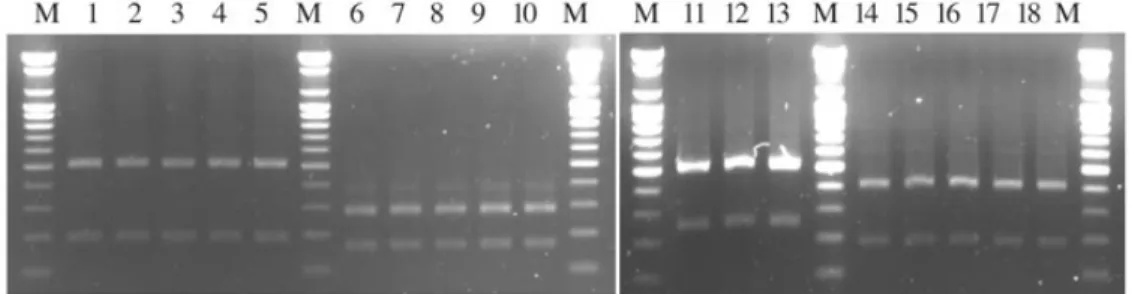
이렇게 확인된 방법을 이용하여 PCR에 의한 바이러스 질병 검사 시 양성 판정된 PCR prod- uct들을 대상으로, PCR-RFLP법 실험을 실시하 여 그 실질적 적용 가능성을 확인하였다. 그 결 과 5개의 어류 iridovirus 양성 시료에 Apa Ⅰ 처 리를 통해 예상된 510 bp, 188 bp의 product를 명 확히 확인할 수 있었고 VHSV 경우에도 PstⅠ 처리에 의해 양성 확인된 5개의 시료에서 각각 의 확정적 fragment를 볼 수 있었다. 3개의 VN- NV, 5개의 HRV 양성 시료를 대상으로 한 실험 에서도 위에서 나타난 각각의 product와 같은 restriction fragment가 확인되었다 (Fig. 2).

PCR 후 전기영동에서 양성으로 추정되는

PCR product 중에서 제한효소를 처리하였을 때 기대되는 fragment로 나눠지지 않은 PCR prod- uct는 sequencing을 실시하여 염기서열을 확인 하였다. 먹장어 (Eptatretus burgeri)의 신장과 비 장에서 어류 iridovirus를 검출하기 위해 fish iri- dovirus에 특이적인 primer (Table 1)을 사용한 PCR에서 약 700 bp의 크기의 PCR product가 형 성되었으나 ApaⅠ을 이용한 RFLP법에서 기대 되는 크기로 나눠지지 않았으며 sequencing을 실시한 후 GeneBank blast 확인에서도 어류 iri- dovirus와 일치하지 않았다. 일부 넙치 시료에서 VHSV 검출용 primer와 VNNV 검출용 primer를 사용하였을 때 양성과 유사한 크기의 PCR prod- uct가 형성되었으나 RFLP 실험 및 sequencing을 실시하여 확인하였을 때 VHSV, VNNV의 유전 자로 확인되지 않았다. 이러한 결과에서 개발된 PCR-RFLP 법에 의해 보다 간편하고 효율적으 로 바이러스성 질병을 진단할 수 있을 것이며 바이러스성 질병 진단법의 신뢰도를 높일 수 있 을 것이라 생각 된다.

양식 해산어류에 큰 피해를 입히는 여러 바이 러스성 질병 중 4가지 바이러스성 질병의 초기 확정 진단에 이러한 PCR-RFLP법의 활용이 가 능하였으며, 특히 제한효소 처리 후 확인된 re- striction fragment의 크기도 최소 112 bp, 최대 322 bp의 차이가 있어 전기영동으로 비교적 쉽 게 확인이 가능하였다. Marine birnavirus도 PCR 에 의해 진단되고 있으나 (조 등, 2007) 생성된

Fig. 2. PCR-RFLP patterns of field isolates. Fish iridovirus isolated from flounder (lanes 1~5), VHSV isolated from flounder

(lanes 6~10), VNNV isolated from flounder (lanes 11~13) and HRV isolated from flounder (lanes 14~18), M = 100 bp

DNA ladder

(6)

PCR product에서 적절한 제한효소 부위와 전기 영동에서 구별이 가능한 크기의 restriction frag- ment를 확인 할 수 없어 앞으로 primer의 변경 과 같은 접근이 필요할 것으로 생각된다.

이번 연구에서 사용된 것과 같은 PCR-RFLP 법은 간편한 실험 방법으로 다양한 목적에 따라 그 활용이 가능하여 실제 다양한 수계환경 병원 체인 aquatic birnavirus, koi herpesvirus, Vibrio sp.

등에서 이미 유전자 variation을 이용한 RFLP 법 의 활용이 많이 보고되었다 (Lee et al., 1996;

Jensen et al., 2002; Gilad et al., 2003; Le Chevalier et al., 2003; Cutrin et al. 2004). 이러한 사례를 통 해 볼 때, PCR-RFLP법으로 여러 다양한 바이러 스성 질병의 초기 확정 진단과 함께 genotype의 분류도 가능하기 때문에 앞으로 이런 부분에 대 한 세부적 연구도 매우 가치 있을 것으로 생각 한다. 뿐만 아니라 본 연구에서 실시한 해산어류 바이러스성 질병 이외에도 담수 양식어류 및 다 양한 갑각류에 대한 파생 연구도 지속적으로 필 요할 것으로 생각한다.

이러한 PCR-RFLP법을 안정적, 지속적으로 사 용하기 위해서는 유전자내 기존 제한 효소 부위 의 variation이 없어야 할뿐 아니라 PCR products 들이 전기영동 상에서 육안 확인 가능한 크기로 절단 되어야 한다. 이를 위해 진단용 특이 primer 제작 시 매우 conserve한 유전자 부위를 대상으로 하거나, 제한 효소 선택 시 적절한 site 및 restriction fragments의 길이 등에 대한 고려 도 함께 있어야 하겠다. 동시에 여러 질병을 진 단하기 위한 multiplex PCR이 다양한 제한 효소 의 이용이 가능할 시 필요에 따라 각각 두개 이 상을 함께 실시하여 진단 확률을 높이는 부분 등에 대한 종합적인 연구도 앞으로 필요할 것으 로 생각한다.

요 약

Polymerase chain reaction (PCR) - restriction fragment length polymorphism (RFLP) 법을 사용

하여 4 종류의 어류 바이러스, 어류 iridovirus, vi- ral hemorrhagic septicaemia virus (VHSV), viral nervous necrosis virus (VNNV), hirame rhab- dovirus (HRV)를 검출하고 동정하고자 하였다. 4 종류의 바이러스는 각각의 특이 primer를 사용 한 PCR에 의해 검출하였다. 어류 iridovirus은 PCR 산물을 제한효소 ApaⅠ로 절단하여 확인하 였고 VHSV의 PCR 산물은 PstⅠ 또는 HindⅢ 를 사용하여 양성과 위양성을 구분할 수 있었 다. VNNV는 제한효소 BamHⅠ을 사용하여 동 정하였고 HRV는 XbaⅠ를 사용하여 확인하였 다. 이런 새로운 방법으로 바이러스성 어류 질병 을 보다 빠르고 간단하며 특이적으로 진단할 수 있을 것이다.

감사의 글

이 연구는 국립수산과학원 (수산생물 질병 모 니터링 및 진단연구, RP-2008-AQ-133)의 지원 에 의해 운영되었습니다.

참 고 문 헌

Cutrin, J. M., Barja, J. L., Nicholson, B. L., Bandin, I., Blake, S. and Dopazo, C. P.: Restriction fragment length polymorphisms and se- quence analysis : an approch for genotyping infectious pancreatic necrosis virus reference strains and other aquabirnaviruses isolated frpom northwestern Spain. Appl. Environ.

Microbiol. 70: 1059-1067, 2004.

Dubach, M.M., Lacroix, C., de Chauvin, M.F., Le Gall, I., Giudicelli, G., Lorenzo F. and Der- ouin F.: Rapid Discrimination among Der- matophytes, Scytalidium spp., and Other Fungi with a PCR-Restriction Fragment Length Polymorphism Ribotyping Method.

J Clin Microbiol. 39: 685-690, 2001.

DO, J. W., Cha, S. J., Kim, J. S., An, E. J., Park, M.

(7)

S., Kim, J. W., Kim, Y. C., Park, M. A. and Park, J. W.: Sequence variation in the gene encoding the major capsid protein of korean fish iridoviruses. Archives of Virology. 150:

351-359, 2005.

Gilad, O., Yun., S., Adkison, M. A., Way, K., Willits, N. H., Bercovier, H. and Hedrick, R.

P.: Molecular comparison of isolates of an emerging fish pathogen, koi herpesvirus, and the effect of water temperature on mortality of experimentally infected koi. J. Gen. Virol.

84: 2661-2667, 2003.

Gorie, S., Nakamoto, K. and Katashima, K.: Dis- ease of cultured hirame (Japanese flounder) Paralichtys olovaceus I. Preliminary report on a disease of marine pen cultured flounder may be caused by viral infection. Bull. Hyo- go. Pref. Fish Exp. Stn : 66-68, 1985.

Hedrick, R. P., Batts, W. N., Yun, S., Traxler, G. S., Kaufman, J. and Winton, J.R.: Host and geo- graphic range extensions of the North Amer- ican strain of Viral heamorrhageic sep- ticemia virus. Dis. Aquat. Org. 55: 211-220, 2003.

He, J. G., Deng, M., Weng, S. P., Li, Z., Zhou, S. Y., Long, Q. X., Wang, X. Z. and Chan, S. M.:

Complete genome analysis of the mandarin fish infectious spleen and kidney necrosis iridovirus. Virology. 291: 126-139, 2001.

Inouye, K., Yamano, K., Maeno, Y., Nakajima, K., Matsuoka, M., Wada, Y. and Sorimachi, M.:

Iridovirus infection of cultured red sea bream, Pagrus major. Fish Pathol. 27: 19-27, 1992.

Jensen, K. E., Winton, J. and Lorenzen, N.: Geno- typing of the fish rhabdovirus, viral haemor- rhagic septicaemia virus, by restriction frag- ment length polymorphisms. Veterinary Mi- crobiology, 106: 167-178, 2005.

Jensen, S., Bergh, O., Enger, O. and Hjeltnes, B.:

Ues of PCR-RELP for genotyping 16S rRNA and characterizing bacteria cultured from halibut fry. Can. J. Microbiol. 48: 379- 386, 2002.

Le Chevalier, P., Le Boulay, C. and Paillard, C.:

Characterization by restriction fragment length polymorphism and plasmid profiling of Vibrio tapetis strains. J. Basic Microbiol.

43: 414-422, 2003.

Lu, L., Zhou, S. Y., Chen, C., Weng, S. P., Chan, S.

M. and He, J. G.: Complete genome se- quence analysis of an iridovirus isolated from the orange-spotted grouper, Epineph- elus coioides. Viology 339: 81-100, 2005.

Lee, M. K., Blake, S. L., Singer, J. T. and Nichol- son, B. L.: Genomic variation of aquatic bir- naviruses analyzed with restriction fragment lenght polymorphism. Appl. Environ. Mi- crobiol. 62: 2513-2520, 1996.

Munday, B. L., Kwang, J. and Moody, N.: Betano- davirus infections of teleost fish: a review. J.

Fish Dis. 25: 127-142, 2002.

Nakajima, K. and Sorimachi, M.: Production of monoclonal antibodies against red sea bream iridovirus. Fish Pathol. 30: 47-52, 1995.

Skall, H. F., Slierendrecht, W. J., Kin, J. A. and Ole- sen, M. J.: Experimental infection of rain- bow trout Oncorhynchus mykiss with Viral heamorrhageic septicemia virus isolates from European marine and farmed fishes.

Dis. Aquat. Org. 58: 99-110, 2004.

Sudthongkong, C., Miyata., M. and Miyazaki, T.:

Viral DNA sequence of genes encoding the ATPase and the major capsid protein of trop- ical iridovirus isolates which are pathogenic to fishes in Japan, South China Sea and Southeast Asian countries. Arch. Virol. 147:

2089-2109, 2002.

(8)

Takano, R., Nishizawa, T., Aritmoto, M. and Muro- ga, K.: Isolation of Viral heamorrhageic sep- ticemia virus (VHSV) from wild Japanese flounder, Paralichthys olivaceus. Bull. Eur.

Ass. Fish Pathol. 20: 186-192, 2000.

Yoshimizu, M., Nishizawa, T., Oseko. and Kimura, T.: Rhabdovirus disease of hirame (Japanese flounder). Proceeding of the symposium 'Disease problem of the fry stage of sea wa- ter fish.' Fish Pathol. 22: 54~55, 1987.

조미영, 김명석, 권문경, 지보영, 최혜승, 최동림, 박경현, 이창훈, 김진도, 이주석, 오윤경, 이 덕찬, 박신후, 박명애.: 2005년부터 2006년 사이 우리나라 양식 넙치, Paralichthys olivaceus의 세균성 질병에 대한 역학조 사. 한국어병학회지, 20(1): 61-70, 2007.

Manuscript Received : October 2, 2008

Revision Accepted : November 25, 2008

Responsible Editorial Member : Jung, Sung-Ju

(Chonnam National University)

수치

Table 1. Specific primers used in PCR to detect four viruses genes
Table 2. Identification of four viruses by PCR-RFLP
Fig. 1. PCR-RFLP patterns of fish iridovirus (A), VHSV (B), VNNV (C) and HRV (D). Electrophoresis of PCR products from iridovirus (a1), VHSV (b1), VNNV (c1) and HRV (d2)
Fig. 2. PCR-RFLP patterns of field isolates. Fish iridovirus isolated from flounder (lanes 1~5), VHSV isolated from flounder (lanes 6~10), VNNV isolated from flounder (lanes 11~13) and HRV isolated from flounder (lanes 14~18), M = 100 bp DNA ladder

참조

관련 문서

Monitoring the microbial population dynamics at the start-up stage of wastewater treatment reactor by terminal restriction fragment length polymorphism analysis based on 16S

Genetic Diversity and Population Structure of the Endangered Fish Pseudopungtungia nigra (Cyprini- dae) from the Geum and Mankyung Rivers Assessed by Amplified

baumannii gyrA and parC, we designed two sets of mismatched PCR-RFLP primers to detect mutations in gyrA (codons 83 and 87) and parC (co- dons 80 and 84) by introducing an

CYP21A2 Mutation Analysis in Korean Patients With Congenital Adrenal Hyperplasia Using Complementary Methods: Sequencing After Long-Range PCR and.. Restriction Fragment

Human Papilloma Virus Genotyping Assay using Restriction Fragment Mass Polymorphism Analysis, and Its Comparison with Sequencing and Hybrid Capture Assays.. Eun Hee