ISSN: 2233-601X (Print) ISSN: 2093-6516 (Online)
Received: August 29, 2018, Revised: November 4, 2018, Accepted: November 5, 2018, Published online: February 5, 2019
Corresponding author: Pil Je Kang, Department of Thoracic and Cardiovascular Surgery, Asan Medical Center, 88 Olympic-ro 43-gil, Songpa-gu, Seoul 05505, Korea
(Tel) 82-2-3010-3580 (Fax) 82-2-3010-6966 (E-mail) [email protected]
© The Korean Society for Thoracic and Cardiovascular Surgery. 2019. All right reserved.
This is an open access article distributed under the terms of the Creative Commons Attribution Non-Commercial License (http://creativecommons.org/
licenses/by-nc/4.0) which permits unrestricted non-commercial use, distribution, and reproduction in any medium, provided the original work is properly cited.
Extracorporeal Life Support in Adult Patients with Hematologic Malignancies and Acute Circulatory
and/or Respiratory Failure
Sungbin Cho, M.D. 1 , Won Chul Cho, M.D. 2 , Ju Yong Lim, M.D. 3 , Pil Je Kang, M.D. 1
1
Department of Thoracic and Cardiovascular Surgery, Asan Medical Center, University of Ulsan College of Medicine,
2
Department of Thoracic and Cardiovascular Surgery, Gangneung Asan Hospital, University of Ulsan College of Medicine,
3
Department of Thoracic and Cardiovascular Surgery, Korea University Medical Center, Korea University College of Medicine
Background: The primary goal of this study was to characterize the clinical outcomes of adult patients with hematologic malignancies (HM) who were treated with extracorporeal membrane oxygenation (ECMO) support when conventional treatments failed. Methods: In this retrospective, observational study at a tertiary medical center, we reviewed the clinical course of 23 consecutive patients with HM requiring ECMO who were ad- mitted to the intensive care unit at Asan Medical Center from March 2010 to April 2015. Results: A total of 23 patients (8 female; median age, 44 years; range, 29–51 years) with HM and severe acute circulatory and/or respiratory failure received ECMO therapy during the study period. Fourteen patients received ve- no-arterial ECMO, while 9 patients received veno-venous ECMO. The median ECMO duration was 104.7 hours (range, 37.1–221 hours). Nine patients were successfully weaned from ECMO. The in-hospital mortality rate was 91.1% (21 of 23). There were complications in 3 patients (cannulation site bleeding, limb ischemia, and gastrointestinal bleeding). Conclusion: ECMO is a useful treatment for patients with circulatory and/or pulmo- nary failure. However, in patients with HM, the outcomes of ECMO treatment results were very poor, so it is advisable to carefully decide whether to apply ECMO to these patients.
Key words: 1. Extracorporeal membrane oxygenation 2. Hematologic neoplasms
3. Adult 4. Mortality
Introduction
Extracorporeal life support (ECLS), or extracor- poreal membrane oxygenation (ECMO), is used to support critically ill patients with acute circulatory and/or respiratory failure when conventional treat- ments have failed. ECMO is indicated in various circumstances. Veno-arterial (VA) ECMO is indicated
for conditions involving cardiogenic shock, such as acute coronary syndrome, myocarditis, post-cardio- tomy syndrome, primary graft dysfunction, and the bridge period to destination therapy [1]. Veno-venous (VV) ECMO is indicated for severe hypoxemia under mechanical ventilation (MV) due to various diseases [2]. The outcomes of ECMO vary depending on the underlying disease [3].
https://doi.org/10.5090/kjtcs.2019.52.1.25
It is increasingly common for patients with hema- tologic malignancies (HM) to require hospitalization in the intensive care unit (ICU) for life-threatening events due to immunosuppression and/or the malig- nancy itself [4]. Some studies have reported recent advances in chemotherapy and conditioning regimes;
in particular, hematopoietic stem cell transplantation (HSCT) and general ICU care have led to better out- comes for these patients [5]. Patients with HM who need ICU treatment are often considered to have an improved, but not good, long-term prognosis [6-8]. In patients receiving MV, mortality ranges from 35% to 70% depending on the associated organ dysfunction and the presence of graft versus host disease [4].
ECMO treatment can even be considered in HM patients with severe circulatory and/or pulmonary dysfunction. Several studies have reported outcomes of ECMO in patients with HM [9-12]. Although ECMO in HM patients is still considered to have an unsat- isfactory prognosis [9,11], its use has not been reported. The primary goal of this study was to char- acterize the clinical outcomes of adult patients with HM who were treated with ECMO when conventional treatments failed, based on a retrospective review of the patients’ medical records.
Methods
We retrospectively studied the clinical outcomes of all adult patients (18 years or older) with HM and cir- culatory and/or respiratory failure treated with ECMO between March 2010 and April 2015 at a tertiary cen- ter in Korea. The study protocol was approved by the institutional review board of Asan Medical Center (IRB approval no., 2016-0665). The requirement for in- formed consent from individual patients was waived due to the retrospective nature of the study.
The baseline characteristics of patients were evaluated. Additionally, disease severity scores were calculated using the Acute Physiology and Chronic Health Evaluation (APACHE) II, Murray Lung Injury Score, the Respiratory Extracorporeal Membrane Oxygenation Survival Prediction Score, and the Simplified Acute Physiology Score (SAPS) II. The type of HM, the reason for ECMO, the type of ECMO, clin- ical considerations before and during ECMO, compli- cations during ECMO, and the success or failure of ECMO weaning were analyzed based on the data
available in the patients’ medical records. Laboratory data, including hemoglobin, white blood cell count, platelet count, C-reactive protein, blood urea nitrogen (BUN), creatinine, albumin, and liver function tests were collected during the ICU stay. The period of ICU admission, length of hospital stay, and time in hospital before ICU admission were noted.
The primary outcome was in-hospital mortality, defined as the number of patients with HM and ECLS support who died in-hospital during the study period. The secondary outcomes were the ECMO weaning rate and complication rate. ECMO support was applied using the Capiox Emergency Bypass System (Terumo, Tokyo, Japan) and/or Permanent Life Support (Maquet Cardiopulmonary AG, Hirrilin- gen, Germany). Vascular access was established pe- ripherally (femoral artery, femoral vein, and/or in- ternal jugular vein).
Data were presented as medians and interquartile ranges (25th and 75th percentiles) for continuous variables and as numbers (percentages) for catego- rical variables. Data were compared using the Mann–
Whitney U-test for continuous variables and the chi-square or Fisher exact test for categorical variables. All tests were 2-sided, and a p-value of
< 0.05 was considered to indicate statistical signi- ficance. Data were analyzed using PASW SPSS Statistics ver. 17.0 (SPSS Inc., Chicago, IL, USA) and R Statistical Software ver. 3.5.1 (The R Foundation for Statistical Computing, Vienna, Austria).
Results
During the study period, a total of 23 patients with HM received ECMO treatment. Fifteen of the pa- tients were men, and the median age was 44 years (range, 29–51 years). There were several types of blood cancer diagnoses among the patients. Nine pa- tients had leukemia (acute myeloid leukemia [n=6], chronic myeloid leukemia [n=2], and both [n=1]).
Four patients had multiple myeloma (n=1), and 1 pa-
tient had anaplastic anemia (n=1). Three patients had
myelodysplastic syndrome (n=3). One patient had he-
mophagocytic lymphohistiocytosis (n=1). Five patients
had lymphoma (n=5). Ten patients underwent HSCT
and 9 patients received chemotherapy. Before ECMO
was initiated, the median SAPS II score was 58.0
(range, 51.0–68.5) and the median APACHE II score
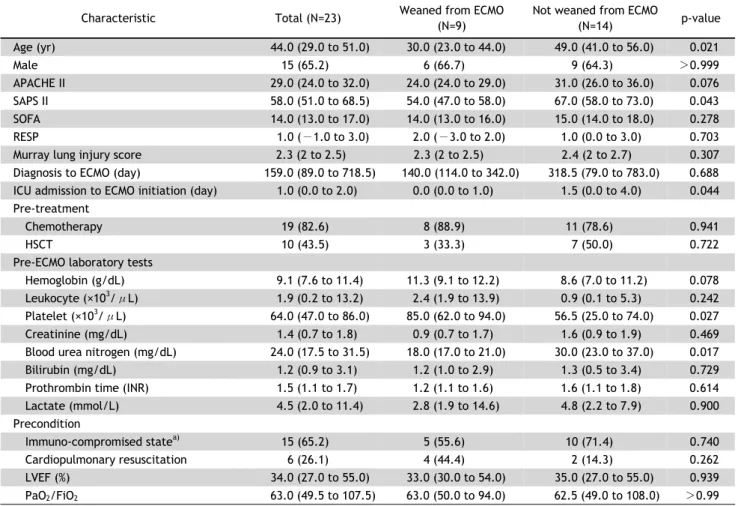
Table 1. Comparison of pre-ECMO characteristics between patients who were and were not weaned from ECMO
Characteristic Total (N=23) Weaned from ECMO
(N=9)
Not weaned from ECMO
(N=14) p-value
Age (yr) 44.0 (29.0 to 51.0) 30.0 (23.0 to 44.0) 49.0 (41.0 to 56.0) 0.021
Male 15 (65.2) 6 (66.7) 9 (64.3) >0.999
APACHE II 29.0 (24.0 to 32.0) 24.0 (24.0 to 29.0) 31.0 (26.0 to 36.0) 0.076
SAPS II 58.0 (51.0 to 68.5) 54.0 (47.0 to 58.0) 67.0 (58.0 to 73.0) 0.043
SOFA 14.0 (13.0 to 17.0) 14.0 (13.0 to 16.0) 15.0 (14.0 to 18.0) 0.278
RESP 1.0 (−1.0 to 3.0) 2.0 (−3.0 to 2.0) 1.0 (0.0 to 3.0) 0.703
Murray lung injury score 2.3 (2 to 2.5) 2.3 (2 to 2.5) 2.4 (2 to 2.7) 0.307
Diagnosis to ECMO (day) 159.0 (89.0 to 718.5) 140.0 (114.0 to 342.0) 318.5 (79.0 to 783.0) 0.688 ICU admission to ECMO initiation (day) 1.0 (0.0 to 2.0) 0.0 (0.0 to 1.0) 1.5 (0.0 to 4.0) 0.044 Pre-treatment
Chemotherapy 19 (82.6) 8 (88.9) 11 (78.6) 0.941
HSCT 10 (43.5) 3 (33.3) 7 (50.0) 0.722
Pre-ECMO laboratory tests
Hemoglobin (g/dL) 9.1 (7.6 to 11.4) 11.3 (9.1 to 12.2) 8.6 (7.0 to 11.2) 0.078
Leukocyte (×10
3/μL) 1.9 (0.2 to 13.2) 2.4 (1.9 to 13.9) 0.9 (0.1 to 5.3) 0.242
Platelet (×10
3/μL) 64.0 (47.0 to 86.0) 85.0 (62.0 to 94.0) 56.5 (25.0 to 74.0) 0.027
Creatinine (mg/dL) 1.4 (0.7 to 1.8) 0.9 (0.7 to 1.7) 1.6 (0.9 to 1.9) 0.469
Blood urea nitrogen (mg/dL) 24.0 (17.5 to 31.5) 18.0 (17.0 to 21.0) 30.0 (23.0 to 37.0) 0.017
Bilirubin (mg/dL) 1.2 (0.9 to 3.1) 1.2 (1.0 to 2.9) 1.3 (0.5 to 3.4) 0.729
Prothrombin time (INR) 1.5 (1.1 to 1.7) 1.2 (1.1 to 1.6) 1.6 (1.1 to 1.8) 0.614
Lactate (mmol/L) 4.5 (2.0 to 11.4) 2.8 (1.9 to 14.6) 4.8 (2.2 to 7.9) 0.900
Precondition
Immuno-compromised state
a)15 (65.2) 5 (55.6) 10 (71.4) 0.740
Cardiopulmonary resuscitation 6 (26.1) 4 (44.4) 2 (14.3) 0.262
LVEF (%) 34.0 (27.0 to 55.0) 33.0 (30.0 to 54.0) 35.0 (27.0 to 55.0) 0.939
PaO
2/FiO
263.0 (49.5 to 107.5) 63.0 (50.0 to 94.0) 62.5 (49.0 to 108.0) >0.99
Values are presented as median (interquartile range) for continuous variables or as number (%) for non-continuous variables.
ECMO, extracorporeal membrane oxygenation; APACHE II, Acute Physiology and Chronic Health Evaluation II; SAPS II, Simplified Acute Physiology Score; SOFA, Sequential Organ Failure Assessment; RESP, Respiratory Extracorporeal Membrane Oxygenation Survival Prediction Score; ICU, intensive care unit; HSCT, hematopoietic stem cell transplantation; INR, international normalized ratio; LVEF (%), left ventricular ejection fraction on echocardiography before ECMO application.
a)
The criteria for an immune-compromised state were as follows: human immunodeficiency virus, aprimary immune deficiency, hematologic malignancy such as lymphoma, post-chemotherapy status, an absolute neutrophil count <1,000, steroid medication (>0.5 mg/kg) for more than 3 weeks, or post-transplantation status.
was 29 (range, 24–32).
The numbers of patients for each indication of ECMO treatment were as follows: septic shock (n=5), acute respiratory distress syndrome (ARDS, n=8), ARDS and septic shock (n=2), cardiogenic shock (n=6), pulmonary hemorrhage (n=1), and stress-induced car- diomyopathy (n=1). Leukopenia (<4×10
3/μL) was present in 15 patients. All study participants had thrombocytopenia (<100×10
3/μL), except for 3 individuals. The basic characteristics and baseline con- ditions of the patients before ECMO initiation are pre- sented in Table 1 according to ECMO weaning status.
The mean age was older, BUN levels at ECMO ini-
tiation were higher, and the time until ECMO applica- tion after ICU admission was longer in patients who were not weaned from ECMO than in those who were.
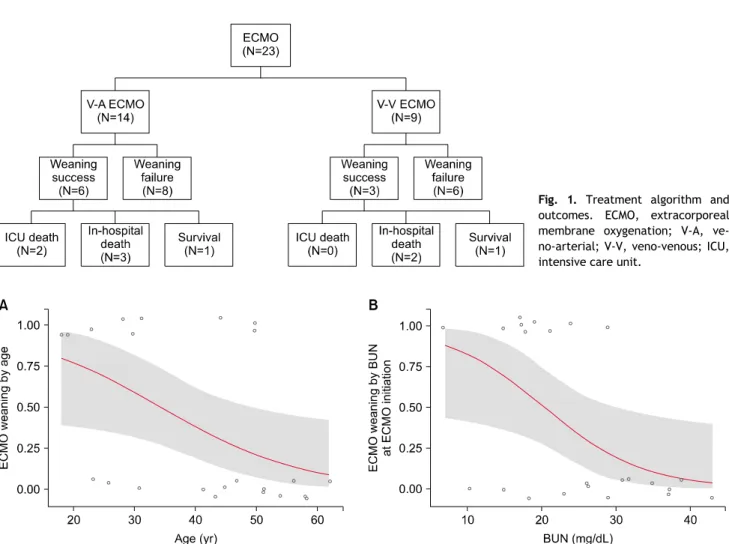
Of the 23 patients who received ECMO treatment, 14 received VA ECMO. Six of the 14 patients who had received VA ECMO were weaned successfully, but the remaining 8 patients failed to be weaned.
Among the 6 successfully weaned patients, 2 died in the ICU, 3 died in the hospital, and only 1 survived.
Three of the 9 patients who received VV ECMO were
weaned successfully, but the remaining 6 patients
failed to be weaned. Among the 3 successfully
weaned patients, 2 died in the hospital, and only 1
Fig. 1. Treatment algorithm and
outcomes. ECMO, extracorporeal membrane oxygenation; V-A, ve- no-arterial; V-V, veno-venous; ICU, intensive care unit.
Fig. 2. Age (A) and BUN levels at ECMO initiation (B) in patients weaned from ECMO were significantly lower than in those who were not
weaned from ECMO in the univariate analysis (age: p=0.03; BUN: p=0.03) in a logistic regression model. ECMO, extracorporeal membrane oxygenation.
patient survived (Fig. 1). ICU mortality was 70% (16 of 23), and the in-hospital mortality rate was 91%
(21 of 23). Multivariate analysis was performed of HM patients with the following risk factors for un- successful weaning from ECMO: age, APACHE II score, SAPS II score, BUN level, hemoglobin level, platelet level at ECMO initiation, lactate level on the first day of ECMO, and the time from ICU admission to ECMO initiation. In the univariate analysis, the age and BUN level at ECMO initiation in the patients who were weaned from ECMO were significantly lower than in the patients who were not (p<0.05) (Fig. 2, Table 2). The median survival period was 80 days (range, 39–168 days) in the ECMO weaning group.
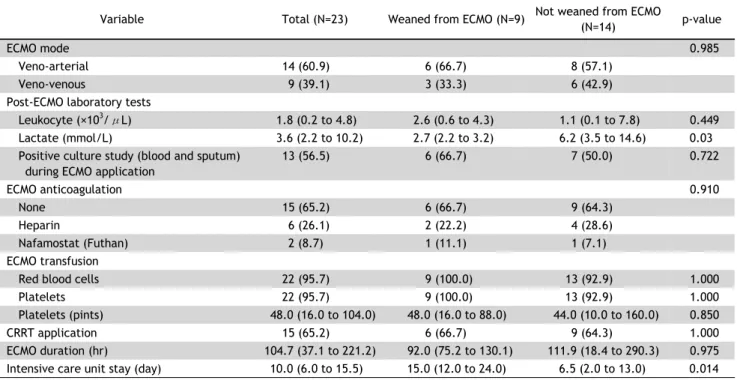
There was no significant difference in survival be- tween the VV and VA ECMO groups. The ECMO-re- lated outcomes are presented in Table 3 according to
whether ECMO weaning was successful.
Fifteen patients (65.2%) did not receive anti- coagulants because of bleeding tendency or platelet reduction. In 2 patients, the ECMO oxygenator had to be changed within a week. There were complications in 3 patients: cannulation site bleeding (n=1), gastro- intestinal bleeding (n=1), and limb ischemia (n=1).
These patients did not need surgical treatment.
Discussion
In most industrialized countries, the number of
HM patients has increased over the last 2 decades
[13]. This is due to more effective diagnoses and
treatments, which have improved the prognosis of
patients with blood cancers [14]. However, mortality
among patients with HM admitted to the ICU still
Table 2. Univariate and multivariate analysis of risk factors
Variable Univariate analysis Multivariate analysis
OR (95% CI) p-value OR (95% CI) p-value
Age 0.92 0.03 0.06 >0.99
SAPS II 0.93 0.08 0.78 >0.99
ICU admission to ECMO application (day) 0.38 0.1 >0.99
Pre-ECMO laboratory tests
Blood urea nitrogen (mg/dL) 0.86 0.03 >0.99
Platelets (×10
3/μL) 1.01 0.13 3.32 >0.99
OR, odds ratio; CI, confidence interval; SAPS II, Simplified Acute Physiology Score; ICU, intensive care unit; ECMO, extracorporeal membrane oxygenation.
Table 3. Comparison of ECMO-related outcomes between patients who were and were not weaned from ECMO