서 론
체외 생명유지술(extracorporeal life support, ECLS)
은 체외순환을 통하여 심장 및 폐 기능을 보조하는 여러 치료방법을 포괄하는 용어로서 체외순환막형산화요법 (extracorporeal membrane oxygenation, ECMO)와 경 피적 심폐보조(percutaneous cardiopulmonary sup- port, PCPS) 등이 포함된다. ECMO는 정맥혈을 뽑아 체 외에서 산소를 보충하고 이산화탄소를 제거한 다음 정맥 또는 동맥 내로 주입하는 것이다1). 전통적으로 수술방에 서 흉골절개술(sternotomy) 후에 상행대동맥에 직접 도 관을 삽입하여 체외순환을 유도하는 방식이 사용되었으 나, 최근에는 침상 곁에서 경피적으로 도관을 삽입하는 PCPS 또한 활발히 사용되고 있다. ECMO는 중증 폐손상
체외 생명유지술을 이용한 중독 환자의 치료: 체계적 고찰
연세대학교 의과대학 응급의학교실
이용희∙고동률∙공태영∙주영선∙유제성∙정성필
Extracorporeal Life Support in Treatment of Poisoning Patient: Systematic Review
Yong Hee Lee, M.D., Dong Ryul Ko, M.D., Taeyoung Kong, M.D., Young Seon Joo, M.D., Je Sung You, M.D., Sung Phil Chung, M.D.
Department of Emergency Medicine, Yonsei University College of Medicine, Seoul, Korea
Purpose: Extracorporeal life support (ECLS) is a term used to describe a number of modalities including extracor- poreal membrane oxygenation (ECMO) to support cardiac and/or pulmonary systems. The purpose of this study is to review the available evidence regarding the effect of ECLS in patients with acute poisoning.
Methods: Electronic literature searches with PubMed, Embase, Cochrane library, and KoreaMed were conducted for identification of relevant studies addressing ECLS in treatment of acute poisoning. The literature search was conducted by two investigators in March, 2016 with publication language restricted to English and Korean. The toxic substance, technique of ECLS, and final outcome of each case were analyzed.
Results: The final analysis included 64 articles including 55 case reports. There were no articles classified accord- ing to a high level of evidence such as randomized trial and prospective cohort study. ECLS treatment was used in the management of patients poisoned with 36 unique substances. Venovenous ECMO was performed in 4 cases.
Among the reported cases, 10 patients died despite treatment with ECLS.
Conclusion: Evidence supporting ECLS for patients with acute poisoning is inadequate. However, many case reports suggest that early consideration of ECLS in poisoned patients with refractory cardiac arrest or hemodynamic compromise refractory to standard therapies may be beneficial.
Key Words: Cardiopulmonary bypass, Extracorporeal circulation, Extracorporeal membrane oxygenation, Poisoning
원원 저저
책임저자: 정 성 필
서울특별시 강남구 언주로 211 연세대학교 의과대학 응급의학교실 Tel: 02) 2019-3030, Fax: 02) 2019-4820 E-mail: [email protected]
투고일: 2016년 4월 15일 1차 심사일: 2016년 4월 18일 게재 승인일: 2016년 5월 2일
의 경우에 폐기능 보조를 목적으로 사용되는 정맥-정맥 (venovenous: VV) 형태와, 펌프를 이용하여 순환 보조 기능을 함께 제공하는 정맥-동맥(venoarterial: VA) 형태 로 나눌 수 있다. 응급 심폐우회술(emergency car- diopulmonary bypass, ECPB)이란 용어도 VA-ECMO와 혼용되어 사용되고 있다2).
임상독성학 분야에서도 중독에 의한 저산소혈증이나 쇼 크 상태가 통상적인 방법으로 교정되지 않는 경우 ECLS 치료가 적용되어 왔다2). 미국 중독관리협회(American Association of Poison Control Centers, AAPCC)의 연 차보고서에 의하면 중독 환자에 대한 ECMO 치료는 2005 년 6건에서 2014년 42명으로 증가하였다3,4). 국내에서도 최근 cyanide 중독5)과 aconite 중독6)환자에게 ECMO 치 료를 적용한 증례가 보고된 바 있다. 저자들은 체계적 고 찰을 통하여 중독 환자의 치료 시 ECLS의 유용성 및 부작 용, 비용효과 등을 알아보고자 하였다.
대상과 방법
본 연구는 기존 문헌들에 대한 체계적 고찰 연구이다.
임상적 질문은“급성 중독으로 내원한 소아 및 성인 환자 에서 ECLS 치료를 시행하는 것이 통상적인 치료방법만을 시행한 것과 비교하여 생존율, 합병증, 비용 등을 변화시 키는가?”이다.
문헌의 포함기준은 1987년부터 2016년까지 출판된 문 헌 가운데 중독 환자에게 ECLS를 시행한 내용이 포함된 경우로 하였다. 문헌검색을 위해 두 명의 연구자가 2016 년 2월 에 PubMed, Embase, Cochrane library, KoreaMed database를 검색하였다. 검색어로는 extra- corporeal membrane oxygenation, ECMO, extracor- poreal life support, ECLS, cardiopulmonary bypass, poisoning, intoxication, overdose, ingestion 등을 사
용하였으며, PubMed에 대한 검색식은 Table 1과 같다.
모든 형태의 문헌을 포함하였으나, 학회 초록이나 인터넷 자료 등은 제외하였다. 제목 및 초록을 보고 선정기준에 해당하는 문헌은 전문을 검토하여 관련 여부를 확인하였 다. 즉, 급성 중독 환자에게 ECMO, PCPS 등의 ECLS를 적용하여 치료효과 또는 안전성, 비용효과 등을 보고한 문 헌에 해당하는지를 검토하였다.
제외기준으로는 1) 주제와 관련이 없거나 개별 환자의 임상 양상이 자세히 언급되지 않은 증례보고, 2) 학회 초 록, 3) 영어나 한국어 이외의 언어로 출판된 경우, 4) 투석 과 같은 신대체요법 또는 심실보조기구(ventricular assist device) 등을 사용한 경우, 5) 흡인이나 가스노출에 의한 폐손상의 경우 등은 제외하였다. 최종 선정된 문헌은 EndNote (X7.0.2, Thomson Reuters)에 정리하여 중복 된 문헌을 제거하였고, 문헌에 인용된 참고문헌들을 검토 하여 빠진 문헌이 있으면 추가하였다. 필요한 항목과 문헌 에 대한 간단한 요약표를 작성하였다.
Table 1. Search strategy for PubMed
Line Search details
01 ECMO [mesh]
02 “extracorporeal membrane oxygenation”[tiab]
03 “ECLS”[tiab]
04 “extracorporeal life support”[tiab]
05 “cardiopulmonary bypass”[tiab]
06 Poisoning [mesh]
07 “intoxic”[tiab]
08 “overdose”[tiab]
09 “ingestion”[tiab]
10 (#1 OR #2 OR #3 OR #4 OR #5) AND (#6 OR #7 OR
#8 OR #9)
11 #10 Filters: Humans; English
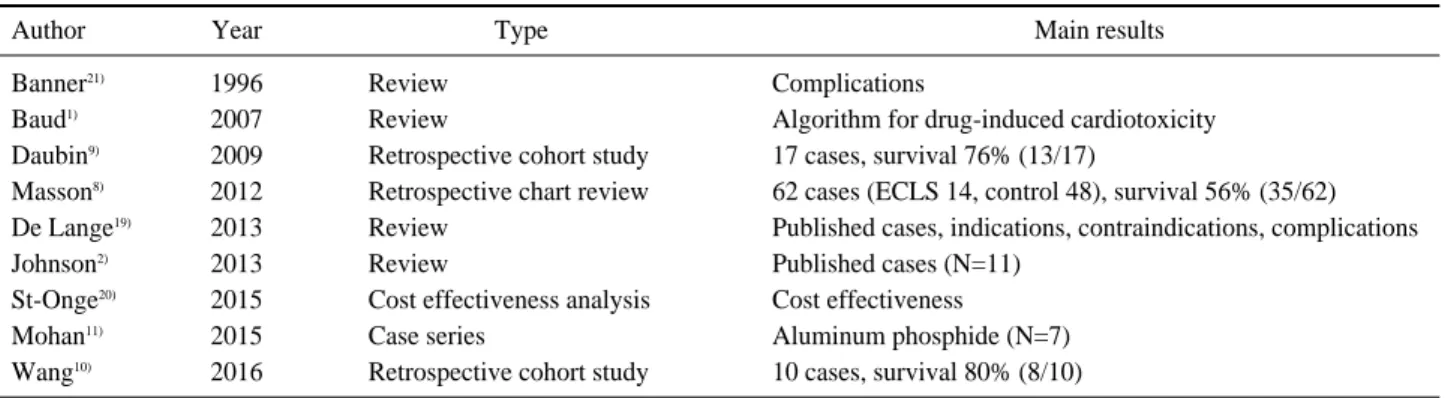
Table 2. Summary of papers about ECLS in the acute poisoning other than case reports
Author Year Type Main results
Banner
21)1996 Review Complications
Baud
1)2007 Review Algorithm for drug-induced cardiotoxicity
Daubin
9)2009 Retrospective cohort study 17 cases, survival 76% (13/17)
Masson
8)2012 Retrospective chart review 62 cases (ECLS 14, control 48), survival 56% (35/62) De Lange
19)2013 Review Published cases, indications, contraindications, complications
Johnson
2)2013 Review Published cases (N=11)
St-Onge
20)2015 Cost effectiveness analysis Cost effectiveness
Mohan
11)2015 Case series Aluminum phosphide (N=7)
Wang
10)2016 Retrospective cohort study 10 cases, survival 80% (8/10)
ECLS: extracorporeal life support
결 과
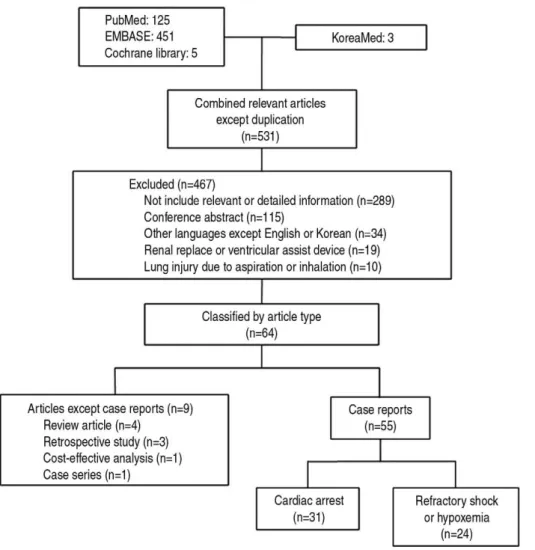
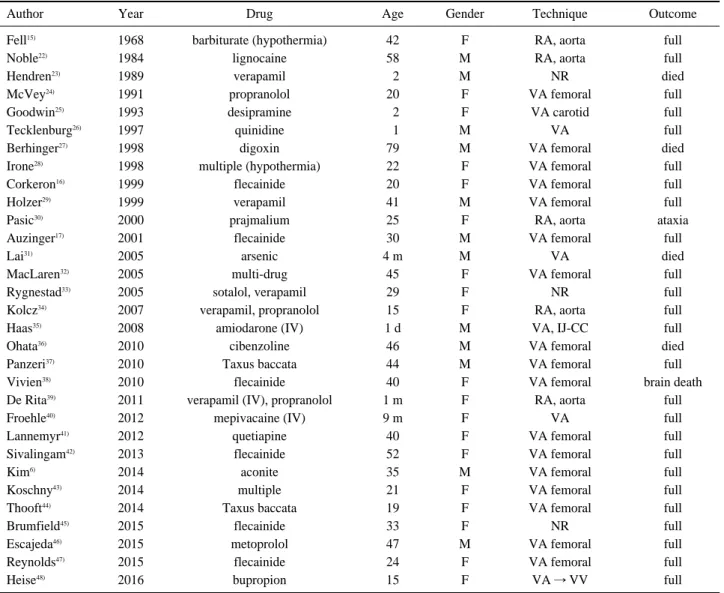
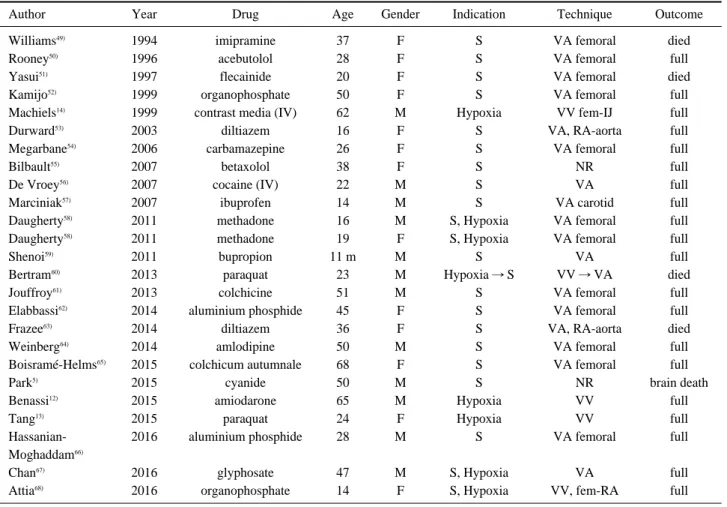
문헌검색을 통해 PubMed 125건, Embase 451건, Cochrane library 5건, KoreaMed 3건이 검색되었다. 이 가운데 포함기준에 해당되는 문헌은 531건 이었다. 제외 기준에 해당되는 문헌을 제외하여 최종적으로 64편의 문 헌이 분석에 포함되었다(Fig. 1). 원저는 후향적 관찰연구 3편과 4편의 종설, 한 편의 비용효과분석 연구 및 증례군 연구였다(Table 2). 중독 환자에게 ECLS를 시행한 증례 보고는 모두 55편(56례)이었는데, 심정지가 발생한 경우 가 31편, 기존 치료에 반응하지 않는 쇼크나 저산소혈증 에 의한 경우가 24편(25례)이었다(Table 3, 4). 증례보고 의 대부분은 VA-ECMO가 적용된 증례였으며, VV- ECMO는 4례에서 적용되었다. 증례보고 가운데 총 10례 에서는 환자가 생존하지 못하였다.
고 찰
중독 환자를 대상으로 ECLS를 치료에 적용한 문헌고찰 결과 ECLS의 효과를 뒷받침할만한 높은 수준의 연구는 없 었다. 무작위대조연구를 비롯한 전향적 연구는 없었으며, 후향적 관찰연구로는 3편이 있었다. 첫 번째는 ECLS를 시 행한 17명의 심정지 환자를 분석한 연구였는데, 12명이 중독에 의한 것이었고 이 중 3명이 생존하여 다른 원인에 의한 경우보다 좋은 예후를 보였다7). 두 번째 연구는 62명 의 다양한 약물 중독 환자 중에서 14명에게 ECLS를 적용 하였는데, ECLS 군의 생존율이 86% vs 48%로 높았으며, 중증도 점수와 베타차단제 중독여부를 보정한 후에도 의 미있는 차이가 있었다고 보고하였다8,9). 세 번째 연구는 4 년동안 ToxIC registry에 등록된 환자 가운데 ECMO를 시 행받은 10명을 분석하여 생존율이 80%라고 보고하였다10). 증례군 연구는 훈증제(fumigant)로 사용되는 알루미늄 인 화물(aluminium phosphide)을 음독한 환자 7명을 증례
Fig. 1. Flow diagram of inclusion process of the literatures.
보고한 논문이다. 모두 ECMO를 적용하였으나 적용시점 에 이미 다발성장기부전이 발생한 2명은 사망하였다11).
증례보고는 대부분 심정지 또는 중증 쇼크 상태의 환자 에게 VA-ECMO를 적용한 경우였으나, 혈역학적 이상없 이 폐손상만 있는 경우에는 VV-ECMO가 적용된 경우도
있었다12-14). 중독 환자의 치료에 ECLS를 성공적으로 사용
한 최초의 보고는 자살 목적의 pentobarbitone 중독 후 중증 저체온으로 심정지가 발생된 환자에게 적용한 것이 다15). 본 연구에 포함된 증례보고들은 82% (46/56)의 생 존율을 보였으나, 결과가 좋지 않을 경우에는 일반적으로 증례보고를 하지 않기 때문에 출판 편견(publication bias)을 동반하는 경우가 많다. 또한 증례들은 대조군이 없기 때문에 그 자체로 치료효과의 근거가 되기 어렵다.
예를 들어 flecainide 중독의 경우 4 g과 6 g을 복용한 증
례에서 ECLS의 성공적인 사용을 보고하였다16,17). 그러나 4.5 g을 복용한 증례에서는 ECMO 사용없이 통상적인 치 료만으로 치료에 성공하였다고 보고하였다18). 따라서 ECLS는 통상적인 치료를 먼저 시행하고 반응이 없는 환 자들을 대상으로 시행하는 것이 적절할 것으로 생각된다.
본 연구에 포함된 증례들의 중독 원인물질을 분류해보 면, 심혈관계 작용 약물이 27례로 가장 많았고, 중추신경계 작용약물 12례, 농약 7례, 식물 4례 등의 순이었다. 그러나 ECLS의 적응증은 중독 원인물질에 따라 결정되기보다는 심폐기능부전의 중증도에 의해 결정된다. Extracorporeal Life Support Organization (ELSO)의 가이드라인 (www.elso.org)을 참조하면“최적의 기존 치료에도 불구 하고 높은 사망 위험을 가진 급성 중증 심폐기능부전”을 ECMO의 적응증으로 제시하고 있으며, 사망위험이 50%
Table 3. Summary of human case reports having cardiac arrest following acute poisoning treated with ECLS (N=31)
Author Year Drug Age Gender Technique Outcome
Fell
15)1968 barbiturate (hypothermia) 42 F RA, aorta full
Noble
22)1984 lignocaine 58 M RA, aorta full
Hendren
23)1989 verapamil 02 M NR died
McVey
24)1991 propranolol 20 F VA femoral full
Goodwin
25)1993 desipramine 02 F VA carotid full
Tecklenburg
26)1997 quinidine 01 M VA full
Berhinger
27)1998 digoxin 79 M VA femoral died
Irone
28)1998 multiple (hypothermia) 22 F VA femoral full
Corkeron
16)1999 flecainide 20 F VA femoral full
Holzer
29)1999 verapamil 41 M VA femoral full
Pasic
30)2000 prajmalium 25 F RA, aorta ataxia
Auzinger
17)2001 flecainide 30 M VA femoral full
Lai
31)2005 arsenic 4 m M VA died
MacLaren
32)2005 multi-drug 45 F VA femoral full
Rygnestad
33)2005 sotalol, verapamil 29 F NR full
Kolcz
34)2007 verapamil, propranolol 15 F RA, aorta full
Haas
35)2008 amiodarone (IV) 1 d M VA, IJ-CC full
Ohata
36)2010 cibenzoline 46 M VA femoral died
Panzeri
37)2010 Taxus baccata 44 M VA femoral full
Vivien
38)2010 flecainide 40 F VA femoral brain death
De Rita
39)2011 verapamil (IV), propranolol 1 m F RA, aorta full
Froehle
40)2012 mepivacaine (IV) 9 m F VA full
Lannemyr
41)2012 quetiapine 40 F VA femoral full
Sivalingam
42)2013 flecainide 52 F VA femoral full
Kim
6)2014 aconite 35 M VA femoral full
Koschny
43)2014 multiple 21 F VA femoral full
Thooft
44)2014 Taxus baccata 19 F VA femoral full
Brumfield
45)2015 flecainide 33 F NR full
Escajeda
46)2015 metoprolol 47 M VA femoral full
Reynolds
47)2015 flecainide 24 F VA femoral full
Heise
48)2016 bupropion 15 F VA � VV full
ECLS: extracorporeal life support, VA: venoarterial, VV: venovenous, RA: right atrium
IJ: internal jugular, CC: common carotid, IV: intravenous, NR: not reported
정도라면 고려해보고, 80% 정도이면 가급적 적용하라고 권장한다. 적용할 경우에는 심폐부전을 초래한 원인이 가 역적이어서 일정시간이 지나면 ECMO의 이탈이 가능할 것으로 예상되는 경우에 시행하는 것이 바람직하다. 최근 개정된 국내 요양급여 기준에 의하면 1) 기존의 치료법에 의해 교정되지 않으나 회복 가능성이 있는 중증 급성 심부 전, 2) 목격된 심정지로 적절한 심폐소생술이 시행되어 회 생가능성이 있는 경우 또는 가역적 심정지(저체온, 약물중 독), 3) 기존의 기계적 인공호흡기 치료로는 생명유지가 불 가능하지만 ECMO 시술로 회복 가능성이 있는 중증 급성 호흡부전, 4) 심장 또는 폐 이식대상환자의 교량치료 (bridge to transplantation)로써 이식등록과정이 사전, 사 후에 확인된 경우를 인정 기준으로 고시하고 있다.
중독 환자들에게 ECLS는 적용하기 위해서는 여러 제한 점을 고려하여야 한다. 먼저 시술 및 관리가 가능한 적절 한 팀이 구성되어 있는 병원에서 시행되어야 한다. 둘째는 시술에 따른 합병증이 고려되어야 한다. 증례보고들은 대 부분 부작용 없이 좋은 결과를 보고하고 있으나, ECLS는
여러 부작용을 가져올 수 있다. ECMO 장비와 관련된 기 계적 문제 이외에도 출혈, 용혈, 감염, 경련, 백혈구 감소, 사지 허혈, 혈소판감소 등이 보고되었다19). 따라서 기존의 치료로 유지되지 않는 경우에 한하여 시행되어야 한다. 세 번째로 ECLS 시술에 소요되는 비용도 무시할 수 없다.
ECMO의 비용효과를 분석한 캐나다 연구에 의하면 심혈 관계 약물에 의한 중독 환자의 치료에 VA-ECMO를 적용 하는 경우의 점증적 비용효과비(incremental cost-effec- tiveness ratio)는 중증 쇼크 환자의 경우 생존년수(life- year: LY)당 8,748 캐나다 달러, 심정지 환자의 경우 생존 년수(LY)당 5,151 캐나다 달러의 비용효과가 있다고 보고 하였다20). 하지만 나라마다 의료제도나 보험적용 기준 등 이 차이가 있으므로 국내 여건을 감안하여 개별 환자의 상 황에 따라 시행여부를 결정하여야 한다.
결 론
급성 중독 환자들의 치료 과정에서 심폐기능부전이 발
Table 4. Summary of human case reports of acute poisoning treated with ECLS due to refractory shock or hypoxemia (N=25)
Author Year Drug Age Gender Indication Technique Outcome
Williams
49)1994 imipramine 37 F S VA femoral died
Rooney
50)1996 acebutolol 28 F S VA femoral full
Yasui
51)1997 flecainide 20 F S VA femoral died
Kamijo
52)1999 organophosphate 50 F S VA femoral full
Machiels
14)1999 contrast media (IV) 62 M Hypoxia VV fem-IJ full
Durward
53)2003 diltiazem 16 F S VA, RA-aorta full
Megarbane
54)2006 carbamazepine 26 F S VA femoral full
Bilbault
55)2007 betaxolol 38 F S NR full
De Vroey
56)2007 cocaine (IV) 22 M S VA full
Marciniak
57)2007 ibuprofen 14 M S VA carotid full
Daugherty
58)2011 methadone 16 M S, Hypoxia VA femoral full
Daugherty
58)2011 methadone 19 F S, Hypoxia VA femoral full
Shenoi
59)2011 bupropion 11 m M S VA full
Bertram
60)2013 paraquat 23 M Hypoxia � S VV � VA died
Jouffroy
61)2013 colchicine 51 M S VA femoral full
Elabbassi
62)2014 aluminium phosphide 45 F S VA femoral full
Frazee
63)2014 diltiazem 36 F S VA, RA-aorta died
Weinberg
64)2014 amlodipine 50 M S VA femoral full
Boisramé-Helms
65)2015 colchicum autumnale 68 F S VA femoral full
Park
5)2015 cyanide 50 M S NR brain death
Benassi
12)2015 amiodarone 65 M Hypoxia VV full
Tang
13)2015 paraquat 24 F Hypoxia VV full
Hassanian- 2016 aluminium phosphide 28 M S VA femoral full
Moghaddam
66)Chan
67)2016 glyphosate 47 M S, Hypoxia VA full
Attia
68)2016 organophosphate 14 F S, Hypoxia VV, fem-RA full
ECLS: extracorporeal life support, VA: venoarterial, VV: venovenous, RA: right atrium,
S: refractory shock, IJ: internal jugular, CC: common carotid, IV: intravenous, NR: not reported
생하여 사망위험이 높다고 판단되는 경우에 통상적인 치 료를 적절히 시행함에도 불구하고 반응하지 않는다면 ECMO 등의 ECLS을 고려할 수 있을 것으로 사료된다. 그 러나 ECLS 치료 효과에 대한 보고는 대부분 증례보고에 근거하고 있으므로 개별 환자에 대한 기대효과, 부작용 및 비용에 대한 부분을 신중하게 고려하여 결정하여야 한다.
참고문헌