JCS
Journal of Chest SurgeryClinical Research Impact of a Multidisciplinary Team Approach on Extracorporeal Circulatory Life Support-Bridged Heart Transplantation
Jae Jun Lee, M.D., Young Su Kim, M.D., Suryeun Chung, M.D., Dong Seop Jeong, M.D., Ph.D., Ji-Hyuk Yang, M.D., Ph.D., Kiick Sung, M.D., Ph.D., Wook Sung Kim, M.D., Ph.D., Tae-Gook Jun, M.D., Ph.D., Yang Hyun Cho, M.D., Ph.D.
Department of Thoracic and Cardiovascular Surgery, Samsung Medical Center, Sungkyunkwan University School of Medicine, Seoul, Korea
ARTICLE INFO
Received September 16, 2020 Revised November 6, 2020 Accepted November 11, 2020 Corresponding author Yang Hyun Cho Tel 82-2-3410-1677 Fax 82-2-3410-6986
E-mail [email protected] ORCID
https://orcid.org/0000-0003-1685-3641
Background: The number of heart transplantations (HTx) is increasing annually. Due to advances in medical and surgical support, the outcomes of HTx are also improving. Ex- tracorporeal circulatory life support (ECLS) provides patients with decompensated heart failure a chance to undergo HTx. A medical approach involving collaboration among ex- perienced experts in different fields should improve the outcomes and prognosis of ECLS- bridged HTx.
Methods: From December 2003 to December 2018, 1,465 patients received ECLS at Sam- sung Medical Center. We excluded patients who had not undergone HTx or underwent re- peated transplantations. Patients younger than 18 years were excluded. We also excluded patients who received an implantable durable left ventricular assist device before HTx. In total, 91 patients were included in this study. A multidisciplinary team approach began in March 2013 at our hospital. We divided the patients into 2 groups depending on whether they were treated before or after implementation of the team approach.
Results: The 30-day mortality rate was significantly higher in the pre-ECLS team group than in the post-ECLS team group (n=5, 18.5% vs. n=2, 3.1%; p=0.023). The 1-year surviv- al rate was better in the post-ECLS team group than in the pre-ECLS team group (n=57, 89.1% vs. n=19, 70.4%; p=0.023).
Conclusion: We found that implementing a multidisciplinary team approach improved the outcomes of ECLS-bridged HTx. Team-based care should be adapted at HTx centers that perform high-risk HTx.
Keywords: Heart transplantation, Extracorporeal circulation, Extracorporeal membrane oxygenation, Patient care team, Multidisciplinary team approach
Copyright©The Korean Society for Thoracic and Cardiovascular Surgery. 2021. All right reserved.
This is an Open Access article distributed under the terms of the Creative Commons Attribution Non-Commercial License (http://creativecommons.org/licenses/
Introduction
After the first heart transplantation (HTx) in Korea in 1992, the number of cases of HTx has increased and their outcomes have been favorable [1]. According to a Korean Organ Transplant Registry report, 184 cases of HTx were performed in 2017 [2]. In a recent study, the 1-year survival rate after HTx in Korea was reported to be 90% [3]. How- ever, in recent years, there have been more elderly recipi- ents and patients with multiple comorbidities than in the early years of HTx in Korea. Furthermore, the use of extra- corporeal life support (ECLS) as a bridge to HTx has expo- nentially increased, owing to the donor shortage and the popularity of ECLS [3-5]. However, the outcomes of ECLS-
bridged HTx have been reported to be poorer than those of HTx without ECLS [6].
There are very few reports on the favorable impact of a multidisciplinary team approach in ECLS; therefore, we described the results of applying such an approach in our program [7,8]. We hypothesized that the presence of a mul- tidisciplinary team dedicated to ECLS management would contribute to better outcomes in patients with heart failure.
In addition, multidisciplinary team management may im- prove the outcomes and prognosis of patients with ECLS- bridged HTx.
https://doi.org/10.5090/jcs.20.115 pISSN: 2765-1606 eISSN: 2765-1614 J Chest Surg. 2021;54(2):99-105
https://doi.org/10.5090/jcs.20.115
JCS
Methods
Study population
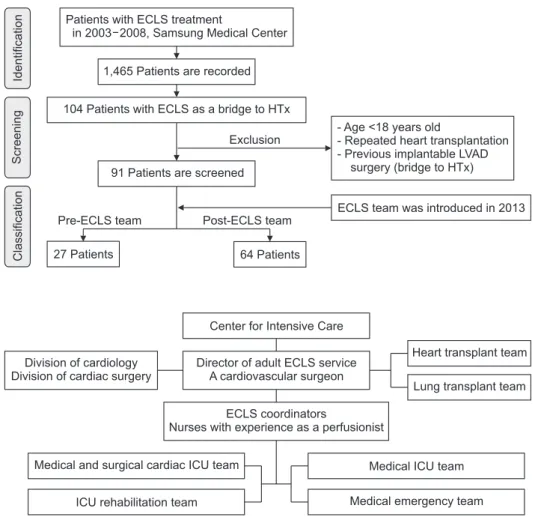
From December 2003 to December 2018, 1,465 patients received ECLS at Samsung Medical Center (Fig. 1). Only 104 patients on ECLS underwent HTx. We excluded pa- tients who had not undergone HTx or underwent repeated transplantations. Patients younger than 18 years were ex- cluded. We also excluded 4 patients who had undergone durable left ventricular assist device (LVAD) implantation before HTx, since conversion of ECLS to an implantable LVAD followed by HTx was only conducted after the ECLS team was established. Finally, 91 patients were selected for the study. The patients scheduled to undergo transplanta- tion were on a waiting list for HTx administered by the Korean Network for Organ Sharing (KONOS).
In March 2013, we involved a dedicated cardiologist and cardiac surgeon in the care of the patients on ECLS. Thus, the multidisciplinary team approach began in March 2013.
We divided the patients into 2 groups, depending on
whether they were treated before or after the team ap- proach was implemented.
This retrospective study was approved by the Institution- al Review Board of Sungkyunkwan University (IRB ap- proval no., 202009115001). The requirement for patient consent was waived owing to the retrospective nature of this study.
Extracorporeal life support organization and outcomes
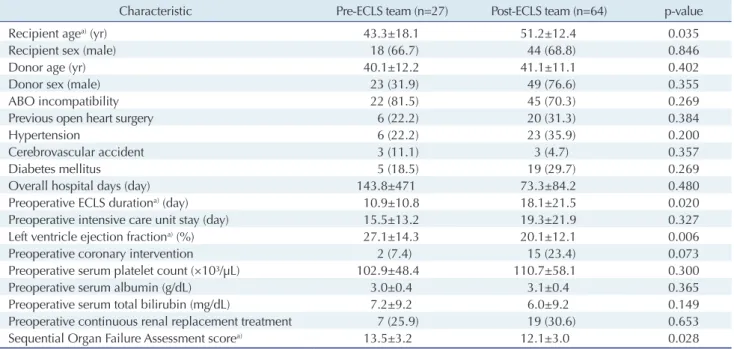
Before the team approach, patients on ECLS were treated separately by cardiovascular surgeons, cardiologists and other consultant physicians. However, after a multidisci- plinary ECLS team was established, all the patients on ECLS at our center were under its care. The team consisted of cardiac surgeons, cardiologists, pulmonologists, neurol- ogists, perfusionists, ECLS coordinators, and an intensive care unit (ICU) team. All team members were involved in patient selection, management, HTx listing, recipient selec- tion, and postoperative care (Fig. 2). Thus, the study sub-
Fig. 1. Flow chart of patient se
lection. ECLS, extracorporeal cir
culatory life support; HTx, heart transplantation; LVAD, left ven tri
cular assist device.
IdentificationScreeningClassification
Patients with ECLS treatment
in 2003 2008, Samsung Medical Center
1,465 Patients are recorded
104 Patients with ECLS as a bridge to HTx
91 Patients are screened
Pre-ECLS team Post-ECLS team
27 Patients 64 Patients
- Age <18 years old
- Repeated heart transplantation - Previous implantable LVAD
surgery (bridge to HTx)
ECLS team was introduced in 2013 Exclusion
Fig. 2. Composition of the multidis
ciplinary ECLS team. ECLS, extra
corporeal circulatory life support;
ICU, intensive care unit.
Center for Intensive Care
Director of adult ECLS service A cardiovascular surgeon
ECLS coordinators
Nurses with experience as a perfusionist Division of cardiology
Division of cardiac surgery
Medical and surgical cardiac ICU team
ICU rehabilitation team
Heart transplant team Lung transplant team
Medical ICU team Medical emergency team
Jae Jun Lee, et al. Team Approach to HTx Patient Management
JCS
jects were divided into 2 groups: the pre-ECLS team group and post-ECLS team group. The primary outcome was 30- day mortality and the secondary outcome was 1-year sur- vival.
Statistical analysis
Categorical variables are presented as numbers and per- centages. Continuous variables are presented as means.
Data were compared using the Mann-Whitney U-test for continuous variables and the chi-square test or Fisher exact test for categorical variables. Variables with p-values of
<0.2 in the univariate Cox regression analysis, along with variables that were considered clinically relevant, were en- tered into the multivariate Cox logistic regression model.
We used multivariate logistic regression with the backward stepwise method to assess independent predictors of 30- day mortality. All p-values <0.05 were considered to indi- cate statistical significance. The statistical tool IBM SPSS for Windows ver. 25.0 (IBM Corp., Armonk, NY, USA) was used for analysis.
Results
Baseline characteristics of patients
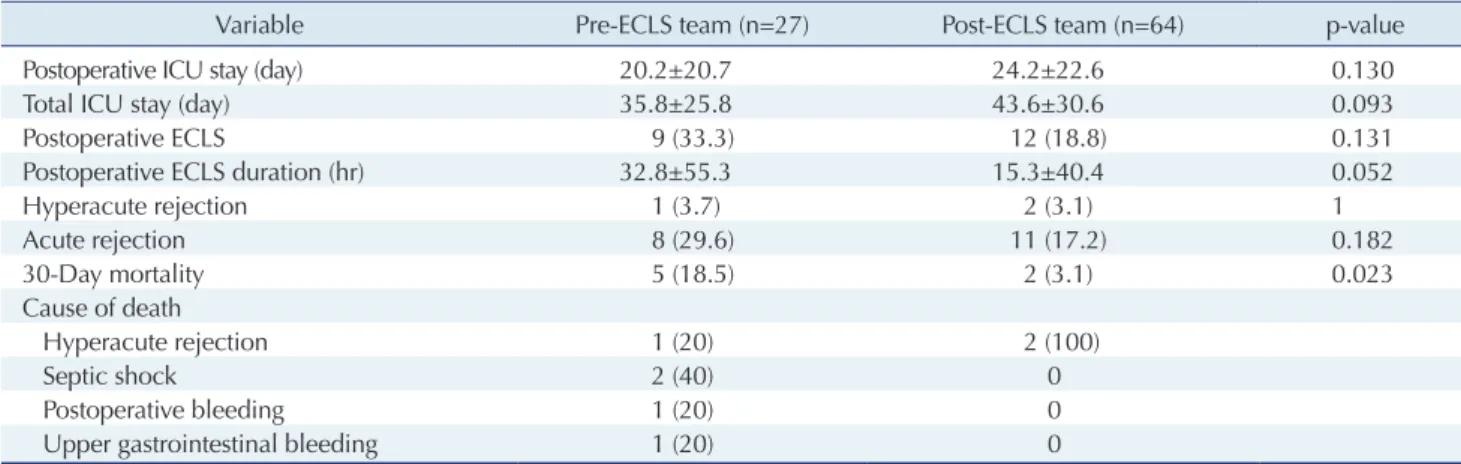
The baseline characteristics of the patients are shown in Table 1. The mean age of the recipients in the pre-ECLS team group was lower than that of those in the post-ECLS team group (43.3±18.1 years versus 51.2±12.4 years, p=0.035). The preoperative ECLS duration was significant- ly longer in the post-ECLS team group than in the pre- ECLS team group (18.1±21.5 days versus 10.9±10.8 days, p=0.020). The left ventricular ejection fraction was worse in the post-ECLS team group than in the pre-ECLS team group (27.1%±14.3% versus 20.1%±12.1%, p=0.006). The Sequential Organ Failure Assessment (SOFA) score was also significantly lower in the post-ECLS team group than in the pre-ECLS team group (12.1±3.0 versus 13.5±3.2, p=0.028). Sex, ABO incompatibility, and underlying dis- eases were not different between the 2 groups.
Clinical outcomes and predictors of mortality
The outcomes of HTx with ECLS are shown in Table 2.
The postoperative ICU stay and total ICU stay were longer in the post-ECLS team group (24.2±22.6 days and 43.6±30.6 days, respectively) than in the pre-ECLS team
Table 1. Patients’ demographic and baseline clinical characteristics
Characteristic PreECLS team (n=27) PostECLS team (n=64) pvalue
Recipient agea) (yr) 43.3±18.1 51.2±12.4 0.035
Recipient sex (male) 18 (66.7) 44 (68.8) 0.846
Donor age (yr) 40.1±12.2 41.1±11.1 0.402
Donor sex (male) 23 (31.9) 49 (76.6) 0.355
ABO incompatibility 22 (81.5) 45 (70.3) 0.269
Previous open heart surgery 6 (22.2) 20 (31.3) 0.384
Hypertension 6 (22.2) 23 (35.9) 0.200
Cerebrovascular accident 3 (11.1) 3 (4.7) 0.357
Diabetes mellitus 5 (18.5) 19 (29.7) 0.269
Overall hospital days (day) 143.8±471 73.3±84.2 0.480
Preoperative ECLS durationa) (day) 10.9±10.8 18.1±21.5 0.020
Preoperative intensive care unit stay (day) 15.5±13.2 19.3±21.9 0.327
Left ventricle ejection fractiona) (%) 27.1±14.3 20.1±12.1 0.006
Preoperative coronary intervention 2 (7.4) 15 (23.4) 0.073
Preoperative serum platelet count (×10³/μL) 102.9±48.4 110.7±58.1 0.300
Preoperative serum albumin (g/dL) 3.0±0.4 3.1±0.4 0.365
Preoperative serum total bilirubin (mg/dL) 7.2±9.2 6.0±9.2 0.149
Preoperative continuous renal replacement treatment 7 (25.9) 19 (30.6) 0.653
Sequential Organ Failure Assessment scorea) 13.5±3.2 12.1±3.0 0.028
Values are presented as mean±standard deviation or number (%).
ECLS, extracorporeal life support.
a)Variables with statistical significance.
https://doi.org/10.5090/jcs.20.115
JCS
group (20.2±20.7 days and 35.8±25.8 days, respectively).
However, this difference was not statistically significant.
The 30-day mortality rate was significantly higher in the pre-ECLS team group than in the post-ECLS team group (n=5, 18.5% versus n=2, 3.1%; p=0.023). Postoperative ECLS implementation was more common and lasted lon- ger in the pre-ECLS team group than in the post-ECLS team group (9 [33.3%] versus 12 [18.8%], p=0.131; 32.8±55.3 hours versus 15.3±40.4 hours, p=0.052), but these differ- ences were not statistically significant. Operation time and ischemic time were similar in both groups. Cardiopulmo- nary bypass time was longer in the pre-ECLS team group than in the post-ECLS team group (172.0±38.5 minutes versus 144.0±38.0 minutes, p<0.001) (Table 3).
The Kaplan-Meier curve log-rank test also showed that the 1-year survival rate was significantly higher in the post-ECLS team group than in the pre-ECLS team group (n=57, 89.1% versus n=19, 70.4%; p=0.023) (Fig. 3).
In univariate Cox regression analysis, the ECLS team ap- proach (odds ratio [OR], 0.327; 95% confidence interval [CI], 0.118–0.902; p=0.031) was a positive predictor of 1-year survival, while total bilirubin (OR, 1.058; 95% CI, 1.027–1.090; p<0.001) and the SOFA score (OR, 1.421; 95%
CI, 1.187–1.702; p<0.001) were negative predictors. In the multivariate Cox regression analysis, the ECLS team ap- proach (OR, 0.226; 95% CI, 0.079–0.647; p=0.006), total bilirubin (OR, 1.072; 95% CI, 1.036–1.109; p<0.001), and
Fig. 3. KaplanMeier curve and log rank test of the pre and post
ECLS team groups. Oneyear survival was better in the postECLS team group than in the preECLS team group (n=57, 89.1% vs.
n=19, 70.4%; p=0.023). ECLS, extracorporeal circulatory life sup
port.
100 95 90 85 80 75
70
12
Survivalprobability(%)
Follow-up time (mo) p=0.023
Pre-ECLS team Post-ECLS team
0 2 4 6 8 10
Table 3. Operative data
Variable PreECLS team (n=27) PostECLS team (n=64) pvalue
Operation time (min) 441.0±65.9 467.5±102 0.526
Cardiopulmonary bypass time (min) 172.0±38.5 144.0±38.0 <0.001
Total ischemic time (min) 188.4±67.1 195.5±59.9 0.520
Major bleedinga) 7 (25.9) 7 (10.9) 0.109
Values are presented as mean±standard deviation or number (%).
ECLS, extracorporeal life support.
a)Major bleeding was defined as requiring an operation for bleeding control.
Table 2. Outcomes of heart transplantation with ECLS
Variable PreECLS team (n=27) PostECLS team (n=64) pvalue
Postoperative ICU stay (day) 20.2±20.7 24.2±22.6 0.130
Total ICU stay (day) 35.8±25.8 43.6±30.6 0.093
Postoperative ECLS 9 (33.3) 12 (18.8) 0.131
Postoperative ECLS duration (hr) 32.8±55.3 15.3±40.4 0.052
Hyperacute rejection 1 (3.7) 2 (3.1) 1
Acute rejection 8 (29.6) 11 (17.2) 0.182
30Day mortality 5 (18.5) 2 (3.1) 0.023
Cause of death
Hyperacute rejection 1 (20) 2 (100)
Septic shock 2 (40) 0
Postoperative bleeding 1 (20) 0
Upper gastrointestinal bleeding 1 (20) 0
Values are presented as mean±standard deviation or number (%).
ECLS, extracorporeal life support; ICU, intensive care unit.
Jae Jun Lee, et al. Team Approach to HTx Patient Management
JCS
recipient age (OR, 1.048; 95% CI, 1.008–1.089; p=0.017) were independent predictors of 1-year survival (Table 4).
Discussion
ECLS is commonly used for the treatment of cardiogenic shock. Intensive care with ECLS is inevitable in patients with acute refractory heart failure. However, no firm con- sensus exists regarding the appropriate timing of ECLS implementation for cardiogenic shock. Thus, an early rec- ognition of signs of deterioration, just before profound shock status, is critical for patient selection, early manage- ment, and intervention timing [9]. Furthermore, the dura- tion of ECLS is closely related to various complications.
Maintaining ECLS for a longer time increases the risk of inflammatory reactions, infections, neurological complica- tions, and other complications [10-13]. Because of these complex conditions, the current trend is to manage pa- tients on ECLS using a multidisciplinary team approach. A professional team with accumulated experience may pro- vide an advanced quality of management and outcomes for patients on ECLS bridged to HTx [14,15]. Our study showed that patients in the post-ECLS team group were older than those in the pre-ECLS team group. The age-re- lated criteria for HTx were recently extended and HTx pri- oritization was revised by the KONOS in 2018. Therefore,
we actively performed transplantation surgery in such cas- es. Moreover, the total mean duration of ECLS before transplantation was significantly longer in the post-ECLS team than in the pre-ECLS team. The longest duration of preoperative ECLS management was 48 days and 126 days in the pre-ECLS and post-ECLS team groups, respectively.
The multidisciplinary approach of the ECLS team allows extension of the transplantation opportunity for patient se- lection and effective management.
Early mortality was significantly higher in the pre-ECLS team group than in the post-ECLS team group. Postopera- tive septic shock and bleeding could be related to the pa- tients’ preoperative condition, as the average SOFA score was lower in the post-ECLS team group than in the pre- ECLS team group. However, the cardiopulmonary bypass time was shorter in the post-ECLS team group than in the pre-ECLS team group, which affected the likelihood of postoperative bleeding-related complications. One case of hyperacute rejection in post-ECLS team group was demon- strated by heart biopsy. The others were diagnosed by clin- ical assessment, and the heart biopsy could not demon- strate graft rejection.
We tried to determine the factors affecting 1-year surviv- al by Cox regression analysis. In multivariate analysis, old- er age of the recipients was associated with a poor 1-year survival rate [16]. Two other factors, namely, low preopera- Table 4. Univariate and multivariate Cox proportional hazard ratios for 1-year mortality
Variable Univariate analysis Multivariate analysis
OR (95% CI) pvalue OR (95% CI) pvalue
PostECLS team 0.327 (0.118–0.902) 0.031 0.226 (0.079–0.647) 0.006
Recipient age 1.032 (0.991–1.075) 0.127 1.048 (1.008–1.089) 0.017
Recipient sex 1.480 (0.527–4.157) 0.457
Donor age 0.988 (0.947–1.030) 0.560
Donor sex 1.899 (0.649–5.556) 0.242
ABO incompatibility 0.991 (0.315–3.112) 0.987
Previous open heart surgery 1.334 (0.456–3.904) 0.599
Hypertension 1.070 (0.366–3.130) 0.902
Cerebrovascular accident 0.044 (0.000–59.765) 0.482
Diabetes mellitus 0.410 (0.092–1.815) 0.240
Preop ECLS duration 0.962 (0.908–1.020) 0.194
Preop intensive care unit stay 0.966 (0.916–1.018) 0.199
Left ventricular ejection fraction 1.014 (0.983–1.047) 0.377
Preop coronary intervention 0.628 (0.142–2.782) 0.540
Preop serum platelet 0.995 (0.984–1.006) 0.394
Preop serum albumin 0.598 (0.181–1.976) 0.399
Preop serum total bilirubin 1.058 (1.027–1.090) <0.001 1.072 (1.036–1.109) <0.001 Preop continuous renal replacement treatment 1.718 (0.611–4.828) 0.305
Sequential Organ Failure Assessment score 1.421 (1.187–1.702) <0.001 OR, odds ratio; CI, confidence interval; ECLS, extracorporeal life support; Preop, preoperative.
https://doi.org/10.5090/jcs.20.115
JCS
tive serum total bilirubin and the ECLS team approach, were statistically significant predictors of 1-year survival.
Because of the congestive physiology in heart failure, he- patic dysfunction is associated with the progression of heart failure. It is well known that hepatic dysfunction be- fore and after transplantation results in a poor prognosis [17]. In cardiogenic shock, multi-organ dysfunction could further deteriorate and be fatal unless the condition is re- solved. Therefore, early restoration of cardiac function fol- lowing improvement in organ perfusion is critically neces- sary for favorable outcomes. Likewise, the preoperative SOFA score, which represents patients’ general condition, was lower in the post-ECLS team group than in the pre- ECLS team group. Preoperative serum bilirubin levels were also lower in the post-ECLS team group than in the pre- ECLS team group, but this difference did not show statisti- cal significance. As shown in Table 2, the differences in postoperative ECLS application and duration between the pre-ECLS team group and the post-ECLS team group may imply that patients had different preoperative conditions and postoperative management.
Before the ECLS team was established, the management of patients with cardiogenic shock differed depending on the medical team. Because the accumulation of experience with ECLS is concentrated in a specific team, the ECLS team will manage patients consistently and efficiently.
Therefore, decisions related to time-critical patients can ef- fectively be made using a multidisciplinary team approach.
During the study period, there was 1 major change relat- ed to the study. Specifically, since 2017, antifungal prophy- laxis has been administered to ECLS patients undergoing HTx.Our study has some limitations. First, all data for this study were collected retrospectively. Second, the popula- tion size was too small for standardization. Third, the findings were affected by selection bias regarding patients’
basic characteristics. There may be some differences in characteristics between patients with acute or chronic de- compensated heart failure; however, we could not reflect these possible differences in our study. Furthermore, the time interval between the pre-ECLS team and post-ECLS team groups was up to 15 years, and the overall medical environment, which has also developed over this period, may have contributed to the improved survival rate. Since patients who underwent conversion to LVAD implantation from ECLS were excluded from this study, further studies should investigate the outcomes achieved by the ECLS team in patients with LVAD bridging to HTx.
In conclusion, we found that a multidisciplinary team
approach improved the outcomes of ECLS-bridged HTx.
Team-based care should be adapted at HTx centers that perform high-risk HTx.
Conflict of interest
No potential conflict of interest relevant to this article was reported.
ORCID
Jae Jun Lee: https://orcid.org/0000-0003-0466-7630 Young Su Kim: https://orcid.org/0000-0003-2923-3732 Suryeun Chung: https://orcid.org/0000-0002-9619-0640 Dong Seop Jeong: https://orcid.org/0000-0002-6947-8403 Ji-Hyuk Yang: https://orcid.org/0000-0002-7349-6778 Kiick Sung: https://orcid.org/0000-0003-0768-9587 Wook Sung Kim: https://orcid.org/0000-0001-7808-3385 Tae-Gook Jun: https://orcid.org/0000-0002-5161-4665 Yang Hyun Cho: https://orcid.org/0000-0003-1685-3641
References
1. Lee HY, Jeon ES, Kang SM, Kim JJ. Initial report of the Korean Or- gan Transplant Registry (KOTRY): heart transplantation. Korean Circ J 2017;47:868-76.
2. Kim IC, Youn JC, Kobashigawa JA. The past, present and future of heart transplantation. Korean Circ J 2018;48:565-90.
3. Kim D, Choi JO, Oh J, et al. The Korean Organ Transplant Registry (KOTRY): second official adult heart transplant report. Korean Circ J 2019;49:724-37.
4. Youn JC, Han S, Ryu KH. Temporal trends of hospitalized patients with heart failure in Korea. Korean Circ J 2017;47:16-24.
5. Youn JC, Kim IC, Park NH, Kim H. Increased risk with older donor age and more frequent pre-transplant ECMO: the second official KOTRY report. Korean Circ J 2019;49:738-41.
6. Fukuhara S, Takeda K, Kurlansky PA, Naka Y, Takayama H. Extra- corporeal membrane oxygenation as a direct bridge to heart trans- plantation in adults. J Thorac Cardiovasc Surg 2018;155:1607-18.
7. Hong D, Choi KH, Cho YH, et al. Multidisciplinary team approach in acute myocardial infarction patients undergoing veno-arterial ex- tracorporeal membrane oxygenation. Ann Intensive Care 2020;10:83.
8. Na SJ, Chung CR, Choi HJ, et al. The effect of multidisciplinary ex- tracorporeal membrane oxygenation team on clinical outcomes in patients with severe acute respiratory failure. Ann Intensive Care 2018;8:31.
9. Reyentovich A, Barghash MH, Hochman JS. Management of refrac- tory cardiogenic shock. Nat Rev Cardiol 2016;13:481-92.
10. Millar JE, Fanning JP, McDonald CI, McAuley DF, Fraser JF. The
Jae Jun Lee, et al. Team Approach to HTx Patient Management
JCS
inflammatory response to extracorporeal membrane oxygenation (ECMO): a review of the pathophysiology. Crit Care 2016;20:387.
11. Biffi S, Di Bella S, Scaravilli V, et al. Infections during extracorpore- al membrane oxygenation: epidemiology, risk factors, pathogenesis and prevention. Int J Antimicrob Agents 2017;50:9-16.
12. Xie A, Lo P, Yan TD, Forrest P. Neurologic complications of extra- corporeal membrane oxygenation: a review. J Cardiothorac Vasc Anesth 2017;31:1836-46.
13. Ouweneel DM, Schotborgh JV, Limpens J, et al. Extracorporeal life support during cardiac arrest and cardiogenic shock: a systematic re- view and meta-analysis. Intensive Care Med 2016;42:1922-34.
14. Dalia AA, Ortoleva J, Fiedler A, Villavicencio M, Shelton K, Cude- mus GD. Extracorporeal membrane oxygenation is a team sport: in-
stitutional survival benefits of a formalized ECMO team. J Cardio- thorac Vasc Anesth 2019;33:902-7.
15. Komindr A, Abe R, Tateishi Y, et al. Establishing extracorporeal membrane oxygenation team increased number of patients and im- proved data recording. J Intensive Care 2019;7:11.
16. Foroutan F, Alba AC, Guyatt G, et al. Predictors of 1-year mortality in heart transplant recipients: a systematic review and meta-analysis.
Heart 2018;104:151-60.
17. Chokshi A, Cheema FH, Schaefle KJ, et al. Hepatic dysfunction and survival after orthotopic heart transplantation: application of the MELD scoring system for outcome prediction. J Heart Lung Trans- plant 2012;31:591-600.