• 검색 결과가 없습니다.

Prognosis in the Patients with Prolonged Extracorporeal Membrane Oxygenation

N/A
N/A
Protected

Academic year: 2021

Share "Prognosis in the Patients with Prolonged Extracorporeal Membrane Oxygenation"

Copied!
6
0
0

로드 중.... (전체 텍스트 보기)

전체 글

(1)

http://dx.doi.org/10.5090/kjtcs.2012.45.4.236 ISSN: 2233-601X (Print) ISSN: 2093-6516 (Online)

Department of Thoracic and Cardiovascular Surgery, Seoul National University Bundang Hospital, Seoul National University College of Medicine

†This study was presented at the 43th Annual Meeting of the Korean Society for Thoracic and Cardiovascular Surgery, Gwangju, Korea.

Received: November 22, 2011, Revised: December 18, 2011, Accepted: January 25, 2012

Corresponding author: Cheong Lim, Department of Thoracic and Cardiovascular Surgery, Seoul National University Bundang Hospital, Seoul National University College of Medicine, 82 Gumi-ro 173beon-gil, Bundang-gu, Seongnam 463-707, Korea

(Tel) 82-31-787-7134 (Fax) 82-31-787-4050 (E-mail) [email protected]

C

The Korean Society for Thoracic and Cardiovascular Surgery. 2012. All right reserved.

CC

This is an open access article distributed under the terms of the Creative Commons Attribution Non-Commercial License (http://creative- commons.org/licenses/by-nc/3.0) which permits unrestricted non-commercial use, distribution, and reproduction in any medium, provided the original work is properly cited.

Prognosis in the Patients with

Prolonged Extracorporeal Membrane Oxygenation

Tae-Hun Kim, M.D., Cheong Lim, M.D., Il Park, M.D., Dong Jin Kim, M.D., Yochun Jung, M.D., Kay-Hyun Park, M.D.

Background: Prolonged usage of extracorporeal membrane oxygenation (ECMO) may induce multi-organ failure.

This study is aimed to evaluate prognostic factors in the patients with ECMO. Also, the prognosis of ECMO with Kidney Injury Network Scoring system is studied. Materials and Methods: From May 2005 to July 2011, 172 cas- es of ECMO were performed. The cases of perioperative use of ECMO were excluded. Renal failure patient and younger than 15 years old one were also excluded. As a result, 26 cases were enrolled in this study. Male pa- tients were 15 (57.7%), and mean age was 56.57±17.03 years old. Demographic data, ECMO parameters, weaning from ECMO, and application of continuous renal replacement therapy are collected and Acute Kidney Injury Network (AKIN) scores were evaluated just before ECMO and day 1, day 2 during application of ECMO. Results:

Venoarterial ECMO was applied in 22 cases (84.6%). The reasons for applications of ECMO were cardiac origin in 21 (80.8%), acute respiratory distress syndrome in 4, and septic shock in 1 case. Successful weaning from ECMO was achieved in 15 cases (57.7%), and survival discharge rate was 9 cases (34.6%). Mean duration of application of ECMO was 111.39±54.06 hours. In univariate analysis, myocarditis was independent risk factors on weaning failure. Using the receiver operating characteristic curve, level of hemoglobin on 24 hours after ECMO, and base excess on 48 hours after ECMO were showed more than 0.7. AKIN score was not matched the prognosis of the patients with ECMO. Conclusion: In our study, the prognosis of the patients with myocarditis was poor.

Hemoglobin level at first 24 hours, and degree of acidosis at 48 hours were useful methods in relating with prog- nosis of ECMO. AKIN scoring system was not related with the prognosis of the patients. Further study for prog- nosis and organ injury during application ECMO may be needed.

Key words: 1. Prognosis

2. Extracorporeal membrane oxygenation

INTRODUCTION

According to the data from Extracorporeal Life Support Organization registry, successful weaning rate from ex- tracorporeal membrane oxygenation (ECMO) is 57%, and overall survival discharge rate is 46% in adult patients (Fig.

1) [1]. Data from Health Insurance Review and Assessment

Service of Korea shows total cases of ECMO have been in-

creasing since 2006 (Fig. 2). Prolonged operation of ECMO

may produce many complications. Among them, organ dam-

ages may play an important role for the prognosis of the pa-

tients with ECMO. New devices, reducing the possibility of

(2)

Table 1. Acute Kidney Injury Network scoring system

Stage Creatinine criteria Urine output criteria

Stage 1

Stage 2 Stage 3

Increase in serum creatinine ≥0.3 mg/dL or increase ≥1.5 times from baseline

Increase in serum creatinine ≥2-fold from baseline

Increase in serum creatinine ≥3-fold from baseline or serum creatinine

≥4.0 mg/dL and initation of renal replacement therapy

≤0.5 mL/kg/hr for more than 6 hr

≤0.5 mL/kg/hr for more than 12 hr

≤0.3 mL/kg/hr for more than 24 hr Fig. 1. Overall outcomes in adult extracorporeal membrane oxy-

genation patients. Data from the Extracorporeal Life Support Organization registry (till July 2011). ECLS, extracorporeal life sup- ports; ECPR, extracorporeal cardiopulmonary resuscitation (Modified from Dalton HJ. Respir Care 2011;56:1445-53, with permission from Daedalus Enterprises Inc.) [1].

Fig. 2. Yearly cases of extracorporeal membrane oxygenation in Korea. A data from Health Insurance Review and Assessment Service of Korea.

complications, have been developed and used. But, there is no perfect device that would not damage organs. Recently, some authors reported that scoring system for renal injury is good predictor for ECMO patients [2]. We reviewed our cas- es of ECMO to find the prognostic factor. To find the rela- tionship between organ damages and prognosis of the patients with ECMO, the known scoring system was applied, which was proposed by Acute Kidney Injury Network group (Table 1) [3].

MATERIALS AND METHODS

From May 2005 to July 2011, 172 cases of ECMO were performed in Seoul National University Bundang Hospital.

Total cases of ECMO that had operated more than 48 hours are 76. Because of the possibility of cardiopulmonary bypass

effect during open heart surgery, the cases of perioperative application of ECMO were excluded. Known renal failure pa- tients with hemo-dialysis were also excluded. Severity of dis- ease classification system (SAPS) II was designed to estimate the severity of disease for patients [4], who admitted in- tensive care unit aged 15 or more, cases of younger than this were also excluded. Finally, twenty-six patients were enrolled in this study (Fig. 3). Male patients were 15 (57.7%), and fe- male 11 (42.3%). Mean age was 56.57 (standard deviation,

±17.03) (range, 20 to 84) years old. Patients were divided in-

to two groups, ECMO weaning success group and failure

group. Body weight, smoking history, presence of diabetes,

hypertension, and history of cerebrovascular accident were

checked. Hemoglobin and serum creatinine levels at the time

of admission, 24 and 48 hours after initiation of ECMO were

checked. Platelet counts, level of aspartate aminotransferase

(AST), total bilirubin, glucose, and albumin 24 and 48 hours

after initiation of ECMO were also checked. Base excess, re-

flecting degree of metabolic acidosis, mean arterial pressure,

(3)

Table 2. Comparison between successful weaning of extracorporeal membrane oxygenation and weaning failure groups

Weaning success group

Weaning

failure group p-value Sex (male:female)

Age (yr) Body weight (kg) Cardiac arrest Cardiogenic shock Respiratory failure Septic shock Myocarditis Hypertension Diabetes mellitus Smoker

10:5 58.0±17.70 62.9±11.96

6 2 2 1 0 4 3 3

5:6 54.6±16.72 60.2±11.81

6 7 2 0 4 9 3 5

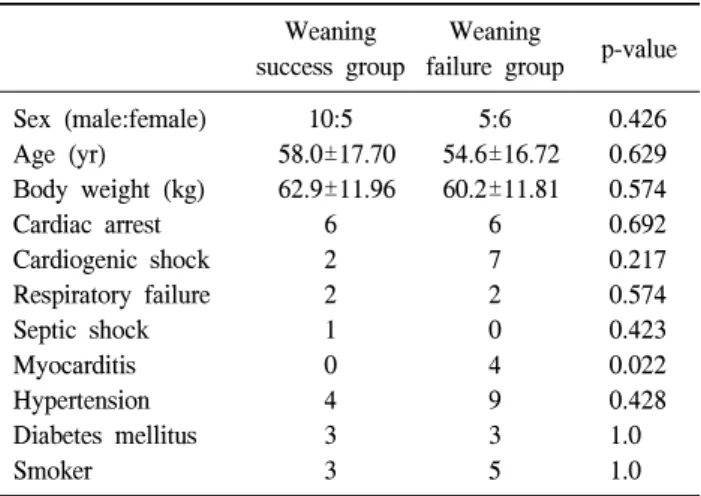
0.426 0.629 0.574 0.692 0.217 0.574 0.423 0.022 0.428 1.0 1.0 Fig. 3. Inclusion and exclusion criteria and distribution by sex.

ECMO, extracorporeal membrane oxygenation; CRF, chronic renal fail- ure; HD, hemodialysis; SAPS, severity of disease classification system.

Table 3. The results of Acute Kidney Injury Network (AKIN) scor- ing system in both groups

Weaning success group

Weaning

failure group p-value AKIN

0-hours

0, 1/2, 3

AKIN

24-hours

0, 1/2, 3 AKIN

48-hours

0, 1/2, 3

13/2 12/3 11/4

9/2 8/3 5/6

0.735 0.664 0.149 flows of ECMO at the time of starting, 24 and 48 hours of

ECMO were investigated. Regarding to ECMO, changes of body weight after 48 hours, the amounts of transfusion, types (venoarterial or venovenous), insertion place, and relation with cardiopulmonary resuscitation, operating duration, and application of continuous renal replacement therapy were evaluated. Vasoactive agents, sequential organ failure assess- ment (SOFA), and SAPS II scores were calculated. Acute Kidney Injury Network (AKIN) scores were calculated and applied for each stage of initiation; AKIN

0-hours

, 24;

AKIN

24-hours

, and 48 hours of ECMO; AKIN

48-hours

(Table 1).

Descriptive statistics for continuous variables are expressed as mean±standard deviation. And categorical variables are ex- pressed as frequency and percentage. All variables were test- ed for normal distributions using the Kolmogorov-Smirnov test. The Student t-test was applied to compare means of con- tinuous variables. Categorical data were tested using the χ

2

test or Fisher’s extract test. Statistical significance were con- sidered if p-values were less than 0.05 (p<0.05). Univariate analysis and linear regression were performed. This study is approved by the institutional review board of Seoul National University Bundang Hospital, Seongnam, Korea.

RESULTS

Venoarterial ECMO was applied in 22 (84.6%) and veno- venous in 4 cases. The reasons for applications of ECMO were cardiac arrest in 12, cardiogenic shock in 9, respiratory

failure in 4, and septic shock in 1. Ventricular tachycardia was classified as cardiac arrest. Patients with myocarditis were 4, who presented with cardiogenic shock in 2 and car- diac arrest in 2. During this period, left ventricular vent were not done for myocarditis. Successful weaning from ECMO was achieved in 15 cases (57.7%), and survival discharge rate was 34.6% (9 cases) in this group. Overall mortality rate was 65.4%. In the weaning success group, there were 10 cases of male patients and 5 of female. In the group of weaning fail- ure, male was 5 and female was 6 cases. There were no stat- istically difference in sex, age, body weight, hypertension, diabetes, smoking, and preceding diseases for initiation of ECMO, except myocarditis (Table 2). Mean duration of appli- cation of ECMO was 111.39±54.06 hours (range, 48.22 to 267.97 hours). In univariate analysis, myocarditis (p=0.022) was the only independent risk factors on weaning failure.

Hemoglobin level at 24 hours after initation of ECMO

showed equivocal significance of p-value 0.05. Changes in

platelet counts, level of AST, total bilirubin, glucose, and al-

(4)

Table 4. AUROC

AUROC±SE p-value 95% CI AUROC±SE p-value 95% CI

AdmHb ECMO24Hb ECMO24Plt ECMO24Glu ECMO24Alb ECMO24TB ECMO24AST ECMO48Glu ECMO48Alb ECMO48TB ECMO48AST BE0

BE24 BE48 MAP0 MAP24 MAP48 ECMOFlow0 ECMOFlow24

0.691±0.112 0.827±0.088 0.515±0.117 0.421±0.114 0.524±0.117 0.436±0.117 0.612±0.122 0.400±0.114 0.376±0.113 0.376±0.124 0.273±0.117 0.406±0.123 0.576±0.121 0.761±0.098 0.588±0.113 0.521±0.119 0.521±0.134 0.491±0.118 0.448±0.115

0.102 0.005 0.897 0.500 0.836 0.586 0.337 0.392 0.287 0.287 0.052 0.421 0.517 0.026 0.452 0.856 0.856 0.938 0.659

0.472−0.910 0.655−0.999 0.285−0.745 0.198−0.644 0.295−0.754 0.207−0.666 0.373−0.851 0.176−0.624 0.153−0.598 0.133−0.618 0.043−0.503 0.166−0.646 0.340−0.812 0.569−0.952 0.366−0.810 0.288−0.755 0.259−0.783 0.260−0.721 0.222−0.675

ECMOFlow48 BwtECMO48 DurationHr IS0 IS24 IS48 VIS0 VIS24 VIS48 ECMO0Cr ECMO24Cr ECMO48Cr AKIN0 AKIN24 AKIN48 SAPS2 SOFA0 SOFA24 SOFA48

0.539±0.116 0.618±0.117 0.485±0.118 0.642±0.115 0.373±0.114 0.294±0.111 0.509±0.123 0.391±0.117 0.358±0.116 0.530±0.116 0.439±0.124 0.318±0.116 0.485±0.117 0.506±0.121 0.361±0.114 0.470±0.125 0.579±0.119 0.364±0.114 0.300±0.104

0.736 0.312 0.897 0.223 0.276 0.078 0.938 0.350 0.223 0.795 0.604 0.119 0.897 0.959 0.233 0.795 0.500 0.243 0.087

0.311−0.768 0.388−0.848 0.254−0.715 0.416−0.869 0.150−0.595 0.076−0.512 0.268−0.750 0.162−0.620 0.130−0.585 0.303−0.757 0.197−0.682 0.091−0.545 0.256−0.714 0.268−0.744 0.136−0.585 0.224−0.716 0.346−0.811 0.141−0.587 0.096−0.504 Numerals indicate hours after initiation of ECMO (for example ECMO24Hb is hemoglobin level 24 hours after initiation of ECMO).

AUROC, area under receiver of characteristics; SE, standard error; CI, confidence interval; Adm, admission; Hb, hemoglobin;

ECMO, extracorporeal membrane oxygenation; Bwt, body weight; Plt, platelet counts; DurationHr, operating time of ECMO by hour; Glu, glucosel; IS, Wernovsky inotropic score; Alb, albumin; TB, total bilirubin; AST, aspartate aminotransferase; VIS, vaso- active inotropic score; Cr, creatinine; BE, base; AKIN, Acute Kidney Injury Network score; MAP, mean arterial pressure; SAPS2, severity of disease classification system II; SOFA, sequential organ failure assessment.

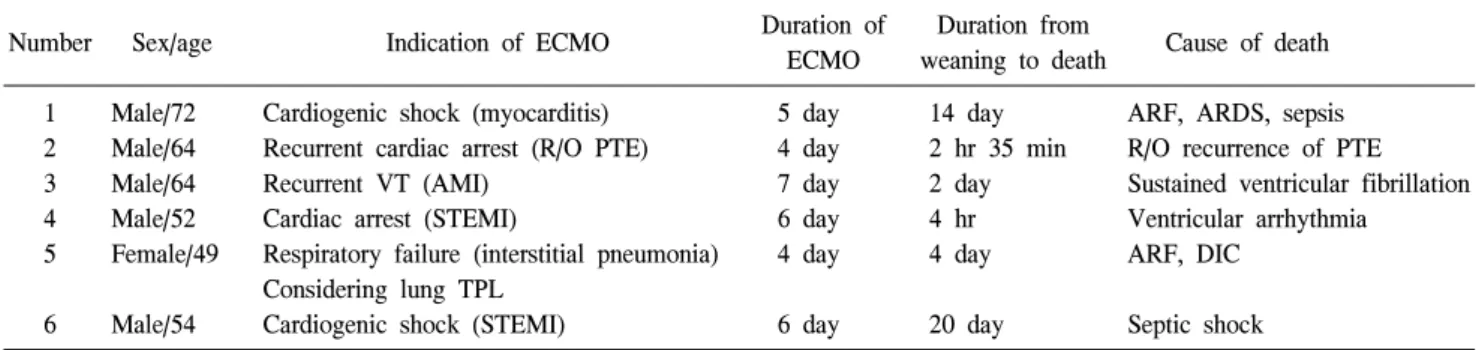
Table 5. Patients died after successful weaning of ECMO

Number Sex/age Indication of ECMO Duration of

ECMO

Duration from

weaning to death Cause of death 1

2 3 4 5

6

Male/72 Male/64 Male/64 Male/52 Female/49

Male/54

Cardiogenic shock (myocarditis) Recurrent cardiac arrest (R/O PTE) Recurrent VT (AMI)

Cardiac arrest (STEMI)

Respiratory failure (interstitial pneumonia) Considering lung TPL

Cardiogenic shock (STEMI)

5 day 4 day 7 day 6 day 4 day

6 day

14 day 2 hr 35 min 2 day 4 hr 4 day

20 day

ARF, ARDS, sepsis R/O recurrence of PTE Sustained ventricular fibrillation Ventricular arrhythmia

ARF, DIC

Septic shock

ECMO, extracorporeal membrane oxygenation; ARF, acute renal failure; ARDS, acute respiratory distress; R/O, rule out; PTE, pul- monary thromboembolism; VT, ventricular tachycardia; AMI, acute myocardial infarction; STEMI, ST elevation myocardial infarction;

DIC, disseminated intravascular coagulation; TPL, transplantation.

bumin during ECMO were statistically insignificant. Further, mean arterial pressure and the amount of blood transfusion were not significant as well. Base excess, flow of ECMO, in- otropic score, and changes in the level of serum creatinine did not show any statistical differences. Eleven cases of suc-

cessful weaning groups are showed lower AKIN

48-hour

stage, but no statistical significance (Table 3).

SAPS and SOFA scores were not matched with prognosis

of ECMO. There were no statistical significant factors except

myocarditis. We assumed that there were some hidden fac-

(5)

tors, which were showed no significant p-value due to small number of total cases. So we applied area under receiver op- erating characteristics curve, to find that factors. The level of hemoglobin at 24 hours after ECMO, and base excess at 48 hours after ECMO were showed more than 0.7 (Table 4). If the number of cases is enough, these factors may be consid- ered as cut off values. Although successful weaning of ECMO, 6 patients died. Brief explanation about them is pre- sented as Table 5.

DISCUSSION

Due to myocardial destruction and remodeling, persistent ventricular dysfunction and dilated cardiomyopathy occurs frequently in myocarditis. Insufficient drainage of right ven- tricular and bronchial circulation will lead to left ventricular (LV) distension. LV distension interferes with myocardial rest and thus greatly imposes impact on influencing the prognosis.

Therefore, LV venting may be helpful in patients with my- ocarditis during ECMO. In Seoul National University Bun- dang Hospital, myocarditis patients did not received LV vent- ing for various reasons. So weaning failures from ECMO in these patients might be result from this. Hemorrhage related with the use of anticoagulants and the formation of thrombus are typical complications that may be occur during ECMO.

Aside from this, long term management may cause severe damage for organs and thus leading to poor prognosis.

Leukocytes, thrombocytes, and complements are activated by ECMO. Acute inflammatory-like reaction can be introduced during the first 24 to 48 hours by the secretion of cytokines, which may cause capillary leakage and thus lead to intra- vascular volume depletion [5,6]. In addition, it is known that the long instillation of ECMO can cause problems, such as hemolysis, and lead to organ damages. Lin et al. [7] reported that the change in creatinine levels and hour urine during ECMO is closely related to the prognosis. A few years later, he reported that AKIN scores at the time of 48 hours after initiation of ECMO was close related with the prognosis [8].

In this study, the relationship between AKIN score and ECMO weaning was not statistically confirmed. However, there were tendency of less severe degree of metabolic acido- sis, slightly higher flow of ECMO, and less inotropic score

and changes in the level of serum creatinine in the successful weaning group. It is a likely possibility that these results arose due to small sample size of patients. If larger number of ECMO patients, the outcome may differ.

Recently, new ECMO equipments are being introduced to reduce the occurrence of hemolysis. Studies regarding these devices and its impact on lowering kidney injuries may be needed. The degree of acidosis 48 hours after initiation of ECMO may reflect the degree of renal insufficiency. The he- moglobin level at the time of 24 hours after initiation of ECMO, regardless of the amounts of transfusion, may be the possible prognostic factor, and degree of acidosis at 48 hours after initiation of ECMO is also.

Maybe due to the small population of the sample size, meaningful factors related with prognosis were not found in this study. The increase in the duration of ECMO causes or- gan dysfunction and will provoke a change in the hemoglobin level. In addition, a progression of acidosis will adversely af- fect the prognosis of the patients. From this perspective, the result of this study may show some relationship between fac- tors and prognosis. With reduction of hemolysis and acidosis, the renal injury will occur less frequently and thus, will result in a better prognosis of ECMO patients.

The first limitation of this present study was that number of the patients enrolled in the study was too small to prove or disprove the existing hypothesis. This could lead to se- lection bias. Secondly, the comparison was not possible be- tween the LV venting group in patients with myocarditis and no venting. It is not possible to differentiate whether my- ocarditis itself is a poor prognosis factor, or LV venting.

However, if the situation of myocarditis is considered, the possibility of the latter is more likely [9,10].

CONCLUSION

This study showed that the hemoglobin levels of 24 hours

after ECMO and degrees of acidosis 48 after initiation of

ECMO are thought as prognostic factors. And patients with

myocarditis had poor prognosis in our cases. There was no

statistical relation between ECMO and renal injury. Further

study may be needed in the future.

(6)

REFERENCES

1. Dalton HJ. Extracorporeal life support: moving at the speed of light. Respir Care 2011;56:1445-53.

2. Yan X, Jia S, Meng X, et al. Acute kidney injury in adult postcardiotomy patients with extracorporeal membrane oxy- genation: evaluation of the RIFLE classification and the Acute Kidney Injury Network criteria. Eur J Cardiothorac Surg 2010;37:334-8.

3. Mehta RL, Kellum JA, Shah SV, et al. Acute Kidney Injury Network: report of an initiative to improve outcomes in acute kidney injury. Crit Care 2007;11:R31.

4. Le Gall JR, Lemeshow S, Saulnier F. A new Simplified Acute Physiology Score (SAPS II) based on a European/North American multicenter study. JAMA 1993;270:2957-63.

5. Godin C, Caprani A, Dufaux J, Flaud P. Interactions between neutrophils and endothelial cells. J Cell Sci 1993;106(Pt

2):441-51.

6. Haller H. Endothelial function: general considerations. Drugs 1997;53 Suppl 1:1-10.

7. Lin CY, Chen YC, Tsai FC, et al. RIFLE classification is predictive of short-term prognosis in critically ill patients with acute renal failure supported by extracorporeal mem- brane oxygenation. Nephrol Dial Transplant 2006;21:2867-73.

8. Chen YC, Tsai FC, Chang CH, et al. Prognosis of patients on extracorporeal membrane oxygenation: the impact of acute kidney injury on mortality. Ann Thorac Surg 2011;91:137-42.

9. Jan SL, Lin SJ, Fu YC, et al. Extracorporeal life support for treatment of children with enterovirus 71 infection-re- lated cardiopulmonary failure. Intensive Care Med 2010;36:

520-7.

10. Rogers JG, Milano CA. The role for mechanical circulatory support for cardiogenic shock. In: Hochman J, Ohman EM.

Cardiogenic shock. Hoboken: Wiley-Blackwell Publishing;

2009. p. 209.

수치

Fig. 2. Yearly cases of extracorporeal membrane oxygenation in  Korea. A data from Health Insurance Review and Assessment  Service of Korea.
Table 3. The results of Acute Kidney Injury Network (AKIN) scor- scor-ing system in both groups
Table 5. Patients died after successful weaning of ECMO

참조

관련 문서

Background: Beyond its current function as a rescue therapy in acute respiratory distress syndrome (ARDS), extracorporeal membrane oxygenation (ECMO) may be applied in

Extracorporeal life support (ECLS), in particular, veno-ve- nous (VV) extracorporeal membrane oxygenation (ECMO) is currently used as rescue therapy on patients with severe

Catastrophic catecholamine-induced cardiomyopathy rescued by extracorporeal membrane oxygenation in recurrent malignant

Indication for extracorporeal membrane oxygenation (ECMO) has been extended as the experience of ECMO in various clinical settings accumulates and the outcome after ECMO

Outcomes of Venovenous Extracorporeal Membrane Oxygenation Support for Acute Respiratory Distress Syndrome in Adults.. Dae Sung Ma, M.D., Joon Bum Kim, M.D., Sung-Ho Jung,

Patients with venoarterial extracorporeal membrane oxygenation (ECMO) frequently suffer from pulmonary edema due to left ventricular dysfunction that accompanies left heart

Delayed Repair of Ventricular Septal Rupture Following Awake Extracorporeal Membrane Oxygenation Support.. − 213 − tubated on the day after the

Extracorporeal life support (ECLS), or extracor- poreal membrane oxygenation (ECMO), is used to support critically ill patients with acute circulatory and/or