Tuberc Respir Dis 2010;68:62-66
CopyrightⒸ2010. The Korean Academy of Tuberculosis and Respiratory Diseases. All rights reserved.
정-정맥 체외막형산소화요법을 이용한 급성호흡부전의 치료
한림대학교 의과대학 춘천성심병원 1흉부외과학교실, 2심장내과학교실, 3호흡기내과학교실, 4내과학교실, 5흉부외과 전임간호사, 6한
림대학교 성심병원 흉부외과학교실, 7강남성심병원 흉부외과학교실, 8강동성심병원 흉부외과학교실
김형수1, 한상진2, 홍경순2, 윤덕형2, 이창률3, 이명구3, 홍원기4, 이순희5, 김건일6, 이희성7, 조성우8
Acute Respiratory Failure Treated with Veno-venous Extracorporeal Membrane Oxygenation
Hyoung Soo Kim, M.D.1, Sang Jin Han, M.D.2, Kyung Soon Hong, M.D.2, Duck Hyoung Yoon, M.D.2, Chang Youl Lee, M.D.3, Myung-Goo Lee, M.D.3, Won Ki Hong, M.D.4, Sun Hee Lee, APN5, Kun Il Kim, M.D.6, Hee-Sung Lee, M.D.7, Sung-Woo Cho, M.D.8
Departments of 1Thoracic & Cardiovascular Surgery, 2Cardiology, 3Pulmonology, 4Internal Medicine, 5Advanced Practice Nurse of Thoracic & Cardiovascular Surgery, Chuncheon Sacred Heart Hospital, Chucheon, Department of Thoracic & Cardiovascular Surgery, 6Hallym University Sacred Heart Hospital, Anyang, 7Kangnam Sacred Heart Hospital, 8Kangdong Sacred Heart Hospital, Hallym University College of Medicine, Seoul, Korea
Background: Extracorporeal membrane oxygenation (ECMO) during severe acute respiratory failure helps to recover the pulmonary function. This study evaluated our experience with veno-venous ECMO in adult patients with acute respiratory failure.
Methods: From January 2007 to July 2009, ECMO was used on 54 patients. Of these 54 patients, 7 were placed on veno-venous ECMO for acute respiratory failure. The indications of ECMO were based on the lung dysfunction measured as a PaO2/FiO2 ratio <100 mm Hg on FiO2 of 1.0, or an arterial blood gas pH <7.25 due to hypercapnia despite the optimal treatment. EBSⓇ, Bio-pumpⓇ, and Centrifugal Rotaflow pumpⓇ were used and all cannulations were performed percutaneously via both femoral veins. When the lung function was improved, an attempt was made to wean on ECMO at moderate ventilator settings followed by decannulation.
Results: Five of the 7 patients were male and the mean age was 46.3±18.3. The causes of acute respiratory failure were 3 cases of pneumonia, 2 near-drownings, 1 pulmonary hemorrhage due to acute hepatic failure and 1 mercury vapor poisoning. The mean support time of ECMO was 17.3±13.7 days. Of the 7 patients implanted with ECMO, 5 patients (71%) were weaned off ECMO and 3 patients (43%) survived to hospital discharge after a mean 89.6 hospital days.
Conclusion: The early use of ECMO for acute respiratory failure in adults due to any cause is a good therapeutic option for those unresponsive to the optimal conventional treatments.
Key Words: Extracorporeal Membrane Oxygenation; Respiratory Distress Syndrome, Acute
Address for correspondence: Hyoung Soo Kim, M.D.
Department of Thoracic & Cardiovascular Surgery, Chun- cheon Sacred Heart Hospital, Hallym University College of Medicine, 153, Kyo-dong, Chuncheon 200-704, Korea Phone: 82-33-240-5347, Fax: 82-33-255-6244
E-mail: [email protected] Received: Oct. 18, 2009 Accepted: Jan. 11, 2010
서 론
급성호흡부전은 여러 가지 원인에 의해서 폐 손상이 발 생하여 적절한 산소 치료에도 불구하고 저산소증이 발생 하는 경우를 말한다. 이러한 급성호흡부전 환자의 치료를 효과적으로 하기 위하여 인공호흡기의 일회 호흡량은 6 mL/kg로 감소시켜 적용하고, 적절한 시기에 스테로이드 를 투여하고, Nitric Oxide 가스의 사용, 그리고 인공 호흡
기 치료 중 복와위를 적용하는 등 여러 치료 방법들이 적 용되고 있다1-4. 그러나 이러한 치료에도 불구하고 저산소 증이 치료되지 않는 경우 정정맥 체외막형산소화요법 (extracoporeal membrane oxygenation, ECMO)을 적용 할 수 있다5. Lee 등6의 증례 보고를 시작으로 최근 국내에 서도 Capiox Emergency Bypass SystemⓇ (Terumo Inc., Tokyo, Japan) 장비가 도입되고, 또한 경피적으로 도관 삽입이 용이해지면서 ECMO의 시술이 증가하고 있는 추 세이다. 그러나 국내에서는 시행된 ECMO 시술의 대부분 은 심인성 쇼크나 심정지 등 심장질환에서 사용하는 동정 맥 ECMO가 대부분이다7,8.
본 연구에서는 다양한 원인에 의해 발생된 급성호흡부 전 환자에서 정정맥 ECMO를 이용한 치료의 효과에 대해 연구하였다.
대상 및 방법
2007년 1월부터 2009년 7월까지 ECMO를 시행하였던 54명의 환자 중 급성호흡부전으로 정정맥 ECMO를 시행 한 7명의 환자를 대상으로 후향적 조사를 시행하였다.
정정맥 ECMO는 급성호흡부전에 대한 적절한 치료에도 불구하고 PaO2/FiO2 비가 100 mm Hg 이하이거나 과이산 화탄소 혈증으로 인해 동맥혈 검사에서 pH가 7.25 이하일 때 시행하였다.
정정맥 ECMO를 시행하기 위한 장비는 Capiox Emer- gency Bypass SystemⓇ (Terumo Inc), Bio-pumpⓇ (Med- tronic Inc., Minneapolis, MN, USA), 그리고 Centrifugal Rotaflow pumpⓇ (Maquet Inc., Hirrlingen, Germany)를 사용하였고, 정맥 도관은 DLPⓇ (Medtronic Inc)와 RMIⓇ (Edward’s Lifescience LLC, Irvine, CA, USA)의 17∼28 Fr 크기의 도관을 사용하였다.
도관 삽입은 심혈관 조영실에서 시행하였고, 양측 대퇴 정맥을 이용하였으며, 관류 도관(17∼21 Fr)은 우심방 내 에 위치시켰고, 배액 도관(17∼28 Fr)은 하대정맥에 거치 시켜 하대정맥 내 도관에서 혈액을 배액하여 인공심폐장 치로 통과시킨 후 우심방에 위치한 도관으로 혈액을 공급 하였다.
혈전 방지를 위한 항응고제는 2008년 12월까지는 헤파 린을 주입하여 activated clotting time을 160∼180초로 유 지하였으나, 2009년 1월부터는 nafamostat mesilate를 사 용하여 aPTT를 정상 수치의 1.5배에서 2배로 유지하였다.
정정맥 ECMO를 시행하는 동안 인공호흡기는 일회호흡
량은 5 mL/kg, PEEP 4 cmH2O, 분당호흡수는 10회로 하 였고, 환자의 말초 산소 포화도는 88∼92%를 유지하였 다. 정정맥 ECMO는 펌프 혈류량이 0.5 L/min에서 인공호 흡기의 일회호흡량이 6 mL/kg, PEEP 4 cmH2O, 분당호흡 수는 16회, FiO2 0.6에서 동맥혈검사에서 산증이 없고, 이 산화탄소 분압이 55 mm Hg 이하이고, 산소 분압이 60 mm Hg 이상일 때 제거하였다.
결 과
대상 환자 7명 중 남자가 5명이었고, 여자는 2명이었다.
평균 나이는 46.3±18.3세였다. 정정맥 ECMO를 시행하 기 전 동맥혈 가스분석은 FiO2 1.0에서 pH 7.18±0.14, PaO2 56.8±20.6 mm Hg, PCO2 68.8±31.6 mm Hg였다.
급성호흡부전의 원인으로는 가익수 2명, 폐렴 3명, 폐 좌 상 및 급성간부전 연관 폐출혈 1명, 그리고 수은 증기 중 독으로 인한 급성폐손상 1명이었다. 폐렴 환자 3명 중 2명 은 수술 후 발생한 폐렴이었는데, 1명은 폐절제술과 위전 절제술을 동시에 시행한 후 그리고 다른 1명은 대동맥 박 리증 수술 후 발생한 급성호흡곤란 증후군이었다. 정정맥 ECMO를 시작하기 전 기계 호흡은 평균 12.1±12.1일을 시행하였고, 내원 당일 시행한 환자는 3명이었다(Table 1).
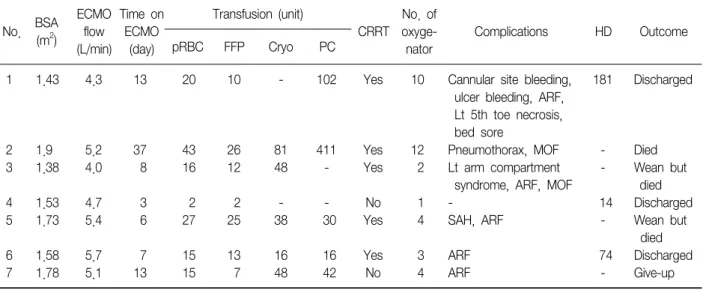
대상 환자들의 체표면적은 평균 1.6±0.2 m2이었고, 정 정맥 ECMO의 혈류량은 최대 평균 4.9±0.6 L/min였다.
정정맥 ECMO를 시행한 시간은 평균 17.3±13.7일이었고, 수혈은 적혈구 농축액 19.7±12.7 units, 신선동결혈장 13.6±8.9 units, 혈액응고인자 농축액 25.3±30.4 units, 혈소판농축액 93.6±143.6 units 등이었다. 정정맥 ECMO 시행 중 6명의 환자에서 15건의 합병증이 발생하였다. 합 병증은 급성 신부전 5건, 도관 부위 출혈 1건, 욕창 1건, 기흉 1건, 좌측 상지 구획 증후군 1건, 좌측 5번째 발가락 괴사 1건, 거미막밑 출혈(subarachnoid hemorrhage) 1건, 그리고 위궤양 출혈 1건이었다. 5명(71%)의 환자에서 ECMO 이탈이 가능하였고, 3명(43%)이 생존하여 퇴원하 였다. 생존하여 퇴원한 환자의 병상일수는 평균 89.6일이 었다(Table 2). 그리고 사망한 환자들의 사망원인은 다발 성 장기부전이었다.
고 찰
ECMO는 심폐부전이 발생하였을 때 일시적으로 심장기 능 및 폐기능을 대체하는 수단으로 체외순환장치를 이용
Table 1. Pre-ECMO patients data
Duration of No. Pts Cause of acute respiratory failure pre-ECMO ventilation (day)
ABGA (FiO2 1.0)
pH PO2 (mm Hg) PCO2 (mm Hg)
1 F/42 Pneumonia, sepsis 1 7.09 31 58
2 M/51 Post-op pneumonia, sepsis: 30 7.25 43 45
Aortic surgery & ICH surgery
3 M/72 Post-op pneumonia: LLL lobectomy 18 7.15 72.3 95.2
by VATS & gastrectomy
4 F/12 Near-drowning: river 1 7.01 67 94
5 M/42 Near-drowning: river 1 7.07 59 54
6 M/55 Pulmonary hemorrhage d/t acute 19 7.43 33 55
hepatic failure: crushing injury (remicon-truck mixer)
7 M/52 Mercury vapor intoxication 18 7.29 43 125.2
ECMO: extracorporeal membrane oxygenation; Pts: patients; post-op: postoperative; ICH: intracranial hemorrhage; d/t: due to; LLL:
left lower lobe lobectomy; VATS: video-assisted thoracoscopic surgery.
Table 2. Data on the seven patients with veno-venous ECMO
No. BSA (m2)
ECMO flow (L/min)
Time on ECMO
(day)
Transfusion (unit)
CRRT
No. of oxyge- nator
Complications HD Outcome
pRBC FFP Cryo PC
1 1.43 4.3 13 20 10 - 102 Yes 10 Cannular site bleeding, 181 Discharged
ulcer bleeding, ARF, Lt 5th toe necrosis, bed sore
2 1.9 5.2 37 43 26 81 411 Yes 12 Pneumothorax, MOF - Died
3 1.38 4.0 8 16 12 48 - Yes 2 Lt arm compartment - Wean but
syndrome, ARF, MOF died
4 1.53 4.7 3 2 2 - - No 1 - 14 Discharged
5 1.73 5.4 6 27 25 38 30 Yes 4 SAH, ARF - Wean but
died
6 1.58 5.7 7 15 13 16 16 Yes 3 ARF 74 Discharged
7 1.78 5.1 13 15 7 48 42 No 4 ARF - Give-up
BSA: body surface area; pRBC: packed RBC; FFP: fresh frozen plasma; Cryo: cryoprecipitate; PC: platelet concentrate; CRRT: con- tinuous renal replacement therapy; ARF: acute renal failure; Lt: left; MOF: multi-organ failure; SAH: subarachnoid hemorrhage; HD:
hospital day.
하는 것을 말한다. 급성심부전 또는 급성호흡부전이 있는 환자에서 적절한 치료에도 불구하고 사망할 확률이 높을 때 ECMO를 이용하여 치료를 하게 되는데, 보통 50%의 사망할 확률이 예측될 때 ECMO를 고려할 수 있고, 80%의 사망할 확률이 예측될 때에는 ECMO의 적응증이 될 수 있다9.
Hemmila 등5은 급성 호흡부전 환자에서 ECMO를 이용 한 치료에서 52%의 생존율을 보고하였다. ECMO를 적용
할 수 있는 각각의 질환이나 상태 등에 대해서는 아직 연 구 중이며 일부 질환에 있어서는 논란이 있지만, 장비의 발달로 인하여 ECMO를 이용하여 시술을 할 수 있는 적응 증의 범위는 점점 확대되고 있는 추세이다10.
정정맥 ECMO를 적용하는 경우는 여러 원인에 의해 발 생된 급성호흡부전에서 사망할 확률이 80% 이상일 때 적용 할 수 있는데, 사망할 확률이 80% 이상으로 예측 될 수 있 는 상태는 FiO2 0.9 이상에서 PaO2/FiO2 <80 mm Hg 이하
이고 Murray score가 3∼4점일 경우이다. 또한 천식이나 다른 원인에 의해 CO2가 축척될 때 사용할 수가 있다9. 본 연구의 대상 환자 모두는 이러한 기준에 충족되는 환자들로서 기계호흡만으로는 더 이상 생존을 기대할 수 없는 상태였다. 또한 대상 환자들 중 폐렴으로 ECMO를 시행한 환자들 중 2명은 패혈증이 동반되어 있었다. 따라 서 ECMO를 시행하기 전 저산소증으로 인한 저혈압으로 혈압상승제를 사용하였으나 ECMO 시행 후 저산소증이 호전되면서 혈압상승제는 필요하지 않게 되었다. 패혈증 또는 패혈성 쇼크에서 급성폐손상이 발생하고 저혈압이 동반되는 경우에는 정정맥 ECMO로는 조직 관류가 저하 되어 대사성 산증이 발생할 가능성이 많아 이러한 경우에 는 동정맥 ECMO를 시행하여야 하여야 한다10.
가익수로 인해 급성 호흡부전이 발생한 환자에게 ECMO를 적용하여 좋은 결과를 얻은 보고들이 있다11-13. 본 연구에서도 2명의 환자에게 정정맥 ECMO를 시행하여 1명의 환자는 합병증의 발생 없이 회복하였으나 다른 1명 의 경우는 물놀이 사고 당시 발생한 저산소성 뇌증으로 거미막밑 출혈이 발생하여 ECMO는 제거할 수 있었으나 사망하였다. 익수로 급성호흡부전이 발생하는 경우에는 초기 심폐소생술이 무엇보다 중요하고 이와 더불어 환자 의 뇌기능에 대한 평가를 정확히 하여 ECMO를 시행한다 면 보다 좋은 결과를 얻을 수 있을 것으로 생각된다.
수은 증기 중독으로 인해 발생한 급성호흡부전의 경우 폐조직의 섬유화가 진행하여 저산소증으로 사망하는 경 우가 대부분이다14,15. 한약재를 만드는 과정 중에 수은 증 기에 중독된 우리 환자의 경우는 ECMO를 적용하였으나 폐의 섬유화가 진행되어 보호자가 치료를 포기하였다. 이 와 같은 비가역성 폐질환의 경우 ECMO의 적용에 있어서 신중한 결정을 하여야 할 것으로 생각된다. 그리고 외상 으로 인한 폐좌상 후 급성간부전 발생으로 폐출혈이 심했 던 환자에서는 정정맥 ECMO를 적용한 후 간기능이 호전 되면서 폐출혈이 멈추었고 급성호흡부전 또한 회복될 수 있었다. 외상으로 심각한 폐좌상이 있는 경우 다른 장기 에도 손상이 동반되어 있는 경우가 많다. 따라서 ECMO를 적용할 때 전신적 항응고제 투여로 인하여 출혈이 악화 될 가능성이 높을 수 있으나 환자의 상태에 따라 적절하게 사용한다면 좋은 결과를 얻을 수 있다16,17.
출혈은 ECMO 시술 중에 발생하는 중요한 합병증 중의 하나이고 이로 인하여 다량의 수혈을 하게 되는 경우가 많이 있다. 도관 삽입부 출혈이 흔히 발생할 수 있고, 보다 심각한 위궤양 출혈, 뇌출혈 등으로 인해 환자가 사망하는
경우도 있으며, 또한 출혈이 발생하는 경우 이를 해결하기 가 어려운 경우가 많다5,7,8. 본 연구 대상 환자에서는 2명 의 환자에서 심각한 출혈성 합병증이 발생하였으나 나머 지 환자들에게서는 발생하지 않았는데 그 이유로는 도관 삽입을 전담하는 한 명의 숙련된 시술자가 심혈관 촬영실 에서 시행하여 도관 삽입부 출혈을 줄일 수 있었다고 생각 된다. 그러나 폐렴과 패혈증이 동반되었던 2명의 환자에 서 혈소판 농축액을 다량으로 수혈하였는데, 이것은 저혈 소판증이 패혈증으로 인해 발생한 것으로 추측된다.
본 연구의 대상 환자 7명 중 5명이 급성신부전이 동반 되어 지속적 신 대체 요법을 시행하였고, 사망한 환자들의 사망 원인은 다발성 장기부전이었다. 이것은 ECMO를 시 행하기 전에 이미 저산소증으로 인한 장기 부전 상태가 진행되고 있었고, ECMO를 적용한 이후에도 회복이 되지 않았기 때문이라고 생각된다.
따라서 다양한 원인에 의해 발생되는 급성 호흡부전에 서 환자의 상태를 정확히 평가하여 조기에 ECMO를 적용 한다면 기존 치료방법으로는 사망할 가능성이 매우 높은 환자에서 좋은 결과를 얻을 수 있을 것으로 생각된다.
참 고 문 헌
1. The Acute Respiratory Distress Syndrome Network.
Ventilation with lower tidal volumes as compared with traditional tidal volumes for acute lung injury and the acute respiratory distress syndrome. N Engl J Med 2000;
342:1301-8.
2. Bernard GR. Acute respiratory distress syndrome: a his- torical perspective. Am J Respir Crit Care Med 2005;172:
798-806.
3. Kallet RH. Evidence-based management of acute lung injury and acute respiratory distress syndrome. Respir Care 2004;49:793-809.
4. Gattinoni L, Tognoni G, Pesenti A, Taccone P, Masch- eroni D, Labarta V, et al. Effect of prone positioning on the survival of patients with acute respiratory failure. N Engl J Med 2001;345:568-73.
5. Hemmila MR, Rowe SA, Boules TN, Miskulin J, McGillicuddy JW, Schuerer DJ, et al. Extracorporeal life support for severe acute respiratory distress syndrome in adults. Ann Surg 2004;240:595-605.
6. Lee KH, Lee SM, Chung YK, Kim KW, Ham BM, Moon HS, et al. Prolonged extracorporeal lung heart assist (extracorporeal membrane oxygenation): 4 cases re- port. Korean J Anesthesiol 1992;25:424-32.
7. Rhee I, Kwon SU, Sung K, Cho SW, Gwon HC, Lee
YT, et al. Experiences with emergency percutaneous cardiopulmonary support in in-hospital cardiac arrest or cardiogenic shock due to the ischemic heart disease.
Korean J Thorac Cardiovasc Surg 2006;39:201-7.
8. Rhee I, Gwon HC, Choi J, Sung K, Lee YT, Kwon SU, et al. Percutaneous cardiopulmonary support for emer- gency in-hospital cardiac arrest or cardiogenic shock.
Korean Circ J 2006;36:11-6.
9. Extracorporeal Life Support Organization. ELSO educa- tion page [Internet]. Ann Arbor (MI): Extracorporeal Life Support Organization; c2009 [Cited 2009 Sep 21].
Available from: http://www.elso.med.umich.edu/gui- de.htm.
10. Maclaren G, Butt W. Extracorporeal membrane oxygen- ation and sepsis. Crit Care Resusc 2007;9:76-80.
11. Eich C, Bräuer A, Kettler D. Recovery of a hypothermic drowned child after resuscitation with cardiopulmonary bypass followed by prolonged extracorporeal mem- brane oxygenation. Resuscitation 2005;67:145-8.
12. Thalmann M, Trampitsch E, Haberfellner N, Eisendle E, Kraschl R, Kobinia G. Resuscitation in near drowning
with extracorporeal membrane oxygenation. Ann Thorac Surg 2001;72:607-8.
13. Peralta R, Ryan DP, Iribrane A, Fitzsimons MG. Extra- corporeal membrane oxygenation and CO2 removal in an adult after near drowning. J Extra Corpor Technol 2005;37:71-4.
14. Ho BS, Lin JL, Huang CC, Tsai YH, Lin MC. Mercury vapor inhalation from Chinese red (Cinnabar). J Toxicol Clin Toxicol 2003;41:75-8.
15. Lim HE, Shim JJ, Lee SY, Lee SH, Kang SY, Jo JY, et al. Mercury inhalation poisoning and acute lung injury.
Korean J Intern Med 1998;13:127-30.
16. Campione A, Agostini M, Portolan M, Alloisio A, Fino C, Vassallo G. Extracorporeal membrane oxygenation in respiratory failure for pulmonary contusion and bronchial disruption after trauma. J Thorac Cardiovasc Surg 2007;133:1673-4.
17. Madershahian N, Wittwer T, Strauch J, Franke UF, Wippermann J, Kaluza M, et al. Application of ECMO in multitrauma patients with ARDS as rescue therapy.
J Card Surg 2007;22:180-4.