• 검색 결과가 없습니다.

Extracorporeal Life Support in Acute Poisoning

N/A
N/A
Protected

Academic year: 2021

Share "Extracorporeal Life Support in Acute Poisoning"

Copied!
7
0
0

로드 중.... (전체 텍스트 보기)

전체 글

(1)

저저

서 론

급성 중독물질에 노출 후 중독 증상은 심혈관계, 호흡기 계, 소화기계, 중추신경계 등 다양하게 나타날 수 있으며, 특히 심장혈관계 부작용이나 호흡기계 부작용은 급성기 사망이나 합병증의 주요 원인이다

1)

. 급성중독에 의한 이 런 부작용은 전문심장소생술이나 전문호흡관리, 전문해 독제를 포함한 전문중독치료 등을 적정하게 사용할 경우

급성 중독에서 체외순환보조장치의 적용

고려대학교병원 응급의학과

이시진∙한갑수∙이의중∙김도현∙박경애∙이지영∙김수진∙이성우

Extracorporeal Life Support in Acute Poisoning

Si Jin Lee, M.D., Gap Su Han, M.D., Ph.D., Eui Jung Lee, M.D., Ph.D., Do Hyun Kim, M.D., Kyoung Yae Park, M.D., Ji Young Lee, M.D., Su Jin Kim, M.D., Ph.D., Sung Woo Lee, M.D., Ph.D.

Department of Emergency Medicine, College of Medicine, Korea University, Seoul, Republic of Korea

Purpose: Cardiovascular or respiratory complications of acute intoxication are the most common causes of mortali- ty. Advanced cardiac life support (ACLS) or specific antidotes help manage these cardiac or respiratory complica- tions in acute intoxication. On the other hand, some cases do not respond to ACLS or antidotes and they require some special treatment, such as extracorporeal life support (ECLS). ECLS will provide the chance of recovery from acute intoxication. This study examined the optimal timing of ECLS in acute intoxication cases.

Methods: This paper is a brief report of a case series about ECLS in acute poisoning. The cases of ECLS were reviewed and the effects of ECLS on the blood pressure and serum lactate level of the patients were analyzed.

Results: A total of four cases were reviewed; three of them were antihypertensive agent-induced shock, and one was respiratory failure after the inhalation of acid. The time range of ECLS application was 4.8-23.5 hours after toxic exposure. The causes of ECLS implementation were one for recurrent cardiac arrest, two for shock that did not respond to ACLS, and one for respiratory failure that did not respond to mechanical ventilator support. Three patients showed an improvement in blood pressure and serum lactate level and were discharged alive. In case 1, ECLS was stared at 23.5 hours post toxic exposure; the patient died due to refractory shock and multiple organ failure.

Conclusion: The specific management of ECLS should be considered when a patient with acute intoxication does not recovery from shock or respiratory failure despite ACLS, antidote therapies, or mechanical ventilator support.

ECLS improved the hemodynamic and ventilator condition in complicated poisoned patients. The early application of ECLS may improve the tissue perfusion state and outcomes of these patients before the toxic damage becomes irreversible.

Key Words: Extracorporeal life support, Poison, Shock, Respiratory failure

책임저자: 이 성 우

서울특별시 성북구 인촌로 73 고려대학교병원 응급의학과 Tel: 02) 920-5408 Fax: 02) 920-5407 E-mail: [email protected]

투고일: 2018년 10월 2일 1차 심사일: 2018년 10월 2일 게재 승인일: 2018년 10월 15일

(2)

대부분 회복 가능하다. 그런데, 일부 중독의 경우 전문심 장소생술이나, 인공호흡기 치료에 불응하여 지속되는 쇼 크와 호흡부전 증상으로 급성기 사망을 초래한다. 이런 경 우 중독환자가 회복할 수 있는 기간을 확보하기 위한 또 다른 전문적 치료의 접목이 필요하다. 체외순환보조장치 (Extracorporeal life support; ECLS)는 기존의 치료에 불 응하는 호흡부전이나 쇼크, 심정지 상태에서 주요 장기에 산소화된 순환상태를 유지시켜 줌으로써 정확한 치료가 이루어지거나, 환자가 회복될 때까지 징검다리(bridge) 역할을 할 수 있는 특수 치료법이다

2,3)

. Megarbanel 등

4)

은 심정지 환자에게 ECLS를 적용한 심폐소생술을 시행한 결 과 급성 중독에 의한 심정지 환자에서 좋은 성과를 보였음 을 보고한 바 있고, Daubin 등

5)

은 급성 중독으로 인한 불 응성 쇼크을 보이는 환자에서 ECLS의 유용성을 보고한 바 있다. 국내에서도 급성 중독의 심장혈관 및 호흡기계 급성 합병증의 치료에 ECLS를 사용한 예가 드물게 보고 되고 있다

6)

. 하지만 급성중독의 치료과정 중 ECLS가 어떤 경우 필요한지, 언제 시작하는 것이 좋은지 등 급성중독에 서 ECLS의 적응증을 파악하기에는 부족하다. 저자는 지 난 10여년간 심정지 및 불응성쇼크, 급성호흡부전증 환자 중 기존 전문치료에 반응하지 않는 경우 ECLS를 적용하 여 치료한 경험을 축적해 왔다. 이 중 급성 중독 후 ECLS 를 적용한 사례를 추출하여 간략히 보고하여 대략적 급성 중독에서 ECLS 사용의 적응증 및 적용시기를 제안해 보 고자 한다.

연구방법

2006년부터 2017년까지 고려대학교병원 ECLS 코호트 에서 급성중독에 의한 사례를 추출하였다. 추출된 사례는 총 4례였다. 각 사례에서 대한 고찰과 함께, ECLS 적용 전

후 혈압 및 젖산 농도의 변화를 조사 분석하였다.

증례 보고

증례 1. 여자 51세로 내원일 자정경 혈압약(Oldeca:

bamidipine 10 mg, concor: bisoprolol 5 mg) 각 10정 을 음독 한 후 아침부터 구토 및 기면 상태 보이다가 음독 일 저녁 6시 30분경 의식 소실된 상태로 보호자에 발견되 어 119에 신고되었다. 저녁 6시 49분 119 도착 당시 pulseless electrical activity 상태의 심정지 상태로 심폐 소생술 받으면서 응급실 도착하였다. 응급실 심정지 리듬 은 무수축이었고 저녁 7시 1분경 자발순환회복이 되었다.

자발순환 회복 후 전문해독제(Table 1) 및 승압제(노르에 피네프린, 도파민)를 최대용량으로 사용하는 상태에서 혈 압 95/55 mmHg로 측정되었다. 이후 저녁 10시 50분경 심정지가 다시 발생하여 음독으로부터 약 24시간 경과 후 (익일 자정)에 쇼크 및 심정지 재발의 높은 가능성을 고려 하여 ECLS 시행하였다. ECLS 후 평균동맥압 40 mmHg 이상 유지 되지 않고 무수축으로 진행되며 사망하였다.

증례 2. 여자 69세로 내원일 새벽 2시경 혈압약(norvasc;

amlodipine bsylate 5 mg) 30정 이상을 음독한 후 새벽 3시경 지역병원을 일차 방문하여 제독 및 저혈압에 대해 최대 용량으로 승압제(노르에피네프린, 도파민, 에피네프 린)를 사용하면서 상급병원으로 아침 7시경 전원되었다.

승압제 및 전문적 해독치료(Table 1)에도 불구하고 지속 적인 저혈압 및 혈중 젖산 농도가 지속적으로 상승하여 아 침 9시 30분경 ECLS 시행하였다. 이후 입원 3일째 ECLS 성공적으로 제거하였으며 입원 11일째 합병증 없이 퇴원 하였다.

증례 3. 남자 76세로 내원일 새벽 5시경 혈압약(herben:

diltiazem 90 mg, isoket: nitrite 40 mg, aprovel: ACE

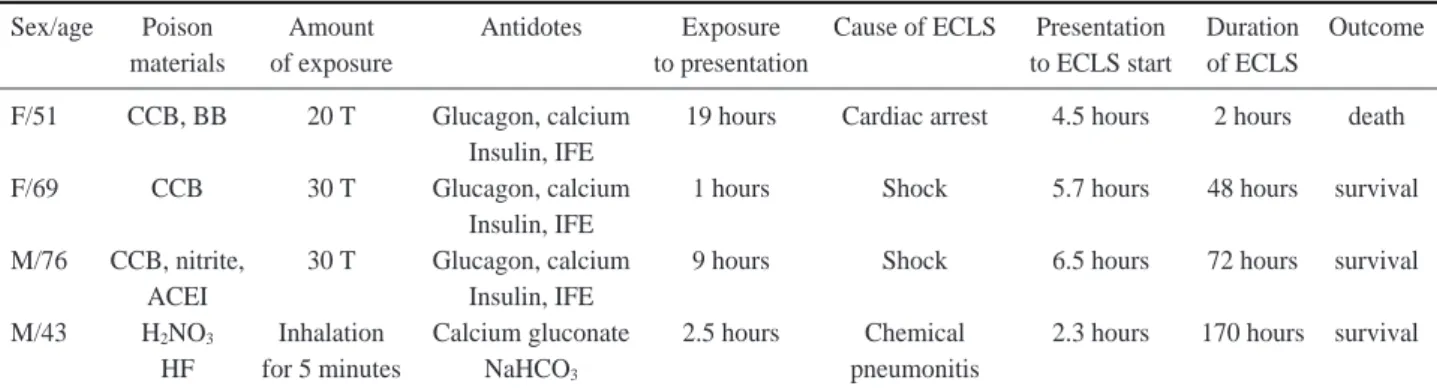
Table 1. The characteristics of 4 patients who were managed with extracorporeal life support

Sex/age Poison Amount Antidotes Exposure Cause of ECLS Presentation Duration Outcome

materials of exposure to presentation to ECLS start of ECLS

F/51 CCB, BB 20 T Glucagon, calcium 19 hours Cardiac arrest 4.5 hours 2 hours death Insulin, IFE

F/69 CCB 30 T Glucagon, calcium 1 hours Shock 5.7 hours 48 hours survival

Insulin, IFE

M/76 CCB, nitrite, 30 T Glucagon, calcium 9 hours Shock 6.5 hours 72 hours survival

ACEI Insulin, IFE

M/43 H

2

NO

3

Inhalation Calcium gluconate 2.5 hours Chemical 2.3 hours 170 hours survival

HF for 5 minutes NaHCO

3

pneumonitis

CCB: calcium channel blocker, BB: beta blocker, ACEI: angiotensin converting enzyme inhibitor, HF: hydrofluoric acid, IFE: intra-

venous fat emulsion, ECLS: extracorporeal life support

(3)

inhibitor 300 mg) 각각 10정 가량 음독한 후 점심까지 깨 지 않아 오후 1시 50분경 응급실로 내원하였다. 내원 당시 혈압은 110/70 mmHg, 맥박수 86회/분, 호흡수 24회/분 이었다. 내원 후 오후 2시 30분경 갑작스런 혈압의 저하 소견 보여 전문해독치료(Table 1)와 함께 최대용량으로 승압제(노르에피네프린, 바소프레신, 에피네프린)를 투여

하였으나 지속적 저혈압 및 혈중 젖산 농도의 상승으로 오 후 7시 10분경 ECLS 시작하였다. 이후 입원 4일째 성공적 으로 ECLS 제거하였으며, 입원 30일째 합병증 없이 퇴원 하였다.

증례 4. 남자43세로 내원일 아침 9시경 보호장비 없이 질산 및 불산 용액으로 반도체 장비 세척 작업을 약 5분간

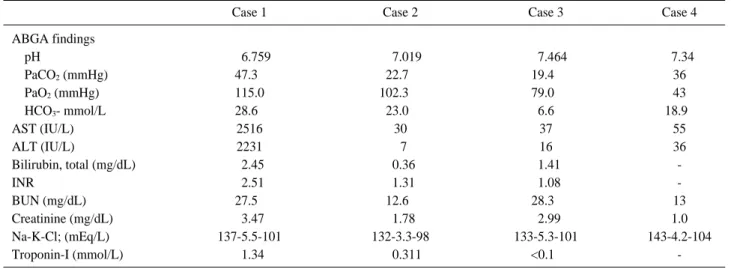
Table 2. Initial laboratory findings of study patients

Case 1 Case 2 Case 3 Case 4

ABGA findings

pH 006.759 007.019 007.464 07.34

PaCO

2

(mmHg) 47.30 22.70 19.40 36

PaO

2

(mmHg) 115.0 102.300 79.00 43

HCO

3

- mmol/L 28.60 23.00 6.6 18.90

AST (IU/L) 2516 30 37 55

ALT (IU/L) 2231 07 16 36

Bilirubin, total (mg/dL) 02.45 00.36 01.41 -

INR 02.51 01.31 01.08 -

BUN (mg/dL) 27.50 12.60 28.30 13

Creatinine (mg/dL) 03.47 01.78 02.99 1.0

Na-K-Cl; (mEq/L) 137-5.5-101 132-3.3-98 133-5.3-101 143-4.2-104

Troponin-I (mmol/L) 01.34 000.311 <0.10 -

Fig. 1. The changes of mean arterial blood pressure (MAP) according to the application of extracorporeal life support (ECLS). MAPs of

case 2-4 were improved after application of ECLS. In case 1, ECLS was stared at about 23 hours post toxic exposure, the patient

died due to refractory shock.

(4)

한 후 오전 11시 36분 호흡곤란으로 응급실 내원하였다.

내원 후 지속적 저산소증으로 기계환기를 시행하였으나 1 시간 30분 가량 동안 약 2L에 이르는 다량의 기도분비물 로 인해 저산소증 및 환기 장애 지속되고 동맥혈 가스검사 가 내원 당시(Table 2)보다 pH 6.93, PaCO

2

105 mmHg, PaO

2

51 (Fio

2

1.0), SaO

2

55.2%로 악화되어, 오후 1시 50분경 ECLS 시행하였다. 입원 9일째 ECLS 성공적으로 제거하였으며 입원 31일째 큰 합병증 없이 퇴원하였다

6)

. 결 과

1. ECLS의 적응증

본 연구에서 ECLS는 해독제 치료 및 전문적 심장구조술 에 반응하지 않는 쇼크 상태에 대해 3예, 기계환기에 의해 유지되지 않은 화학성 폐손상에 의한 급성 호흡부전 상태 에 1례가 적용되었다.

모든 환자는 ECLS 적용 전 모두 2종류 이상의 승압제를 최대용량으로 사용하고 있었다. 이들의 ECLS 적용 직전 평균동맥압은 증례 순서대로 각각 0, 65 mmHg, 37 mmHg, 50 mmHg였으나 ECLS 적용 후 사망 사례 1을

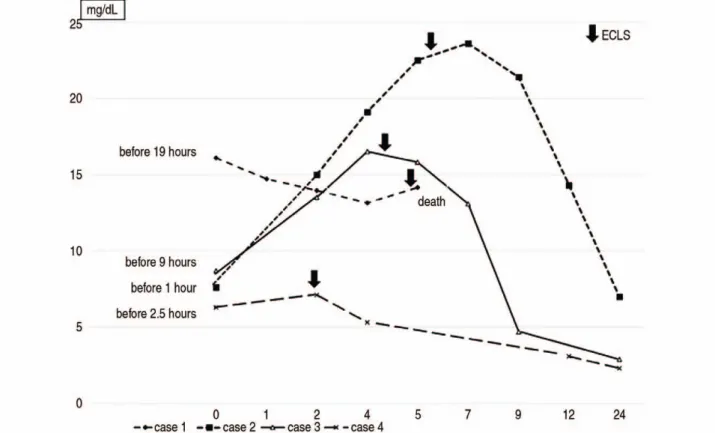
제외하고는 모두 상승되는 패턴을 보였다(Fig. 1). 이들의 혈중 젖산농도는 13.2 mg/dL, 22.5 mg/dL, 16.5 mg/dL, 6.5 mg/dL로 상승되어 있었으나, ECLS 적용 후 사망 사 례 1을 제외하고는 점차 감소하는 추세를 보였다(Fig. 2).

증례 2의 경우 승압제 사용 후 평균동맥압은 내원 직후 46.7 mmHg에서 65 mmHg까지 상승하였으나, 혈청 젖 산농도는 7.6 mg/dL에서 22.5 mg/dL로 꾸준히 악화되었 으며, ECLS 적용 후 23.6 mg/dL까지 악화된 후 적용 18 시간째 7.0 mg/dL로 호전되었다(Fig. 3). 중독 후 급성기 쇼크의 합병증을 보인 증례 2의 경우 혈압과 젖산치의 호 전여부가 일치하지 않았다(Fig. 3).

고 찰

본 사례보고를 기준으로 중독의 급성기 치명적 합병증 인 쇼크의 발생이나 호흡부전의 발생 때 기존 전문해독치 료나 혈역학적 및 전문호흡기를 통한 중환자치료가 실패 하는 경우 ECLS의 적용을 적극 고려해 볼 수 있으며, 적용 시기의 경우 혈압이나 혈청 젖산농도를 감시하면서 조기 에 결정하는 것이 좋은 성과로 이어질 가능성이 높다. 증 례 2의 경우처럼 승압제 사용으로 혈압이 적정 범위로 상

Fig. 2. The changes of serum lactate level according to the application of extracorporeal life support (ECLS). The levels of serum lactate

in case 2-4 were improved after application of ECLS. In case 1, ECLS was stared at about 23 hours post toxic exposure, the

patient died due to refractory shock.

(5)

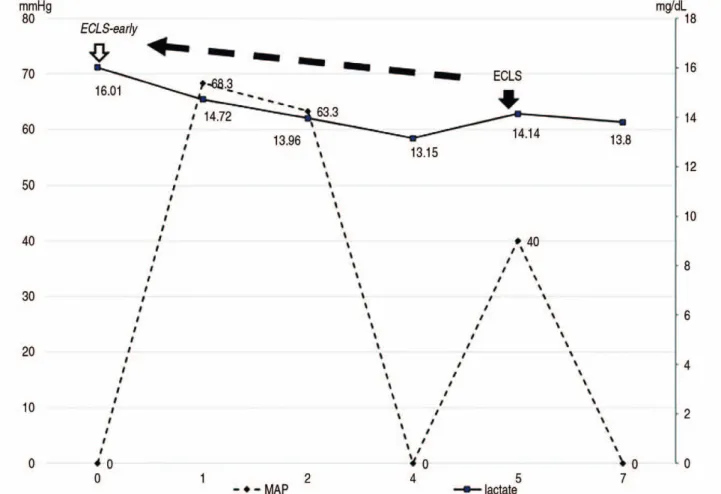
승하더라도, 혈청 젖산농도는 지속적으로 악화되는 경우 ECLS의 적용을 고려해 봄직하다. 아울러, 증례 1의 경우 노출 후 19시간 경과 후 심정지 상태로 응급실을 방문하 였고 전문적 심폐소생술 후 자발 순환이 회복되었으나 혈 청 젖산농도는 지속적으로 높아 이러한 조직저관류 상태 의 지속으로 심정지가 재발한 것으로 추정할 수 있다. 이 후 ECLS를 적용했음에도 불구하고 불응성 쇼크와 다발성 장기부전에 의한 급성기 사망의 결과를 초래한 것으로 보 인다. 특히 증례 1의 경우 내원 당시 검사실 검사 소견에 서 다발성 장기 부전의 패턴을 보이고 있어 초기에 적극적 인 혈역학적 집중치료가 필요한 상태였던 것으로 판단된 다. 따라서, 비가역적 손상의 정도를 줄이기 위해 내원 초 기 자발순환회복 후 혈압은 유지되더라도, 젖산농도의 호 전이 보이지 않을 경우 조기 ECLS적용을 고려해 볼 수 있 을 것이라 생각한다(Fig. 4).

Labarinas 등

7)

은 디펜히드라민 음독으로 내원 후 심정 지가 발생한 환자에게 전문적 심폐소생술에 반응이 없어 ECLS를 이용한 심폐소생술을 시행하여 좋은 성적을 보고

한 바 있다. 전문적 심폐소생술에 심정지 환자가 반응하지 않을 경우 ECLS를 이용한 심폐소생술의 효과가 많이 보 고되고 있다

3,8)

. 이를 Extracorporeal Cardiopulmonary Resuscitation (ECPR)이라고 표현하는데 ECPR의 전제조 건으로 심정지의 원인이 가역적이고, no-flow time이 짧 으며, 심정지 환자가 표준 심폐소생술에 반응하지 않는 경 우 시행해 볼 수 있다

9)

. 급성중독에 의해 발생하는 심정지 나 심혈관계, 호흡기계 합병증은 급성 중독으로 인한 주요 급성기 사망원인으로 보고된다

1)

. 치료는 중독환자를 위한 일반적 치료부터 해독제나 혈액투석 등의 전문적 치료를 포함한다. 중독의 급성기 심혈관계 및 호흡기계 합병증은 중독의 전문적 치료 외에 전문 심장구조술과 기계환기를 이용한 인공호흡을 요구한다. 하지만 이런 중환자치료에 도 불구하고 쇼크나 호흡부전이 지속되는 경우 ECLS는 환자의 생명을 구하기 위한 또 다른 치료방법으로 고려되 어야 한다. 급성 중독의 급성기 합병증은 대부분 가역적인 경우가 많고 급성기 합병증의 치료기간 동안 ECLS를 통 해 전신 순환상태와 폐의 환기 상태를 지지할 수 있다면 Fig. 3. The changes of mean arterial blood pressure (MAP) and serum lactate level according to the specific management in case 2. The

serum lactate level was increasing despite of the improvement of MAP after use of vasopressors.

(6)

충분히 회복할 여지가 있기 때문이다

10,11)

. Daubin 등

5)

은 치명적 합병증이 발생한 급성 중독환자에서 ECLS를 사용 한 경험을 보고 하였는데 ECLS 시행 환자 중 76.5%가 생 존 퇴원하였다.

중독으로 인해 급성기 심혈관 및 호흡기계 합병증 발생 하는 경우 언제 ECLS를 시행하여야 하는지에 대해서는 현재 알려진 바 없다. 다만 급성기 합병증으로 인해 비가 역적 조직 손상이 발생하기 전에 시행하는 것이 예후에 좋 을 것으로 저자들은 생각하고 있다

8)

. 조직의 비가역적 손 상을 대표할 수 있는 특정 지표값은 없으나, 쇼크의 치료 에서 사용되는 혈압과 함께 조직관류를 반영하는 혈중 젖 산농도의 추적관찰이 중요한 가이드가 될 수 있을 것이다.

승압제의 사용에도 불구하고 혈압이 오르지 않거나, 혈압 이 일시적으로 오르더라도 혈중 젖산 농도의 호전이 없는 경우 조기에 ECLS를 이용한 혈역학적 지지 치료를 시행 한다면 좀 더 나은 치료 성적을 기대할 수 있을 것이다.

흡입에 의한 중독의 경우 폐의 직접적 손상이나 지연성 폐렴에 의해 호흡부전의 치명적 합병증을 초래할 수 있다.

기관삽관 및 기계환기는 전통적으로 사용되어 온 호흡부 전의 치료법이나 본 증례 4와 같이 전통적 방법만으로 급 성기 합병증을 조절하기 어려운 경우가 있다. 이 때 ECLS 는 좋은 치료 대안이 될 수 있다. ECLS는 개발 초기부터 현재까지 호흡부전 환자를 대상으로 많이 사용되었으며 지금도 ELSO (extracorporeal life support organiza- tion) 보고에 따르면 세계 성인 ECLS 사용의 약 50% 이상 은 호흡부전을 치료하기 위한 목적이며 이들의 생존퇴원 율은 58%로 보고되고 있다

12)

.

이 연구는 급성 중독환자 중 급성 심혈관계 합병증과 호 흡기계 합병증으로 인해 ECLS 치료를 받은 적은 사례들 의 보고이다. 따라서, 이 사례보고들만을 기준으로 급성 중독의 합병증 때 ECLS의 적응증을 단정하여 결론 내리 기는 어렵다. 다만, 급성중독에서 ECLS의 현재까지 활용 범위는 급성 심혈관계 합병증에 의한 심정지나 불응성 쇼 크, 급성 호흡기계 합병증에 의한 기계환기에 반응하지 않 는 증증 호흡부전의 경우 사용 범주가 될 수 있을 것으로 보여진다. 아울러, 급성기 합병증을 치료하기 위한 전통적

Fig. 4. Review of case 1 with the consideration of early application of extracorporeal life support (ECLS). The patient achieved return of

spontaneous circulation after advanced life support. However, the levels of serum lactate were consistently high before re-arrest

event and ECLS. Early application of ECLS (black dot arrow) may improve the tissue perfusion state of this patient.

(7)

중환자처치술에서 ECLS로 전환하여야 하는 적정 시기를 제시할 수는 없지만, 조직의 비가역적 손상이 발생하기 전 에 시행하는 것이 바람직하여 비가역적 손상의 간접적 척 도로 혈압 뿐 아니라 혈중 젖산 농도를 이용할 수 있음을 고려하여야 한다.

결 론

급성 중독환자가 치명적 심혈관계 및 호흡기계 합병증 을 보이는 경우 해독제를 포함한 전문적 중독 치료 및 전 문심장구조술, 기계환기술 등의 전문 중환자치료법이 사 용된다. 하지만 일부 환자의 경우 이런 전통적 전문치료에 반응하지 않아 사망에 이르게 된다. 이 때 우리는 전통적 전문 치료법에 더하여 혈역학적 지지 및 폐환기를 위해 ECLS를 고려해 보아야 한다. 급성 중독의 합병증이 비가 역적 조직손상을 초래하기 전 ECLS를 이용한 치료는 급 성 중독환자의 급성기 사망을 줄이는데 도움이 될 것으로 판단된다.

ORCID

Si Jin Lee (https://orcid.org/0000-0001-9556-0665) Gap Su Han (https://orcid.org/0000-0003-0205-1269) Eui Jung Lee (https://orcid.org/0000-0001-8065-2014) Su Jin Kim (https://orcid.org/0000-0003-3769-9647) Sung Woo Lee (https://orcid.org/0000-0003-4492-0258)

참고문헌

01. Manini AF, Melson LS, Stimmel B, Viahov D, Hoffman RS. Incidence of adverse cardiovascular events in adults following drug overdose. Acad Emerg Med 2012;19:843-9.

02. Reynolds JC, Frisch A, Rittenberger JC, Callaway CW.

Duration of Resuscitation Efforts and Functional Outcome After Out-of-Hospital Cardiac Arrest: When Should We Change to Novel Therapies? Circulation. 2013;128:2488-94.

03. Kim SJ, Kim HJ, Lee HY, Ahn HS, Lee SW. Comparing extracorporeal cardiopulmonary resuscitation with con-

ventional cardiopulmonary resuscitation: A meta-analysis.

Resuscitation. 2016;103:106-16.

04. Megarbanel B, Leprince P, Deye N, Reiere D, Guerrier G, Rettab S, et al. Emergency feasibility in medical intensive care unit of extracorporeal life support for refractory cardiac arrest.

Intensive Care Med 2007;33:758-64.

05. Daubin C, Lehoux P, Ivascau C, Tasle M, Bousta M, Lepage O, et al. Extracorporeal life support in severe drug intoxication:

a retrospective cohort study of seventeen cases. Critical Care 2009;13:R138.

06. Shin JS, Lee SW, Kim NH, Park JS, Kim KJ, Choi SH, et al. Successful extracorporeal life support after potentially fatal pulmonary oedema caused by inhalation of nitric acid and hydrofluoric acid fumes. Resuscitation 2007;75:184-8.

07. Labarinas S, Meulmester K, Greene S, Thomas J, Virk M, Erkonen G. Extracorporeal cardiopulmonary resuscitation after diphenhydramine ingestion. J Med Tox 2018;14:253-6.

08. Kim SJ, Jung JS, Park JH, Park JS, Hong YS, Lee SW. An optimal transition time to extracorporeal cardiopulmonary resuscitation for predicting good neurological outcome in patients with out-of-hospital cardiac arrest: A propensity- matched study. Critical Care. 2014;18:1-15.

09. Brooks SC, Anderson ML, Bruder E, Daya MR, Gaffney A, Otto CW, et al. Part 6: Alternative Techniques and Ancillary Devices for Cardiopulmonary Resuscitation: 2015 American Heart Association Guidelines Update for Cardiopulmonary Resuscitation and Emergency Cardiovascular Care. Circulation.

2015;132:S436-43.

10. Lim CH, Son HS, Baek KJ, Lee JJ, Ahn CB, Moon KC, et al.

Comparison of coronary artery blood flow and hemodynamic energy in a pulsatile pump versus a combined nonpulsatile pump and an intra-aortic balloon pump. ASAIO J. 2006;52:

595-7.

11. Koicz J, Pietrzyk J, Januszewska K, Procelewska M, Mroczek T, Malec E. Extracorporeal life support in severe propranolol and verapamil intoxication. J Intensive Care Med 2007;22:

381-5.

12. Thiagarajan RR, Barbaro RP, Rycus PT, Mcmullan M,

Conrad SA, Fortenberry JD, et al. Extracorporeal life support

organization registry International report 2016. ASAIO Journal

2017;63:60-7.

수치

Table 1. The characteristics of 4 patients who were managed with extracorporeal life support
Table 2. Initial laboratory findings of study patients
Fig. 2. The changes of serum lactate level according to the application of extracorporeal life support (ECLS)
Fig. 4. Review of case 1 with the consideration of early application of extracorporeal life support (ECLS)

참조

관련 문서

Thirdly, it appeared that social support had meaningful effect on self-efficacy and the quality of life, and in the case of the difference analysis by

Third, there was no statistically significant difference in their conspicuous consumption according to their and their parents' consumer life education, the places of the

Eighth, the difference in life satisfaction according to the grade level of junior high school is a sub-factor of friendship, relationship a teacher,

A suspension of platinum black and carbon powder in ethanol-water solutions serves to optimize the uniformity of the coating, electrical conductivity, and in the case of

Key words: Tolerance, Innovation, the aged welfare policy, silver industry, improvement of quality of elderly life,

It considers the energy use of the different components that are involved in the distribution and viewing of video content: data centres and content delivery networks

After first field tests, we expect electric passenger drones or eVTOL aircraft (short for electric vertical take-off and landing) to start providing commercial mobility

1 John Owen, Justification by Faith Alone, in The Works of John Owen, ed. John Bolt, trans. Scott Clark, &#34;Do This and Live: Christ's Active Obedience as the