ISSN: 2233-601X (Print) ISSN: 2093-6516 (Online)
Received: August 20, 2015, Revised: September 16, 2015, Accepted: September 17, 2015, Published online: August 5, 2016
Corresponding author: Hwan Wook Kim, Department of Thoracic and Cardiovascular Surgery, Seoul St. Mary’s Hospital, The Catholic University of Korea College of Medicine, 222 Banpo-daero, Seocho-gu, Seoul 06591, Korea
(Tel) 82-2-2258-2858 (Fax) 82-2-594-8644 (E-mail) [email protected]
© The Korean Society for Thoracic and Cardiovascular Surgery. 2016. All right reserved.
This is an open access article distributed under the terms of the Creative Commons Attribution Non-Commercial License (http://creativecommons.org/
licenses/by-nc/4.0) which permits unrestricted non-commercial use, distribution, and reproduction in any medium, provided the original work is properly cited.
Extracorporeal Life Support in Patients with Hematologic Malignancies: A Single Center Experience
Kuk Bin Choi, M.D., Hwan Wook Kim, M.D., Ph.D., Keon Hyon Jo, M.D., Ph.D., Do Yeon Kim, M.D., Hang Jun Choi, M.D., Seok Beom Hong, M.D.
Department of Thoracic and Cardiovascular Surgery, Seoul St. Mary’s Hospital, The Catholic University of Korea College of Medicine
Background: Extracorporeal life support (ECLS) in patients with hematologic malignancies is considered to have a poor prognosis. However, to date, there is only one case series reported in the literature. In this study, we compared the in-hospital survival of ECLS in patients with and without hematologic malignancies.
Methods: We reviewed a total of 66 patients who underwent ECLS for treatment of acute respiratory failure from January 2012 to December 2014. Of these patients, 22 (32%) were diagnosed with hematologic malig- nancies, and 13 (59%) underwent stem cell transplantation before ECLS. Results: The in-hospital survival rate of patients with hematologic malignancies was 5% (1/22), while that of patients without malignancies was 26% (12/46). The number of platelet transfusions was significantly higher in patients with hematologic ma- lignancies (9.69±7.55 vs. 3.12±3.42 units/day). Multivariate analysis showed that the presence of hematologic malignancies was a significant negative predictor of survival to discharge (odds ratio, 0.07; 95% confidence interval, 0.01–0.79); p=0.031). Conclusion: ECLS in patients with hematologic malignancies had a lower in-hos- pital survival rate, compared to patients without hematologic malignancies.
Key words: 1. Extracorporeal membrane oxygenation 2. Acute respiratory distress syndrome (ARDS) 3. Hematology
Introduction
Extracorporeal life support (ECLS) is a modified cardiopulmonary bypass to provide short-term respi- ratory or circulatory support to critically ill patients.
It is frequently performed for treating acute respira- tory failure (ARF) when conventional management strategies fail. According to the Extracorporeal Life Support Organization (ELSO) database, the use of ECLS for ARF has been increasing since 2009; this is attributed to the H1N1 influenza pandemic and the publication of the conventional ventilation or extra-
corporeal membrane oxygenation (ECMO) for severe adult respiratory failure (CESAR) trial [1]. The overall survival to discharge after the ECLS for a respiratory failure was approximately 55%, based on 3,369 adult respiratory failure patients in the ELSO database [1].
The CESAR trial was a prospective randomized study that reported an increased survival rate at 6 months in severe acute respiratory distress syndrome (ARDS) patients who were treated with the ECLS, compared to conventional therapy [2].
ARF is also a major indication for intensive care unit admissions in patients with hematologic malig-
http://dx.doi.org/10.5090/kjtcs.2016.49.4.280
nancies (HMs) [3-5], and their in-hospital mortality with an invasive ventilator is also high [4-6]. If a pa- tient is refractory to conventional ventilator care, but his or her HM was curable, then ECLS could be con- sidered. However indications and results of ECLS in ARF patients with HMs are not well established.
Wohlfarth et al. [7] reported 7 survivals among 14 adult patients with both HM and ARF, who were dis- charged or transferred to other facilities. This is the only case series published to date for ECLS outcomes in adult ARF patients with HMs, and clarification is much needed for this issue.
The purpose of this study was to determine differ- ences in regard to in-hospital survival between adult patients with and without HMs. We also evaluated factors that may influence survival.
Methods
Accessing the electronic medical records of our in- stitution, Seoul Saint Mary’s Hospital, we identified 68 adult patients with ARF who were treated with ECLS from January 2012 through December 2014.
The patients who were treated with ECLS who were transferred to other hospitals during this timeframe were excluded, and patients under 18 years of age were also excluded from this analysis. After review- ing medical records, the patients were categorized in- to two groups, the HM group and the non- HM group, based on whether or not they had been diagnosed with an HM prior to ECLS therapy. The collection of data was focused on the survival rate, pre-ECLS char- acteristics including a hematologic profile, the num- ber of transfusions, and the occurrence of major bleeding events. In order to compare pre-ECLS sta- tus, the measured physiological variables were used to calculate the Sequential Organ Failure Assessment (SOFA) scores [8], and the Respiratory Extracorporeal Membrane Oxygenation Survival Prediction (RESP) scores [9].
The HMs are defined as neoplastic diseases of the hematologic and lymphoid tissue, according to the World Health Organization classification [10]. Survival is defined as survival to discharge from the hospital or to transfer to a referring facility. Successful wean- ing is defined as a weaning from the ECLS followed by survival >48 hours. The Berlin Definition of ARDS was used for defining and grading the patients with
respiratory failure [11]. The number of daily trans- fusions was calculated by dividing the total number of transfusions from the first to the last day of the ECLS into the total number of days under the ECLS.
Major bleeding was defined as clinically overt bleed- ing accompanied with a decreased hemoglobin level of at least 2 g/dL, or a transfusion requirement of 1 or more packed red blood cells in a 24-hour period.
The initiation of the ECLS was decided either by the discretion of the cardiac surgeon, thoracic sur- geon, or pulmonologist. Thus, there were no absolute criteria for initiating ECLS. All ECLSs were performed via peripheral cannulation. Veno-arterial ECMO was used in 8 patients (12%) and the pumpless extra- corporeal lung assist was used in 7 patients (10%).
During ECLS, protective lung ventilation was per- formed. Continuous intravenous heparin was admi- nistered and titrated to achieve an activated clotting time of 180s. No specific anticoagulation protocol for patients with HMs was followed. Packed red blood cells and platelets were administered to maintain a hematocrit >35% and a platelet count >100,000/μL.
Weaning from the ECLS was attempted according to the ELSO guidelines [12].
Data were described as mean±standard deviation or median and interquartile ranges (25%–75%), un- less otherwise indicated. Dichotomous data were pre- sented as a number and percentage. The comparison between groups was made with the Student t-test for normally distributed variables and the Mann-Whitney rank sum test for those with non-normal distribution.
The χ
2and Fisher exact tests were used for catego- rical variables. Multivariate logistic regression analy- sis was performed to identify significant risk factors associated with survival. The differences were consid- ered to be statistically significant with p<0.05.
Results
During the study period, 105 patients underwent
ECLS, and 71 suffered from ARF. Of those 71 pa-
tients, 66 who underwent ECLS for ARF met the
study criteria and 5 were excluded according to the
exclusion criteria. Two patients without HMs under-
went 2 episodes of ECLS during different hospital ad-
missions. The mean age of all patients was 55.1±18.3
and 47 were male (69%). Prior to ECLS, the partial
pressure of arterial oxygen (P
aO
2)/fractional inspired
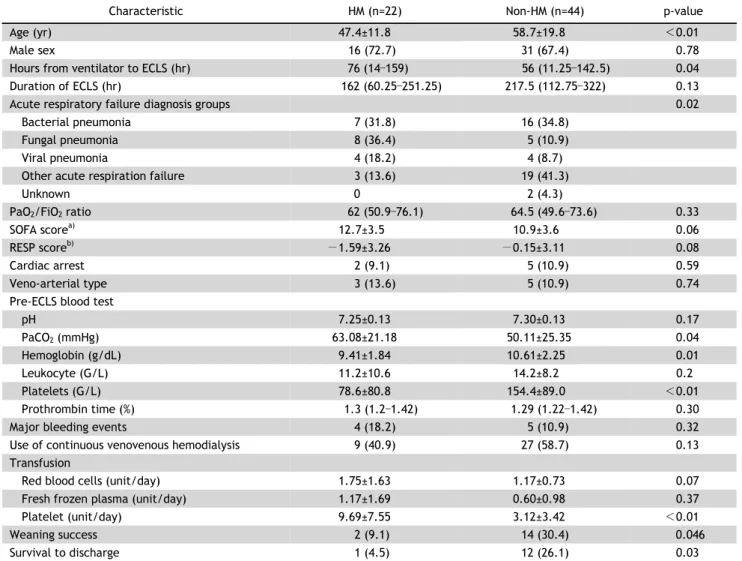
Table 1. Characteristics and outcomes between patients with HMs and patients without HMs
Characteristic HM (n=22) Non-HM (n=44) p-value
Age (yr) 47.4±11.8 58.7±19.8 <0.01
Male sex 16 (72.7) 31 (67.4) 0.78
Hours from ventilator to ECLS (hr) 76 (14 –159) 56 (11.25 –142.5) 0.04
Duration of ECLS (hr) 162 (60.25 –251.25) 217.5 (112.75 –322) 0.13
Acute respiratory failure diagnosis groups 0.02
Bacterial pneumonia 7 (31.8) 16 (34.8)
Fungal pneumonia 8 (36.4) 5 (10.9)
Viral pneumonia 4 (18.2) 4 (8.7)
Other acute respiration failure 3 (13.6) 19 (41.3)
Unknown 0 2 (4.3)
PaO
2/FiO
2ratio 62 (50.9 –76.1) 64.5 (49.6 –73.6) 0.33
SOFA score
a)12.7±3.5 10.9±3.6 0.06
RESP score
b)−1.59±3.26 −0.15±3.11 0.08
Cardiac arrest 2 (9.1) 5 (10.9) 0.59
Veno-arterial type 3 (13.6) 5 (10.9) 0.74
Pre-ECLS blood test
pH 7.25±0.13 7.30±0.13 0.17
PaCO
2(mmHg) 63.08±21.18 50.11±25.35 0.04
Hemoglobin (g/dL) 9.41±1.84 10.61±2.25 0.01
Leukocyte (G/L) 11.2±10.6 14.2±8.2 0.2
Platelets (G/L) 78.6±80.8 154.4±89.0 <0.01
Prothrombin time (%) 1.3 (1.2 –1.42) 1.29 (1.22 –1.42) 0.30
Major bleeding events 4 (18.2) 5 (10.9) 0.32
Use of continuous venovenous hemodialysis 9 (40.9) 27 (58.7) 0.13
Transfusion
Red blood cells (unit/day) 1.75±1.63 1.17±0.73 0.07
Fresh frozen plasma (unit/day) 1.17±1.69 0.60±0.98 0.37
Platelet (unit/day) 9.69±7.55 3.12±3.42 <0.01
Weaning success 2 (9.1) 14 (30.4) 0.046
Survival to discharge 1 (4.5) 12 (26.1) 0.03
Values are presented as mean±standard deviation, number (%), or median (interquartile range).
HM, hematologic malignancies; ECLS, extracorporeal life support; PaO
2, partial pressure of arterial oxygen; FiO
2, fractional inspired oxygen concentration; PaCO
2, partial pressure of arterial carbon dioxide.
a)
Sequential Organ Failure Assessment Score at ECLS baseline [8].
b)Respiratory Extracorporeal Membrane Oxygenation Survival Prediction score at ECLS baseline [9].
oxygen concentration (FiO
2) ratios of 66 patients (97%) were <100. Two patients (2.9%) underwent ECLS because of an uncontrolled hypercapnia, despite the fact that their P
aO
2/FiO
2ratios were >100. The median duration of the ECLS was 203 hours (range, 82.5–305.5 hours) and the mean ventilator to ECLS time was 74 hours (range, 13.75–162.5 hours). The weaning success rate was 23.5% (16/68) and the in-hospital survival rate was 19.1% (13/68).
Twenty-two patients (32%) were diagnosed with an HM, and 13 (59%) underwent stem cell trans- plantation (SCT) before the ECLS. Acute myeloid leu-
kemia was the most common type of underlying HM (14 patients, 64%). Moreover, there were 4 cases of acute lymphoblastic leukemia, 2 cases of Hodgkin’s lymphoma, 1 case of multiple myeloma, and 1 case of myelodysplastic syndrome. In the patients who un- derwent a SCT, a complete remission was achieved prior to ECLS in 9 patients and transplantation with- in 1 year was performed in 6 patients. Six patients with HMs, but who had not undergone a SCT, had recently received chemotherapy.
Baseline demographics and characteristics of the
HM and the non-HM groups, including SOFA and
Table 2. Characteristics and outcomes between in-hospital sur- vivors and non-survivors
Characteristic Survivors Non-survivors p-value
Age (yr) 53.23±21.06 55.49±17.83 0.69
Male sex 6 (46.2) 41 (74.5) 0.09
Hours from ventilator to ECLS (hr)
107.5±170.5 114.4±125.9 0.11
Duration of extracorporeal membrane oxygenation (hr)
230.7±156.2 240.2±220.3 0.88
Acute respiratory failure diagnosis groups
0.19
Bacterial pneumonia 4 (30.8) 19 (34.5)
Fungal pneumonia 0 13 (23.6)
Viral pneumonia 2 (15.4) 6 (10.9)
Other acute respiration failure
7 (53.9) 17 (30.9)
Unknown 2 (3.6) 0
PaO
2/FiO
2ratio 71.8±37.6 66.5±24.5 0.53
SOFA score
a)9.7±2.8 11.9±3.7 0.049
RESP score
b)1.31±2.53 −1.07±3.20 0.02
Cardiac arrest 1 (14.3) 6 (10.9) 0.73
Pre-ECLS pH 7.33±0.11 7.27±0.13 0.17
Pre-ECLS PaCO
2(mmHg) 44.8±20.5 56.5±25.2 0.13 Veno-arterial type 2 (15.4) 6 (10.9) 0.64
Major bleeding events 0 9 (16.4) 0.19
Use of continuous venovenous hemodialysis
5 (38.5) 31 (56.4) 0.36
Transfusion
Red blood cells (unit/day) 1.14±0.96 1.40±1.16 0.07 Fresh frozen plasma
(unit/day)
0.30±0.56 0.90±1.36 0.07
Platelet (unit/day) 1.73±2.20 6.08±6.25 0.006 Values are presented as mean±standard deviation or number (%).
ECLS, extracorporeal life support; PaO
2, partial pressure of arterial oxygen; FiO
2, fractional inspired oxygen concentration; PaCO
2, partial pressure of arterial carbon dioxide.
a)
Sequential Organ Failure Assessment Score at ECLS baseline [8].
b)
Respiratory Extracorporeal Membrane Oxygenation Survival Pre- diction score at ECLS baseline [9].
RESP scores, are presented in Table 1. The mean age was significantly younger (p<0.01) and the pre-ECLS ventilator time was longer (p=0.04) in the HM group than in the non-HM group. In regard to hematologic findings just before the ECLS, the serum hemoglobin and the platelet counts were significantly lower (p=0.04) in the HM group. There was also a sig- nificant difference (p=0.02) in the etiology of the ARF between the two groups. The proportion of fun- gal pneumonia was 25% higher in the HM group compared to the non-HM group. There were no stat-
istically significant differences in the other pre-ECLS variables: SOFA and RESP scores, cardiac arrest, and P
aO
2/FiO
2ratio. Successful weaning was achieved in only 2 patients with an HM (9%) and discharge alive from the hospital occurred in only 1 patient (5%), compared to 12 cases (26%) in the non- HM group.
No patient who received a SCT survived to discharge with ECLS. The only survival in the HM group was a 58-year-old woman who had been undergoing a course of induction chemotherapy for acute myeloid leukemia. The patient suffered from intractable bacte- rial pneumonia, but was discharged from the hospital after 300 hours of ECLS therapy. No complications such as hemorrhage or renal failure occurred during ECLS sessions.
In regard to transfusions per day, the number of platelet transfusions was significantly higher in pa- tients with HMs than those without HMs (9.69±7.55 vs. 3.12±3.42 units/day, p<0.001). In regard to red blood cell transfusions, the rate was higher in the HM group, but the difference was not statistically sig- nificant (p=0.071). Major bleeding events were docu- mented in 9 cases (13%). Episodes of major bleeding were higher in the HM group (n=4, 18.2%) than in the non-HM group (n=5, 10.9%); however, the differ- ence was not statistically significant (p=0.32). Specifi- cally, bleeding events in the HM group occurred as 2 cases of massive pulmonary hemorrhage, 1 case of gastrointestinal bleeding, and 1 case of hematuria.
Three cases were treated conservatively with trans- fusions and discontinuation of anticoagulation; how- ever, the patient with pulmonary hemorrhage expired from uncontrolled hemorrhage accompanied by pro- gressive respiratory failure. The patient with gastro- intestinal bleeding was successfully weaned from the ECLS, but he expired from recurrent pneumonia fol- lowing chemotherapy.
No difference was found in risk factors between survivors and non-survivors, including age, duration of mechanical ventilation before ECLS, and bleeding events during ECLS (Table 2). The SOFA score and the RESP score revealed that more risk factors were present in non-survivors than in survivors before ECLS.
The number of platelet transfusions was significantly
higher (p<0.01) in the non-survivors. The number of
red blood cell transfusions was also higher in
non-survivors, but the difference was not statistically
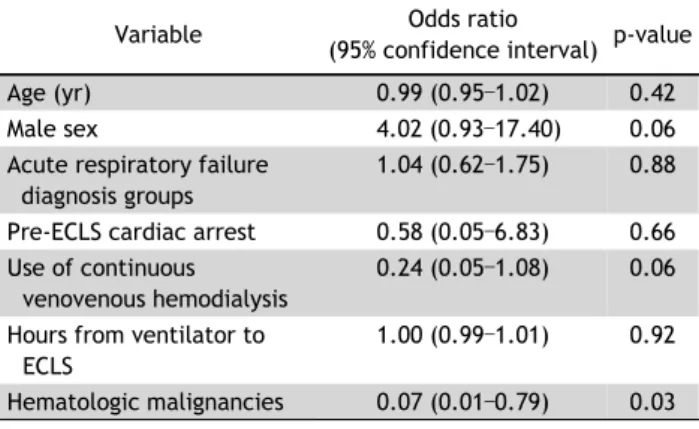
significant (p=0.07). Multivariate analysis performed
Table 3. Multivariate logistic regression analysis for mortality