서 론
급성호흡곤란증후군(acute respiratory distress syndrome, ARDS)은 약 60% 이상의 높은 사망률을 보이고,1-3 장기적으로 육 체적 기능 장애를 유발할 수 있는 폐질환이다.4-6 기계환기로 가스 교환이 유지되지 않는 중증 급성호흡곤란증후군에서 체외막산소
공급장치(extracorporeal membrane oxygenation, ECMO)는 기계 환기로 인한 폐손상을 막고, 효과적인 산소와 이산화탄소의 가스 교환을 위한 고도의 침습적 치료요법으로 대두되고 있다.1,2,7-9
1980년대 이전에는 급성호흡곤란증후군에서 체외막산소공급 장치를 이용한 치료가 좋은 성적을 거두지 못한다고 보고되었다.10 그러나 체외막산소공급장치의 회로와 기계가 발전하면서, 급성호
Allergy Asthma Respir Dis 5(3):141-146, May 2017 https://doi.org/10.4168/aard.2017.5.3.141 ORIGINAL ARTICLE
Correspondence to: Kyung Won Kim https://orcid.org/0000-0003-4529-6135 Department of Pediatrics, Yonsei University College of Medicine, 50-1 Yonsei-ro, Seodaemun-gu, Seoul 03722, Korea
Tel: +82-2-2228-2050, Fax: +82-2-393-9118, E-mail: [email protected]
Received: September 5, 2016 Revised: October 24, 2016 Accepted: December 15, 2016
© 2017 The Korean Academy of Pediatric Allergy and Respiratory Disease The Korean Academy of Asthma, Allergy and Clinical Immunology This is an Open Access article distributed under the terms of the Creative Commons Attribution Non-Commercial License
(Allergy Asthma Respir Dis 2017:5:141-146)
소아 급성호흡곤란증후군에서 체외순환막장치 적용에 대한 RESP, PRESERVE, ECMOnet 점수 체계의 유용성
안원기, 한정호, 김윤희, 설인숙, 윤서희, 김민정, 김경원, 손명현, 김규언 연세대학교 의과대학 소아과학교실
Usefulness of the RESP, PRESERVE, and ECMOnet scores for
extracorporeal membrane oxygenation in children with acute respiratory distress syndrome
Won Kee Ahn, Jung Ho Han, Yoon Hee Kim, In Suk Sol, Seo Hee Yoon, Min Jung Kim, Kyung Won Kim, Myung Hyun Sohn, Kyu-Earn Kim Department of Pediatrics, Yonsei University College of Medicine, Seoul, Korea
Purpose: With increasing use of extracorporeal membrane oxygenation (ECMO) for acute respiratory distress syndrome (ARDS) in children, development of standardized strategies for survival prediction has become crucial; however, this has not been accom- plished yet. We evaluated the adult scoring systems for survival prediction used for their applicability in pediatric ARDS and vali- dated them.
Methods: A total of 11 children with ARDS receiving ECMO from 2013 to 2014 were evaluated with adult scoring systems, including the Respiratory Extracorporeal-membrane-oxygenation Survival Prediction (RESP), the PRedicting dEath for SEvere ARDS on VV- ECMO (PRESERVE), and the ECMOnet scores. We compared the scores on these scales and the clinical characteristics between survi- vors and nonsurvivors.
Results: Eight of the 11 children died (72.7%). The PRESERVE score (survivors vs. nonsurvivors: 2 vs. 5.25, P= 0.048), and the ECMOnet score (4.1 vs. 5.63, P= 0.048) were lower in survivors than in nonsurvivors. They correctly predicted mortality prediction. There was no significant difference in the RESP score between survivors and non-survivors (-4.33 vs. -2.62, P= 0.63). The parameters that showed significant differences in this study were peak inspiratory pressure, platelet, and delta neutrophil index. All children who were under immunocompromised conditions, such as those with tumors, or underwent hematopoietic stem cell transplantation died. The immunocompromised status should be considered an important factor for survival prediction in children with ARDS.
Conclusion: This is the first pilot study to apply the survival prediction scoring system to pediatric ARDS with ECMO. It is necessary to establish and modify the survival prediction score system for pediatric ARDS with ECMO. (Allergy Asthma Respir Dis 2017;5:141-146) Keywords: Extracorporeal membrane oxygenation, Acute respiratory distress syndrome, Survival, Child
흡곤란증후군 환자에게 보다 더 생체적합하고, 합병증을 최소화 하는 형태로 발전하고 있다. CESAR (conventional ventilator sup- port versus extracorporeal membrane oxygenation for severe adult respiratory failure) 연구에서는 중등도의 성인 급성 호흡부 전에서 체외막산소공급장치를 적용했을 경우가 기존의 고식적 기 계환기만으로 치료했을 경우보다 사망률을 유의하게 낮춘다고 보 고하였다.11,12
급성호흡곤란증후군의 체외막산소공급장치의 사용이 증가함 에 따라 체외막산소공급장치 적용 전에 환자의 예후를 평가하는 것이 중요해지고 있다. 성인 급성호흡곤란증후군에서 체외막산소 공급장치를 적용했을 때, 생존율을 예측하는 점수체계에는 EC- MOnet, PRedicting dEath for SEvere ARDS on VV-ECMO (PRE- SERVE), Respiratory Extracorporeal Membrane Oxygenation Survival Prediction (RESP) 등이 있다. 모든 점수체계는 개별 항목 마다 부여되는 점수가 있고, 그 총 합계 점수를 계산하여 사망률을 예측하는 방식이다.13-16
ECMOnet은 H1N1 독감으로 인한 성인 급성호흡곤란증후군 환 자를 대상으로 이루어진 전향적 다기관 연구를 통하여, 체외막순 환장치를 적용하기 전 재원 기간, 빌리루빈(bilirubin), 크레아티닌 (creatinine), 적혈구용적률(hematocrit), 평균동맥압(mean arterial pressure)의 항목으로 구성되며, 사망률을 예측하기 위한 결정점 수치(cut-off value)를 설정한 점수체계이다. PRESERVE는 나이, 신 체질량지수(body mass index), 면역저하 상태, sequential organ failure assessment (SOFA), 체외막산소공급장치를 적용하기 전 기 계환기 기간, 복와위, 호기말양압(positive end-expiratory pres- sure), 고평부압(plateau pressure)으로 구성되며, 합계 점수는 4단 계로 분류되어 낮은 점수일수록 높은 생존율과 높은 삶의 질을 나 타내는 체계이다. RESP는 2천여 명의 대규모 연구를 통해 나이, 면 역저하 상태, 체외막산소공급장치 적용 전의 기계환기 기간, 급성 호흡부전의 원인 질환, 중추신경계 손상, 폐 이외의 급성 감염, 신경 근 억제제나 산화질소 사용 여부, 중탄산염 사용 여부, 심정지 여 부, 동맥혈탄산가스분압, 최고흡기압(peak inspiratory pressure) 등 의 12가지 항목으로 구성되며, 합계 점수는 5단계로 분류되어 점수 가 높을수록 높은 생존율을 나타내는 점수체계이다.13-15
성인과 소아 급성호흡곤란증후군은 기저질환, 역학 및 예후의 차이를 보이고 있으나,7,17 소아 급성호흡곤란증후군의 기계환기 전 략을 포함한 대부분의 치료는 성인의 치료에 기반을 두고 있는 실 정이다.7-9,18-23
소아 급성호흡곤란증후군에서도 체외막산소공급장치 적용이 증 가하고 있지만, 그 적응증과 생존율을 예측하는 점수체계에 대한 연 구는 아직 없다. 이에 저자들은 이를 위한 파일럿 연구로, 성인 급성 호흡곤란증후군의 체외막산소공급장치 적용에 대한 생존율 예측 점수 체계를 소아에서 적용하여, 그 유용성을 평가하고자 하였다.
대상 및 방법
1. 대상
2013년 3월부터 2014년 10월까지 세브란스병원 내과계 중환자실 에 입실한 생후 1개월에서 18세 미만의 중환자실 입실 환자는 205 명이었으며, 그 중 급성호흡곤란증후군 환자가 44명이었고,17 고식 적 치료에도 중증의 저산소혈증이 지속되어 체외막산소공급장치 를 적용한 11명을 대상으로 하였다. 기저질환을 포함한 보존적 요 법 외에 시행된 고식적 치료에는 기계환기, 산화질소, 복와위, 전신 스테로이드 요법이 포함되었다.7 모든 대상은 중환자실에서의 사망 여부에 따라 생존군과 사망군으로 분류하였다.
출생 1개월 미만의 신생아나 심장혈관 질환과 외과계 중환자는 이번 연구에서 제외되었다. 이번 연구의 자료 수집 당시에 중환자실 에서 퇴실하지 않았거나 다른 병원 중환자실로 전원한 경우도 제외 하였다. 이 연구는 세브란스병원 임상시험윤리위원회의 심의를 거 쳐 모든 환아들의 의무기록을 후향적으로 조사하였다(승인번호:
4-2015-1194).
2. 자료 수집과 통계 분석
대상군 11명에 대하여 체외막산소공급장치를 시작하기 직전의 나이, 성별, 급성호흡곤란증후군의 주요원인 질환, 기계호흡 치료 기간 등의 임상정보와 치료 인자들을 수집하였다. 이 자료를 성인 의 급성호흡곤란증후군의 점수체계인 RESP, PRESERVE, EC- MOnet 점수에 적용하였다.13-15 사망과 생존 두 군에서 연속형 변수 를 비교할 때 Mann-Whitney test를 시행하였고, 범주형 변수를 비 교할 때는 Fisher exact test를 시행하였다.
모든 통계 분석은 IBM SPSS Statistics ver. 22.0 (IBM Co., Ar- monk, NY, USA)를 이용하였으며, P 값이 0.05 미만인 경우를 통계 적으로 유의한 것으로 판단하였다.
결 과
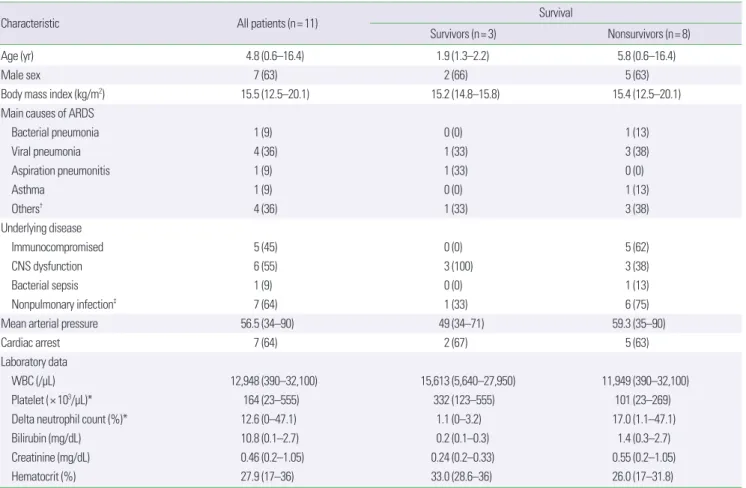
대상 환아 11명 중 생존군은 3명(27.3%)이고, 사망군은 8명 (72.7%)이었다. 생존군과 사망군 간에 나이, 성별은 통계적으로 의 미 있는 차이를 보이지 않았으며, 나이의 중간값은 4.6세, 그 중 남 자는 63%였다. 급성호흡곤란증후군의 원인 질환으로 바이러스성 폐렴(독감 및 메타뉴모바이러스)이 4예(36%), 세균성 폐렴, 흡인성 폐렴, 천식발작이 각각 1예(9%)로 감염성 폐렴이 가장 주된 원인이 었다. 대상자의 기저질환 중에서 뇌종양, 혈액암, 조혈모세포이식 상태와 같은 면역기능저하 상태가 5예(45%)에서 동반되었고, 이 환 자들은 모두 사망하였다. 중추신경계 이상이 6예(55%)에서 있었 고, 저산소성 뇌병증, 간질성 뇌병증 등이 포함되어 있었다. 2예 (18%)에서 체외막산소공급장치를 적용하기 전에 심정지가 발생하
였고, 5예(45%)에서 체외막산소공급장치 적용 시술 중에 심정지가 발생하였다(Table 1).
사망률을 예측하기 위한 체계인 ECMOnet 점수는 생존군 4.5, 사망군 5.5 (P= 0.048)로 생존군에서 사망군보다 더 낮은 값을 보 였으나(Table 2),13 체외막산소공급장치를 적용하기 전 재원 기간, 빌리루빈, 크레아티닌, 적혈구용적률, 평균동맥압 등의 개별항목 에 대하여는 생존군과 사망군 사이에 차이가 없었다(Table 3). 낮을 수록 높은 생존율을 갖는 PRESERVE 점수는 생존군 2, 사망군 5.25 (P = 0.048)로 생존군에서 의미 있게 낮았고(Table 2),14 PRE- SERVE 점수의 개별 항목인 면역저하, 체외막산소공급장치를 적용 하기 전 기계환기만으로 치료한 기간, 호기말양압과 패혈증과 관련 된 장기부전 정도(SOFA 점수), 복와위 자세 등에서 생존군과 사망 군 간의 차이를 보이지 않았다(Table 3). 높을수록 더 높은 생존율 을 보이는 RESP 점수는 생존군 -4.33, 사망군 -2.62 (P= 0.63)로 의 미 있는 차이는 보이지 않았다(Table 2).15
체외막산소공급장치를 적용할 당시 신경근 차단제 사용이 73%,
복와위 18%, 전신적 스테로이드 사용이 100%였다. 체외막산소공 급장치는 기계환기를 적용한 시점부터 0.96 (0.25–27.04)일 후 시행 되었으며, 체외막산소공급장치를 적용하기 직전 기계환기 설정 중 호기말양압은 9.36 (5–15) cmH2O, 최고흡기압은 32.09 (19-40) cmH2O였다. 동맥혈가스분석검사상 높은 동맥혈탄산가스분압 (PaCO2, 56.09 [22–90] mmHg) 및 높은 산소포화도지수 (oxygen saturation index) 18.97 (8–28.28)을 보였고, 체외막산소공급장치 의 적용 기간은 12.18 (4–40)일이었다.
각 점수체계의 개별항목 중 생존군과 사망군 사이에 유의미한 차이를 보인 항목을 살펴보면, PRESERVE 점수의 최고흡기압과 호기말양압이 사망군에서 높게 나타났고, RESP 점수의 체외막산 소공급장치를 적용하기 전 기계환기의 기간, 최고흡기압이 사망군 에서 더 높았다. 기존 점수체계의 항목들 외에 혈소판(생존군 대 사 망군, 332,000 대 101,000, P= 0.048)이 사망군에서 더 낮았고, 델타 호중구 지수(생존군 대 사망군 1.06 대 16.96, P= 0.048)가 더 높았 다(Table 3).
Table 1. Clinical characteristics between the survivors and nonsurvivors
Characteristic All patients (n= 11) Survival
Survivors (n= 3) Nonsurvivors (n= 8)
Age (yr) 4.8 (0.6–16.4) 1.9 (1.3–2.2) 5.8 (0.6–16.4)
Male sex 7 (63) 2 (66) 5 (63)
Body mass index (kg/m2) 15.5 (12.5–20.1) 15.2 (14.8–15.8) 15.4 (12.5–20.1)
Main causes of ARDS
Bacterial pneumonia 1 (9) 0 (0) 1 (13)
Viral pneumonia 4 (36) 1 (33) 3 (38)
Aspiration pneumonitis 1 (9) 1 (33) 0 (0)
Asthma 1 (9) 0 (0) 1 (13)
Others† 4 (36) 1 (33) 3 (38)
Underlying disease
Immunocompromised 5 (45) 0 (0) 5 (62)
CNS dysfunction 6 (55) 3 (100) 3 (38)
Bacterial sepsis 1 (9) 0 (0) 1 (13)
Nonpulmonary infection‡ 7 (64) 1 (33) 6 (75)
Mean arterial pressure 56.5 (34–90) 49 (34–71) 59.3 (35–90)
Cardiac arrest 7 (64) 2 (67) 5 (63)
Laboratory data
WBC (/μL) 12,948 (390–32,100) 15,613 (5,640–27,950) 11,949 (390–32,100)
Platelet (× 103/μL)* 164 (23–555) 332 (123–555) 101 (23–269)
Delta neutrophil count (%)* 12.6 (0–47.1) 1.1 (0–3.2) 17.0 (1.1–47.1)
Bilirubin (mg/dL) 10.8 (0.1–2.7) 0.2 (0.1–0.3) 1.4 (0.3–2.7)
Creatinine (mg/dL) 0.46 (0.2–1.05) 0.24 (0.2–0.33) 0.55 (0.2–1.05)
Hematocrit (%) 27.9 (17–36) 33.0 (28.6–36) 26.0 (17–31.8)
Values are presented as median (interquartile range) or number (%).
ARDS, acute respiratory distress syndrome; CNS, central nervous system; WBC, white blood cell.
*P< 0.05 survivors vs. nonsurvivors. †Others are postpneumonectomy syndrome, pulmonary hemorrhage and 2 cases of lung graft-versus-host disease. ‡Nonpulmonary infection is defined as another fungal, bacterial or viral infection confirmed through blood sample that did not involve the lung.
고 찰
이번 연구는 체외막산소공급장치를 적용한 소아 급성호흡곤란 증후군 환자의 생존율 예측을 성인의 점수체계에 적용하고, 그 유 용성을 분석한 첫 파일럿 연구이다. 사망군에서 ECMOnet과 PRE- SERVE 점수는 높았고, RESP 점수는 의미 있는 차이를 보이지 않
았다.13-15 기저질환으로 면역저하 상태를 보이는 대상자들은 모두
사망하였으며, 중추신경계 기능 이상을 보이는 대상자는 50%의 생 존율을 보였다. 기존의 예후와 관련된 점수체계의 항목들 외에 델 타 호중구 지수, 혈소판 수치 등의 패혈증과 관련된 지표가 생존군 과 사망군에서 의미 있는 차이를 보였다.24
ECMOnet은 60명의 A형독감(H1N1)과 관련된 성인 급성호흡곤 란증후군 환자를 대상으로 이루어진 연구를 통해서 체외막순환장 치 적용에 대한 사망률을 예측하는 점수체계로 총 점수가 높을수 록 더 높은 사망률을 보인다.13 이번 연구의 대상자들에서는 EC- MOnet 점수의 개별항목에서 생존군과 사망군 간에 의미 있는 차 이를 확인하지 못하였으나, 총합에서 사망군이 더 높은 값을 보여 소아 사망률 예측에도 유용함을 확인하였다. 이 점수 체계의 항목 들은 다양한 장기부전에 대한 항목으로 구성되며, 이 연구 결과를 바탕으로 전반적인 장기부전이 진행되면 체외막산소공급장치의 적용이 생존율을 개선시키지 못함을 확인할 수 있었다. 그러나 ECMOnet은 급성호흡곤란증후군의 원인 질환과 환자의 기저질환 Table 2. Comparison of the scoring systems between survivors and nonsurvivors
Score All patients (n= 11) Survival
Survivors (n= 3) Nonsurvivors (n= 8)
ECMOnet score* 5.5 (2.8–6.5) 4.5 (2.8–5) 5.5 (4.5–6.5)
PRESERVE score* 4.4 (0–8) 2 (0–3) 5.3 (3–8)
RESP score -3.1 (-8 to 4) -4.3 (-6 to -2) -2.6 (-8 to 4)
Values are presented as median (interquartile range).
ECMO, extracorporeal membrane oxygenation; PRESERVE score, PRedicting dEath for SEvere score; RESP score, Respiratory Extracorporeal Membrane Oxygenation Survival Prediction score.
*P< 0.05 survivors vs. nonsurvivors
Table 3. Comparison of each item for the PRESERVE, RESP, ECMOnet scores between survivors and nonsurvivors
Variable All patients (n= 11) Survival
Survivors (n= 3) Non-survivors (n= 8)
Pre-ECMO rescue therapy
NM blockade agents 8 (73) 3 (100) 5 (63)
Prone position 2 (18) 1 (33) 1 (13)
Systemic steroids 11 (100) 3 (100) 8 (100)
Bicarbonate infusion 11 (100) 3 (100) 8 (100)
Interval MV-ECMO (day) 1.0 (0.3–27.0) 0.3 (0.3–1.8) 0.8 (0.3–27.0)
Pre-ECMO ventilator settings
PaO2 /FiO2 120.1 (40–232) 151.4 (69–290.3) 108.4 (40–256)
FiO2 0.9 (0.6–1.0) 0.9 (0.6–1.0) 0.9 (0.6–1.0)
PIP (cmH2O)* 32.1 (19–40) 25.7 (19–30) 34.5 (26–40)
MAP (cmH2O) 16.7 (11.7–21.5) 13.0 (11.7–16.7) 11.7 (11.9–21.5)
PEEP (cmH2O) 9 (5–15) 6 (5–10) 10 (5–15)
Pre-ECMO Gas study
PaCO2 (mmHg) 56.1 (22–90) 43 (22–67) 61 (28–90)
PaO2 (mmHg) 97 (40–232) 132 (69–232) 85 (40–128)
Oxygenation index 17.8 (4.0–53) 13.7 (4.0–24.2) 24.2 (6–53)
Oxygen saturation index 19.0 (8–28.3) 15.3 (10.1–19.0) 13.0 (8.0–28.3)
Duration of ECMO support (day) 12.2 (4–40) 7.7 (6–10) 18 (4–40)
Values are presented as number (%) or median (interquartile range).
PRESERVE score, PRedicting dEath for SEvere score; RESP score, Respiratory Extracorporeal Membrane Oxygenation Survival Prediction score; ECMO, extracorporeal mem- brane oxygenation; NM blockade, neuromuscular blockade; Interval MV-ECMO, duration of mechanical ventiliation before extracorporeal membrane oxygenation; PIP, peak in- spiratory pressure; MAP, mean airway pressure; PEEP, positive end-expiratory pressure.
*P< 0.05 survivors vs. nonsurvivors.
에 대하여 고려하지 않고 있다. 소아에서 면역저하 상태 및 기저질 환의 중증도가 생존에 중요한 인자로 보여, ECMOnet을 소아 급성 호흡곤란증후군 환자에 직접적으로 적용하는 데 한계가 있는 것 으로 보인다.
PRESERVE는 성인 호흡곤란증후군 환자 140명을 대상으로, 체 외막산소공급장치를 적용한 시점부터 6개월이 경과되었을 때의 삶 의 질 및 사망률을 예측한 점수체계로, 높은 점수일수록 사망률이 더 높다.14 이번 연구에서도 사망군에서 유의하게 PRESERVE 점수 가 높았다. 그러나 PRESERVE 점수에 있는 나이에 대한 항목은 18 세가 기준으로 소아청소년을 대상으로 할 때 유효하지 않은 항목 으로 적용할 수 없었다. 체질량지수가 높을수록 좋은 예후를 보이 나, 이번 연구에서는 생존군과 사망군 사이에 의미 있는 결과를 얻 지 못하였으며, 전체 대상자의 체질량지수의 편차가 적어 이 연구 에서 체질량지수 항목을 비교하는 것은 한계가 있었다. 체외막산 소공급장치 적용 전 기계환기 기간의 경우, 사망군에서 기계환기 의 기간이 길었으나, 기간의 편차가 커서 두 군 간에 통계적으로 의 미 있는 차이를 보이지 않았지만 뚜렷한 경향을 확인할 수 있었다.
이는 적은 모집단으로 인해 통계학적 효용성을 확인할 수 없었지 만, 대규모 연구가 필요한 부분이다.
RESP는 2,355명의 체외막산소공급장치를 적용한 성인 중증 급 성호흡곤란증후군 환자들을 대상으로 한 대규모 연구를 통하여 체외막산소공급장치를 적용하기 직전의 변수들을 회귀분석을 통 해 생존율을 예측한 점수체계이며, 점수가 높을수록 더 좋은 생존 율을 보인다.15 면역저하 상태는 비교적 높은 개별 점수를 갖지만, 이번 연구에서 면역저하 상태를 보인 대상자들은 모두 사망하였 고, 그 대상자들은 모두 낮은 RESP 총합 점수를 보였다. 또한 RESP 점수에서 중추신경계 기능 이상은 가장 낮은 개별 점수를 갖지만, 이번 연구에서는 생존군과 사망군 간의 차이는 보이지 않았다. 이 는 성인의 중추신경계 기능 이상이 뇌경색, 뇌색전증, 신경외상 등 의 비가역적인 손상인 반면, 이 연구의 대상자들은 저산소뇌병증, 뇌전증 등으로 성인과는 다른 종류의 중추신경계 이상이므로 동일 하게 적용하기는 어려울 것으로 보인다. 즉, 소아에서 면역저하 상 태, 중추신경계 이상 등을 포함하는 기저질환이 체외막산소공급장 치 적용 후 생존율에 미치는 영향에 대하여 추가 연구가 필요하다.
기존 점수체계 항목에 없는 델타 호중구 지수(delta neutrophil index), 혈소판은 소아 급성호흡곤란증후군 환자의 생존율을 예측 하기 위한 인자 중 하나로 생각해볼 수 있다. 델타 호중구 지수와 혈 소판은 소아 중환자에서의 예후 예측 인자이며 특히 패혈증 환자 에 대하여 더욱 의미가 있는 것으로 알려져 있다.24 이번 연구에서 도 델타 호중구 지수는 사망군에서 높은 수치를 보였고 혈소판은 낮은 수치를 보여 소아 급성호흡곤란증후군 환자의 생존율 예측인 자로도 사용할 수 있을 것으로 생각한다.
이번 연구는 우리나라 소아 급성호흡곤란 증후군에서 성인 급성
호흡곤란증후군의 체외막산소공급장치 적용에 대한 예후를 예측 하는 ECMOnet, PRESERVE, RESP 점수체계의 유용성을 평가한 첫 연구라는 점에서 의의가 있지만, 적은 규모의 연구로 통계적 의 의를 평가하고 새로운 체계를 제시하는 데 한계가 있다. 이 연구를 통하여 성인의 점수체계를 직접적으로 소아에 적용하는 것은 어려 움이 있을 것으로 생각하지만, 의미가 있는 점수체계의 세부 항목 중 면역저하 상태, 중추신경계 이상 등의 기저질환, 감염성 질환 및 장기부전 정도를 평가하는 것이 예후 예측에 필요함을 확인하였 다. 또한 체질량지수, 신경근이완제의 사용, 복와위와 같은 체외막 산소공급장치를 적용시키기 전 개별항목들에 대한 의미를 검증하 여 적용해야 할 것으로 생각한다.
결론적으로 이번 연구는 체외막 산소공급장치를 적용한 성인 급 성호흡곤란 증후군 환자들의 생존율 예측 점수체계를 소아 급성호 흡곤란 증후군 환자에게 적용한 파일럿 연구이다. 우리는 기존 점 수체계의 유용성을 분석하였고, ECMOnet 점수 및 PRESERVE 점 수체계가 소아에서도 적용이 가능함을 확인하였다. 그러나 소아에 직접 적용하기 어렵거나 생존율에 의미 있는 영향이 없을 것 같은 항목에 대한 재검토가 필요할 것으로 생각한다. 또한 기존의 점수 체계에 포함되어 있지 않은 델타 호중구 지수, 혈소판에 대한 적용 이 고려되어야 할 것으로 생각한다. 향후 소아 급성호흡곤란증후 군 환자의 체외막산소공급장치의 적응증 및 생존율 예측을 위한 더 큰 규모의 연구가 필요하다.
REFERENCES
1. Combes A, Bacchetta M, Brodie D, Müller T, Pellegrino V. Extracorporeal membrane oxygenation for respiratory failure in adults. Curr Opin Crit Care 2012;18:99-104.
2. Peek GJ, Clemens F, Elbourne D, Firmin R, Hardy P, Hibbert C, et al. CE- SAR: conventional ventilatory support vs extracorporeal membrane oxy- genation for severe adult respiratory failure. BMC Health Serv Res 2006;
6:163.
3. Rubenfeld GD, Herridge MS. Epidemiology and outcomes of acute lung injury. Chest 2007;131:554-62.
4. Davidson TA, Caldwell ES, Curtis JR, Hudson LD, Steinberg KP. Reduced quality of life in survivors of acute respiratory distress syndrome com- pared with critically ill control patients. JAMA 1999;281:354-60.
5. Herridge MS, Cheung AM, Tansey CM, Matte-Martyn A, Diaz-Grana- dos N, Al-Saidi F, et al. One-year outcomes in survivors of the acute re- spiratory distress syndrome. N Engl J Med 2003;348:683-93.
6. Herridge MS, Tansey CM, Matté A, Tomlinson G, Diaz-Granados N, Cooper A, et al. Functional disability 5 years after acute respiratory dis- tress syndrome. N Engl J Med 2011;364:1293-304.
7. Pediatric Acute Lung Injury Consensus Conference Group. Pediatric acute respiratory distress syndrome: consensus recommendations from the Pediatric Acute Lung Injury Consensus Conference. Pediatr Crit Care Med 2015;16:428-39.
8. Meade MO, Cook DJ, Guyatt GH, Slutsky AS, Arabi YM, Cooper DJ, et al. Ventilation strategy using low tidal volumes, recruitment maneuvers, and high positive end-expiratory pressure for acute lung injury and acute
respiratory distress syndrome: a randomized controlled trial. JAMA 2008;299:637-45.
9. Hickling KG, Henderson SJ, Jackson R. Low mortality associated with low volume pressure limited ventilation with permissive hypercapnia in severe adult respiratory distress syndrome. Intensive Care Med 1990;16:
372-7.
10. Zapol WM, Snider MT, Hill JD, Fallat RJ, Bartlett RH, Edmunds LH, et al. Extracorporeal membrane oxygenation in severe acute respiratory failure. A randomized prospective study. JAMA 1979;242:2193-6.
11. Noah MA, Peek GJ, Finney SJ, Griffiths MJ, Harrison DA, Grieve R, et al.
Referral to an extracorporeal membrane oxygenation center and mortality among patients with severe 2009 influenza A(H1N1). JAMA 2011;306:
1659-68.
12. Combes A, Pellegrino V. Extracorporeal membrane oxygenation for 2009 influenza A (H1N1)-associated acute respiratory distress syndrome. Se- min Respir Crit Care Med 2011;32:188-94.
13. Pappalardo F, Pieri M, Greco T, Patroniti N, Pesenti A, Arcadipane A, et al. Predicting mortality risk in patients undergoing venovenous ECMO for ARDS due to influenza A (H1N1) pneumonia: the ECMOnet score.
Intensive Care Med 2013;39:275-81.
14. Schmidt M, Zogheib E, Rozé H, Repesse X, Lebreton G, Luyt CE, et al.
The PRESERVE mortality risk score and analysis of long-term outcomes after extracorporeal membrane oxygenation for severe acute respiratory distress syndrome. Intensive Care Med 2013;39:1704-13.
15. Schmidt M, Bailey M, Sheldrake J, Hodgson C, Aubron C, Rycus PT, et al.
Predicting survival after extracorporeal membrane oxygenation for severe acute respiratory failure. The Respiratory Extracorporeal Membrane Oxy- genation Survival Prediction (RESP) score. Am J Respir Crit Care Med 2014;189:1374-82.
16. Lee S, Yeo HJ, Yoon SH, Lee SE, Cho WH, Jeon DS, et al. Validity of out-
come prediction scoring systems in Korean patients with severe adult re- spiratory distress syndrome receiving extracorporeal membrane oxygen- ation therapy. J Korean Med Sci 2016;31:932-8.
17. ARDS Definition Task Force, Ranieri VM, Rubenfeld GD, Thompson BT, Ferguson ND, Caldwell E, et al. Acute respiratory distress syndrome: the Berlin Definition. JAMA 2012;307:2526-33.
18. Dobyns EL, Cornfield DN, Anas NG, Fortenberry JD, Tasker RC, Lynch A, et al. Multicenter randomized controlled trial of the effects of inhaled nitric oxide therapy on gas exchange in children with acute hypoxemic respiratory failure. J Pediatr 1999;134:406-12.
19. Meduri GU, Headley AS, Golden E, Carson SJ, Umberger RA, Kelso T, et al. Effect of prolonged methylprednisolone therapy in unresolving acute respiratory distress syndrome: a randomized controlled trial. JAMA 1998;280:159-65.
20. Young D, Lamb SE, Shah S, MacKenzie I, Tunnicliffe W, Lall R, et al.
High-frequency oscillation for acute respiratory distress syndrome. N Engl J Med 2013;368:806-13.
21. Thomas NJ, Hollenbeak CS, Lucking SE, Willson DF. Cost-effectiveness of exogenous surfactant therapy in pediatric patients with acute hypox- emic respiratory failure. Pediatr Crit Care Med 2005;6:160-5.
22. Guérin C, Reignier J, Richard JC, Beuret P, Gacouin A, Boulain T, et al.
Prone positioning in severe acute respiratory distress syndrome. N Engl J Med 2013;368:2159-68.
23. Sud S, Friedrich JO, Adhikari NK, Taccone P, Mancebo J, Polli F, et al. Ef- fect of prone positioning during mechanical ventilation on mortality among patients with acute respiratory distress syndrome: a systematic review and meta-analysis. CMAJ 2014;186:E381-90. .
24. Seok Y, Choi JR, Kim J, Kim YK, Lee J, Song J, et al. Delta neutrophil in- dex: a promising diagnostic and prognostic marker for sepsis. Shock 2012;37:242-6.