• 검색 결과가 없습니다.

Cu-Mn/CeO2-ZrO2 촉매를 이용한 질소산화물 제거 반응

N/A
N/A
Protected

Academic year: 2021

Share "Cu-Mn/CeO2-ZrO2 촉매를 이용한 질소산화물 제거 반응"

Copied!
4
0
0

로드 중.... (전체 텍스트 보기)

전체 글

(1)

Appl. Chem. Eng., Vol. 23, No. 3, June 2012, 348-351

348

Cu-Mn/CeO 2 -ZrO 2 촉매를 이용한 질소산화물 제거 반응

전미진⋅전종기*⋅박성훈**⋅박영권

서울시립대학교 에너지환경시스템공학과, *공주대학교 화학공학과, **순천대학교 환경공학과 (2012년 5월 9일 접수, 2012년 5월 15일 심사, 2012년 5월 16일 채택)

-

Removal of Nitrogen Oxides Using Cu-Mn/CeO 2 -ZrO 2 Catalyst

Mi-Jin Jeon, Jong-Ki Jeon

*

, Sung Hoon Park

**

, and Young-Kwon Park

Graduate School of Energy and Environmental System Engineering, University of Seoul, Seoul 130-743, Korea

*

Department of Chemical Engineering, Kongju National University, Cheonan 330-717, Korea

**
Department of Environmental Engineering, Sunchon National University, Suncheon 540-742, Korea (Received May 9, 2012; Revised May 15, 2012; Accepted May 16, 2012)

본 연구에서는 NO의 저온 SCR 반응에서 구리 첨가가 Mn/CeO 2 -ZrO 2 촉매의 활성에 미치는 영향을 알아보았다. 이를

위하여 Mn/CeO 2 -ZrO 2 촉매에 구리가 각각 5, 10, 15 wt% 첨가된 세가지 촉매의 활성을 조사하였다. 촉매의 특성은 BET, XRD, XPS, H 2 -TPR 을 통해 분석하였다. 구리가 첨가된 촉매의 질소산화물 저감 효율을 측정한 결과 Cu 농도가 증가할수록 활성이 증가하였으며 Cu 15 wt%가 담지하였을 경우 질소산화물 저감효율이 99%까지 도달하는 등 가장 높은 저감효율을 나타내었다. 이는 표면의 망간과 구리의 interaction에 의한 환원의 향상이 촉매 효율 증가의 원인으로 여겨진다.

The effect of the addition of Cu on the catalytic activity of the Mn/CeO 2 -ZrO 2 catalyst for the low-temperature SCR reaction of NO was investigated. Three different amounts of Cu, 5, 10, and 15 wt%, were impregnated on the Mn/CeO 2 -ZrO 2 catalyst.

The characteristics of the synthesized catalysts were examined by BET, XRD, XPS, and H 2 -TPR analyses. The de-NOx effi- ciency of the Cu-added catalysts increased with the amount of Cu. When 15 wt% Cu was impregnated, the deNOx efficiency was the highest, reaching as high as 99%. The increased deNOx efficiency is attributed to the enhanced reducing power stem- ming from the interaction between Mn and Cu on the catalyst surface.

Keywords: NO, Mn/CeO 2 -ZrO 2 , Cu, SCR

1. Introduction

1)

NOx refers to nitrogen oxides that are emitted from combustion processes. NOx is one of the most important air pollutants that irritates and destroys respiratory cells of humans and animals, induces respira- tory diseases, causes acid rain, and reacts in the air with volatile organ- ic compounds to generate photochemical smog containing oxidants such as ozone and PAN[1,2]. In South Korea, recent improvement of deNOx facilities and enhanced regulations for NOx emission have re- duced ambient NOx concentration, but the NOx emissions and concen- tration are still too high. In order to reduce the NOx emissions further in the Seoul metropolitan area, a cap and trade (C&T) program was launched in 2007. One objective of the C&T program is to regulate the NOx emissions from large stationary sources including power sta- tions and promote installation of deNOx technologies.

Low-NOx burner, selective catalytic reduction (SCR), selective non-

† 교신저자 (e-mail: [email protected])

catalytic reduction (SNCR), and SCR-SNCR hybrid are representative deNOx technologies that have widely been employed to reduce NOx emissions. Among others, in particular, SCR is the most efficient meth- od in terms of NOx removal efficiency, selectivity, and economic feasibility. In an SCR process, NH 3 , urea, or hydrocarbon is used as the reducing agent to reduce NOx into N 2 or H 2 O over an appropriate catalyst. In particular, NH 3 is known to be the most efficient reducing agent[3-5].

Of various catalysts applied to the SCR process, W-V 2 O 5 /TiO 2 has high catalytic activity and durability to SO 2 , being widely used in com- mercial applications. One drawback of this catalyst is that it exhibits high activity within a relatively narrow temperature range of 300∼400

℃, which leads to high operation cost of the SCR process. To over- come this problem, efforts have recently been made to develop cata- lysts that can be operated at a lower temperature than W-V 2 O 5 /TiO 2

[6]. A representative low-temperature catalyst that reportedly shows

high activity in a low-temperature SCR process is Mn-based catalyst

[7]. The Mn-based catalyst is known to exert catalytic activity at a low

(2)

349 Cu-Mn/CeO 2 -ZrO 2 촉매를 이용한 질소산화물 제거 반응

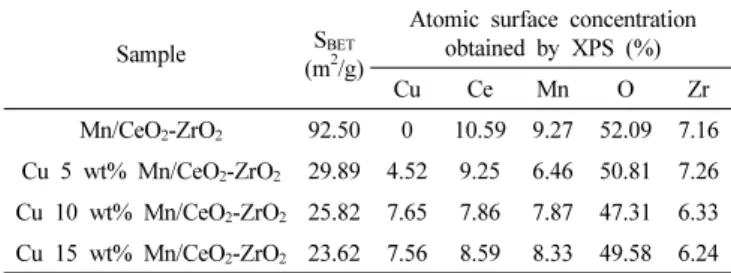
Appl. Chem. Eng., Vol. 23, No. 3, 2012 Table 1. Compositions and Properties of Catalysts

Sample S BET

(m 2 /g)

Atomic surface concentration obtained by XPS (%)

Cu Ce Mn O Zr

Mn/CeO 2 -ZrO 2 92.50 0 10.59 9.27 52.09 7.16 Cu 5 wt% Mn/CeO 2 -ZrO 2 29.89 4.52 9.25 6.46 50.81 7.26 Cu 10 wt% Mn/CeO 2 -ZrO 2 25.82 7.65 7.86 7.87 47.31 6.33 Cu 15 wt% Mn/CeO 2 -ZrO 2 23.62 7.56 8.59 8.33 49.58 6.24 temperature (< 200 ℃). Mn-based catalysts have been synthesized by

impregnating various support materials (TiO 2 , ZrO 2 , CeO 2 , CeO 2 -ZrO 2 , zeolite, etc) with Mn, to be used for NOx removal[8-11]. However, re- search on the addition of a secondary metal to Mn to enhance the cata- lytic activity further has seldom carried out.

In this study, Cu was added to Mn and its effect on the catalytic activity was investigated. CeO 2 -ZrO 2 was used as the support material.

2. Experimental

2.1. Synthesis of Catalysts

The CeO 2 -ZrO 2 support was synthesized using the supercritical hy- drothermal method. The support material was then impregnated with Mn based on the incipient wetness impregnation method using Mn(CH 3 COO) 2 (Aldrich, 99%+) as the Mn precursor. The amount of Mn was controlled to be 5 wt%. The generated catalyst was calcined for 3 h at 550 ℃. To examine the effect of addition of a secondary metal, the Mn-impregnated catalyst was impregnated with Cu using the same method for impregnation of Mn. (C 2 H 3 O 2 ) 2 Cu (Aldrich, 98%+) was used as the Cu precursor. The amount of Cu was controlled to be 5, 10, and 15 wt%. The impregnated catalyst was then calcined for 3 h at 550 ℃.

2.2. Characterization of Catalysts

Brunaure-Emmett-Teller (BET), X-ray Diffraction (XRD), X-ray photo- electron spectroscopy (XPS), and H 2 -Temperature Programmed Reduction (H 2 -TPR) were used to characterize the synthesized catalysts and investigate the effects of the catalyst properties on the NOx re- moval performance.

Nitrogen adsorption-desorption analysis (Sorptomatic, Thermo) was performed at -196 ℃ to examine the specific surface area and pore volume of the catalysts synthesized under different conditions and pre-treated at 180 ℃ under the atmospheric pressure. The obtained ad- sorption-desorption isotherms were analyzed by the BET method to calculate the specific surface area. An X-ray Diffractometer (Rigaku D/MAX-III) was used to analyze the crystal phases of MnOx and CuOx impregnated on the catalysts. The analysis was conducted using Cu Kα X-ray source with the scan range of 0∼80° and the step size of 0.02°.

An XPS spectrometer (AXIS-NOVA, Kratos. Inc) was used to ex- amine the oxidation status of the catalyst surface. The analysis was conducted under a monochromatic Al K-alpha (1486.6 eV) condition while controlling the pressure of the analysis chamber below 10 -8 torr.

A correction was made on the analysis results for the chemical shift phenomenon with the basis bond energy of C 1S peak of 285 eV.

H 2 -TPR analysis was performed to investigate the degree of reduction of the synthesized catalysts. ChemBET 3000 (Quantrachrome) was used as the TPR analyzer. The catalysts were pre-treated for 5 h at 200 ℃ under N 2 atmosphere. H 2 consumption was measured with the analysis gas of 5% He/Ar and with the temperature rise rate of 10 ℃ /min from 35 to 640 ℃.

2.3. De-NOx Experiment

A stainless steel pipe with the inner diameter of 260 mm and the height of 1500 mm was used to fabricate a de-NOx reactor. The space above and below the catalyst layer was filled with quartz wool to mini- mize the channeling phenomenon in the reactor and to fasten the cata- lyst layer. A bypass line was installed to measure the NO concentration before the reactor inlet. The inlet gas was composed of NO, N 2 , O 2 , and NH 3 . The flow rate was controlled by a mass flow controller (Sierra Instruments, Inc, & Hi-Tec co.). The concentrations of NO, NH 3 and O 2 in the inlet gas mixture were controlled at 1000 ppm, 1000 ppm, and 5 vol%, respectively. The ratio of the catalyst weight over the reactant gas flow rate (W/F) was set at 5 g min/L (SV ≒ 6000 hr -1 ). A NOx analyzer (42i-HL, Thermo Ins) was used to measure the NO concentrations at the inlet and at the outlet. The de-NOx effi- ciency was calculated using the following equation:

      ×      

 : NO concentration (ppm) at the reactor inlet

 : NO concentration (ppm) at the reactor outlet

3. Results and Discussion

3.1. Characteristics of Catalysts

The specific surface areas of the catalysts synthesized using different amounts of Cu are compared in Table 1. It is shown that the specific surface area was reduced dramatically due to the impregnation of Cu.

The reduction was higher with larger amount of Cu impregnated, but the difference was small compared to the initial reduction caused by 5 wt% Cu impregnation. The reduction of specific surface area due to the Cu impregnation is attributed to the blocking of the pores by the impregnated Cu. The concentration of Mn on the catalyst surface de- creased when 5 wt% Cu was added. When Cu was added further to 10 and 15 wt%, however, the surface Mn concentration increased, which implies formation of new combined structure, e.g., spinel struc- ture, by Cu and Mn. It has been reported in the literature that coex- istence of Cu and Mn can lead to formation of spinel structure by in- teraction between the two metals[12]. Additional study is needed in the future to examine this possibility.

Figure 1 shows the XRD patterns of the catalysts before and after

the Cu addition. It is shown that the intensities of the peaks appearing

(3)

350 전미진⋅전종기⋅박성훈⋅박영권

공업화학, 제 23 권 제 3 호, 2012

Figure 1. XRD patterns of catalysts. (a) Mn/CeO 2 -ZrO 2 , (b) Cu 5 wt%

Mn/CeO 2 -ZrO 2 , (c) Cu 10 wt% Mn/CeO 2 -ZrO 2 , and (d) Cu 15 wt%

Mn/CeO 2 -ZrO 2 .

Figure 2. TPR profiles of catalysts. (a) Mn/CeO 2 -ZrO 2 , (b) Cu 5 wt%

Mn/CeO 2 -ZrO 2 , (c) Cu 10 wt% Mn/CeO 2 -ZrO 2 , (d) Cu 15 wt%

Mn/CeO 2 -ZrO 2 .

Figure 3. Cu 2P XPS spectra of catalysts. (a) Cu 5 wt%

Mn/CeO 2 -ZrO 2 , (b) Cu 10 wt% Mn/CeO 2 -ZrO 2 , (c) Cu 15 wt%

Mn/CeO 2 -ZrO 2 .

Figure 4. NOx removal efficiencies of different catalysts.

at 35° and 38° (CuO) increased as Cu was added to Mn/CeO 2 -ZrO 2 . Figure 2 shows the H 2 -TPR results of the catalysts. The Cu-added catalysts showed lower reduction temperature than pure Mn/CeO 2 - ZrO 2 . In particular, the Cu-added catalysts showed a single merged peak, while the Mn/CeO 2 -ZrO 2 catalyst showed two clearly separated peaks. The reduction temperature was the lowest when the Mn:Cu ratio was 1:1, increasing with the amount of Cu added. It is known that Cu promotes the reduction of Mn on a catalyst with a Cu-Mn spinel struc- ture[12]. In this study, too, the Cu-added catalysts showed the reduc- tion peaks at a lower temperature than the pure Mn/CeO 2 -ZrO 2 cata- lyst, suggesting that Cu promoted the reduction of Mn. This result again implies that the spinel structure has possibly been formed in this study. Together with the results of XPS analysis, additional research is needed to prove this hypothesis.

Figure 3 shows the XPS analysis results that provide information on the oxidation status of Cu. Generally, CuO and Cu 2 O have bond en- ergies of 933.4 ∼933.9 eV and 932.1∼932.5 eV, respectively[13]. In Figure 3, the main Cu peak, Cu 2P 3/2 , appeared at 933.7 eV accom- panying a strong secondary peak at 940∼946 eV, indicating that Cu 2+

is the main oxidation status of Cu existing on the catalyst surface[14].

This result is in accordance with the XRD analysis result. As the amount of Cu increased, however, the shoulder peak representing Cu + at 932.3 ± 2 eV became clearer. As this was not shown in the XRD result, it is believed that Cu + was dispersed well on the catalyst surface.

3.2. De-NOx Experiments

Figure 4 compares the deNOx efficiencies of the catalysts having different Cu concentrations. All the catalysts used in this study showed increasing deNOx efficiency with temperature. The efficiency also in- creased with the Cu concentration, being the maximum for Cu 15 wt%

Mn/CeO 2 -ZrO 2 . In particular, Cu 15 wt% Mn/CeO 2 -ZrO 2 showed the

steepest increase of the deNOx efficiency with increasing temperature

(4)

351 Cu-Mn/CeO 2 -ZrO 2 촉매를 이용한 질소산화물 제거 반응

Appl. Chem. Eng., Vol. 23, No. 3, 2012 over the low temperature range, becoming 88% at 100 ℃ and 99% at

200 ℃. When Cu and Mn were impregnated with the ratio of 1 : 1, i.e., when 5 wt% of Cu was impregnated, the deNOx efficiency was lower than that of pure Mn/CeO 2 -ZrO 2 , which is attributed to the substantial reduction of the specific surface area due to the blocking of the pores by impregnated Cu (Table 1). On the other hand, when 10 or 15 wt%

of Cu was impregnated, increase in the deNOx efficiency was observed although the specific surface area decreased further and the H 2 -TPR re- duction temperature increased. It is believed that the enhanced catalytic activity by added Cu more than compensated for the reduced surface area and increased reduction temperature. Sultana et al. [15] argued that the NO removal reaction rate increased under the existence of Cu + . In this study, the increase in the amount of impregnated Cu resulted in the enhancement of the Cu + shoulder peak and the increase of the amount of surface Mn (see the XPS result in Table 1), which implies formation of a new phase by interaction between Cu and Mn. This change is believed to have led to overall increase of strongly reducing Cu-Mn mixing state, like the spinel structure, that can act as the active sites, resulting in increased catalytic activity. However, additional re- search is needed for more accurate scientific knowledge on the inter- action between Cu and Mn.

4. Conclusions

The effect of addition of Cu on the catalytic activity of the Mn/CeO 2 -ZrO 2 catalyst was investigated. When Cu was impregnated, surface area was reduced. Also, the reducing ability of catalyst was in- creased as Cu was added. Among 5, 10, 15 wt% Cu added catalysts, 15 wt% Cu showed a very high NOx removal efficiency (99%) at 200 ℃. The increased activity is attributed to the enhanced reducing power by addition of Cu and the increase in the well-dispersed Cu + .

Acknowledgement

This work was supported by Korea Sanhak Foundation.

References

1. H. Bosch and F. Janssen, Catal. Today, 2, 369 (1988).

2. G. Qi and R. T. Yang, Appl. Catal. B : Environ., 44, 217 (2003).

3. T. Valdés-Solís, G. Marbán, and A. B. Fuertes., Appl. Catal. B : Environ., 46, 261 (2003).

4. N. Isabella, D. Lorenzo, L. Luca, G. Elio, and F. Pio, Appl. Catal.

B : Environ., 35, 31 (2001).

5. X. Tang, J. Hao, H. Yi, and J. Li, Catal. Today, 126, 406 (2007).

6. J. P. Chen and R. T Yang, Appl. Catal. A : Gen., 80, 135 (1992).

7. M. Kang, E. D. Park, J. M. Kim, and J. E. Yie, Appl. Catal. A : Gen., 327, 261 (2007).

8. L. Singoredjo, R. Korver, F. Kapteijn, and J. Moulijn, Appl. Catal.

B : Environ., 1, 297 (1992).

9. M. Richter, A. Trunschke, U. Bentrup, K. W. Brzezinka, E.

Schreier, M. Schneider, M. M. Pohl, and R. Fricke, J. Catal., 206, 98 (2002).

10. G. S. Qi, R. T. Yang, and R. Chang, Catal. Lett., 87, 67 (2003).

11. Y. J. Kim, H. J. Kwon, I. S. Nam, J. W. Choung, J. K. Kil, H.

J. Kim, M. S. Cha, and G. K. Yeo, Catal. Today, 151, 244 (2010).

12. M. R. Morales, B. P. Barbero, and L. E. Cadus, Appl. Catal. B : Environ., 67, 229 (2006).

13. http://www.lasurface.com.

14. M. Kramer, T. Schmidt, K. Stowe, and W. F. Maier, Appl. Catal.

A : Gen., 302, 257 (2006).

15. A. Sultana, T. Nanba, M. Haneda, M. Sasaki, and H. Hamada,

Appl. Catal. B : Environ., 101, 61 (2010).

수치

Figure 1 shows the XRD patterns of the catalysts before and after  the Cu addition. It is shown that the intensities of the peaks appearing
Figure 2. TPR profiles of catalysts. (a) Mn/CeO 2 -ZrO 2 , (b) Cu 5 wt%

참조

관련 문서

– 임상시험을 의뢰 받은 병원은 내부에 설치된 임상 시험심사위원회(IRB; Institutional Review Board)의 승인을 받는 절차 진행..

Key Words : 커뮤니케이션 목표, 계층적 효과모형, DAGMAR적 접근방법... 광고가 매출에 미치는 효과는 상당한 기간이

직선 혹은 단순한 곡선을 따라 같은 방향으로 연결된 것처럼 보이는 요소 들은 동일한 그룹으로

시민들간의 신뢰는 안정적, 성공적 인 민주체제에서 살아온 일상적인 경험으로 부터 나오는 학습효과이다. • 좋은 정치가 좋은

1) 원인 : 뇌하수체 전엽에서 분비되는 ACTH 과잉생성에 의해서 발생. ① 뇌하수체 종양 및 뇌하수체 호르몬 과잉분비 : cushing

Classmate였던 James Rose, Dan Kiley와 함께 순 수미술의 원리를 벗어나 과학과 건축과 예술을 현대 Landscape

④ 가맹본부는 가맹점의 매출증대, 효율적인 점포운영기법제공 등을 통한 고객 만족을 유지․발전시켜 나가야 하며 사업성패의 핵심은 매뉴얼사업이라는

[r]