Association between Bsm1 Polymorphism in Vitamin D Receptor Gene and Diabetic Retinopathy of Type 2
Diabetes in Korean Population
Yong Joo Hong, Eun Seok Kang, Myoung Jin Ji, Hyung Jin Choi, Taekeun Oh, Sung-Soo Koong, Hyun Jeong Jeon Department of Internal Medicine, Chungbuk National University College of Medicine, Cheongju, Korea
Background: Type 2 diabetes is one of the most common diseases with devastating complications. However, genetic susceptibil- ity of diabetic complications has not been clarified. The vitamin D endocrine system is related with calcification and lipolysis, in- sulin secretion, and may be associated with many complicated disease including diabetes and cardiovascular disease. Recent studies reported that single nucleotide polymorphisms of vitamin D receptor (VDR) gene were associated with diabetic compli- cations.
Methods: In present study, we evaluated the association of BsmI polymorphism of VDR with diabetic complications in Korean diabetes patients. Total of 537 type 2 diabetic subjects from the Endocrinology Clinic of Chungbuk National University Hospital were investigated. Polymerase chain reaction-restriction fragment length polymorphism was used to test the genotype and allele frequency of BsmI (rs1544410; BB, Bb, bb) polymorphisms.
Results: Mean age was 62.44±10.64 years and mean disease duration was 13.65±7.39 years. Patients with B allele (BB or Bb) was significantly associated with lower risk of diabetic retinopathy (severe non-proliferative diabetic retinopathy or proliferative retinopathy; 7.4%, 5/68) compared with patients without B allele (bb; 17.3%, 81/469; P=0.035). This association was also sig- nificant after adjusting for hemoglobin A1c level, body mass index, age, sex, and diabetes mellitus duration, concurrent dyslipid- emia and hypertension (odds ratio, 2.99; 95% confidence interval, 1.08 to 8.29; P=0.035) in logistic regression analysis.
Conclusion: Our findings suggest that B allele of Bsm1 polymorphism in VDR gene is associated with lower risk of diabetic reti- nopathy in type 2 diabetic patients. Bsm1 genotype could be used as a susceptibility marker to predict the risk of diabetes compli- cation.
Keywords: Diabetes mellitus, type 2; Diabetic retinopathy; Polymorphism, single nucleotide; Receptors, calcitriol
INTRODUCTION
Despite recent advances, diabetes is a complex condition to treat in clinical practice, and mortality remains high. Diabetic compli-
cations may play an important role in increasing mortality of dia- betic patients. The mechanisms underlying the role of hypergly- cemia in diabetic complications remain incompletely explained, which means potential involvement of genetic factors in diabetic
Received: 14 July 2014, Revised: 27 March 2015, Accepted: 6 October 2015 Corresponding author: Hyun Jeong Jeon
Division of Endocrinology and Metabolism, Department of Internal Medicine, Chungbuk National University College of Medicine, 776 1sunhwan-ro, Seowon- gu, Cheongju 28644, Korea
Tel: +82-43-269-6352, Fax: +82-43-273-3252, E-mail: [email protected]
Copyright © 2015 Korean Endocrine Society
This is an Open Access article distributed under the terms of the Creative Com- mons Attribution Non-Commercial License (http://creativecommons.org/
licenses/by-nc/3.0/) which permits unrestricted non-commercial use, distribu- tion, and reproduction in any medium, provided the original work is properly cited.
complications. The vitamin D endocrine system is associated with various disease including diabetes, cancer, cardiovascular disorder, metabolic syndrome, autoimmune disorders, and tuber- culosis [1-4]. Active vitamin D mediates its biological effects by binding to the vitamin D receptor (VDR), which is located in the nuclei of target cells. VDR is associated with insulin secretion and sensitivity, also it is expressed in the pancreas. These results show that VDR is a possible role in the development of diabetes.
To date, more than 25 different polymorphisms have been mapped to the VDR locus. The human VDR gene is located on chromosome 12q13.1. It has at least 5 promoter regions, 8 pro- tein-coding exons and 6 untranslated exons, which are alterna- tively spliced into FokI (in exon 2), BsmI and ApaI (both in in- tron 8), and TaqI (in exon 9). Recently, there are several reports these VDR polymorphisms are associated with type 2 diabetes, insulin secretion [5-10]. Also, VDR polymorphisms are related with metabolic syndrome, metabolic changes related with obe- sity and diabetic retinopathy. These studies suggested that VDR polymorphism may play a possible role in the development of diabetic complications. Although, there is insufficient studies of association between VDR polymorphism and Korean type 2 diabetes patients.
In this study, we evaluate the association of VDR polymor- phism with diabetic complications in Korean type 2 diabetes patients.
METHODS
The study was designed as a case-control study, which enrolled 537 of patients with type 2 diabetes in Chungbuk National Uni- versity Hospital. The study was approved by the International Review Board of Chungbuk National University Hospital and all patients gave informed consent prior to being included in the study.
Diagnosis of type 2 diabetes was based on the World Health Organization criteria for diabetes. Diabetic retinopathy was as- sessed through dilated pupils by trained ophthalmologists and classified as no apparent diabetic retinopathy (mild to moder- ate, severe), non-proliferative diabetic retinopathy, or prolifera- tive diabetic retinopathy, which were based on the International Clinical Retinopathy Severity Scale. Diabetic nephropathy was defined by the presence of microalbuminuria or overt albumin- uria and elevated creatinine level. The macrovascular compli- cations including coronary heart disease or stroke were as- sessed by the medical records. All subjects underwent bio- chemical tests, medical history and family history of diabetes.
Patients were divided into two groups according to presence of B allele (BB or Bb genotype vs. bb genotype). We compared the clinical characteristics and prevalence of diabetic complica- tions according to presence of B allele.
Genotyping
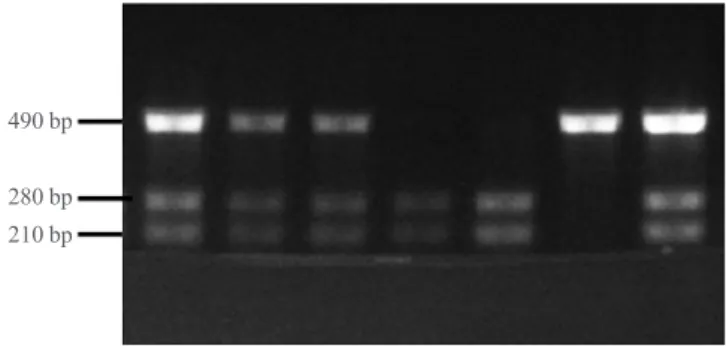
The genomic DNA was isolated from peripheral leukocytes obtained from ethylenediaminetetraacetic acid-treated whole blood. Polymerase chain reaction-restriction fragment length polymorphism (PCR-RFLP) was used to determine the Bsm1 VDR gene polymorphism. The primers for VDR gene was de- signed based on previous literature. The following Bsm1 prim- ers were used for amplification: forward 5´-CAACCAAGAC- TACAAGTACCGCGTCAGTGA-3´ and reverse 5´-AAC- CAGCGGAAGAGGTCAAGGG-3´. The PCR was conducted in a 25 µL volume, with an initial denaturation of 3 minutes at 94°C, followed by 30 seconds denaturation at 94°C, 30 sec- onds annealing at 62°C, and 1 minute extension at 72°C for 30 cycles, and a final extension of 5 minutes at 72°C. The PCR products were digested overnight at 37°C by Fermentas restric- tion enzymes, and resolved in 1.5% agarose gel ethidium bro- mide by electrophoresis for genotype analysis. Digestion with Bsm1 yields 3 genotypes: BB (825 bp), Bb (825, 650, 175 bp), and bb (650, 175 bp) (Fig. 1).
Statistical analysis
Hardy-Weinberg equilibrium was tested to evaluate the rela- tionship between gene frequencies and genotype frequencies.
The data was expressed as mean±standard deviation.
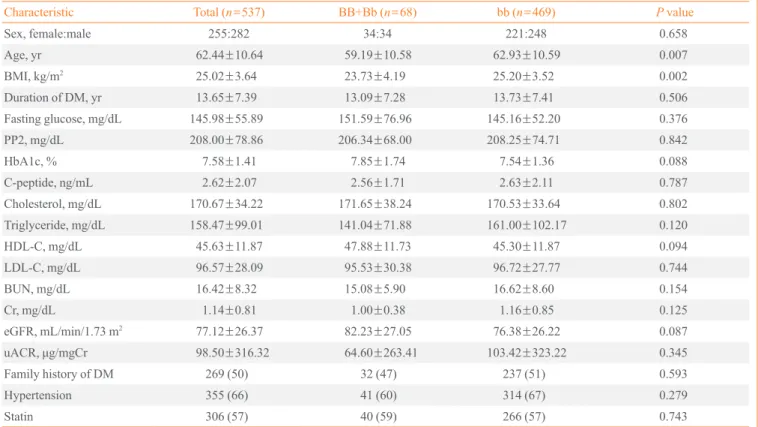
The clinical characteristics of the patients were compared using the chi-square test for categorical variables and Student t test for continuous variables (Table 1). Multivariate analysis was using the logistic regression to adjust interaction effect of metabolic risk factors to diabetic complication outcomes (Table 2). P values of <0.05 were considered statistically significant.
Fig. 1. BsmI and ApaI sites.
490 bp 280 bp 210 bp
All statistical analyses were performed using SPSS version 15.0 (SPSS Inc., Chicago, IL, USA).
RESULTS
Clinical characteristics
The clinical and biochemical characteristics of the patients are summarized in Table 1. The mean age of the patient population was 62.44±10.64 years, body mass index (BMI) was 25.02±
3.64 kg/m2, duration of diabetes was 13.65±7.39 years. There was no difference in sex, duration of diabetes, family history of diabetes and concurrent hypertension, dyslipidemia in between two groups, but results showed significant difference in age Table 1. Clinical Characteristics of Patients of Type 2 Diabetes according to Bsm1 Genotype
Characteristic Total (n=537) BB+Bb (n=68) bb (n=469) P value
Sex, female:male 255:282 34:34 221:248 0.658
Age, yr 62.44±10.64 59.19±10.58 62.93±10.59 0.007
BMI, kg/m2 25.02±3.64 23.73±4.19 25.20±3.52 0.002
Duration of DM, yr 13.65±7.39 13.09±7.28 13.73±7.41 0.506
Fasting glucose, mg/dL 145.98±55.89 151.59±76.96 145.16±52.20 0.376
PP2, mg/dL 208.00±78.86 206.34±68.00 208.25±74.71 0.842
HbA1c, % 7.58±1.41 7.85±1.74 7.54±1.36 0.088
C-peptide, ng/mL 2.62±2.07 2.56±1.71 2.63±2.11 0.787
Cholesterol, mg/dL 170.67±34.22 171.65±38.24 170.53±33.64 0.802
Triglyceride, mg/dL 158.47±99.01 141.04±71.88 161.00±102.17 0.120
HDL-C, mg/dL 45.63±11.87 47.88±11.73 45.30±11.87 0.094
LDL-C, mg/dL 96.57±28.09 95.53±30.38 96.72±27.77 0.744
BUN, mg/dL 16.42±8.32 15.08±5.90 16.62±8.60 0.154
Cr, mg/dL 1.14±0.81 1.00±0.38 1.16±0.85 0.125
eGFR, mL/min/1.73 m2 77.12±26.37 82.23±27.05 76.38±26.22 0.087
uACR, μg/mgCr 98.50±316.32 64.60±263.41 103.42±323.22 0.345
Family history of DM 269 (50) 32 (47) 237 (51) 0.593
Hypertension 355 (66) 41 (60) 314 (67) 0.279
Statin 306 (57) 40 (59) 266 (57) 0.743
Values are expressed as mean±SD or number (%).
BMI, body mass index; DM, diabetes mellitus; PP2, post-prandial 2 hours blood glucose; HbA1c, hemoglobin A1c; HDL-C, high density lipoprotein cholesterol; LDL-C, low density lipoprotein cholesterol; BUN, blood urea nitrogen; eGFR, estimated glomerular filtration rate; uACR, urinary mi-
croalbumin-creatinine ratio.
Table 2. Prevalence of Other Diabetic Microvascular/Macro- vascular Complications according to Bsm1 Genotype
Variable BB+Bb bb P value
ESRDa 0 4 (9) 0.580
Polyneuropathyb 33 (48.5) 233 (49.7) 0.979
Strokec 5 (7.4) 50 (10.7) 0.273
MI 4 (5.9) 14 (3.0) 0.183
PADd 0 6 (1.3) 0.442
DM foot 2 (2.9) 18 (3.8) 0.524
Values are expressed as number (%).
ESRD, end-stage renal disease; MI, myocardiac infarction; PAD, pe- ripheral artery disease; DM, diabetes mellitus.
aPatient who have kidney replacement therapy; bPatient who have an- ti-neuralgia medicine; cCerebral ischemic event including transient ischemic attack; dAbove 50% arterial stenosis confirmed by angiogra- phy.
Table 3. Distribution of Bsm1 Genotypes in Type 2 Diabetic Patients
No. (%)
Total 537 (100)
BB 10 (1.86)
Bb 58 (10.80)
bb 469 (87.34)
(P=0.007), BMI (P=0.002) between two groups (Table 1).
Bsm1 polymorphism and diabetic retinopathy
The genotypic distribution of Bsm1 met Hardy-Weinberg equi- librium. The frequency of Bsm1 genotype in patients was as follows: BB, 1.86% (n=10); Bb, 10.80% (n=58); bb, 87.34%
(n=469) (Table 3). Patients with BB or Bb genotype was sig- nificantly associated with lower risk of diabetic retinopathy compared with patients with bb genotype (BB or Bb genotype 7.4% vs. bb genotype 82.7%, P=0.035) (Table 4).
In logistic regression analysis, B allele was associated with the lower risk of diabetic retinopathy in this study (odds ratio, 2.63;
P=0.037). And this association continued after adjusted with other clinical factors (Table 4). Multivariate logistic regression analysis with an enter method was used to evaluate the effect of other clinical factors. In baseline characteristics, there was sig- nificant difference with age and BMI between two groups, but after adjustment with these factors, the association with diabetic retinopathy and Bsm1 type still continued (Table 4).
The retinopathy divided to two groups, one is no apparent diabetic retinopathy and mild to moderate non-proliferative retinopathy and the other is severe non-proliferative retinopa- thy and proliferative retinopathy. Because of some confused description of severities of non-proliferative retinopathy (mild, moderate), but severe retinopathy and proliferative retinopathy may lead to significant consequence (laser treatment or sur- gery), so this two groups’ separation was clinically significant.
Bsm1 polymorphism and diabetic microvascular and macrovascular complications
We also evaluate the association of Bsm1 polymorphism and diabetic nephropathy, neuropathy, diabetic foot, coronary artery disease, stroke, and peripheral artery disease. There was no as- sociation between the Bsm1 polymorphism and diabetic mac- rovascular complication, nephropathy, neuropathy, and diabetic foot (Table 2).
DISCUSSION
We evaluated the association of Bsm1 polymorphism with dia- betic complications in Korean type 2 diabetic patients. Patients with B allele (BB or Bb) were significantly associated with lower risk of diabetic retinopathy compared with patients with- out B allele (bb). It showed that B allele in VDR may be a pro- tective factor in the development of diabetic retinopathy. There are a few data about the association with Bsm1 polymorphism and diabetic retinopathy. Bucan et al. [11] showed that bb geno- type in VDR has a higher risk of developing diabetic retinopa- thy. But they didn’t show that the association of b allele and di- abetic retinopathy. Although Capoluongo et al. [12] did not find Bsm1 association with diabetic complications in the Italian population. Cyganek et al. [5] also reported the same results that no association was observed between the Bsm1 polymor- phism and diabetic retinopathy. The relationship of Bsm1 poly- morphism with diabetic retinopathy is still controversial. The discrepancies of these results were likely due to the difference in ethnicity or enrolled characteristics of subject among studies.
Diabetic microvascular complications result from several mechanisms including hyperglycemia, hypertension, seem to be also affected by genetic factors. There are several genes about the development of diabetic microvascular complications including endothelial physiology, vasoconstriction, coagula- tion, oxidative processes, and growth factors. Vitamin D is well known for maintaining normal homeostasis of calcium and phosphorus also has anti-proliferative, anti-angiogenic effect and apoptosis process. The active form of this vitamin D through a specific VDR, VDR is widely expressed in human tissues and organs, including retina. As mentioned earlier, vita- min D has anti-proliferative action in vitro; vitamin D inhibits vascular smooth muscle cell growth and effects on endothelial physiology. Therefore, it is postulated that VDR polymorphism may influence on the development of diabetic retinopathy.
In this study, we demonstrated of possible association with B allele and lower risk of diabetic retinopathy. And this result Table 4. Logistic Analysis of Multiple Risk Factors for the As-
sociation with Diabetic Retinopathy according to Bsm1 Geno- type
Variable Severe NPDR, PDR
OR (95% CI) P value
Non-B allele 2.63 (1.03–6.75) 0.037
HbA1c 2.87 (1.11–7.45) 0.030
Body mass index 3.23 (1.23–8.48) 0.017
Sex 3.20 (1.22–8.40) 0.018
Age 3.05 (1.16–8.03) 0.024
DM duration 2.86 (1.04–7.87) 0.042
Dyslipidemia 2.96 (1.08–8.13) 0.035
Hypertension 2.99 (1.08–8.29) 0.035
NPDR, non-proliferative diabetic retinopathy; PDR, proliferative dia- betic retinopathy; OR, odds ratio; CI, confidence interval; HbA1c, he- moglobin A1c; DM, diabetes mellitus.
was about Korean population, there was no previous study about association with diabetic complication and VDR poly- morphisms.
We try to evaluate another association in diabetic complica- tion, such as nephropathy, macrovascular complications. There was no association between Bsm1 polymorphism and diabetic nephropathy (end-stage renal disease, P=0.580; normo-/mi- cro-/macroalbuminuria, P=0.302). Zhang et al. [8] reported that B allele in Bsm1 is correlated with large amount albumin- uria in the Han Chinese population with type 2 diabetes, and is probably a risk factor for early-onset diabetic nephropathy.
Contrary to our result, this study showed that B allele could be responsible for the pathogenesis of early-onset diabetic ne- phropathy. Bucan et al. [11] showed that no association was observed between Bsm1 genotype and diabetic nephropathy, in common with our data. Marco et al. [13] reported that the greater prevalence of ischemic heart disease and death from cardiovascular causes in BB and Bb genotypes. They suggested that the Bsm1 VDR polymorphism might affect cardiovascular morbidity or mortality through calcium metabolism or VDR mediated influence of 1, 25-dihydroxyvitmain D3 on vascular smooth muscle cells and myocytes. Gyorffy et al. [14] showed that patient with the BB genotype in VDR have a higher risk of development in coronary artery disease. In our study, there was no association between the Bsm1 polymorphism and diabetic macrovascular complications especially myocardiac infarction (Table 2).
These two contrary results (lower risk of retinopathy in B al- lele in our study, higher risk of coronary artery disease in B al- lele in other studies) may explained by biochemical features of Bsm1 polymorphism. Polymorphism for Bsm1 was known functional effects because it is located within intron 8 which will be removed during mRNA posttranscriptional. Although, VDR itself may not be the disease affecting locus, but rather a marker locus in linkage disequilibrium with the residual locus, and the discrepant findings may reflect variable strengths of linkage disequilibrium in different populations [15]. Another possible mechanism is that alternation of Bsm1 in intronic se- quence may influence protein expression [14].
There are several hypotheses for development of metabolic disorder in alternation of vitamin D system. First, vitamin D is fat soluble and can be stored in adipose tissue. Second, large cohort studies have been reported that high BMI is strongly and inversely correlated with serum vitamin D level. Third, vi- tamin D regulates calcium trafficking in pancreatic β-cells in vitro. Also, vitamin D effects intracellular ionized calcium sig-
naling in the adipocyte, which in turn induces increased lipo- genesis and decreased lipolysis via uncoupling protein-2. These mechanisms postulated that alternation of the VDR potentially contributes to the development of metabolic syndrome and car- diovascular disease. Unfortunately, our patients have only few data with serum vitamin D level, so we couldn’t evaluate the association with vitamin D level and other results.
In present study, we suggested that Bsm1 polymorphism in VDR gene is associated with lower risk of diabetic retinopathy in type 2 diabetic patients. Bsm1 polymorphism in VDR gene could be used as a susceptibility marker to predict the risk of diabetic complication. But further large study will be needed.
CONFLICTS OF INTEREST
No potential conflict of interest relevant to this article was re- ported.
ACKNOWLEDGMENTS
This work was supported by a research fund of Daejeon and Chungcheong Branch of Korean Endocrine Society. The bio- specimens for this study were provided by the Chungbuk Na- tional University Hospital, a member of the National Biobank of Korea, which is supported by the Ministry of Health, Wel- fare and Family Affairs. All samples derived from the National Biobank of Korea were obtained with informed consent under Institutional Review Board-approved protocols.
REFERENCES
1. Tamilselvan B, Seshadri KG, Venkatraman G. Role of vita- min D on the expression of glucose transporters in L6 myo- tubes. Indian J Endocrinol Metab 2013;17(Suppl 1):S326- 8.
2. Kahn BB. Facilitative glucose transporters: regulatory mecha- nisms and dysregulation in diabetes. J Clin Invest 1992;89:
1367-74.
3. Vaidya A, Williams JS. The relationship between vitamin D and the renin-angiotensin system in the pathophysiology of hypertension, kidney disease, and diabetes. Metabolism 2012;61:450-8.
4. Riek AE, Oh J, Sprague JE, Timpson A, de las Fuentes L, Bernal-Mizrachi L, et al. Vitamin D suppression of endo- plasmic reticulum stress promotes an antiatherogenic mono- cyte/macrophage phenotype in type 2 diabetic patients. J
Biol Chem 2012;287:38482-94.
5. Cyganek K, Mirkiewicz-Sieradzka B, Malecki MT, Wolkow P, Skupien J, Bobrek J, et al. Clinical risk factors and the role of VDR gene polymorphisms in diabetic retinopathy in Pol- ish type 2 diabetes patients. Acta Diabetol 2006;43:114-9.
6. Nosratabadi R, Arababadi MK, Salehabad VA, Shamsiza- deh A, Mahmoodi M, Sayadi AR, et al. Polymorphisms within exon 9 but not intron 8 of the vitamin D receptor are associated with the nephropathic complication of type-2 di- abetes. Int J Immunogenet 2010;37:493-7.
7. Velayoudom-Cephise FL, Larifla L, Donnet JP, Maimaitim- ing S, Deloumeaux J, Blanchet A, et al. Vitamin D defi- ciency, vitamin D receptor gene polymorphisms and car- diovascular risk factors in Caribbean patients with type 2 diabetes. Diabetes Metab 2011;37:540-5.
8. Zhang H, Wang J, Yi B, Zhao Y, Liu Y, Zhang K, et al.
BsmI polymorphisms in vitamin D receptor gene are asso- ciated with diabetic nephropathy in type 2 diabetes in the Han Chinese population. Gene 2012;495:183-8.
9. Ferrarezi DA, Bellili-Munoz N, Dubois-Laforgue D, Cheur- fa N, Lamri A, Reis AF, et al. Allelic variations of the vita- min D receptor (VDR) gene are associated with increased risk of coronary artery disease in type 2 diabetics: the DIAB- HYCAR prospective study. Diabetes Metab 2013;39:263- 70.
10. Yokoyama K, Nakashima A, Urashima M, Suga H, Mimura
T, Kimura Y, et al. Interactions between serum vitamin D levels and vitamin D receptor gene FokI polymorphisms for renal function in patients with type 2 diabetes. PLoS One 2012;7:e51171.
11. Bucan K, Ivanisevic M, Zemunik T, Boraska V, Skrabic V, Vatavuk Z, et al. Retinopathy and nephropathy in type 1 di- abetic patients: association with polymorphysms of vitamin D-receptor, TNF, neuro-D and IL-1 receptor 1 genes. Coll Antropol 2009;33 Suppl 2:99-105.
12. Capoluongo E, Pitocco D, Concolino P, Santonocito C, Di Stasio E, d’Onofrio G, et al. Slight association between type 1 diabetes and “ff” VDR FokI genotype in patients from the Italian Lazio Region. Lack of association with dia- betes complications. Clin Biochem 2006;39:888-92.
13. Marco MP, Craver L, Betriu A, Fibla J, Fernandez E. Influ- ence of vitamin D receptor gene polymorphisms on mortality risk in hemodialysis patients. Am J Kidney Dis 2001;38:965- 74.
14. Gyorffy B, Vasarhelyi B, Krikovszky D, Madacsy L, Tordai A, Tulassay T, et al. Gender-specific association of vitamin D receptor polymorphism combinations with type 1 diabe- tes mellitus. Eur J Endocrinol 2002;147:803-8.
15. Tawfeek MA, Habib FA, Mouhamed Saultan EE. Vitamin D receptor Bsm1 gene polymorphisms and gestational diabetes mellitus: a Saudi study. Br J Med Med Res 2011;1:459-68.