www.kafm.or.kr
520
서 론1,013명을 대상으로 한 Göbel 등1) 연구와 10만 명의 헌혈인을 대상 으로 한 Atsma 등2)연구에서 헤모글로빈과 혈압이 양의 상관관계가 있었다. 혈액투석 환자에서 erythropoietin의 투여는 혈압 상승과 관 련이 있다.3,4) 기립성 저혈압 환자에서 erythropoietin의 투여는 기립 시 혈압을 올렸다.5) Erythropoietin 투여로 증가한 자유헤모글로빈이 nitric oxide (NO)와 결합하면 혈관을 이완시키는 NO가 감소하여 혈 관을 수축시키고 혈압이 증가한다는 가설이 있다6). 헤마토크릿과 헤모글로빈의 증가는 혈액점성도를 증가시킨다.7) 증가한 혈액점성 도는 혈압을 상승시켜 허혈성 심질환, 뇌졸중 같은 심혈관질환 이벤 트와 관련이 있다는 보고가 있다.7) 증가한 헤모글로빈이 혈압을 올
릴 수 있는 가능성을 시사한 것이다.
따라서 본 연구의 목적은 우리나라 모집단을 대표하는 2014년 국 민건강영양조사를 이용하여 비교적 건강한 성인 남녀에서 헤모글 로빈과 혈압의 연관성을 알아보는 것이다.
방 법
1. 연구 대상
2014년 국민건강영양조사에 참가한 20–65세 성인 남녀를 대상으 로 하였다. 현재 항고혈압제를 복용하는 경우, 의사에 의해 당뇨병 진단을 받은 경우와 임산부는 연구 대상에서 제외하였다.
분석 변수에 결측값이 있는 대상자도 분석에서 제외되어 최종 연
Breif
Communication
한국 성인에서 헤모글로빈과 혈압의 연관성:
2014년 국민건강영양조사 자료 이용
조성철, 황예원*, 강병두, 전무경, 김소희, 한경아, 유상은
세림병원 가정의학과
Association between Hemoglobin Level and Blood Pressure in Korean Adults:
Using Korean National Health and Nutrition Examination Survey in 2014
Sung-Chul Cho, Ye-Won Hwang*, Byung-Du Kang, Mu-Kyung Jeon, So-Hee Kim, Kyung-Ah Han, Sang-Eun Yu Department of Family Medicine, Serim Hospital, Incheon, Korea
Background: This study investigated the association between hemoglobin level and blood pressure using a representative sample of the Korean
population.Methods: We used data from the Korea National Health and Nutrition Examination Survey, 2014. A complex samples general linear model was used to
assess the association between hemoglobin level and mean arterial blood pressure. All results were controlled for age, sex, and body mass index.Results: With each increase in hemoglobin level of 1 g/dL, mean arterial blood pressure increased by 1.224 mmHg and 1.193 mmHg in men and
women, respectively.Conclusion: Relatively high hemoglobin level can be a risk factor for cardiovascular disease.
Keywords: Hemoglobins; Blood Pressure; Risk Factors; Cardiovascular Diseases
https://doi.org/10.21215/kjfp.2016.6.5.520 eISSN 2233-9116Korean J Fam Pract. 2016;6(5):520-523
KJFP
Korean Journal of Family PracticeReceived March 10, 2016 Revised June 29, 2016 Accepted July 7, 2016 Corresponding author Ye-Won Hwang
Tel: +82-32-509-5570, Fax: +82-32-509-5768 E-mail: [email protected]
Copyright © 2016 The Korean Academy of Family Medicine
This is an open-access article distributed under the terms of the Creative Commons At- tribution Non-Commercial License (http://creativecommons.org/licenses/by-nc/4.0) which permits unrestricted noncommercial use, distribution, and reproduction in any medium, provided the original work is properly cited.
www.kafm.or.kr 조성철 외. 한국 성인에서 헤모글로빈과 혈압의 연관성
Korean J Fam Pract. 2016;6(5):520-523
521
Korean Journal of Family Practice
KJFP
Breif
Communication
Korean Journal of Family Practice 구 대상자는 2,965명으로 남녀 각각 1,188명, 1,777명이었다.
2. 분석 변수
연속 변수인 체질량지수, 헤마토크릿, 헤모글로빈은 2014년 국민 건강영양조사의 검진 조사 항목에서 만 나이와 성별은 기본조사 항 목에서 구하였다. 평균동맥압은 (최종수축기혈압)/3+(최종이완기혈 압×2)/3으로 구하였다.
3. 통계 분석
연속 변수의 평균과 표준오차는 복합표본 기술통계로 구했고 성 별에 따른 차이는 복합표본 일반선형모형(t-검정)을 이용하여 P값을 산출했다. 헤모글로빈과 평균동맥압, 헤마토크릿과 평균동맥압의 연관성을 분석하기 위해 남녀 별도의 복합표본 일반선형모형을 시 행하였다.
통계프로그램은 IBM SPSS Statistics ver. 21.0 (IBM Co., Armonk, NY, USA)을 사용하였고 P값이 0.05보다 작으면 통계적으로 유의미 하다고 정의하였다.
결 과
1. 연구 대상자의 일반적 특징
연구 대상자의 일반적 특징은 Table 1과 같았다. 각 변수의 평균, 표 준오차, 비율(%)은 복합표본 가중치를 반영한 추정값이다.
평균동맥압 평균은 남녀 각각 91.02 mmHg, 84.23 mmHg였다. 성 별에 따른 평균동맥압 수치는 P<0.001로 통계적으로 유의하였다. 혈 색소 평균은 남녀 각각 15.54 g/dL, 13.17 g/dL이며 성별에 따른 차이 는 P<0.001로 유의하였다. 체질량지수와 헤마토크릿 평균도 성별에 따른 차이는 P<0.05로 남자가 여자보다 유의미하게 컸다.
2. 헤모글로빈과 혈압의 연관성
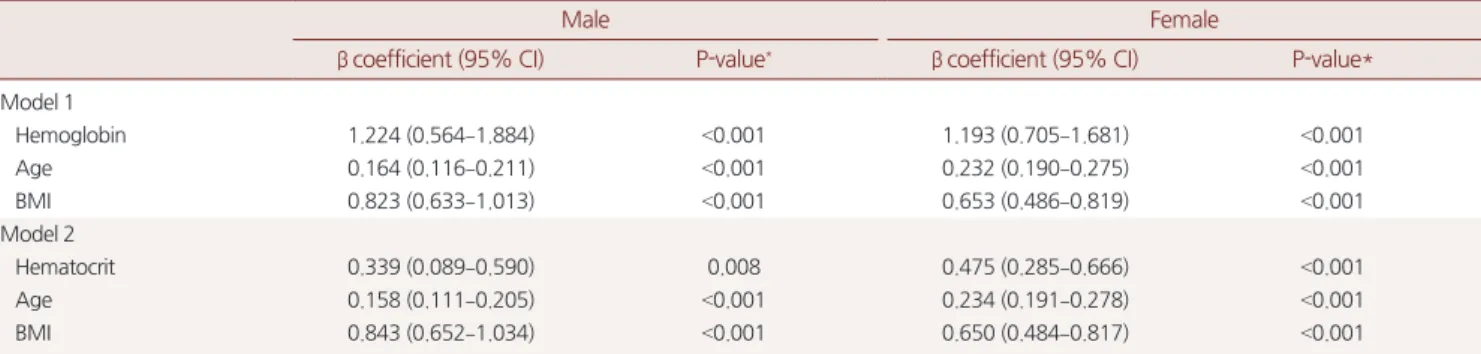
Table 2는 복합표본 일반선형모형에 의한 다중회귀분석 결과이다.
헤모글로빈, 헤마토크릿, 만 나이, 체질량지수와 같은 연속형 변수의 회귀계수는 선형회귀모형의 기울기를 의미한다.
남자는 헤모글로빈이 1 g/dL 증가할 때마다 평균동맥압은 1.224 mmHg 증가했고 P<0.05로 유의미했다. 여자는 헤모글로빈이 1 g/dL 증가할 때마다 평균동맥압은 1.193 mmHg 증가했고 P<0.05로 유의미 했다. 남녀 모두 헤모글로빈 수치가 증가할 때 평균동맥압이 증가하 는 경향을 보였다.
남녀 모두 헤마토크릿 수치가 증가할 때 평균동맥압이 증가하는 경향이었고 P<0.05로 통계적으로 유의미했다. 남녀 모두 만 나이와 체질량지수도 양의 상관관계를 보였다.
고 찰
헤마토크릿, 헤모글로빈 모두 남자가 여자보다 높았다. 안드로겐 이 신장에 직접 작용하여 erythropoietin 생산을 자극하기 때문이 다.8) 남자와 여자의 헤마토크릿과 헤모글로빈의 차이가 남녀의 평균
Table 1. Baseline characteristics of the participants (n=2,965) Characteristic Male
(n=1,188)
Female
(n=1,777) P-value* Mean arterial pressure (mmHg) 91.02±0.417 84.23±0.325 <0.001
Hematocrit (%) 45.48±0.098 39.57±0.084 <0.001
Hemoglobin (g/dL) 15.54±0.033 13.17±0.030 <0.001
Age (y) 39.89±0.444 40.97±0.397 0.023
Body mass index (kg/m2) 24.23±0.107 22.65±0.102 <0.001 Values are presented as mean±standard error. Mean, standard error are estimat- ed values reflecting of complex sample weight.
*P-values represent differences between men and women by t-test for continu- ous variables.
Table 2. Complex samples general linear model for mean arterial pressure
Male Female
β coefficient (95% CI) P-value* β coefficient (95% CI) P-value*
Model 1
Hemoglobin 1.224 (0.564–1.884) <0.001 1.193 (0.705–1.681) <0.001
Age 0.164 (0.116–0.211) <0.001 0.232 (0.190–0.275) <0.001
BMI 0.823 (0.633–1.013) <0.001 0.653 (0.486–0.819) <0.001
Model 2
Hematocrit 0.339 (0.089–0.590) 0.008 0.475 (0.285–0.666) <0.001
Age 0.158 (0.111–0.205) <0.001 0.234 (0.191–0.278) <0.001
BMI 0.843 (0.652–1.034) <0.001 0.650 (0.484–0.817) <0.001
β coefficients are estimated values in mmHg reflecting of complex sample weight.
Model 1, hemoglobin, age, and BMI were analyzed for mean arterial pressure; Model 2, hematocrit, age, and BMI were analyzed for mean arterial pressure.
CI, confidence Interval; BMI, body mass index.
*By complex sample general linear model.
Sung-Chul Cho, et al. Association between Hemoglobin Level and Blood Pressure in Korean Adults
www.kafm.or.kr
522
Korean J Fam Pract. 2016;6(5):520-523Korean Journal of Family Practice
KJFP
동맥압 차이와 인과관계가 있는지는 명확하지 않다.
본 연구에서 만 나이와 체질량지수는 평균동맥압과 양의 상관관 계가 있었다. 만 나이와 체질량지수의 영향력을 보정한 상태에서 남 녀 모두 평균동맥압이 헤모글로빈 및 헤마토크릿과 양의 상관관계 를 보인 결과는 Göbel 등1) 연구와 비슷한 경향의 결과를 보였다.
헤모글로빈과 혈압이 양의 상관관계를 보이는 기전은 명확히 알 려져 있지 않다.2)
헤모글로빈이 동맥경직도(arterial stiffness)와 강하게 관련이 있다 는 연구결과가 있다.9)
NO는 혈관의 내피세포에서 생성되어 혈관 근육세포를 이완시키 는데7) 자유헤모글로빈이 NO를 감소시켜 혈압을 상승시킨다.6)
헤모글로빈이 증가하면 혈액점성도가 증가하는데 이것이 혈압 상 승의 기전이라는 연구가 있지만,7) 그렇지 않다는 연구도 있어,10) 혈액 점성도가 주된 기전이라는 것에 대해서는 명확하지 않다.
혈액점성도의 증가는 혈관을 확장시키는 NO 생산 증가를 유발하 여 혈압상승효과를 상쇄시킨다.2)
혈액점성도는 헤마토크릿과 직접적인 관련이 있다.7)
본 연구에서는 헤마토크릿이 평균동맥압과 양의 상관관계를 보여 혈액점성도가 혈압 상승에 어느 정도 영향력이 있을 가능성이 있다.
빈혈 치료에 쓰이는 erythropoietin의 투여는 혈관내피세포의 erythropoietin receptor에 작용하여 endothelin1이 방출되고 혈관을 수축하여 혈압이 상승한다.3,4)
본 연구는 몇 가지 한계가 있다. 첫째, 단면 연구라서 헤모글로빈 증가와 혈압 증가 사이의 선후 인과관계가 명확하지 않다. 둘째, 헤 모글로빈 수치와 혈압 수치는 계절 변동성에 영향을 받는데 본 연구 에서는 실외 온도 자료가 없어 이것을 고려하지 못했다.11,12)
하지만 우리나라의 비교적 건강한 성인 남녀에서도 헤모글로빈과 혈압 사이 양의 상관관계를 보일 수 있다는 가능성을 제시했다.
비교적 건강한 고혈압환자는 일년에 몇차례 헌혈로 혈색소 수치 를 떨어뜨리면 혈압을 감소시킬 가능성이 있다.2)
상대적으로 높은 헤모글로빈 수치는 혈압을 올리는 인자로 작용 하여 심혈관질환의 위험인자가 될 수 있는 가능성을 보여 준 것은 의 미가 있다고 하겠다.
향후 증가한 헤모글로빈이 혈압을 올리는 기전을 명확히 밝히는 연구가 있어야 할 것이다.
요 약
연구배경:
헤모글로빈 수치와 혈압에 관련성이 있다는 보고가 있었 다. 자유헤모글로빈이 혈관을 확장시키는 nitric oxide를 감소시키고헤모글로빈이 혈액점성도를 증가시킨다. 본 연구는 2014년 국민건강 영양조사를 활용하여 헤모글로빈과 혈압의 연관성을 분석하였다.
방법:
2014년 국민건강영양조사 자료의 20–65세 성인을 대상으로 하였고 항고혈압제 복용자, 당뇨병 의사진단 받은 자와 임산부는 제 외한 총 2,965명이 최종 대상자이다. 혈압에 영향을 줄 수 있는 교란 변수들 즉 나이, 체질량지수를 보정하여 남녀 각각 헤모글로빈과 평 균동맥압의 관련성을 분석하기 위해 복합표본 일반선형모형을 시 행하였다.결과:
나이, 체질량지수를 보정한 복합표본 일반선형모형을 시행한 결과 남자는 헤모글로빈이 1 g/dL 증가할 때마다 평균동맥압은 1.224 mmHg (95% confidence interval [CI], 0.564–1.884) 증가했고 여자는 헤 모글로빈이 1 g/dL 증가할 때마다 평균동맥압은 1.193 mmHg (95%CI, 0.705–1.681) 증가했다.
결론:
남녀 모두 헤모글로빈과 혈압은 연관성이 있다. 따라서 상대 적으로 높은 헤모글로빈 수치는 혈압을 올리는 인자로 작용하여 심 혈관질환의 위험인자가 될 가능성이 있다.중심단어:
헤모글로빈; 혈압; 위험인자; 심혈관질환REFERENCES
1. Göbel BO, Schulte-Göbel A, Weisser B, Glänzer K, Vetter H, Düsing R. Arte- rial blood pressure. Correlation with erythrocyte count, hematocrit, and he- moglobin concentration. Am J Hypertens 1991; 4: 14-9.
2. Atsma F, Veldhuizen I, de Kort W, van Kraaij M, Pasker-de Jong P, Deinum J.
Hemoglobin level is positively associated with blood pressure in a large co- hort of healthy individuals. Hypertension 2012; 60: 936-41.
3. Kanbay M, Akcay A, Delibasi T, Uz B, Kaya A, Koca C, et al. Comparison of effects of darbepoetin alfa and epoetin alfa on serum endothelin level and blood pressure. Adv Ther 2007; 24: 346-52.
4. Chambers JK. Case study of the anemic patient: epoetin alfa-focus on blood pressure. ANNA J 1994; 21: 154-7.
5. Hoeldtke RD, Streeten DH. Treatment of orthostatic hypotension with erythropoietin. N Engl J Med 1993; 329: 611-5.
6. Cabrales P, Han G, Nacharaju P, Friedman AJ, Friedman JM. Reversal of he- moglobin-induced vasoconstriction with sustained release of nitric oxide.
Am J Physiol Heart Circ Physiol 2011; 300: H49-56.
7. Lowe GD, Lee AJ, Rumley A, Price JF, Fowkes FG. Blood viscosity and risk of cardiovascular events: the Edinburgh Artery Study. Br J Haematol 1997; 96:
168-73.
8. Mirand EA, Gordon AS, Wenig J. Mechanism of testosterone action in erythropoiesis. Nature 1965; 206: 270-2.
9. Kawamoto R, Tabara Y, Kohara K, Miki T, Kusunoki T, Katoh T, et al. A slight- ly low hemoglobin level is beneficially associated with arterial stiffness in Japanese community-dwelling women. Clin Exp Hypertens 2012; 34: 92-8.
10. Martini J, Carpentier B, Negrete AC, Frangos JA, Intaglietta M. Paradoxical hypotension following increased hematocrit and blood viscosity. Am J
www.kafm.or.kr 조성철 외. 한국 성인에서 헤모글로빈과 혈압의 연관성
Korean J Fam Pract. 2016;6(5):520-523
523
Korean Journal of Family Practice
KJFP
Physiol Heart Circ Physiol 2005; 289: H2136-43.
11. Hoekstra T, Veldhuizen I, van Noord PA, de Kort WL. Seasonal influences on hemoglobin levels and deferral rates in whole-blood and plasma donors.
Transfusion 2007; 47: 895-900.
12. Kristal-Boneh E, Harari G, Green MS, Ribak J. Summer-winter variation in 24 h ambulatory blood pressure. Blood Press Monit 1996; 1: 87-94.