INTRODUCTION
The family Soleidae, which belongs to the order Pleu- ronectiformes, comprises 175 species in 32 genera world- wide(Nelson et al., 2016), while seven soleid species in two genera have been reported in Korea up to the present (MABIK, 2017). All species of Soleidae have eyes on the right side of body, preopercle embedded in skin and without free margin, dorsal fin extending far forward on head, and the origin of dorsal fin anterior to eyes(Munroe, 2001; Nelson et al., 2016).
Twenty-three species in genus Brachiurs have been re- ported worldwide(Froese and Pauly, 2019), of which two species were recorded in Japan(Nakabo and Doiuchi, 2013), but none in Korea yet.
Recently, a single specimen of unrecorded soleid species was collected by drift gill net at a fishing ground locating between Jejudo and Geomundo Islands, the southern coast of Korea. It was morphologically identified as Brachirus annularis according to Nakabo and Doiuchi(2013). Here,
we described its morphological characters based on a spec- imen and added the species to the Korean fish fauna.
Counts and measurements followed the method of Hubbs and Lagler(1964). The examined specimen was deposited at the Fish Genetics and Breeding Laboratory, Jeju National University(JNU), Korea.
Brachirus Swainson, 1939 (Korean genus name: Eol-luk-seo-dae-sok) Brachiurs(subgenus of Solea) Swainson, 1839: 187, 303
(type species: Pleuronectes orientalis)
Very short predorsal length; caudal fin joined to dorsal and anal fins; eye and mouth generally small; pectoral fin present; opercular membrane not joined to distal tips of upper rays of pectoral fin on either side of body; oper- cular openings of both sides not restricted, confluent in front of pelvic fins; lips with or without labial papillae (Lapierre, 2007).
Brachirus annularis Fowler, 1934 (New Korean name: Eol-luk-seo-dae)
(Fig. 1; Table 1)
—178 — http://www.fishkorea.or.kr
* Corresponding author: Choon Bok Song Tel: 82-64-754-3471, Fax: 82-64-750-3493, E-mail: [email protected]
First Record of the Annular Sole, Brachirus annularis (Soleidae, Pleuronectiformes) from Korea
By Maeng Jin Kim, Soo Jin Koh, Byoung Sun Yoon
1, Sung-Tae Kim
2and Choon Bok Song
3,*West Fisheries Research Institute, National Institute of Fisheries Sciences, Incheon 22383, Republic of Korea
1South Fisheries Research Institute, National Institute of Fisheries Sciences, Yeosu 59780, Republic of Korea
2Fisheries Resources Research Center, National Institute of Fisheries Science, Tongyeong 53064, Republic of Korea
3College of Ocean Sciences, Jeju National University, Jeju 63243, Republic of Korea
ABSTRACT This is the first report of Brachirus annularis(Pleuronectiformes: Soleidae) from Korea.
A specimen of B. annularis(229.0mm standard length) was firstly collected by drift gill net at a fishing ground locating between Jejudo and Geomundo Islands, the southern coast of Korea on 31 March, 2019. This species was characterized by having five large, deep colored patches on the ocular side of body, each patch outlined by dark brown ring, united dorsal and anal fins jointed with caudal fin, and short pectoral fin. We add this species to the Korean fish fauna and propose its new Korean names,
“Eol-luk-seo-dae-sok” and “Eol-luk-seo-dae” for the genus and species, respectively.
Key words: Brachirus annularis, Soleidae, first record, Jejudo, Korea
Brachiurs annularis Foweler, 1934: 346(type locality:
China Sea, vicinity of Taiwan); Randall and Lim, 2000:
646(South China Sea); Nakabo, 2002: 1387(Japan);
Ho and Shao, 2011: 62(Taiwan); Nakabo and Doiuchi, 2013: 1692(Japan).
Synaptura annularis: Keith et al., 1985: 292(Australia);
Gonzales et al., 1994: 491(Japan); Nair, 2006: 118(In- dia).
Material examined. JNU1503, one specimen, 161.0 mm in standard length(SL), southern coast of Korea(be- tween Jejudo lsland and Geomundo Island), drift gill net, 31 March, 2019.
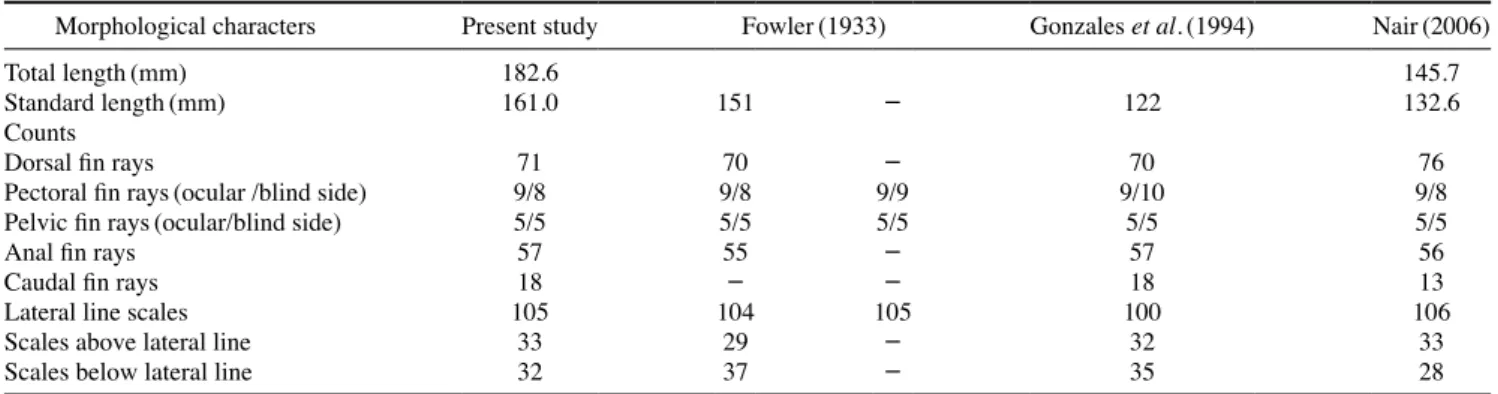
Description. Counts for the present specimen are shown in Table 1.
Measurements are presented as percentage against SL:
Body depth 38.4; body width 8.3; head length 21.7;
prepectoral fin length 19.1; preanal fin length 21.8; pre- ventral fin length 18.6; preanul length 20.1; length of lon- gest dorsal fin ray 6.9; length of longest anal fin ray 7.3;
upper jaw length 5.5; upper eye dimeter 3.7; lower eye di- ameter 2.7; snout length 2.4; postorbital length 12.1.
Body oval, its depth about two-fifths of SL, covered
with ctenoid scales; contours evenly arched dorsal pro- file of head; predorsal length very short, origin of dorsal fin started almost at the tip of the snout; dorsal and anal joined to caudal fin rays; each eye on the ocular side separated by a wide scaly interorbital area with ctenoid scales; upper eye slightly in advance of the lower, larger than lower eye diameter; snout length smaller than eye diameter; anterior nostril elongated, tubular, immediately above upper jaw and posterior nostril covered by a small tubular fleshy papilla in front of the lower eye; fleshy papillae below the lower jaw of the blind side extending up to base of head and onto ocular side margin(Fig. 2);
upper jaw not extending to the end of lower eye; lateral line straight on both sides, but the lateral line rounded on the head; pectoral fin very short, joined to opercular membrane; first and last elements of the pectoral fin on the ocular side elongated to like horns; pectoral fin on the blind side has seven rays covered by a flap of white skin;
five rays on pelvic fin joined by a flap of skin; pelvic fin on blind side slightly smaller than ocular; all fin bases scales and all fin rays joined by flap of skin; posterior of caudal fin rounded.
Coloration of specimen. When fresh, the body uni-
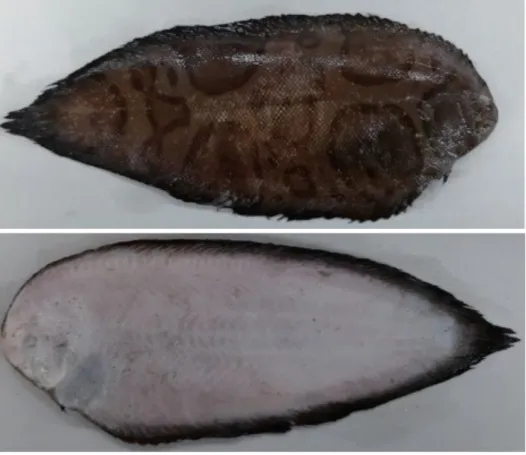
Fig. 1. Brachirus annularis, JNU1503, 161.0mmSL, southern coast of Korea.
formly pale brown on ocular side and white on blind side;
six large patches each outlined by dark brown ring on oc- ular side, two large patches on dorsal and ventral margin of body, and each one large patch on posterior region of body and head; several small blotches scattered among larger patches; dorsal, anal and caudal fins dark black on both sides, pectoral fin dark black on ocular side, but white on blind side. After fixation, body color in preserva- tive uniformly light brown; all fins light brown, but pecto- ral fins white on blind side; body on blind side white.
Distribution. Known from Australia(Keith et al., 1985), India(Nair, 2006), Taiwan(Ho and Shao, 2011), South China Sea(Randall and Lim, 2000), Japan(Gonza- les et al., 1994) and Korea(Jejudo Island, present study).
Remarks. The present specimen was characterized by
having five large, remarkable colored patches on ocular side of body, each outlined by a dark brown ring, united dorsal and anal fins jointed with caudal fin and short pec- toral fin. The morphological characters of the specimen were compared with those of the previous studies(Fowler, 1833; Gonzales et al., 1994; Nair, 2006), which revealed that all morphological characteristics examined clearly fit the previous species descriptions of B. annularis(Table 1).
Thus, we identified our specimen as B. annularis based on the morphological characters.
This species morphologically resembles Zebrias zebri- nus and Z. fasciatus inhabiting the Korean water, but it is easily distinguishable from the latter by having the vari- ous annular patches on ocular side of the body(vs. hori- zontal lines in Zebrias spp.) and brown color on caundal fin(vs. yellow spots)(Nakabo and Doiuchi, 2013). We add this species to the Korean fish fauna and propose its new Korean name, “Eol-luk-seo-dae” because it has dis- tinct, dark brown annular patches on ocular side of the body.
ACKNOWLEDGEMENTS
We would like to thank Seon-Jeong Heo, a TAC investi- gator at the Korea Fisheries Resources Agency for provid- ing the sample. This work was supported by a grant from the National Institute of Fisheries Science(R2019026).
REFERENCES
Fowler, H.W. 1934. Descriptions of new fishes obtained 1907 to 1910, chiefly in the Philippine islands and adjacent seas. Proc.
Acad. Nat. Sci. Philad., 85: 233-367.
Froese, R. and D. Pauly(eds.). 2019. FishBase. World Wide Web elec- tronic publication. www.fishbase.org, version(04/2019).
Morphological characters Present study Fowler(1933) Gonzales et al.(1994) Nair(2006)
Total length(mm) 182.6 145.7
Standard length(mm) 161.0 151 - 122 132.6
Counts
Dorsal fin rays 71 70 - 70 76
Pectoral fin rays(ocular /blind side) 9/8 9/8 9/9 9/10 9/8
Pelvic fin rays(ocular/blind side) 5/5 5/5 5/5 5/5 5/5
Anal fin rays 57 55 - 57 56
Caudal fin rays 18 - - 18 13
Lateral line scales 105 104 105 100 106
Scales above lateral line 33 29 - 32 33
Scales below lateral line 32 37 - 35 28
Fig. 2. Shape of head and mouth of Brachirus annularis.
Gonzales, B.J., O. Okamura, K. Nakamura and H. Miyahara. 1994.
New record of the Annular Sole, Synaptura annularis(Solei- dae, Pleuronectiformes) from Japan. Japan. J. Ichthyol., 40:
491-494.
Hubbs, C.L. and K.F. Lagler. 1964. Fishes of the Great Lakes Re- gion. Bull. Granbrook Inst. Sci., 26: 19-27.
Ho, H.C. and K.T. Shao 2011. Annotated checklist and type catalog of fish genera and species described from Taiwan. Zootaxa, 2957: 1-74.
Keith, S.J., P.J. Kailola and G.G. Leyland. 1985. Continental shelf fishes of northern and north-western Australia. CSIRO Div.
Fisher. Res., Canberra, 375pp.
Lapierre, K.L. 2007. Taxonomic revision of the genera Achiroides, Brachirus, Dexillus, and Paradicula(Pleuronectiformes:
Soleidae), MSc Thesis, Ottawa Carleton Institute of Biolo- gy, 197pp.
MABIK(National Marine Biodiversity Institute of Korea). 2017.
National list of marine species. National Marine Biodiversi- ty Institute of Korea, Seocheon, 1071pp.(in Korean) Munroe, T.A. 2001. Soleidae. Soles. In: Carpenter, K.E. and V.H.
Niem(eds.), Species identification guide for fishery pur- poses. The living marine resources of the Western Central
Pacific, vol. 6. Bony fishes, part 4.(Labridae to Latimerii- dae), estuarine crocodiles, sea turtles, sea snakes and marine mammals. FAO, Rome, pp. 3878-3889.
Nakabo, T. and R. Doiuchi. 2013. Soleidae. In: Nakabo, T.(ed.), Fishes of Japan with pictorial keys to the species, 3rd edition.
Tokai Univ. Press, Tokyo, pp. 1687-1692.(in Japanese).
Nair, R.J. 994. First record of the Annular Sole, Synaptura annularis (Soleidae, Pleuronectiformes) from India. J. Mar. Biol. Ass.
India, 48: 118-120.
Nakabo, T. 2002. Soleidae. In: Nakabo, T.(ed.), Fishes of Japan with pictorial keys to the species, English edition. Tokai Univ.
Press, Tokyo, pp. 1383-1387.
Nelson, J.S., T.C. Grande and M.V.H. Wilson. 2016. Fishes of the world, 5th ed. John Wiley & Sons Inc, Hoboken, New Jer- sey, 705pp.
Randall, J.E. and K.K.P. Lim. 2000. A checklist of the fishes of the South China Sea. Raffles Bull. Zool. Suppl., 8: 569-667.
Swainson, W. 1839. The natural history and classification of fishes, amphibians, and reptiles, or monocardian animals, vol 1.
Longman, Orne, Brown, Gree, Longmans and John Taylor (eds.), London.
한국산 납서대과 어류 1미기록종, Brachirus annularis
김맹진
·
고수진·
윤병선1·
김성태2·
송춘복3국립수산과학원 서해수산연구소, 1국립수산과학원 남해수산연구소, 2국립수산과학원 수산자원연구센터
3제주대학교 해양과학대학
요 약 : 납서대과에 속하는 Brachirus annularis 1개체(표준 체장 161.0mm)가 제주도와 거문도 사이의 해역에 서 2019년 3월에 처음으로 채집되었다. 이 종은 유안측에 불규칙한 형태의 반점과 얼룩무늬를 가지고 있으며, 꼬
리지느러미는 등지느러미와 뒷지느러미와 연결되었고, 머리와 눈 그리고 가슴지느러미가 작은 형태를 띠는 특징을
갖는다. 따라서 유안측에 불규칙한 형태의 반점과 얼룩무늬를 가지는 특징에 기초하여 이 종의 속명과 국명은 각
각 “얼룩서대속”과 “얼룩서대”라고 명명하였다.
찾아보기 낱말 : 납서대과, 얼룩서대, 미기록종, 제주도, 한국