—50—
INTRODUCTION
Four fish specimens belong to the genus Eleotris Bloch and Schneider, 1801 were collected at the lower part of a small stream located in the southern part of Jeju Island, Korea in 2013, identified as E. oxycephala Temminck and Schlegel, 1845 tentatively, and deposited in the fish collection of the National Institute of Biological Re- sources (NIBR), Korea. The senior author subsequently re-examined these specimens in detail and revealed that they were not E. oxycephala but E. acanthopoma Bleek- er, 1853 based on the difference in the arrangement pat- tern of the cephalic sensory papillae (==free neuromast organ). Although it has been known from brackish estu- aries and lower reaches of freshwater streams of the Western Pacific widely (Maeda et al., 2011), E. acantho- poma was not reported from the Korean waters up to date. More recently the only Eleotris species known to be in the Korean waters, E. oxycephala Temminck and Schlegel, was redescribed on the basis of a single speci- men collected from the lower reach of Jwagwang stream near Busan, Korea (Kim et al., 2014).
We describe, therefore, E. acanthopoma as the first record as well as the second species of the genus Eleotris from Korea. Counts and measurements are those of Hubbs and Lagler (1964) with some exceptions. Both scale counts and the relation between the pterygiophores of the dorsal fins and vertebrae (P-V), and notations of cephalic sensory canals and papillae follow those of Akihito (1984) and Akihito (1967), respectively. Vertical fins, P-V, and vertebrae were examined by radiographs.
Superscriptions in the description mean the number of specimens used in counts and measurements.
Eleotris acanthopoma Bleeker, 1853 (New Korean name: Geom-eun-gu-gul-mu-chi)
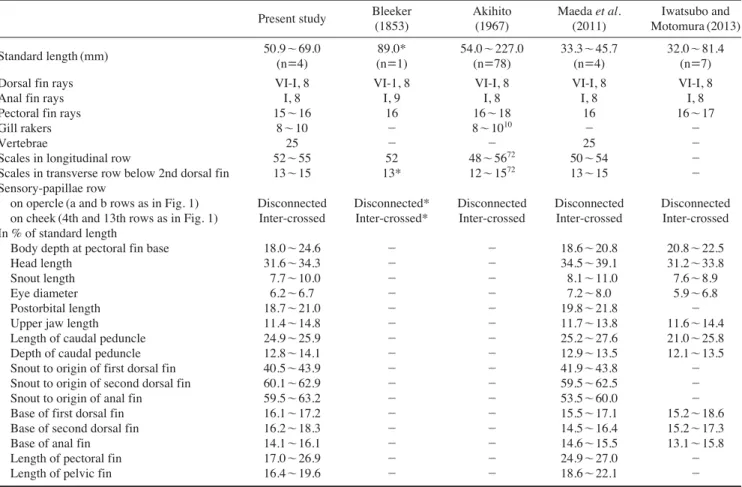
(Figs. 1~2; Table 1).
Eleotris acanthopoma Bleeker, 1853: 275 (type locality:
Western Sumatra, Indonesia); Akihito, 1967: 152 (Japan); Maeda et al., 2011: 257 (French Polynesia);
Iwatsubo and Motomura, 2013: 55 (Kagoshima Pre- fecture, Japan).
Materials examined. Four specimens: NIBR-P28901, 69.0 mm in standard length (SL), NIBR-P28902, 55.8 mm SL, NIBR-P28903, 53.2 mm SL, NIBR-P28904, 50.9 mm SL, Taehueng-ri, Namwon-eup, Seogwipo-si,
New Record of the Spinecheek Gudgeon, Eleotris acanthopoma (Perciformes: Eleotridae) from Jeju Island, Korea
By Byung-Jik Kim*, Seon-Man Kweon
1, Hyun-Geun Cho
1, Seung-Ho Choi
2and Dong-Won Kang
3Biological and Genetic Utilization Division, National Institute of Biological Resources, Incheon 404-708, Korea
1Animal Resources Division, National Institute of Biological Resources, Incheon 404-708, Korea
2Korean Association for Conservation of Freshwater Fish, Seoul 135-922, Korea
3Department of Biology, Cheonnam National University, Jeonnam 550-749, Korea
ABSTRACT Based on four specimens (50.9~~69.0 mm SL) collected from a small stream of southern coast of Jeju Island, Eleotris acanthopoma was described as the second Eleotris species as well as the first record from Korea. They were characterized by having two dorsal fins, well-separated pelvic fins, separation of two rows of sensory papillae on opercle and extending the fourth row of sensory papillae beyond the 13th longitudinal sensory-papillae row on cheek. We proposed a new Korean name, “Geom-eun-gu-gul-mu-chi”, for the species.
Key words : Eleotris acanthopoma, new Korean record, description, Jeju Island
*Corresponding author: Byung-Jik Kim Tel: 82-32-590-7127 Fax: 82-32-590-7223, E-mail: [email protected]
Accepted: March 26, 2015
http://www.fishkorea.or.kr
Jeju-do, Korea, 29 October 2013, collected by Seung- Ho Cho and Dong-Won Kang.
Diagnosis. An eleotrid species with having separation of two rows of sensory papillae on opercle and extend- ing the fourth row of sensory papillae beyond the longi- tudinal sensory-papillae row 13 (sensu Akihito, 1967)
Description. Dorsal fin rays VI-I, 8; anal fin rays I, 8;
pectoral fin rays 15~16 (mainly 16), upper- and lower- most rays unbranched; pelvic fin rays, I, 5; principal caudal fin rays 15; gill rakers 8~10, only prominent counted; vertebrae 252; P-V 3/I II II I/82; scales in lon- gitudinal row 52~55; scales in transverse row 13~15.
Proportion of percentage in SL: body depth at origin of pectoral fin 18.0~24.6 (mean 20.8); body width 17.7~
19.4 (18.3); head length 31.6~34.3 (33.0); head width 19.4~20.9 (20.2); eye diameter 6.2~6.7 (6.4); interor- bital width 8.8~10.3 (9.6); snout length 7.7~10.0 (8.4);
upper jaw length 11.4~14.8 (12.6); postorbital length 18.7~21.0 (20.1); snout to origin of first dorsal fin 40.5
~43.9 (42.2); snout to origin of second dorsal fin 60.1~
62.9 (61.2); snout to origin of pectoral fin 31.8~35.1 (33.4); snout to origin of pelvic fin 31.0~34.3 (32.4);
snout to origin of anal fin 59.5~63.2 (61.3); base of first dorsal fin 16.1~17.2 (16.5); base of second dorsal fin 16.2~18.3 (17.0); base of anal fin 14.1~16.1 (15.1);
length of pectoral fin 17.0~26.9 (23.9); length of pelvic fin 16.4~19.6 (18.0); length of caudal fin 24.6~16.7 (25.7)3; depth of caudal peduncle 12.8~14.1 (13.4);
length of caudal peduncle 24.9~25.9 (25.4).
Fig. 1.Two species of Eleotris collected from Korea. A, Eleotris acanthopoma, NIBR-P28901, 69.0 mm SL, male, Jeju Island, Korea; B, Eleotris oxycephala, NIBR-P23462, 62.1 mm SL, female, near Busan, Korea.
Fig. 2.Sensory papillae on lateral head region in Eleotris acanthopo- ma (above, NIBR-P28901) and E. oxycephala (below, NIBR-P23462).
Numerals as Akihito (1967) and arrows show the character state (not connected) of the opercular sensory-papillae rows between row ‘a’
and row ‘b’. Bar==5 mm.
A
B
Body elongate, cylindrical anteriorly and slightly com- pressed posteriorly with rather deep caudal peduncle.
Head moderate and somewhat depressed. Mouth oblique, lower jaw slightly longer than upper jaw, its posterior tip reaching a vertical at center of pupil; small conical teeth on upper and lower jaws, in three to four and five to six irregular rows, respectively; vomer and palatines without teeth; anterior nostril tubular and posterior nos- tril simple pore. Eye rather large and interorbital space somewhat convex. Upper end of gill opening situated over origin of pectoral fin and gill membranes fused to isthmus. Dorsal fin two and separated each other; second dorsal fin slightly higher than first dorsal fin and of near- ly equal height as anal fin. Fin rays of first dorsal fin not elongated and third to fourth spines longest; all soft rays of second dorsal fin branched. Pectoral fin rather large, all rays branched, its posterior margin aligned vertically.
Pelvic fin fully separated. Caudal fin round.
Lateral side of body with ctenoid. Predorsal region, most part of cheek, opercles, most of abdominal region, and bases of pectoral and caudal fins with cycloid. Dor- sal and ventral sides of head including snout region, and gill membrane naked. Cephalic sensory canal absent.
Upper and lower papillae rows on opercle not connected each other at posterior margin of opercle; fourth trans- verse row of sensory papillae extending beyond longitu- dinal sensory-papillae row 13 (sensu Akihito, 1967).
Color after preservation. Head and body uniformly dark. Dorsal tips of anterior three to four spines and their membranes of first dorsal fin without any dark spots.
Dorsal and anal fins darkish with densely scattered mi- nute black dots, become paler distally. In smaller speci- mens, two rather broad horizontal bars on first dorsal and three to five blackish dotted lines on second dorsal and anal fins.
Distribution. Known from the Western Pacific widely:
Japan, Taiwan, Hong Kong, Ogasawara Islands, Mari- ana Islands, Cebu, western Sumatra, Lombok, northeast- ern Australia, Solomon Island, New Caledonia, Moorea (Maeda et al., 2011), and Korea (Jeju Island, present study).
Ecological notes. E. acanthopoma was found near stones in the shallow-water area (ca. 0.3~0.5 m in water depth at ebb tide) of the lower reach of a small stream, southern coast of Jeju Island, Korea, with Tridentiger obscurus which occurs dominantly.
Table 1.Comparison of major meristic and morphometric characters of Eleotris acanthopomaβ
Present study Bleeker Akihito Maeda et al. Iwatsubo and
(1853) (1967) (2011) Motomura (2013)
Standard length (mm) 50.9~69.0 89.0* 54.0~227.0 33.3~45.7 32.0~81.4
(n==4) (n==1) (n==78) (n==4) (n==7)
Dorsal fin rays VI-I, 8 VI-1, 8 VI-I, 8 VI-I, 8 VI-I, 8
Anal fin rays I, 8 I, 9 I, 8 I, 8 I, 8
Pectoral fin rays 15~16 16 16~18 16 16~17
Gill rakers 8~10 - 8~1010 - -
Vertebrae 25 - - 25 -
Scales in longitudinal row 52~55 52 48~5672 50~54 -
Scales in transverse row below 2nd dorsal fin 13~15 13* 12~1572 13~15 -
Sensory-papillae row
on opercle (a and b rows as in Fig. 1) Disconnected Disconnected* Disconnected Disconnected Disconnected on cheek (4th and 13th rows as in Fig. 1) Inter-crossed Inter-crossed* Inter-crossed Inter-crossed Inter-crossed In % of standard length
Body depth at pectoral fin base 18.0~24.6 - - 18.6~20.8 20.8~22.5
Head length 31.6~34.3 - - 34.5~39.1 31.2~33.8
Snout length 7.7~10.0 - - 8.1~11.0 7.6~8.9
Eye diameter 6.2~6.7 - - 7.2~8.0 5.9~6.8
Postorbital length 18.7~21.0 - - 19.8~21.8 -
Upper jaw length 11.4~14.8 - - 11.7~13.8 11.6~14.4
Length of caudal peduncle 24.9~25.9 - - 25.2~27.6 21.0~25.8
Depth of caudal peduncle 12.8~14.1 - - 12.9~13.5 12.1~13.5
Snout to origin of first dorsal fin 40.5~43.9 - - 41.9~43.8 -
Snout to origin of second dorsal fin 60.1~62.9 - - 59.5~62.5 -
Snout to origin of anal fin 59.5~63.2 - - 53.5~60.0 -
Base of first dorsal fin 16.1~17.2 - - 15.5~17.1 15.2~18.6
Base of second dorsal fin 16.2~18.3 - - 14.5~16.4 15.2~17.3
Base of anal fin 14.1~16.1 - - 14.6~15.5 13.1~15.8
Length of pectoral fin 17.0~26.9 - - 24.9~27.0 -
Length of pelvic fin 16.4~19.6 - - 18.6~22.1 -
*from Akihito (1967). Superscription means the number of specimens examined.
Remarks. The specimens collected from the southern stream of Jeju Island, Korea in this study were easily identified as a member of the genus Eleotris Schneider in having well-separated two dorsal fins and pelvic fins without formation of sucking disc (Akihito, 1967; Miller, 1998). Out of four species occurring from the northern West Pacific, these specimens showed well accordance with E. acanthopoma Bleeker, 1853 as following cha- racteristics: two rows of sensory papillae are separated each other at the posterior margin of opercle, the fourth row of sensory papillae on cheek extending beyond the 13th longitudinal sensory-papillae row (sensu Akihito, 1967) as shown in Fig. 2. Additionally, they were also have no lateral line, having six spines of the first dorsal fin, no serration on interorbital region, having a blunt preopercular spine embedded beneath skin, no free pec- toral rays, no whitish spots on ventral side of head when alive, as mentioned by Maeda et al. (2011). Both the Korean and Japanese specimens of E. acanthopoma have a smaller head and eyes than those from French Polyne- sia, however, they were shown well-accordance between them in other characters (Table 1). Although further examination is needed, the size difference seems to be come from geographical variation of the species.
Eleotris acanthopoma is similar to E. oxycephala in having separation of two rows of sensory papillae on opercle, however the former is easily differentiated from the latter by having the fourth row of sensory papillae extending beyond the 13th longitudinal sensory-papillae row (sensu Akhioto, 1967) (vs. not extending the 11th longitudinal row for E. oxycephala) as shown in Fig. 2.
We proposed a new Korean name, “Geom-eun-gu-gul- mu-chi” for E. acanthopoma referring to its blackish body color.
Comparative materials. Eleotris oxycephala: NIBR- P23462, 62.1 mm SL, Jwagwang stream, Jwacheon-ri, Jangan-eup, Gijang-gun, Busan-si, Korea, January 2006, collected by M.H. Jang and J.D. Yoon
ACKNOWLEDGMENTS
We thank to Ms. Ye-Seul Lee (NIBR) for her kind assistance to taking radiographs and specimen process- ing. This work was supported by a grant from the Nation- al Institute of Biological Resources, funded by the Min- istry of Environment of the Republic of Korea (NIBR No. 201401101).
REFERENCES
Akihito, Prince. 1967. On four species of the gobiid fishes of the genus Eleotris found in Japan. Japanese Jour- nal of Ichthyology, 14: 135-166. (in Japanese) Akihito, Prince, 1984. Suborder Gobioidei. In: Masuda, H.,
K. Amakoka, C. Araga, T. Uyeno and T. Yhoshino (eds.), The fishes of the Japanese Archipelago. Tokai University Press, Tokyo, pp. 236-289.
Bleeker, P. 1853. Diagnostische beschrijvingen van nieuwe of weinig bekende vischsoorten van Sumatra. Tiental V-X. Natuurkundig Tijdschrift voor Nederlandsch Indië, 4: 243-302.
Bloch, M.E. and J.G. Schneider. 1801. M. E. Blochii, Sys- tema Ichthyologiae Iconibus cx Ilustratum. Post obi- tum auctoris opus inchoatum absolvit, correxit, inter- polavit Jo. Gottlob Schneider, Saxo. Berolini. Sumti- bus Auctoris Impressum et Bibliopolio Sanderiano Commissum. lx+584pp, 110pls.
Dybowski, B.N. 1877. Fishes of the Amur water system.
Izvestiya Zapadno-Sibirskogo otdiela Imperatorska- go russkago geograpficheskago obshchestva, v. 8: 1- 29.
Hubbs, C.L. and K.F. Lagler. 1964. Fishes of the Great Lakes region. University of Michigan Press, Ann Arbor, xv+213pp.
Iwatsubo, H. and H. Motomura. 2013. First record of Eleotris acanthopoma (Perciformes: Eleotridae) from Yoron- jima Island, Kagoshima Prefecture, southern Japan.
Nature of Kagoshima, 39: 55-57. (in Japanese) Kim, B.J., M.H. Jang, J.D. Yoon and H.B. Song. 2014. First
reliable record of an eleotrid fish, Eleotris oxycepha- la (Perciformes: Eleotridae) from the lower reach of Jwagwang Stream near Busan, Korea. Korean Jour- nal of Ichthyology, 26: 230-234.
Maeda, K., T. Mukai and K. Tachibara. 2011. Newly col- lected specimens of the sleeper Eleotris acanthopo- ma (Teleostei: Eleotridae) from French Polynesia indicate a wide and panmitic distribution in the West and South Pacific. Pacific Science, 65: 257-264.
Miller, P.J. 1998. The West African species of Eleotris and their systematic affinities (Teleostei: Gobioidei). Jour- nal of Natural History, 32: 273-296.
Temminck, C.J. and H. Schlegel. 1845. Pisces. In: Fauna Japonica, sive descriptio animalium quae in itinere per Japoniam suscepto annis 1823-30 collegit, notis observationibus et adumbrationibus illustravit P. F.
de Siebold. Parts 7-9: 113-172, 143pls.
제주도 남부 연안역에서 채집된 농어목 구굴무치과 한국미기록종, Eleotris acanthopoma
김병직∙권선만1∙조현근1∙최승호2∙강동원3
국립생물자원관 유용자원활용과, 1국립생물자원관 동물자원과, 2(사)한국민물고기보존협회,
3전남대학교 생물과학∙생물기술학과
요 약 :2013년 제주도 남부 연안으로 유입되는 소하천에서 구굴무치과(Eleotridae) 구굴무치속(Eleotris)에 속 하는 어류 4개체 (표준체장 50.9~69.0 mm)를 채집하였다. 이들은 등지느러미가 2개이며 배지느러미가 서로 유 합하지 않고 분리되어 있는 점, 새개부 상하 공기열이 새개부 후단에서 서로 만나지 않는 점, 협부 4번째 공기열 이 13번째 공기열을 지나 하방으로 신장하는 점 등에서 E. acanthopoma로 동정되었다. 본 종은 이러한 특징에 서 북부 서태평양 해역에 분포하는 구굴무치를 포함한 같은 속의 유사종과 쉽게 구별되며, 신한국명으로는 체 색이 대체로 흑색인 점에서 ‘검은구굴무치’를 제안한다.
찾아보기 낱말 :검은구굴무치, 구굴무치과, 한국미기록종, 기재, 제주도