Since Kim and Youn (1994) carried out the tax- onomic revision of the suborder Pleuronectoidei from Korea firstly, Kim et al. (2005) have reco- gnized six families and 52 species in the order Pleuronectiformes from Korea.
Concerning fishes of the East China Sea and the Yellow Sea, Yamada et al. (1995) provided their Korean, Japanese, and Chinese names, brief descriptions, and distribution of six pleuro- nectiform fishes [i.e., Samariscus japonicus Kamohara, 1936, Plagiopsetta glossa Franz, 1910, Aseraggodes kaianus (Günther, 1880), Pseudorhombus arsius (Hamilton, 1822), Arno- glossus yamanakai Fukui, Yamada and Ozawa, 1988, and Psettina iijimae (Jordan and Starks, 1904)]. However, they just only focused on unifi- cation of the fish names of three countries and did not describe about the samples in detail.
During a survey of the fisheries resources in Korean waters, three species of the order Pleu- ronectiformes, as mentioned by Yamada et al.
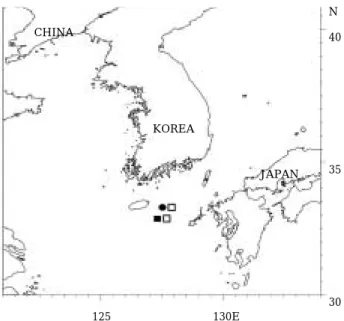
(1995), were collected around Jeju Island, sou- thern sea of Korea recently (Fig. 1). Therefore, in this study, we redescribe the three pleuronecti-
form fishes on the basis of the Korean specimens in detail and compare them with those of pre- vious studies for the first time.
Counts and measurements were followed those of Hubbs and Lagler (1964) and Nakabo (2002a).
Number of vertebrae and median fin rays were counted from radiographs. The examined speci- mens were deposited in the National Fisheries Research and Development Institute (NFRDI) of Korea.
Family Samaridae
(New Korean name: Sin-wol-ga-ja-mi-gwa) Fishes of the family Samaridae live in, pri- marily deep water, tropical and subtropical seas of the Indo-Pacific Ocean. The origin of dorsal fin in front of eyes, lateral line well-developed or rudimentary, pelvic fins symmetrical, postclei- thra absent and 16 caudal fin rays. It comprises three genera, Plagiopsetta Franz, 1910, Samaris Gray, 1831, and Samariscus Gilbert, 1905 with about 20 species in the World (Sasaki and Uyeda, 2002; Nelson, 2006).
Redescriptions of the Three Pleuronectiform Fishes (Samaridae and Soleidae) from Korea
Jeong-Ho Park, Jin Koo Kim*, Jung Hwa Choi and Dae Soo Chang Fisheries Resources Research Team, National Fisheries Research and Development Institute, 408-1 Sirang-ri, Gijang-gun, Busan 619-902, Korea
Three pleuronectiform fishes are redescribed based on specimens from southern sea of Korea. A single specimen (73.4 mm SL) of Samariscus japonicus of the family Samaridae is characterized by having no pectoral fin on blind side and 5 pectoral fin rays on ocular side of body. Twenty specimens (53.6~125.8 mm SL) of Plagiopsetta glossa of the same family are characterized by having 8~10 pectoral fin rays and 6 black ring-shaped blotches on ocular side of body. Three specimens (74.1~83.4 mm SL) of Aseraggodes kaianus of the family Soleidae are characterized by having blackish-brown reticulations on ocular side of body.
Key words : Redescription, Pleuronectiformes, Samariscus japonicus, Plagiopsetta glossa, Aseraggodes kaianus
*Corresponding author: [email protected]
─
─ 73 ──
Genus Samariscus Gilbert, 1905
(New Korean name: Sin-wol-ga-ja-mi-sok) Samariscus Gilbert, 1905: 682, pl. 96 (Type spec-
ies: Samariscus corallinus Gilbert, 1905).
Samariscus japonicus Kamohara, 1936 (Korean name: Sin-wol-ga-ja-mi)
(Figs. 2A, Table 1)
Samariscus japonicus Kamohara, 1936: 1006, fig. 1 (type locality: Kochi, Japan); Sakamoto in Masuda et al., 1984: 354, pl. 318-G (Japan);
Matsuura in Okamura et al., 1985: 623, fig.
395 (Okinawa Trough, Japan); Yamada et al., 1995: 209, pl. 293 (East China Sea); Sakamoto in Okamura and Amaoka, 1997: 678, fig. 7 (Tosa Bay, Japan); Shinohara et al., 2001: 336 (listed, Tosa Bay, Japan); Nakabo, 2002b: 1382 (Key, description, Japan).
Fig. 1. Map showing the sampling area of three pleuro- nectiform fishes, Samariscus japonicus (●), Pla- giopsetta glossa (□), and Aseraggodes kaianus (■), from southern sea of Korea.
Fig. 2. Ocular (left) and blind (right) sides of three pleuronectiform fishes from the southern sea of Korea. A, Samariscus japonicus Kamohara, NFRDI 20070104-20, 73.4 mm SL; B, Plagiopsetta glossa Franz, NFRDI 20070104-23, 117.2 mm SL; C, Aseraggodes kaianus (Günther), NFRDI 20070104-35, 83.4 mm SL.
A
B
C
CHINA
KOREA
JAPAN
125 130E
N 40
35
30
Material examined. NFRDI 20070104-20, 1 specimen, 73.4 mm in standard length (SL), 127�
42′E, 33�22′N, southern sea of Korea (around Jeju Island), 118 m depth, 26 October, 2006, bot- tom trawl, collected by J. H. Park.
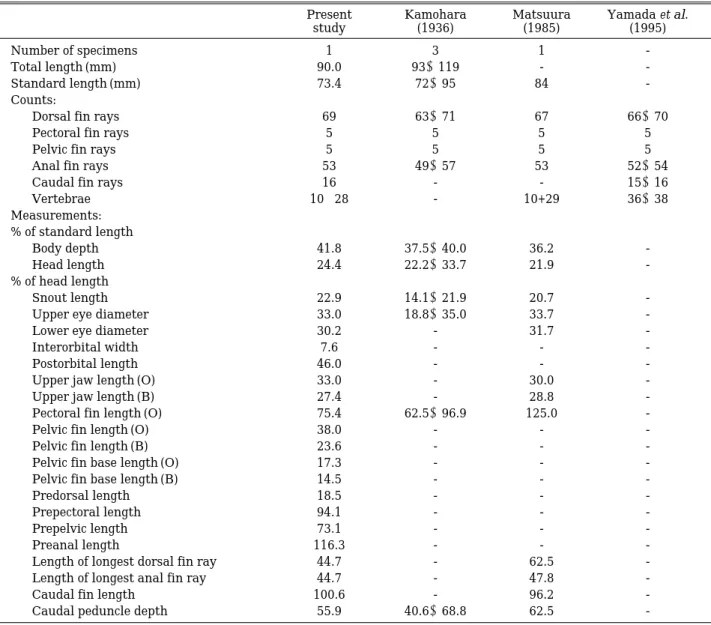
Description. Counts and measurements are given in Table 1.
Body elliptical; eyes on right side of body, se- parated by a narrow ridge; upper eye bigger than lower eye; mouth extend to anterior edge of lower eye; rays of dorsal and anal fins longer posteri- orly; dorsal fin begin at anterior to the eye; pelvic fin on ocular side longer than that on blind side;
pectoral fin rays unbranched, elongate on ocular side; no pectoral fin on blind side; anal fin con- nected with pelvic fin on ocular side by a mem-
brane; caudal fin rounded and its middle rays branched; anus located between pelvic fin and anal fin; lateral line straight, rising slightly over pectoral fin; teeth on both jaws villiform; scales small, cycloid, covered on both sides.
Color when fresh. Body brown or dark brown on ocular side; three pairs of dark brown circular or half circular blotches dorsally and ventrally;
pectoral fin black; dorsal and anal fins white with a lot of spots; two black blotches on end of dorsal and anal fins; body uniformly white on blind side; dorsal and anal fins have many dark brown spots.
Color after preservation. Body light brown on ocular side; white on blind side; small dark spots on dorsal and anal fins.
Table 1. Comparison of counts and measurements of Samariscus japonicus (O, ocular side; B, blind side)
Present Kamohara Matsuura Yamada et al.
study (1936) (1985) (1995)
Number of specimens 1 3 1 -
Total length (mm) 90.0 93~119 - -
Standard length (mm) 73.4 72~95 84 -
Counts:
Dorsal fin rays 69 63~71 67 66~70
Pectoral fin rays 5 5 5 5
Pelvic fin rays 5 5 5 5
Anal fin rays 53 49~57 53 52~54
Caudal fin rays 16 - - 15~16
Vertebrae 10++28 - 10+29 36~38
Measurements:
% of standard length
Body depth 41.8 37.5~40.0 36.2 -
Head length 24.4 22.2~33.7 21.9 -
% of head length
Snout length 22.9 14.1~21.9 20.7 -
Upper eye diameter 33.0 18.8~35.0 33.7 -
Lower eye diameter 30.2 - 31.7 -
Interorbital width 7.6 - - -
Postorbital length 46.0 - - -
Upper jaw length (O) 33.0 - 30.0 -
Upper jaw length (B) 27.4 - 28.8 -
Pectoral fin length (O) 75.4 62.5~96.9 125.0 -
Pelvic fin length (O) 38.0 - - -
Pelvic fin length (B) 23.6 - - -
Pelvic fin base length (O) 17.3 - - -
Pelvic fin base length (B) 14.5 - - -
Predorsal length 18.5 - - -
Prepectoral length 94.1 - - -
Prepelvic length 73.1 - - -
Preanal length 116.3 - - -
Length of longest dorsal fin ray 44.7 - 62.5 -
Length of longest anal fin ray 44.7 - 47.8 -
Caudal fin length 100.6 - 96.2 -
Caudal peduncle depth 55.9 40.6~68.8 62.5 -
Distribution. Northwest Pacific: Korea (around Jeju Island, present study), Japan (Nakabo, 2002b), and China (Yamada et al., 1995).
Remarks. The counts and measurements of the present specimen are agree well with those of original description of Samariscus japonicus (Table 1). The species is characterized by having no pectoral fin on blind side and five pectoral fin rays on ocular side of body. Three species, S. ja- ponicus, S. xenicus Ochiai and Amaoka, 1962, and S. latus Matsubara and Takamuki, 1951, were described from Japan (Nakabo, 2002). S.
japonicus differs from S. xenicus in having the slender body and five rays (vs. four for the latter) in pectoral fin. S. japonicus is also different from S. latus in having pectoral fin length shorter than head length and pectoral fin uniformly black (Matsuura, 1985; Nakabo, 2002b).
We follow “Sin-wol-ga-ja-mi” provided by Ya- mada et al. (1995) for a Korean name of S. japo-
nicus.
Genus Plagiopsetta Franz, 1910
(New Korean name: Jung-seol-ga-ja-mi-sok) Plagiopsetta Franz, 1910: 64, pl. 5, fig. 58 (Type
species: Plagiopsetta glossa Franz, 1910).
Plagiopsetta glossa Franz, 1910 (Korean name: Jung-seol-ga-ja-mi)
(Figs. 2B, Table 2)
Plagiopsetta glossa Franz, 1910: 64, pl. 5, fig. 58 (type locality: Yakushima, Japan, depth 150 m); Sakamoto in Masuda et al., 1984: 353, pl.
318-F (Japan); Shen et al., 1993: 575, pl. 194-5 (Taiwan); Cooper et al., 1994: 215, fig. 1 (New South Wales, Australia); Masuda and Koba- yashi, 1994: 406, fig. 2 (Izu Peninsula, Japan);
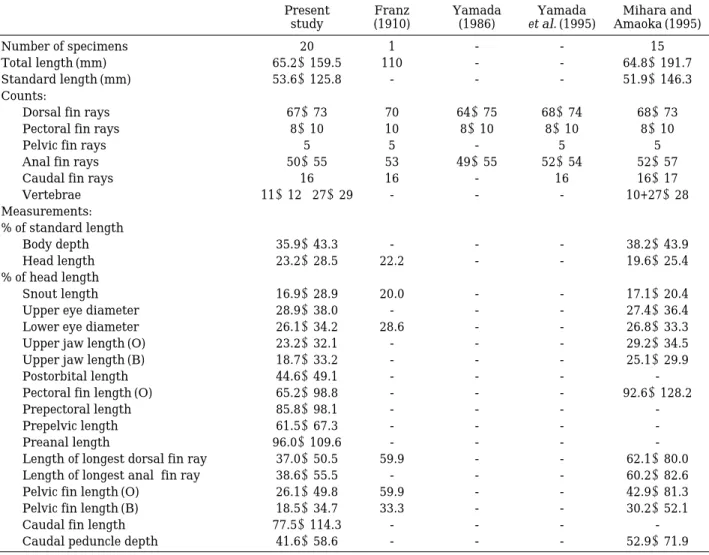
Table 2. Comparison of counts and measurements of Plagiopsetta glossa (O, ocular side; B, blind side)
Present Franz Yamada Yamada Mihara and study (1910) (1986) et al. (1995) Amaoka (1995)
Number of specimens 20 1 - - 15
Total length (mm) 65.2~159.5 110 - - 64.8~191.7
Standard length (mm) 53.6~125.8 - - - 51.9~146.3
Counts:
Dorsal fin rays 67~73 70 64~75 68~74 68~73
Pectoral fin rays 8~10 10 8~10 8~10 8~10
Pelvic fin rays 5 5 - 5 5
Anal fin rays 50~55 53 49~55 52~54 52~57
Caudal fin rays 16 16 - 16 16~17
Vertebrae 11~12++27~29 - - - 10+27~28
Measurements:
% of standard length
Body depth 35.9~43.3 - - - 38.2~43.9
Head length 23.2~28.5 22.2 - - 19.6~25.4
% of head length
Snout length 16.9~28.9 20.0 - - 17.1~20.4
Upper eye diameter 28.9~38.0 - - - 27.4~36.4
Lower eye diameter 26.1~34.2 28.6 - - 26.8~33.3
Upper jaw length (O) 23.2~32.1 - - - 29.2~34.5
Upper jaw length (B) 18.7~33.2 - - - 25.1~29.9
Postorbital length 44.6~49.1 - - - -
Pectoral fin length (O) 65.2~98.8 - - - 92.6~128.2
Prepectoral length 85.8~98.1 - - - -
Prepelvic length 61.5~67.3 - - - -
Preanal length 96.0~109.6 - - - -
Length of longest dorsal fin ray 37.0~50.5 59.9 - - 62.1~80.0
Length of longest anal fin ray 38.6~55.5 - - - 60.2~82.6
Pelvic fin length (O) 26.1~49.8 59.9 - - 42.9~81.3
Pelvic fin length (B) 18.5~34.7 33.3 - - 30.2~52.1
Caudal fin length 77.5~114.3 - - - -
Caudal peduncle depth 41.6~58.6 - - - 52.9~71.9
Mihara and Amaoka, 1995: 208, fig. 1 (Kochi, Japan); Yamada et al., 1995: 208, pl. 292 (East China Sea); Wu et al., 1999: 719 (listed, China);
Randall and Lim, 2000: 645 (listed, South China Sea); Shinohara et al., 2001: 335 (listed, Tosa Bay, Japan); Nakabo, 2002b: 1381 (Key, description, Japan); Sasaki and Uyeda, 2002:
389, fig. 1 (Tosa Bay, southern Japan); Shino- hara et al., 2005: 443 (listed, Ryukyu Islands, Japan).
Material examined. NFRDI 20070104-01~
10, 10 specimens, 59.4~115.8 mm SL, 127�42′E, 33�22′N, southern sea of Korea (around Jeju Island), 117 m depth, 26 October, 2006, bottom trawl; NFRDI 20070104-23~32, 10 specimens, 53.6~125.8 mm SL, 127�10′E, 32�47′N, southern sea of Korea (around Jeju Island), 118 m depth, 27 October, 2006, bottom trawl, collected by J.H.
Park.
Description. Counts and measurements are given in Table 2.
Body elliptical; eyes on right of body; upper eye bigger than lower eye; no pectoral fin on blind side; pectoral fin slightly shorter than head; dor- sal fin begin at anterior margin of upper eye;
pelvic fin on ocular side longer than that on blind side; middle rays of caudal fin branched; scales ctenoid on both side; lateral line straight; caudal fin rounded.
Color when fresh. Body on ocular side almost black; dorsal, anal, and pelvic fins dark brown with black blotches; pectoral fin more dark; six ring-shaped blotches on ocular side of body; pos- terior margin of caudal fin darker; dark brown on blind side of body.
Color after preservation. Ocular side gray- ish and six ring-shaped blotches pale; blind side light brown.
Distribution. Western Pacific: Korea (around Jeju Island, present study), southern Japan (Nakabo, 2002b), Taiwan (Shen et al., 1993), China (Wu et al., 1999), and New South Wales of Australia (Cooper et al., 1994).
Remarks. The counts and measurements of the present specimens are similar to those of pre- vious studies, but there are some remarkable dif- ferences in the length of each longest ray of dor- sal and anal fins (Table 2). Although these differ- ences may be due to geographic variation, fur- ther studies on morphological and molecular dif- ferences are necessary.
Plagiopsetta glossa is characterized by having
8~10 pectoral fin rays and six black ring-shaped blotches on ocular side of body. P. glossa has been believed to be endemic to Japan previously, however recent studies have shown that the species is distributed widely from Japan to Australia (Sasaki and Uyeda, 2002).
We follow “Jung-seol-ga-ja-mi” provided by Yamada et al. (1995) for a Korean name of P.
glossa.
Aseraggodes kaianus (Günther, 1880) (Korean name: Geu-mul-dong-seo-dae)
(Figs. 2C, Table 3)
Solea kaiana Günther, 1880: 49, pl. 21, fig. C (type locality: Ki Islands, Indonesia).
Aseraggodes kaianus: Ochiai in Masuda et al., 1984: 354, pl. 319-F (Japan); Shen et al., 1993:
582, pl. 197-6 (Taiwan); Yamada et al., 1995:
210, pl. 296 (East China Sea); Sakamoto in Okamura and Amaoka, 1997: 682, fig. 2 (Tosa Bay, Japan); Wu et al., 1999: 80 (listed, China);
Randall and Lim, 2000: 645 (listed, South China Sea); Shinohara et al., 2001: 335 (listed, Tosa Bay, Japan); Nakabo, 2002b: 1385 (key, description, Japan).
Material examined. NFRDI 20070104-35~
37, 3 specimens, 74.1~83.4 mm SL, 127�10′E, 32�47′N, southern sea of Korea (around Jeju Island), 118 m depth, 27 October, 2006, bottom trawl, collected by J. H. Park.
Description. Counts and measurements are given in Table 3.
Body elliptical; eyes very small, located on right of body; interorbital space rather narrow;
mouth almost straight or slightly curved; ante- rior nasal tube short, not reaching anterior edge of lower eye; dorsal fin origin at snout; rays of dorsal and anal fins longer posteriorly; pectoral fin absent on both sides; dorsal and anal fins unbranched; anus locate at origin of anal fin;
caudal fin rounded, not connected with dorsal and anal fins; lateral line straight; scales small, ctenoid.
Color when fresh. Ground color of ocular side of body overall brown or light brown; blackish- brown reticulations on ocular side; blind side uniformly white; fins brown on both sides.
Color after preservation. Ocular side of body light brown; brown or light brown reticula- tions on ocular side; blind side of body white; fins light brown on both sides.
Distribution. Western Pacific: Korea (around Jeju Island, present study), southern Japan (Nakabo, 2002b), China (Wu et al., 1999), Taiwan (Shen et al., 1993), Philippines, and Indonesia (Günther, 1880).
Remarks. The counts and measurements of the present specimens are almost consistent with those of previous description of Yamada et al.
(1995), but some differences are found, especially in number of vertebrae (37 vs. 45~48 in the latter) (Table 3). It may be due to misprint by Yamada et al. (1995), because same authors already reported its number of vertebrae as 36~
37 (Yamada, 1986).
A. kaianus is similar to A. kobensis in having the pectoral fin absent on both sides, anterior nasal tube short, and dorsal and anal fins rays simple (Nakabo, 2002b). However, the former is easily distinguished from the latter in having some blackish-brown reticulations on ocular side of body (vs. absent for A. kobensis).
We follow “Geu-mul-dong-seo-dae” provided by Yamada et al. (1995) for a Korean name of A.
kaianus.
Acknowledgements
This work was funded by the National Fisher- ies Research and Development Institute (NFRDI) of Korea. We express our thanks to the captain and crews of RV Tamgu-1.
References
Cooper, J.A., K. Graham and F. Chapleau. 1994.
New record of the tongue flatfish, Plagiopsetta glossa (Samaridae, Pleuronectiformes) from Australia. Jpn. J. Ichthyol., 41 : 215~218.
Franz, V. 1910. Die Japanischen Knochenfische der Sammlungen Haberer und Doflein (Beiträge zur Naturgeschichte Ostasiens.). Abh. Akad. Wiss.
Munchen Math.-Phys. Kl., pp. 1~135.
Fukui, A. and T. Ozawa. 1988. Arnoglossus yama- nakai. In: Okiyama, M. (ed.), An atlas of the early stage of fishes in Japan. Tokai University Table 3. Comparison of counts and measurements of Aseraggodes kaianus (O, ocular side)
Present Günther Yamada Yamada
study (1880) (1986) et al. (1995)
Number of specimens 3 1 - -
Total length (mm) 90.0~101.8 108.0 - -
Standard length (mm) 74.1~83.4 - - -
Counts:
Dorsal fin rays 65~67 70 64~71 63
Pelvic fin rays 5 - - 5
Anal fin rays 48~49 50 47~52 48
Caudal fin rays 18 - 17~18 18
Vertebrae 10++27 - 36~37 45~48
Measurements:
% of standard length
Body depth 40.0~42.5 40.0 - -
Head length 26.0~27.7 over 25.0 - -
% of head length
Snout length 27.5~30.9 - - -
Upper eye diameter 9.8~13.8 - - -
Lower eye diameter 9.7~12.9 - - -
Interorbital width 7.1~8.8 - - -
Upper jaw length (O) 23.9~26.0 - - -
Postorbital length 42.7~47.3 - - -
Length of longest dorsal fin ray 33.3~36.1 - - -
Length of longest anal fin ray 30.2~33.3 - - -
Pelvic fin length (O) 25.4~31.4 - - -
Pelvic fin base length (O) 7.9~10.0 - - -
Prepelvic length 84.8~87.6 - - -
Preanal length 110.7~123.0 - - -
Caudal fin length 71.7~76.0 - - -
Caudal peduncle depth 47.8~52.1 - - -
Press, Tokyo, pp. 923~924. (in Japanese) Gilbert, C.H. 1905. II. The deep-sea fishes of the
Hawaiian Islands. In: The aquatic resources of the Hawaiian Islands. Bull. U.S. Fish Comm., 23 : 577~713, pls. 66~101.
Gray, J.E. 1831. Description of three new species of fish, including two undescribed genera, discover- ed by John Reeves, Esq., in China. Zool. Misc., 1831 : 4~5.
Günther, A. 1880. Report on the shore fishes pro- cured during the voyage of H.M.S. Challenger in the years 1873~1876. In: Report of the scien- tific results of the voyage of H.M.S. Challenger during the years 1873~76. Zoology, 6 : 1~82, pls. 1~32.
Hamilton, F. 1822. An account of the fishes found in the river Ganges and its branches. Edinburgh
& London. Fishes Ganges, pp. 1~405, pls. 1~
39.
Hubbs, C.L. and K.F. Lagler. 1964. Fishes of the Great Lake Region. Bull. Cranbrook Inst. Sci., 26 : 19~27.
Jordan, D.S. and E.C. Starks. 1904. List of fishes dredged by the steamer Albatross off the coast of Japan in the summer of 1900, with descriptions of new species and a review of the Japanese Macrouridae. Bull. U.S. Fish Comm., 22 : 577~
630, pls. 1~8.
Kamohara, T. 1936. On two new species of fishes found in Japan. Zool. Mag., 48 : 1006~1008.
Kim, I.S. and C.H. Youn. 1994. Taxonomic revision of the flounders (Pisces: Pleuronectiformes) from Korea. Korean J. Ichthyol., 6 : 99~131. (in Korean)
Kim, I.S., Y. Choi, C.L. Lee, Y.J. Lee, B.J. Kim and J.H. Kim. 2005. Illustrated Book of Korean Fishes. Kyohak Publishing, Seoul, pp. 1~615.
(in Korean)
Masuda, H. and Y. Kobayashi. 1994. Grand atlas of fish lifes modes. Tokai University Press, Tokyo, pp. 1~465. (in Japanese)
Matsubara, K. and H. Takamuki. 1951. The Ja- panese flatfishes of the genus Samariscus. Jpn.
J. Ichthyol., 1 : 361~367. (in Japanese)
Matsuura, K. 1985. Family Pleuronectidae. In:
Okamura, O., Y. Machida, T. Yamakawa, K.
Matsuura and T. Yatou (eds.), Fishes of the Okinawa trough and the adjacent waters. II.
The intensive research of unexploited fishery resources on continental slopes. Japan Fisheries Resource Conservation Association, Tokyo, pp.
618~623.
Mihara, E. and K. Amaoka. 1995. Samariscus fas- ciatus Fowler, 1934, a junior synonym of Plagio- psetta glossa Franz, 1910 (Pleuronectiformes:
Pleuronectidae). Jpn. J. Ichthyol., 42 : 208~211.
Nakabo, T. 2002a. Introduction of Ichthyology. In:
Nakabo, T (ed.), Fishes of Japan with pictorial keys to the species, English ed. Tokai University
Press, Tokyo, pp. xxi~xlii.
Nakabo, T. 2002b. Families Samaridae and Solei- dae. In: Nakabo, T (ed.), Fishes of Japan with pictorial keys to the species, English ed. Tokai University Press, Tokyo, pp. 1381~1387.
Nelson, J.S. 2006. Fishes of the world, 4th ed. John Wiley & Sons, New York, pp. 1~601.
Ochiai, A. 1984. Family Soleidae. In: Masuda, H., K. Amaoka, C. Araga, T. Uyeno and T. Yoshino (eds.), The fishes of the Japanese archipelago.
Tokai University Press, Tokyo, pp. 354~355.
Ochiai, A. and K. Amaoka. 1962. Review of the Japanese flatfishes of the genus Samariscus, with the description of a new species from Tonk- ing Bay. Ann. Mag. Nat. Hist., (Ser. 13) 5 : 83~ 91.
Randall, J.E. and K.K.P. Lim. 2000. A checklist of the fishes of the South China Sea. Raffles Bull.
Zool., Suppl. 8 : 569~667.
Sakamoto, K. 1984. Family Pleuronectidae. In:
Masuda, H., K. Amaoka, C. Araga, T. Uyeno and T. Yoshino (eds.), The fishes of the Japanese archipelago. Tokai University Press, Tokyo, pp.
351~354.
Sakamoto, K. 1997. Families Pleuronectidae and Soleidae. In: Okamura, O. and K. Amaoka (eds.), Sea fishes of Japan. Yama-kei Publishers, Tokyo, pp. 672~682. (in Japanese)
Sasaki, K. and S. Uyeda. 2002. A pelagic larva of Plagiopsetta glossa (Pleuronectiformes, Samari- dae), characterized by a trailing gut and S-shap- ed pelvic bone: description and phylogenetic con- siderations. Ichthyol. Res., 49 : 389~391.
Shen, S.C., K.T. Shao, C.T. Chen, C.H. Chen, S.C.
Lee and H.K. Mok. 1993. Fishes of Taiwan. De- partment of Zoology, National Taiwan Univer- sity, Taipei, pp. 1~960. (in Chinese)
Shinohara, G., H. Endo, K. Matsuura, Y. Machida and H. Honda. 2001. Annotated checklist of the deepwater fishes from Tosa Bay, Japan. Natl.
Sci. Mus. Monogr., 20 : 283~343.
Shinohara, G., T. Sato, Y. Aonuma, H. Horikawa, K. Matsuura, T. Nakabo and K. Sato. 2005.
Annotated checklist of the waters around the Ryukyu Islands, Japan. Natl. Sci. Mus. Monogr., 29 : 385~452.
Steindachner, F. 1896. Bericht über die während der Reise Sr. Maj. Schiff “Aurora” von Dr. C.
Ritter v. Microszewski in den Jahren 1895 und 1896, gesammelten Fische. Ann. Naturh. Hof- mus. Wien, 11 : 197~230, pls. 1~4.
Wu, H.L., K.T. Shao and C.F. Lai. 1999. Latin- Chinese dictionary of fishes names. Sueichan Press, Keelung, pp. 1~1028.
Yamada, U. 1986. Families Pleuronectidae and Soleidae. In: Okamura, O (ed.), Fishes of the East China Sea and the Yellow Sea. Seikai Re- gional Fisheries Research Laboratory, Nagasa- ki, pp. 378~408. (in Japanese)
Yamada, U., S. Shirai, T. Irie, M. Tokimura, S.
Deng, Y. Zheng, C. Li, Y.U. Kim and Y.S. Kim.
1995. Names and Illustrations of Fishes from
the East China Sea and the Yellow Sea. Over- seas Fishery Cooperation Foundation, Tokyo, pp. 1~288.
Received : January 23, 2007 Accepted : March 5, 2007
한국산 가자미목 어류 3종의 재기재 박정호∙김진구*∙최정화∙장대수
국립수산과학원 자원연구팀
한국 남해안에서 저층 트롤로 채집된 가자미목 어류 3종을 표본에 근거하여 재기재하였다.
Samaridae (국명신칭: 신월가자미과)에 속하는 Samariscus japonicus (표준체장 73.4 mm 1개체)는
유안측에 5개의 가슴지느러미 연조를 가지고 무안측에는 가슴지느러미가 없다. 같은 과의
Plagiopsetta glossa (표준체장 53.6~125.8 mm 20개체)는 유안측은 흑갈색이고 가슴지느러미 연 조가 8~10개이며, 6개의 고리 모양의 검은 반점이 있다. 또한 납서대과에 속하는 Aseraggodes kaianus (표준체장 74.1~83.4 mm 3개체)는 유안측의 몸과 지느러미에 흑갈색 그물무늬가 있는 것이 특징이다.