IntroductIon
The snapper fish(family Lutjanidae), belonging to the order Perciformes, comprises 185 species in 17 genera worldwide(Nelson, 2006). Among them, 13 species in five genera were known in Korea(Kim et al., 2005, 2012).
The family Lutjanidae is characterized by having scales on the cheek, preopercle and gill cover, but no scales on the snout or preorbital area(Allen, 1984; Nelson, 2006).
The genus Symphorus Günther, 1872 comprises only one species of Symphorus nematophorus(Bleeker, 1860) worldwide and is characterized by having the anterior portion of dorsal and anal fins elongated much longer than the posterior part in juvenile and subadult, and no tooth on the vomer as well(Allen, 1985).
Recently, a single specimen of S. nematophorus was firstly collected by a set net in the coastal waters of Geo- jae Island located in the South Sea of Korea on August 1, 2014. Here, we describe the morphological characters of S. nematophorus as a new addition to the list of Korean fishes.
MaterIals and Methods
The specimen was preserved in 10% formalin for a week and then transferred to 70% ethanol. Counts and measurements are followed by the methods of Hubbs and Lagler(1964). The examined specimen is deposited at the Fish Genetics and Breeding Laboratory, Jeju National University(JNU), Korea.
results and dIscussIon Genus Symphorus Günther, 1872 (New Korean genus name: Sil-tung-dom-sok) Symphorus Günther, 1872: 438(type species: Symphorus
taeniolatus Günther, 1872=Symphorus nematophorus).
Vomer toothless; anterior portion of dorsal(third throu- gh sixth) and anal fins(second through fourth) elongated much longer than posterior part in juvenile and subadult;
snout more rounded without an interorbital hump; a groove or pit between eye and nostril. One species of S.
nema tophorus in the world(Allen, 1985).
—149 — http://www.fishkorea.or.kr
* Corresponding author: Choon Bok Song Tel: 82-64-754-3471, Fax: 82-64-756-3496, E-mail: [email protected]
Korean Journal of Ichthyology, Vol. 27, no. 2, 149-152, June 2015 ISSn: 1225-8598(Print), 2288-3371(online)
received: april 17, 2015 revised: June 8, 2015 accepted: June 24, 2015
New Record of the Chinamanfish, Symphorus nematophorus (Perciformes: Lutjanidae) from Korea
By Maeng Jin Kim, Tae Seok Mun1, Jeong-Hoon Lee1, Young Min Choi and Choon Bok Song2,*
West Sea Fisheries Research Institute, National Fisheries Research and Development Institute(NFRDI), Incheon 400-420, Korea
1Southeast Sea Fisheries Research Institute, NFRDI, Tongyeong 690-943, Korea
2College of Ocean Sciences, Jeju National University, Jeju City 690-756, Korea
ABSTRACT a single specimen of Symphorus nematophorus(481.0mm in sl), belonging to the family lutjanidae, was firstly collected by a set net in the coastal waters of Geojae Island, located in south sea of Korea on august 1, 2014. this specimen was characterized by having the anterior dorsal soft rays produced into filaments, a pit between eye and nostril, no tooth on vomer, and nine longitudinal blue strips on both sides of the body. We propose a new Korean name, “sil-tung-dom-sok”
and “sil-tung-dom” for the genus and species, respectively.
Key words: Lutjanidae, Symphorus nematophorus, new record, Geojae Island, Korea
150 Maeng Jin Kim, tae Seok Mun, Jeong-hoon lee, young Min choi and choon Bok Song
Symphorus nematophorus (Bleeker, 1860) (New Korean name: Sil-tung-dom)
(Fig. 1; Table 1)
Mesoprion nematophorus Bleeker, 1860: 56(type locali- ty: Celebes).
Symphours nematophorus: Allen, 1985: 160(Indo-west- ern Pacific); Lee, 1987: 280(Taiwan); Allen and Swain- ston, 1988: 17(north-western Australia); Randall and Lim, 2000: 618(South China Sea); Shimada, 2002: 827 (Japan); Randall, 2005: 256(South Pacific).
Material examined. JNU-1400, 481.0mm in standard length(SL), set net, Geojae Island, August 1, 2014.
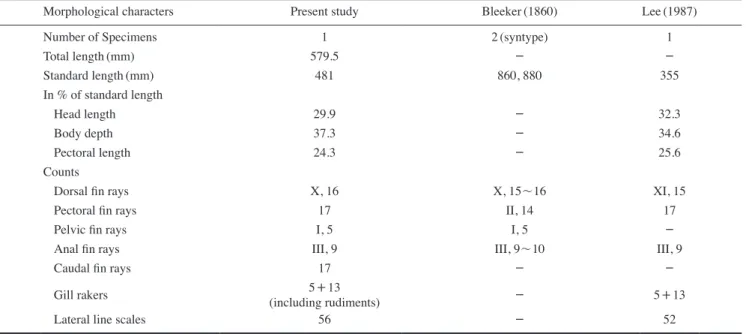
Description. Measurements and counts of morpholog- ical traits for the present specimen are shown in Table 1.
Measurements are revealed as a percentage against SL:
body depth 37.3; body width 18.2; head length 29.9; up- per jaw length 12.6; snout length 14.3; eye diameter 4.2;
interorbital length 11.6; predorsal fin length 33.3; prepec- toral fin length 27.4; preanal fin length 60.9; length of longest dorsal fin ray 23.2; length of longest pectoral fin ray 24.3; length of longest anal fin ray 23.2; caudal ped- uncle depth 12.4; caudal peduncle length 19.5.
Body moderately elongate and compressed, covered with ctenoid scales aligned in horizontal rows; a low scaly sheath at base of dorsal and anal soft rays; six and seven series of scales on the cheek and opercle, respectively;
anterior profile of head curved steeply; lower jaw similar to upper jaw; maxilla extends to below anterior margin of eye; eye somewhat small and located above dorsal part
of head; teeth in both jaw form narrow bands with outer ones enlarged and canine teeth present at front of upper jaw; a pit between eye and nostril; tongue with granular teeth; vomer toothless; dorsal fin continuous and anterior dorsal soft rays(third through sixth) produced into fil- aments; anal soft rays slightly elongated; pectoral fin pointed and its posterior tip reaching below the seventh dorsal spine; pelvic fins triangular and its transverse posterior tip not reached anus; no black bloch on caudal peduncle and caudal fin emarginate.
Color when fresh. Body and head overall reddish, but yellowish-red ventrally; black transverse bars on dorsal part of body; all fins red with yellowish posterior margin;
caudal fin margin black; nine longitudinal bright blue strips on both sides of body.
Color in alcohol. Body uniformly pale brown; dark transverse bars on dorsal part of body; all fins yellowish;
posterior margin of caudal fin black; nine longitudinal pale strips on both sides of the body.
Distribution. Western Pacific throughout the Indo- Australian northward to Japan(Allen, 1985) and Korea (present study).
Remarks. The present specimen was collected in the coastal waters of Geojae Island, Korea. It was character- ized by having toothless vomer, elongated filaments at the anterior portion of dorsal fin, emarginate caudal fin, and a deep groove between eye and nostril. When the morphological characters of the present specimen were examined and compared with those previously reported on S. nematophorus, all morphological traits were well
Table 1. Comparison of the morphological characters of Symphorus nematophorus
Morphological characters Present study Bleeker(1860) Lee(1987)
Number of Specimens 1 2(syntype) 1
Total length(mm) 579.5 - -
Standard length(mm) 481 860, 880 355
In % of standard length
Head length 29.9 - 32.3
Body depth 37.3 - 34.6
Pectoral length 24.3 - 25.6
Counts
Dorsal fin rays X, 16 X, 15〜16 XI, 15
Pectoral fin rays 17 II, 14 17
Pelvic fin rays I, 5 I, 5 -
Anal fin rays III, 9 III, 9〜10 III, 9
Caudal fin rays 17 - -
Gill rakers 5+13
(including rudiments) - 5+13
Lateral line scales 56 - 52
new record of Symphorus nematophorus from Korea 151
matched each other(Bleeker, 1860; Lee, 1987; Table 1).
Thus, we identified our specimen to be S. nematophorus based on the morphological characters.
Symphorus nematophorus is morphologically similar to Symphorichthys spilurus(Günther, 1874) which inhabits the coastal waters of East Asia because both have the fil- amentous dorsal rays and blue lines on body side, but the former is easily distinguishable from the latter by having no dark blotch on caudal peduncle(vs. a large dak blotch for S. spilurus), a groove or pit between eye and nostrils and snout rounded without interorbital hump(vs. steeply
sloped with a distinct interorbital hump)(Lee, 1987; Shi- mada, 2002)(Fig. 2). We herein propose a new Korean fish name, “Sil-tung-dom-sok” and “Sil-tung-dom” for genus and species, respectively.
acKnoWledGMents
This work was funded by a grant from the National Fisheries Research & Development Institute(RP-2015- AQ-032).
Fig. 1. Symphorus nematophorus(Bleeker, 1860), JNU-1400, 481mm SL, Geojae, Korea.
Fig. 2. A photograph showing a pit in front of eyes(A), dorsal soft rays(B), longitudinal blue lines on body sides(C), and no black blotch on cau- dal peduncle(D).
152 Maeng Jin Kim, tae Seok Mun, Jeong-hoon lee, young Min choi and choon Bok Song
references
Allen, G.R. 1984. Lutjanidae. In: Fischer, W. and G. Bianchi(eds.), FAO species identification sheets of fishery purpose, West- ern Indian Ocean(Fishing Area 51), Vol. 3. FAO, Rome.
Allen, G.R. 1985. FAO species catalogue. Vol. 6. Snappers of the world. An annotated and illustrated catalogue of lutjanid species known to date. FAO Fish. Synop. No. 125, 6: 1-208.
Allen, G.R. and R. Swainston 1988. The marine fishes of north- western Australia. A field guide for anglers and divers. West
ern Australian Museum, Geraldton, AU, 201p.
Bleeker, P. 1860. Dertiende bijdrage tot de kennis der vischfauna van Celebes(Visschen van Bonthain, Badjoa, Sindjai, La- goesi en Pompenoea). Acta Societatis Regiae Scientiarum Indo-Neêrlandicae, 8(art. 7): 1-60.
Günther, A. 1872. Notice on two new fishes from Celebes. Annals and Magazine of Natural History(Series 4) 9(art. 46): 438- Günther, A. 1874. Andrew Garrett’s Fische der Südsee. Band I, Heft. 440.
III. Journal des Museum Godeffroy, Band II, Heft VII. F.
Friederichsen & Co., Hamburg. Bd 1,(Heft 3): 58-96.
Hubbs, G.L. and K.F. Lagler. 1964. Fishes of the Great Lake Re- gion. Bull. Granbrook Inst. Schi., 26: 19-27.
Kim, I.S., Y. Choi, C.L. Lee, Y.J. Lee, B.J. Kim and J.H. Kim. 2005.
Illustrated book of Korean Fish. Kyo-Hak Publishing Co.
Ltd., Seoul, KR, pp. 320-322.(in Korean)
Kim, M.J., B.Y. Kim, J.S. Kim and C.B. Song. 2012. Two unrecord- ed species of the snapper(Perciformes: Lutjanidae) collect- ed from Jeju Island, Korea. Fish. Aquat. Sci., 15: 313-316.
Lee, S.C. 1987. Fishes of the family Lutjanidae of Taiwan. Bull. Ist.
Zool., Academia Sinica, 26: 280-281.
Nelson, J.S. 2006. Fishes of the world. 4th edition. John Wiley and Sons Inc, Hoboken, New Jersey, 601p.
Randall, J.E. 2005. Reef and shore fishes of the South Pacific. New Caledonia to Tahiti and the Pitcairn Islands. i-xii + 1-707.
Randall, J.E. and K.K.P. Lim. 2000. A checklist of the fishes of the South China Sea. The Raffles Bull. Zool. Suppl., 8: 569667.
Shimada, K. 2002. Lutjanidae. In: Nakabo T.(ed.), Fishes of Japan with pictorial keys to the species, English edition, Tokai Univ. Press, Tokyo, pp. 819-832.
한국산 퉁돔과 어류 1미기록종, Symphorus nematophorus
김맹진·문태석1·이정훈1·최영민·송춘복2
국립수산과학원 서해수산연구소, 1국립수산과학원 남동해연구소, 2제주대학교 해양과학대학
요 약 : 퉁돔과에 속하는 Symphorus nematophorus 1개체(표준체장 481mm)가 거제 연안의 정치망에서 처음으
로 채집되었다. 이 종은 등지느러미 연조의 앞부분이 길게 연장되어 있고, 눈과 코구멍 사이에 파인 홈이 있으며,
서골에는 이빨이 없고 체측에는 선명한 9개의 파란 줄이 존재한다. 이 미기록종의 속명과 국명은 각각 “실퉁돔속”
과 “실퉁돔”으로 제안한다.
찾아보기 낱말 : 미기록종, 퉁돔과, 실퉁돔, Symphorus nematophorus, 거제도