아주대학교 의과대학 호흡기내과학교실
이규성, 김영선, 이형노, 박주헌, 오윤정, 신승수, 최영화, 박광주, 황성철
Correlation of Nitric Oxide and Corticosteroids Along the Course of Sepsis
Keu Sung Lee, M.D., Young Sun Kim, M.Sc., Hyoung No Lee, M.D., Joo Hun Park, M.D., Yoon Jung Oh, M.D., Seung Soo Sheen, M.D., Young Hwa Choi, M.D., Kwang Joo Park, M.D., and Sung Chul Hwang, M.D.
Department of Pulmonary and Critical Care Medicine, Ajou University School of Medicine, Suwon, Korea
Background: The nitric oxide (NO) released by inducible NO synthase (iNOS) plays an important role in the pathophysiology of sepsis. Corticosteroids also play a role in the hemodynamic and inflammatory reactions in sepsis.
Both have been shown to have a relationship theoretically, but their correlation and clinical impacts have rarely been evaluated.
Methods: 26 patients with sepsis and 14 healthy controls were enrolled in this study. The initial random plasma total NO and the serum cortisol levels were measured. The same measurements were serially carried out on the 3rd, 5th, and 7th days.
Results: The initial total plasma levels of NO and cortisol were higher in the patients with sepsis than in the healthy controls. The total NO levels were higher in patients with severe sepsis than in the those with mild sepsis. There was a correlation between the total NO and cortisol level throughout the study.
Conclusion: In patients with sepsis, the levels of plasma NO and cortisol were well correlated during the first week of sepsis, which suggests an interrelationship. However, the clinical and pathogenetic implications await further evaluation. (Tuberc Respir Dis 2007; 62: 308-313)
Key words: Sepsis, Septic shock, Nitric oxide, Nitric oxide synthase, Corticosteroids, Cortisol, Correlation.
Address for correspondence: Kwang Joo Park, M.D.
Department of Pulmonary and Critical Care Medicine, Ajou University School of Medicine, San 5, Wonchon- dong, Yeongtong-gu, Suwon, Gyeonggi-do, 443-721, Korea
Phone: 82-31-219-5121, Fax: 82-31-219-5124 E-mail: [email protected]
Received: Nov. 29. 2006 Accepted: Mar. 22. 2007
서 론
패혈증의 병태생리에 있어서 다양한 염증 매개물질 들이 관여한다1,2. 그 중 Nitric oxide(NO)는 패혈증에 의한 전신적 염증반응과 혈역학적 변화 등의 병태생 리에 중요한 역할을 하는 것으로 알려져 있다3-5.
NO는 NO synthase(NOS)에 의해 생성되며, 이는 constitutive NOS(cNOS)와 inducible NOS(iNOS)로 나뉘는데 패혈증과 같은 병적인 상황에 있어서는 iNOS의 활성화에 의한 NO의 과도한 생성이 중요한 역할을 한다6-8. 패혈증에서 생성되는 NO는 카테콜아
민 작용에 대한 저항성 및 혈관확장을 유발하여 패혈 성쇼크의 발현에 관여하며, 또한 미세혈관의 손상, 심 근기능저하, 다발성장기부전 등을 초래한다9-12.
패혈증에서 내독소 등은 혈관내피세포에서 iNOS 를 활성화시켜 NO의 유리를 증가시키며13,14, 그 결과 과도하게 생성된 NO는 스테로이드 호르몬수용체에 결합하여 스테로이드 호르몬의 작용을 억제한다15. 반 대로 스테로이드는 패혈증에서 NO 생성의 강력한 억 제 작용을 하는 것으로 알려져 있다16,17. 이와 같이 패 혈증에서 NO와 스테로이드 호르몬은 서로 길항작용 을 하며, 그러한 상호작용은 병태생리에 있어서 역할 을 할 것으로 생각된다.
스테로이드 호르몬도 패혈증에 있어서 항염증작용 및 혈역학적인 변화에 있어서 역할을 하는 것으로 알 려져 있으며, 저자 등은 최근 패혈증 환자를 대상으로 초기 스테로이드 호르몬 농도와 상대적 부신기능 저 하증의 임상적 의의에 대한 보고를 한 바 있다18. 그러 나 패혈증 환자들에서 혈중 NO와 스테로이드의 연관 성 및 시간에 따른 변화 양상 등은 잘 알려져 있지 않다.
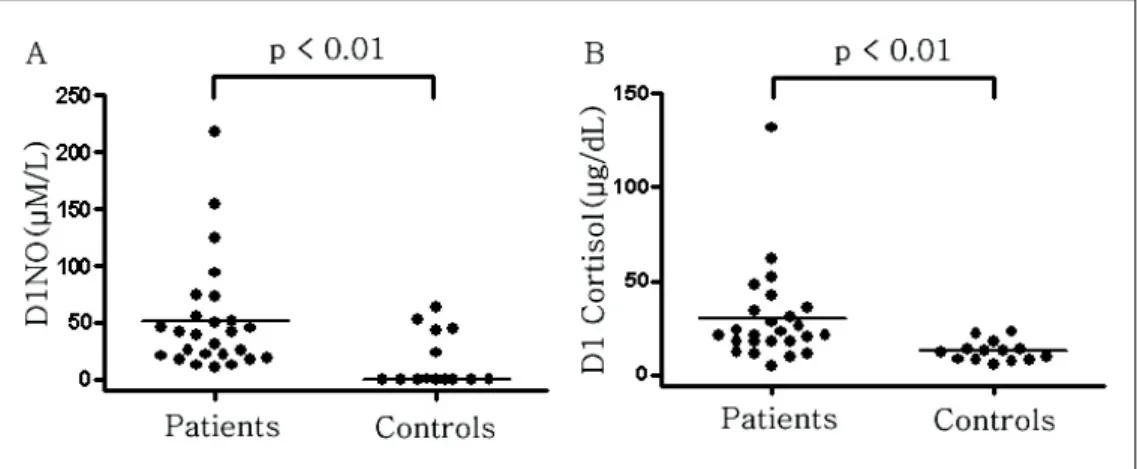
Figure 1. Comparison of initial levels of (A) plasma total NO, and (B) serum cortisol between sepsis patients and the controls.
Figure 2. Comparison of initial levels of plasma NO between patients with severe and mild sepsis.
이에 본 연구자들은 스테로이드 호르몬의 의의에 대하여 조사하였던 이전 연구18의 패혈증 환자들을 대 상으로 추가적으로 대조군과의 비교연구를 시행하였 는데 본 연구에서는 초기 농도뿐만 아니라 시간의 경 과에 따른 혈중 NO와 혈중 스테로이드의 변화양상, 연관성 및 임상적 의의를 분석하여 간략한 형식으로 보고하고자 한다.
대상 및 방법 1. 대 상
환자군은 2005년 5월부터 8월까지 내원한 패혈증 환자 26예(나이 64.4 ± 18.1세, 남:여=15:11)를 대상으 로 전향적 연구를 진행하였다. 이중 중증패혈증 환자 들은 19예였고 그 중에서 패혈성쇼크 환자들은 17예 였다19. 총 환자 26예에서 28일 사망률은 27%(n=7)이 었다. 패혈증을 유발한 원인 감염증의 종류로는 폐렴 (n=10), 요로감염(n=9), 농흉(n=2), 괴사성 근막염 (n=2), 종격동염(n=1), 심부경부감염(n=1), 봉와직염 (n=1) 등이었다. 환자분류 및 제외기준은 이전의 연구 와 동일하게 적용하였다18. 전체 환자의 APACHE II 점수는 20.0±10.2이었다20. 건강 대조군은 14예로 평균 연령은 55.6±8.9세, 남녀비=7:7이었다.
본 연구는 아주대학교병원 임상심의위원회의 승인 을 받았고 가능하면 환자의 동의를 득하였으나 환자
의 동의가 불가능한 경우에는 보호자의 동의를 득한 후에 시행하였다.
2. 방 법
1) 혈액채취
대상 패혈증 환자의 정맥혈을 내원 24시간 내(제 1 병일) 및 제 3, 5, 7병일에 연속적으로 채취한 후 혈장 및 혈청을 분리하여 -70℃에서 보관하였다. 대조군의 정맥혈도 같은 방법으로 처리 및 보관하였다.
2) 스테로이드 호르몬 등 혈청 인자 측정 혈청 검체에서 코티졸 농도는 Solid-phase Radio- immunoassay(Diagnostic Products, Los Angeles,
Days NO (μΜ/L) Cortisol (μg/dL) rs p value
D1 40.8 (20.4 – 59.6) 21.4 (17.6 – 34.7) 0.429 <0.05
D3 34.1 (15.9 – 58.7) 18.8 (15.1 – 26.5) 0.497 0.101
D5 37.3 (26.3 – 57.0) 15.7 (14.1 – 29.3) 0.829 <0.05
D7 35.0 (22.6 – 45.6) 30.6 (4.4 – 69.3) 0.900 <0.05
Data are given as median (interquartile range).
Table 1. Serial correlations between NO and cortisol levels in the 1st (D1), 3rd (D3), 5th (D5), and 7th (D7) days in patients with sepsis
Figure 3. Correlations between levels of initial plasma NO and other parameters; (A) serum cortisol levels, (B) serum lactate levels, and (C) APACHE II scores in patients with sepsis.
CA, USA)를 이용하여 측정하였다. 혈청 lactate의 농 도 측정은 환자군에서만 시행하였다.
3) 혈중 총 NO 농도 측정
환자군과 건강 대조군의 정맥혈 혈장에서 NO 농도 를 측정하였다. Nitrate reductase에 의하여 nitrate를 nitrite로 환원한 후 총 nitrite의 농도를 측정하였다 (Griess 반응). 측정은 Total NO assay kit(R&D, Minneapolis, MN, USA)를 사용하여 540nm 파장에 서 spectrophotometry를 이용하여 총 NO 농도를 측 정하였다.
4) 통계 분석
통계 분석은 SPSS for Windows(version 12, SPSS Inc, Chicago, IL, USA)를 이용하였다. 인구통계학 (demographic) 자료만 평균±표준편차로 표시하였고, 측정치는 정규분포를 하지 않아 중앙값;사분위수범위 로 표시하였으며, 분석도 비모수검정을 시행하였다.
군간의 비교는 Mann-Whitney U 검정을 시행하였고, 상관성 분석은 Spearman 검정을 시행하였다. p 값이
0.05 미만인 경우 유의한 것으로 판단하였다.
결 과
패혈증 환자군은 대조군에 비해 제1병일 혈중 NO 농도(중앙값;사분위수범위, 40.8;20.4-59.6 vs. 4.8;2.2- 44.1 μM/L, p<0.01)와 혈중 코티졸 농도(21.4;17.6–
34.7 vs. 12.4;8.1–15.2 μg/dL, p<0.01)가 유의하게 높았다(Figure 1).
제 1병일 혈중 NO농도는 중증패혈증 환자군에서 경증패혈증 환자군보다 유의하게 높았다(42.5;25.5–
74.8 vs. 21.1;12.8–45.3 μM/L, p<0.05; Figure 2). 사 망군과 생존군 간의 1일 혈중 NO농도는 유의한 차이 가 없었다(45.7;25.5–72.8 vs. 31.3;18.0–51.5 μM/L).
제 1병일 혈중 NO농도는 혈청 코티졸 농도(rs=0.43, p<0.05), lactate 농도 (rs=0.68, p<0.001) 및 APACHE II 점수(rs=0.69, p<0.001)와 유의한 상관관계를 보였 다(Figure 3).
패혈증환자에서 제 1, 5, 7병일에 측정한 혈중 NO 농도와 코티졸 농도는 유의한 상관성을 보였고 제 3
병일에는 상관성의 경향을 보였다(Table 1).
고 찰
본 연구에서 특기할 만한 점은 패혈증 환자들에서 혈중 NO 및 코티졸 농도가 시간의 경과에 따라 지속 적으로 유의한 상관성을 보였다는 점이며 이러한 상 관성이 실제 환자에서 측정되어 보고된 것은 아직 알 려진 바가 없다.
패혈증에서 iNOS의 과발현에 의해 생성된 NO가 과도한 혈관확장과 조직손상에 중요한 역할을 한다
21,22
. 이때 혈중 NO 농도의 증가는 패혈성쇼크나 다발 성장기부전을 동반한 환자들에서 더 현저하며23, 임상 적으로 NO 농도는 중증도 및 생존율과도 상관성이 있는 것으로 보고된 바 있다24-26.
본 연구에서 중증 패혈증 환자군에서 경증 환자군 에 비해 초기 혈중 NO 농도가 높았고, 군간의 수적 불균형(사망군; n=7) 때문에 통계적 유의성에 도달하 지는 못하였으나 사망군에서 생존군보다 초기 혈중 NO 농도가 높았다. 또한, 혈중 lactate 농도 및 APACHE II 점수 등과 상관성을 보였다는 점에서 NO 농도가 패혈증의 중증도를 평가하는 유의한 지표 임을 확인할 수 있었다.
스테로이드는 패혈증에서 iNOS의 발현을 억제하 고 arginine의 세포막을 통한 전달을 억제하며, NOS 에 대한 보조인자인 tetrahydrobiopterin의 합성을 억 제하는 등 NO의 생성에 있어서 다양한 길항작용을
한다16,17. 또한, 패혈증에서 스테로이드는 iNOS의 발
현을 억제하나 cNOS의 발현은 촉진하는 것으로 보고 된 바 있다27. 동물실험에서 스테로이드는 lipopoly- saccharide(LPS)와 lipoteichoic acid에 의한 iNOS의 발현을 억제하고 혈압상승제에 대한 반응 둔화를 역 전시키는 것으로 보고된 바 있으며28, 패혈성쇼크가 발생하기 전에 스테로이드 전처치를 한 경우 iNOS의 발현이 억제되고 혈역학적 변화가 완화되는 것으로 보고된 바 있다15,29.
이러한 배경들에 근거하여 최근 패혈증에서 소량의 스테로이드가 치료에 사용되고 있다. 스테로이드 투 여가 혈압상승효과와 혈압상승제의 치료적 요구량 감
소에 도움이 되지만30, 그 작용에는 한계가 있으며, 중 증 패혈증에 있어서는 스테로이드의 iNOS 억제효과 가 둔화되는 것으로 알려지고 있다15. 이러한 현상이 나타나는 기전으로는 NO에 의해서 스테로이드 수용 체의 cysteine에 S-nitrosylation이 일어나 스테로이 드 수용체에 대한 코티졸의 결합을 저지하여 혈중 스 테로이드 농도가 높은데도 불구하고 스테로이드의 작 용은 감소하게 된다는 이론이 제시된 바 있다15,31.
본 연구에서 스테로이드 호르몬과 NO의 혈중치가 상호 유의한 상관성이 나타났으며, 특히 병일에 따라 연속적으로 상관성이 유지되었다. 현재까지 이 두 인 자에 대한 연구는 주로 외부에서 주입한 스테로이드 나 NO 억제제에 의한 변화 양상을 통하여 간접적으 로 상호작용을 분석한 것이 대부분이었으며, 본 연구 와 같이 인체에서 두 인자간 측정치의 상관성 분석은 아직 알려진 바가 없다. 그 결과 상호 유의한 상관성 을 보였지만 실제로 두 인자간의 상호 양성 조절이나 촉진작용은 별로 알려진 바가 없다. 실제로 코티졸에 의한 신장 혈관확장을 NO가 매개한다는 보고32 및 NO가 부신의 혈류를 증가시키는 데 중요한 작용을 한다는 보고33 등의 일부 연구결과에 근거하여 간접적 으로 상호 양성 상관성의 기전에 대한 추정을 할 수는 있을 것이다. 하지만 NO와 코티졸 사이에 이러한 상 호작용에 iNOS의 활성화가 직접적으로 관여한다는 근거는 없고 실제로 패혈증에서는 이러한 기전에 대 한 연구가 특별히 알려진 바가 없어 상호 촉진작용이 나 양성 조절 기능에 대한 이론적 근거는 박약하다.
실제적으로 현재까지의 연구 결과에 따르면 전술한 바와 같이 서로 길항작용을 한다는 것이 통념이며, 본 연구의 방법론만으로는 상호작용의 정확한 기전에 대 한 근거는 제시할 수가 없는 것으로 사료된다. 또한 이러한 상관성은 질환의 중증도에 비례하여 독립적으 로 생성이 증가하여 나타난 단순한 2차적 결과일 가 능성도 높은 것으로 생각된다. 한편, 일반적으로 알려 진 작용기전상으로는 상호를 길항하는 작용이 있는 데에도 불구하고 이러한 양성 상관성이 계속적으로 유지된다는 본 연구의 결과를 볼 때 패혈증에서 서로 를 억제하는 기작이 충분히 효능을 발휘하지 못한다 는 사실은 최소한 말해 줄 수 있겠으며, 이는 전술한
수용체 불활성화 작용 기전 등이 관여할 것이라고 사 료된다.
실제로 본 연구에서 이에 대한 좀더 기전적인 연구 로서 말초혈액 백혈구를 분리하여 iNOS를 enzyme- linked immunosorbent assay(ELISA)로 측정하고 또 한 스테로이드수용체의 S-nitrosylation 정도를 평가 하려는 시도를 하였으나 단백질 추출에 있어서 균일 성이 부족하고 농도의 변이가 커서 유의한 결과를 얻 지 못하였다. 이에 대해서는 향후 세포 또는 동물실험 등을 통한 좀더 심도 있는 연구가 뒷받침되어야 할 것 으로 사료된다.
본 연구의 제한점들로는 첫째, 전체 환자군의 수가 26예로 적은 수로서 세부적인 통계적 분석에서 유의 성을 얻는 데 무리가 있었다. 둘째, 패혈증과 관련된 여러 가지 염증성 사이토카인들의 혈중 농도를 연속 적으로 같이 측정하였다면 좀더 다양하고 유의성이 있는 분석이 가능하였을 것으로 생각된다. 셋째, 일부 중증 패혈성쇼크 환자들이 조기 사망하는 경우로 인 하여 병일이 진행할수록 중증환자들이 제외되는 현상 이 불가피하게 발생하였기 때문에 분석에 있어서 제 한점이 되었다.
결 론
패혈증 환자들에서 초기 혈중 NO농도가 유의하게 증가하며 패혈증 초기 혈중 NO농도는 패혈증의 중증 도와 연관이 있음을 알 수 있었다. 또한 혈청 코티졸 농도와 혈중 NO 농도는 패혈증에서 시간의 경과에 따라 지속적으로 유의한 상관관계를 나타냄을 알 수 있었다.
요 약
연구배경: 패혈증에서 Nitric oxide 스테로이드 호 르몬은 혈역학적 변화와 염증반응에 관여하는데 이 두 인자는 서로 상관성이 있는 것으로 알려지고 있다.
하지만 실제 환자에서 서로의 상관성이나 임상적 의 의는 연구가 부족한 실정이다.
방 법: 패혈증 환자 26예와 대조군 14예를 대상으
로 혈중 총 NO와 혈중 코티졸 농도를 측정하였고 이 어서 제 3, 5, 7병일에도 연속적으로 측정을 하였다.
결 과: 패혈증 환자군에서 초기 혈중 코티졸 및 총 NO 농도는 대조군에 비하여 유의하게 증가하였고 경 증 패혈증에 비하여 중증 패혈증 환자군에서 유의하 게 높았다. 초기 혈중 총 NO의 농도는 APACHE II 점수, 정맥혈 lactate 농도와 상관성이 있었다. 패혈증 의 시간의 경과에 따라 혈중 NO 농도는 제 1병일, 제 5병일, 제 7병일에 혈중 코티졸의 농도와 유의한 상관 성이 있었다.
결 론: 패혈증 환자들에서 혈중 NO와 코티졸 농도 는 증가되어 있었으며, 경과에 따라 서로 유의한 상관 성이 지속되었다. 상호작용기전에 대하여는 추가적인 연구가 필요할 것이다.
참 고 문 헌
1. Marsh CB, Wewers MD. The pathogenesis of sepsis.
Factors that modulate the response to gram-negative bacterial infection. Clin Chest Med 1996;17:183-97.
2. Annane D, Bellissant E, Cavaillon JM. Septic shock.
Lancet 2005;365:63-78.
3. Rees DD. Role of nitric oxide in the vascular dysfunction of septic shock. Biochem Soc Trans 1995;23:1025-9.
4. Kirkeboen KA, Strand OA. The role of nitric oxide in sepsis: an overview. Acta Anaesthesiol Scand 1999;
43:275-88.
5. Vincent JL, Zhang H, Szabo C, Preiser JC. Effects of nitric oxide in septic shock. Am J Respir Crit Care Med 2000;161:1781-5.
6. Alderton WK, Cooper CE, Knowles RG. Nitric oxide synthases: structure, function and inhibition. Biochem J 2001;357:593-615.
7. Davies MG, Fulton GJ, Hagen PO. Clinical biology of nitric oxide. Br J Surg 1995;82:1598-610.
8. Parratt JR. Nitric oxide in sepsis and endotoxaemia.
J Antimicrob Chemother 1998;41S:31-9.
9. Laszlo F, Whittle BJ, Evans SM, Moncada S.
Association of microvascular leakage with induction of nitric oxide synthase: effects of nitric oxide synthase inhibitors in various organs. Eur J Pharmacol 1995;283:47-53.
10. Boyle WA 3rd, Parvathaneni LS, Bourlier V, Sauter C, Laubach VE, Cobb JP. iNOS gene expression modulates microvascular responsiveness in endotoxin-
challenged mice. Circ Res 2000;87:E18-24.
11. Hollenberg SM, Cunnion RE, Zimmerberg J. Nitric oxide synthase inhibition reverses arteriolar hypores- ponsiveness to catecholamines in septic rats. Am J Physiol 1993;264:660-3.
12. Thijs LG, Groeneveld AB, Hack CE. Multiple organ failure in septic shock. Curr Top Microbiol Immunol 1996;216:209-37.
13. Salvemini D, Korbut R, Anggard E, Vane J.
Immediate release of a nitric oxide-like factor from bovine aortic endothelial cells by Escherichia coli lipopolysaccharide. Proc Natl Acad Sci U S A 1990;87:2593-7.
14. Liu S, Adcock IM, Old RW, Barnes PJ, Evans TW.
Lipopolysaccharide treatment in vivo induces wides- pread tissue expression of inducible nitric oxide synthase mRNA. Biochem Biophys Res Commun 1993;196:1208-13.
15. Duma D, Silva-Santos JE, Assreuy J. Inhibition of glucocorticoid receptor binding by nitric oxide in endotoxemic rats. Crit Care Med 2004;32:2304-10.
16. Radomski MW, Palmer RM, Moncada S. Gluco- corticoids inhibit the expression of an inducible, but not the constitutive, nitric oxide synthase in vascular endothelial cells. Proc Natl Acad Sci U S A 1990;87:10043-7.
17. Simmons WW, Ungureanu-Longrois D, Smith GK, Smith TW, Kelly RA. Glucocorticoids regulate inducible nitric oxide synthase by inhibiting tetrahy- drobiopterin synthesis and L-arginine transport. J Biol Chem 1996;271:23928-37.
18. Lee KS, Baek SH, Lee HN, Park JH, Oh YJ, Sheen SS, et al. Significance of corticosteroids and their relationship with other parameters in patients with sepsis. Tuberc Respir Dis 2006;61:631-40.
19. Levy MM, Fink MP, Marshall JC, Abraham E, Angus D, Cook D, et al. 2001 SCCM/ESICM/ACCP/ATS/SIS International Sepsis Definitions Conference. Crit Care Med 2003;31:1250-6.
20. Knaus WA, Draper EA, Wagner DP, Zimmerman JE.
APACHE II: a severity of disease classification system. Crit Care Med 1985;13:818-29.
21. Kilbourn RG, Traber DL, Szabo C. Nitric oxide and shock. Dis Mon 1997;43:277-348.
22. Ceppi ED, Smith FS, Titheradge MA. Nitric oxide, sepsis and liver metabolism. Biochem Soc Trans 1997;25:929-34.
23. Gomez-Jimenez J, Salgado A, Mourelle M, Martin MC, Segura RM, Peracaula R, et al. L-arginine: nitric oxide pathway in endotoxemia and human septic shock. Crit Care Med 1995;23:253-8.
24. Mitaka C, Hirata Y, Yokoyama K, Wakimoto H, Hirokawa M, Nosaka T, et al. Relationships of circulating nitrite/nitrate levels to severity and multiple organ dysfunction syndrome in systemic inflammatory response syndrome. Shock 2003;19:
305-9.
25. MacKenzie IM, Garrard CS, Young JD. Indices of nitric oxide synthesis and outcome in critically ill patients. Anaesthesia 2001;56:326-30.
26. Groeneveld PH, Kwappenberg KM, Langermans JA, Nibbering PH, Curtis L. Nitric oxide (NO) production correlates with renal insufficiency and multiple organ dysfunction syndrome in severe sepsis. Intensive Care Med 1996;22:1197-202.
27. Mariotto S, Menegazzi M, Suzuki H. Biochemical aspects of nitric oxide. Curr Pharm Des 2004;10:
1627-45.
28. Szabo C, Thiemermann C, Wu CC, Perretti M, Vane JR. Attenuation of the induction of nitric oxide synthase by endogenous glucocorticoids accounts for endotoxin tolerance in vivo. Proc Natl Acad Sci U S A 1994;91:271-5.
29. Rees DD, Cellek S, Palmer RM, Moncada S.
Dexamethasone prevents the induction by endotoxin of a nitric oxide synthase and the associated effects on vascular tone: an insight into endotoxin shock.
Biochem Biophys Res Commun 1990;173:541-7.
30. Annane D, Sebille V, Charpentier C, Bollaert PE, Francois B, Korach JM, et al. Effect of treatment with low doses of hydrocortisone and fludrocortisone on mortality in patients with septic shock. JAMA 2002;288:862-71.
31. Galigniana MD, Piwien-Pilipuk G, Assreuy J.
Inhibition of glucocorticoid receptor binding by nitric oxide. Mol Pharmacol 1999;55:317-23.
32. De Matteo R, May CN. Glucocorticoid-induced renal vasodilatation is mediated by a direct renal action involving nitric oxide. Am J Physiol 1997;273:1972-9.
33. Riquelme RA, Sanchez G, Liberona L, Sanhueza EM, Giussani DA, Blanco CE, et al. Nitric oxide plays a role in the regulation of adrenal blood flow and adrenocorticomedullary functions in the llama fetus. J Physiol 2002;544:267-76.